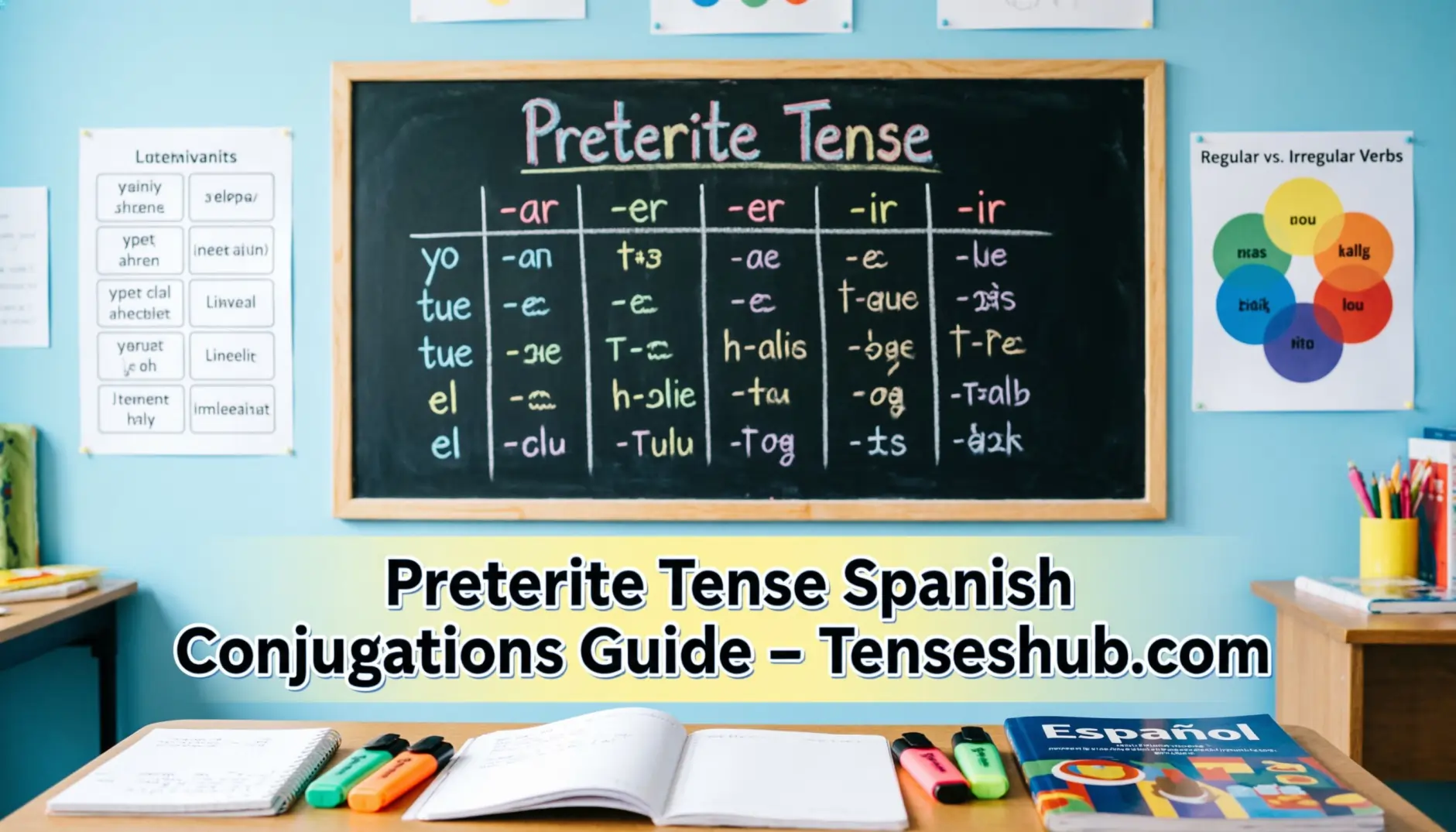
Have you ever tried to tell a story in Spanish and felt stuck when talking about past actions like “I ate,” “she went,” or “they played”? Many learners feel confused because Spanish has more than one past tense, and the preterite tense Spanish conjugations can look tricky at first.
You might wonder: Why do some verbs change completely? Why do endings look so different from English? And when exactly should you use this tense?
The good news is that the preterite tense Spanish conjugations are actually very logical once you understand the pattern. It is used to talk about completed actions in the past—simple, clear, and finished events. Think of it as telling a story with a beginning and an end.
In this article, you will learn everything step by step in a very easy way, including structures, rules, tables, examples, and practice exercises so you can confidently use it in real conversations.
Quick Answer (Featured Snippet)
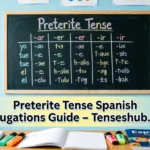
The preterite tense Spanish conjugations are used to describe completed actions in the past. They follow specific verb endings depending on the subject.
| Subject | AR Verbs | ER / IR Verbs |
|---|---|---|
| Yo | hablé | comí |
| Tú | hablaste | comiste |
| Él / Ella | habló | comió |
What Is Preterite Tense Spanish Conjugations?
The preterite tense Spanish conjugations refer to how Spanish verbs change when talking about completed actions in the past.
In simple words:
- It shows actions that are DONE
- It has a clear start and end time
- It is one of the most common past tenses in Spanish
Example:
- I ate pizza yesterday → Yo comí pizza ayer
- She called me last night → Ella me llamó anoche
This tense is very important because it helps you describe events, stories, and experiences clearly.
Structure of Sentences of Preterite Tense Spanish Conjugations
In Spanish, sentence structure is usually:
Positive Sentences:
Subject + Verb (preterite form) + Object
- Yo hablé con él (I talked with him)
- Ella comió arroz (She ate rice)
Negative Sentences:
Subject + no + verb (preterite form) + object
- Yo no hablé con él (I did not talk with him)
- Ella no comió arroz (She did not eat rice)
Question Sentences:
Verb + subject + object?
- ¿Hablaste tú con él? (Did you talk with him?)
- ¿Comió ella arroz? (Did she eat rice?)
The structure stays simple; only the verb form changes.
Formation of Preterite Tense Spanish Conjugations
The preterite tense Spanish conjugations are formed by removing the verb ending ( ar, er, ir) and adding special endings.
Step 1: Take the verb
- hablar (to speak)
- comer (to eat)
- vivir (to live)
Step 2: Remove ending
- habl
- com
- viv
Step 3: Add preterite endings
AR verbs endings:
- é, aste, ó, amos, asteis, aron
ER/ IR verbs endings:
- í, iste, ió, imos, isteis, ieron
Example:
- hablar → hablé, hablaste, habló
- comer → comí, comiste, comió
This pattern is key to mastering Spanish past tense.
How to Use Preterite Tense Spanish Conjugations
You use the preterite tense Spanish conjugations when:
1. Completed actions
- I finished homework → Terminé la tarea
2. Specific time in past
- Yesterday, last year, at 5 PM
3. Series of events
- I woke up, ate, and left → Me desperté, comí y salí
4. Short actions
- He called me → Él me llamó
Important Tip:
If the action is finished and does NOT continue, use preterite.
Conjugation or Structure Table
Regular Verbs in Preterite Tense
| Subject | Hablar (to speak) | Comer (to eat) | Vivir (to live) |
|---|---|---|---|
| Yo | hablé | comí | viví |
| Tú | hablaste | comiste | viviste |
| Él / Ella | habló | comió | vivió |
| Nosotros | hablamos | comimos | vivimos |
| Vosotros | hablasteis | comisteis | vivisteis |
| Ellos | hablaron | comieron | vivieron |
Real Life Examples
- Yo estudié ayer.
- Ella trabajó mucho.
- Nosotros viajamos a Lahore.
- Tú comiste pizza.
- Ellos jugaron fútbol.
- Yo no hablé con él.
- ¿Visitaste a tu amigo?
- Él compró un coche.
- Nosotros vimos una película.
- Ella escribió una carta.
- Tú no dormiste bien.
- ¿Salieron ustedes anoche?
- Ellos llegaron tarde.
- Yo aprendí español.
- Ella llamó a su madre.
Common Mistakes
Mistake 1:
❌ I goed to school
✔ I went to school → Fui a la escuela
Mistake 2:
❌ Yo comero pizza
✔ Yo comí pizza
Mistake 3:
❌ Ella hablo ayer
✔ Ella habló ayer
Mistake 4:
❌ Nosotros comimoses
✔ Nosotros comimos
Mistake 5:
❌ They eated lunch
✔ They ate lunch → Ellos comieron
Key Grammar Rules
- Preterite is used for finished actions.
- Every subject has a fixed ending pattern.
- Accent marks are important (habló vs hablo).
- Irregular verbs must be memorized.
- Time expressions often trigger preterite (ayer, anoche).
- Do not mix present tense with preterite.
- Use it for storytelling events.
Comparisons with Similar Grammar Forms
Preterite vs Imperfect
| Preterite | Imperfect |
|---|---|
| Completed action | Ongoing action |
| Yo comí (I ate) | Yo comía (I was eating) |
| Specific time | No specific time |
Preterite vs Present Perfect
- Preterite: Yo comí (I ate)
- Present Perfect: Yo he comido (I have eaten)
Preterite focuses on finished past actions.
Exercises
Fill in the blanks
- Yo ____ (hablar) ayer.
- Ella ____ (comer) pizza.
- Nosotros ____ (vivir) en Lahore.
- Tú ____ (estudiar) mucho.
- Ellos ____ (jugar) fútbol.
Sentence correction
- Yo hablo ayer → ______
- Ella comio pizza → ______
- Nosotros vivimos ayer → ______
- Tú estudiaste ayer → ______
- Ellos jugaron ayer → ______
Rewrite tasks
- I ate food yesterday.
- She visited her friend.
- They played football.
- We studied Spanish.
- He called me.
MCQs
- Preterite is used for:
A) Future actions
B) Completed past actions
C) Ongoing actions
D) Habitual actions - “Yo comí” means:
A) I eat
B) I will eat
C) I ate
D) I am eating - Ending for AR verbs (yo form):
A) o
B) é
C) a
D) ía - “Ayer” means:
A) Tomorrow
B) Yesterday
C) Today
D) Now - “Habló” is:
A) Present tense
B) Past tense
C) Future tense
D) Infinitive
Answers
Fill in the blanks:
- hablé
- comió
- vivimos
- estudiaste
- jugaron
Sentence correction:
- Yo hablé ayer
- Ella comió pizza
- Nosotros vivimos ayer
- Tú estudiaste ayer
- Ellos jugaron ayer
MCQs:
1 B, 2 C, 3 B, 4 B, 5 B
FAQs
1. What is preterite tense in Spanish?
It is a past tense used for completed actions.
2. When do we use preterite tense?
When actions are finished in the past.
3. Is preterite easy to learn?
Yes, once you learn patterns, it becomes simple.
4. What are common preterite endings?
- é, aste, ó for AR verbs
- í, iste, ió for ER/ IR verbs
5. What is difference between preterite and imperfect?
Preterite is for completed actions; imperfect is for ongoing past actions.
6. Are all verbs regular?
No, some verbs are irregular and must be memorized.
7. What is example of preterite sentence?
Yo comí arroz (I ate rice).
8. Do we use time words with preterite?
Yes, like ayer, anoche, la semana pasada.
9. Is accent important?
Yes, it changes meaning of verbs.
10. Can beginners learn it easily?
Yes, with practice and examples.
Conclusion
The preterite tense Spanish conjugations are one of the most important parts of Spanish grammar. They help you talk about actions that are finished and happened in the past.
At first, the endings may seem confusing, but with practice, they become very easy to remember. The key is to learn the patterns for regular verbs and slowly memorize irregular ones.
Try using this tense in simple sentences every day. Practice talking about your yesterday, your last weekend, or your past activities. The more you use it, the more natural it becomes.
Remember, learning a language is a step by step journey, and mastering the preterite tense will greatly improve your Spanish speaking and writing skills.
Hi, I’m Robert Lowth, a passionate expert in English tenses and grammar. I specialize in simplifying complex tense rules to help learners understand and use English with confidence. My goal is to make grammar clear, practical, and easy for everyday communication. tenseshub.com