Have you ever written a sentence like “Yesterday, I begin my homework early” and felt something is wrong, but you are not sure what?
Many English learners face this confusion when using the begin past tense. The verb “begin” is simple in the present, but it completely changes when talking about the past. Instead of “begin,” we say “began.”
This small change often causes big mistakes in speaking and writing. Learners mix present and past forms, especially in daily conversations and exams.
Understanding the begin past tense is important because it is used in storytelling, reports, conversations, and everyday communication.
In this article, you will learn everything about begin past tense, including structure, rules, examples, mistakes, and practice exercises. By the end, you will confidently use “began” in real life English without confusion.
Quick Answer (Featured Snippet)
The begin past tense is “began.” It is used to describe an action that started in the past.
| Base Verb | Past Tense | Example |
|---|---|---|
| begin | began | I began my work yesterday. |
We simply replace begin → began when talking about the past.
What Is begin past tense?
The begin past tense refers to the verb form used when we talk about starting something in the past. The base verb “begin” means to start, but in past tense, it changes to “began.”
Function in English Grammar:
- It shows an action that started and happened in the past
- It is used in storytelling and daily communication
- It helps describe completed actions
Basic Examples:
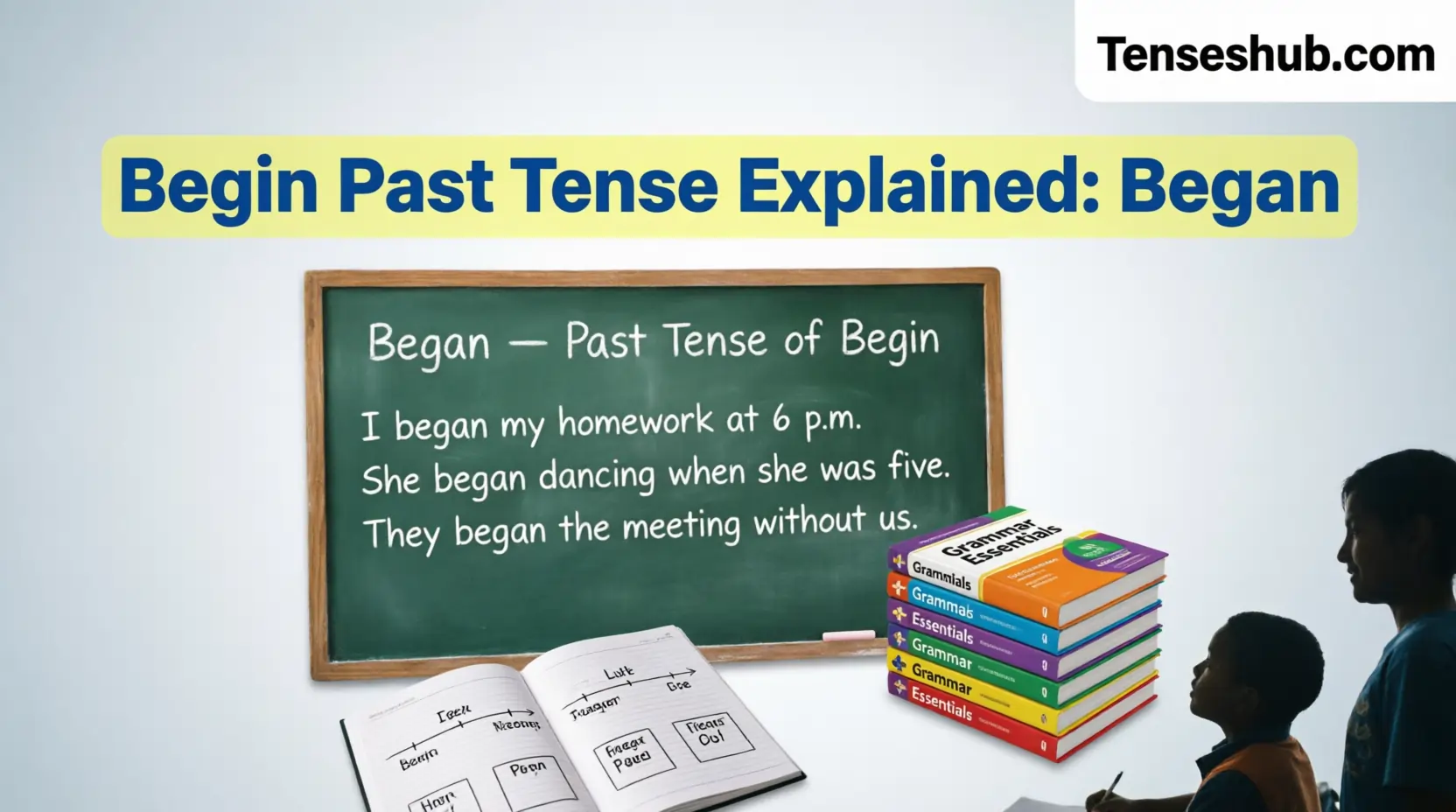
- I began reading a new book yesterday.
- She began her job last month.
- They began the meeting at 10 AM.
So, whenever you talk about starting something in the past, use began instead of begin.
Structure of Sentences of begin past tense
Understanding sentence structure helps you use begin past tense correctly in all forms.
1. Positive Sentences
Formula:
Subject + began + object
Examples:
- I began my homework.
- He began a new project.
- They began the lesson.
2. Negative Sentences
Formula:
Subject + did not + begin + object
Examples:
- I did not begin my homework.
- She did not begin the task.
- They did not begin the class.
3. Questions
Formula:
Did + subject + begin + object?
Examples:
- Did you begin your work?
- Did he begin the meeting?
- Did they begin the game?
Formation of begin past tense
The begin past tense is formed by changing the irregular verb “begin” into “began.”
Key Points:
- “Begin” is an irregular verb
- It does NOT follow regular “ ed” rule
- Past form is: begin → began
- Past participle is: begun
Verb Forms:
- Present: begin
- Past: began
- Past Participle: begun
Example:
- Present: I begin my study at 6 PM.
- Past: I began my study at 6 PM yesterday.
- Perfect: I have begun my study.
How to Use begin past tense
You use begin past tense when talking about actions that started and happened in the past.
Real Life Usage:
- Storytelling: “The story began in a small village.”
- Daily routine: “I began my day early.”
- Work/Study: “She began learning English last year.”
- Events: “The meeting began at 9 AM.”
Important Tips:
- Use “began” only for past actions
- Do not use “did began” (incorrect)
- Use “did begin” in questions only
Conjugation or Structure Table (Begin)
| Tense/Form | Structure | Example |
|---|---|---|
| Present | begin | I begin work. |
| Past | began | I began work. |
| Negative | did not begin | I did not begin work. |
| Question | did + begin | Did you begin work? |
| Perfect | have/has begun | I have begun work. |
Real Life Examples
- I began my homework after dinner.
- She began learning English last year.
- They began the meeting on time.
- We began our journey early in the morning.
- He did not begin his project yet.
- Did you begin your assignment?
- The movie began at 7 PM.
- I began reading a new novel.
- She began crying after the news.
- They began building the house.
- I did not begin my studies yesterday.
- Did he begin the class on time?
- The teacher began the lesson with a story.
- We began working together last month.
- The festival began with fireworks.
Common Mistakes
1. Using “begined” ❌
- Wrong: I begined my work.
- Correct: I began my work.
👉 “Begin” is irregular, so no ed form.
2. Double past mistake ❌
- Wrong: I did began my homework.
- Correct: I did begin my homework.
👉 After “did,” use base form.
3. Wrong tense confusion ❌
- Wrong: She begin yesterday.
- Correct: She began yesterday.
👉 Past action needs “began.”
Key Grammar Rules
- “Begin” is an irregular verb
- Present: begin
- Past: began
- Past participle: begun
- Never add “ ed” to “begin”
- Wrong: begined
- Correct: began
- Use “did + begin” in questions only
- Did you begin the task?
- Use “began” for completed past actions
- I began my work yesterday.
- Use “begun” with helping verbs
- I have begun my work.
Comparisons with Similar Grammar Forms
Begin vs Started
- Begin → more formal
- Start → more common in daily speech
Example:
- The class began at 9 AM.
- The class started at 9 AM.
Began vs Begun
- Began → simple past
- Begun → past participle
Example:
- I began my work. (past)
- I have begun my work. (perfect tense)
Exercises
Fill in the blanks
- I ___ my homework yesterday. (begin)
- She ___ reading the book.
- They ___ the meeting late.
- He did not ___ his work.
- Did you ___ the class?
Answers:
- began
- began
- began
- begin
- begin
Sentence Correction
- I begined my work.
- She begin yesterday.
- He did began the task.
- They begins the class.
- We begined early.
Answers:
- I began my work.
- She began yesterday.
- He did begin the task.
- They began the class.
- We began early.
Rewrite Tasks
- I start my work yesterday.
- She starts learning English last year.
- They begin the game yesterday.
- He does not start his work.
- Did you start the class?
Answers:
- I began my work yesterday.
- She began learning English last year.
- They began the game yesterday.
- He did not begin his work.
- Did you begin the class?
MCQs
- Past tense of begin is:
A) begined B) began C) begun D) begin
Answer: B - “I ___ my work yesterday.”
A) begin B) began C) begun D) beginning
Answer: B - “Have begun” is:
A) present B) past C) perfect D) future
Answer: C - Which is correct?
A) I did began B) I did begin C) I begined D) I begun
Answer: B - “Begin” is a:
A) regular verb B) irregular verb C) noun D) adjective
Answer: B - Correct past form of begin:
A) begined B) began C) beguned D) begining
Answer: B - “Did you ___ the class?”
A) began B) begin C) begun D) begins
Answer: B - “I have ___ my homework.”
A) begin B) began C) begun D) beginning
Answer: C - “She ___ her journey early.”
A) begin B) began C) begun D) begins
Answer: B - Choose correct sentence:
A) He begined work
B) He began work
C) He begun work
D) He beginning work
Answer: B
FAQs
1. What is the past tense of begin?
The past tense of begin is began.
2. Is “begined” correct?
No, it is incorrect. The correct form is began.
3. What is the past participle of begin?
It is begun.
4. Can we say “did began”?
No, we say did begin, not “did began.”
5. What is the difference between began and begun?
“Began” is simple past, “begun” is used with helping verbs.
6. Is begin a regular verb?
No, it is an irregular verb.
7. When do we use began?
We use it for actions that started in the past.
8. Can begin be used in future tense?
Yes: I will begin tomorrow.
9. What is correct: begin or began yesterday?
“Began yesterday” is correct.
10. Why is begin past tense important?
It helps you speak and write correct English about past actions.
Conclusion
Learning the begin past tense is an important step in mastering English grammar. The verb “begin” may look simple, but its irregular form “began” often confuses learners.
Once you understand the rules, patterns, and examples, it becomes very easy to use in daily communication.
Remember, practice is the key. Try using “began” in your own sentences, stories, and conversations. The more you use it, the more natural it will feel. Don’t worry about mistakes they are part of learning.
Keep practicing, stay consistent, and soon you will confidently use the begin past tense without thinking twice. English becomes easy when you learn step by step.