Have you ever tried telling a story in Spanish and felt stuck when describing past habits, ongoing actions, or background situations?
Many learners know the simple past tense, but they struggle when they need to say things like “I used to play football” or “It was raining every day”. This is where imperfect tense Spanish examples become very important.
The imperfect tense helps you talk about the past in a soft, descriptive, and continuous way. It is not about one completed action but about actions that were repeated, ongoing, or happening in the background.
Many students get confused because it does not translate directly into English word for word.
In this article, you will learn imperfect tense Spanish examples in the easiest way possible. You will see structure, usage, rules, real life sentences, mistakes, exercises, and comparisons so you can finally understand it clearly and use it with confidence in real conversations.
Quick Answer (Featured Snippet)
The imperfect tense in Spanish is used to describe past habits, ongoing actions, or background situations that were not completed at a specific time.
Here are simple imperfect tense Spanish examples:
| Spanish Sentence | English Meaning |
|---|---|
| Yo comía pizza | I used to eat pizza |
| Ella estudiaba | She was studying |
| Nosotros vivíamos allí | We used to live there |
What Is Imperfect Tense Spanish Examples?
The imperfect tense Spanish examples show how we talk about the past in a descriptive way. In Spanish, this tense is called “pretérito imperfecto.”
Its main function is to describe:
- Repeated actions in the past
- Ongoing past actions
- Background descriptions (weather, time, age, feelings)
For example:
- Yo jugaba fútbol cada día. (I used to play football every day.)
- Hacía frío. (It was cold.)
So, the imperfect tense is not about finished actions. It is about “what was happening” or “what used to happen.”
Structure of Sentences of Imperfect Tense Spanish Examples
Understanding structure is very important for learning imperfect tense Spanish examples. Let’s break it into simple patterns.
Positive Sentences
Formula:
Subject + verb (imperfect form) + rest of sentence
Examples:
- Yo hablaba español.
- Ella comía fruta.
Negative Sentences
Formula:
Subject + no + verb (imperfect form) + rest
Examples:
- Yo no hablaba inglés.
- Ellos no jugaban aquí.
Questions
Formula:
¿ + verb (imperfect form) + subject + ?
Examples:
- ¿Tú estudiabas aquí?
- ¿Ellos vivían en España?
This structure helps you form correct imperfect tense Spanish examples easily.
Formation of Imperfect Tense Spanish Examples
The imperfect tense is formed by adding specific endings to verb stems. Spanish verbs are divided into three groups:
- AR verbs (hablar, jugar)
- ER verbs (comer, beber)
- IR verbs (vivir, escribir)
For regular verbs, the stem stays the same, and only the ending changes.
For example:
- hablar → hablaba
- comer → comía
- vivir → vivía
Irregular verbs are fewer but important:
- ir → iba
- ser → era
- ver → veía
So, learning imperfect tense Spanish examples means practicing these patterns again and again.
How to Use Imperfect Tense Spanish Examples
You use imperfect tense Spanish examples in daily communication when talking about the past in a descriptive or habitual way.
1. Past Habits
- Cuando era niño, jugaba mucho.
(I used to play a lot when I was a child.)
2. Ongoing Past Actions
- Estudiaba cuando llamaste.
(I was studying when you called.)
3. Descriptions
- El día estaba soleado.
(The day was sunny.)
4. Age, Time, Weather
- Tenía diez años.
(I was ten years old.)
These uses make storytelling smoother and more natural in Spanish.
Conjugation or Structure Table
| Subject | AR verbs (hablar) | ER verbs (comer) | IR verbs (vivir) |
|---|---|---|---|
| Yo | hablaba | comía | vivía |
| Tú | hablabas | comías | vivías |
| Él/Ella | hablaba | comía | vivía |
| Nosotros | hablábamos | comíamos | vivíamos |
| Ellos | hablaban | comían | vivían |
Real Life Examples of Imperfect Tense Spanish Examples
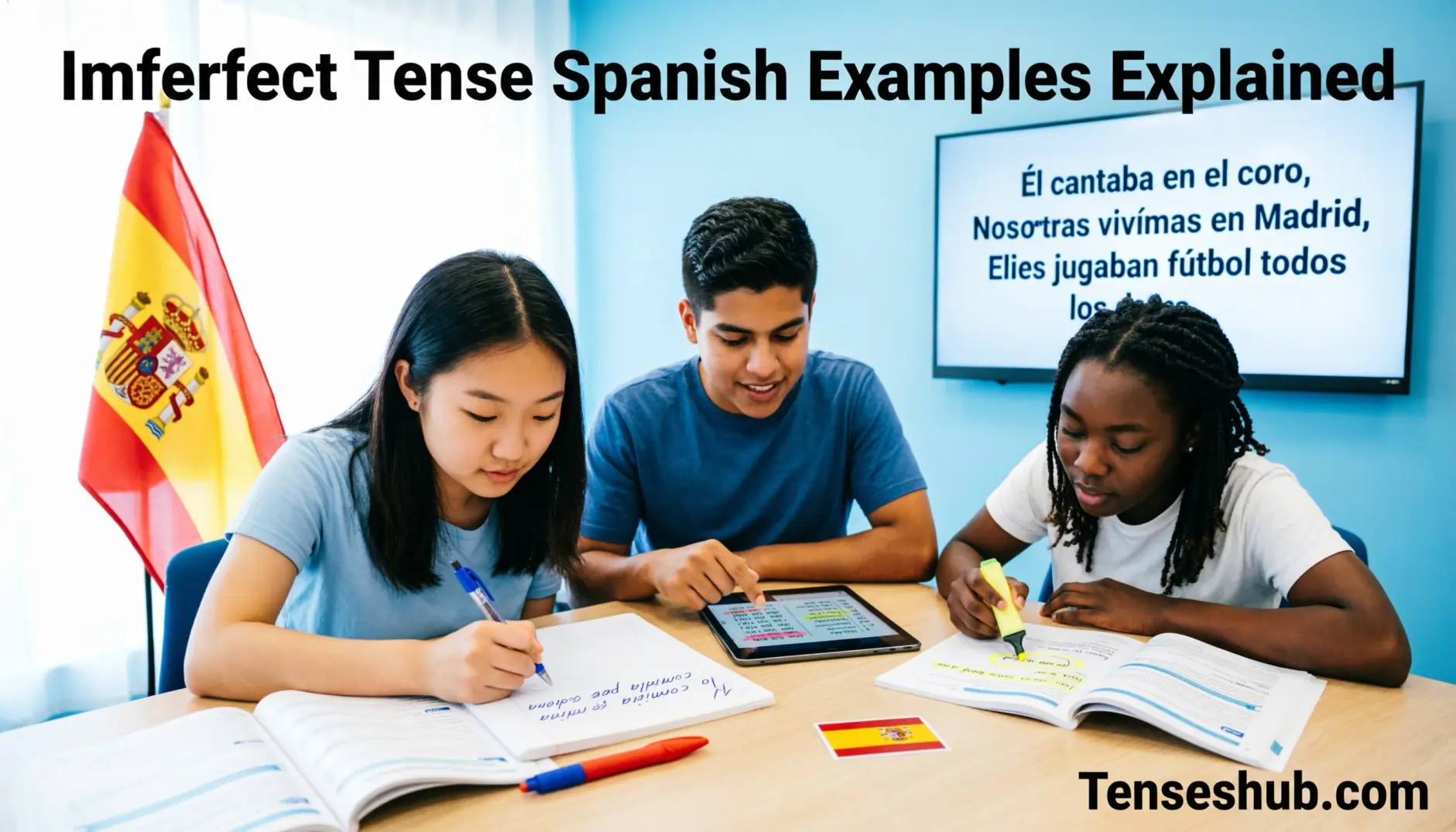
Here are 15 simple and natural imperfect tense Spanish examples:
- Yo jugaba fútbol cada día.
- Ella leía un libro.
- Nosotros vivíamos en Madrid.
- Tú mirabas la televisión.
- Ellos comían juntos.
- Yo no hablaba francés.
- Ella estudiaba medicina.
- Nosotros viajábamos mucho.
- ¿Tú trabajabas aquí?
- El niño dormía temprano.
- Hacía frío ayer.
- Siempre íbamos al parque.
- Yo veía películas en casa.
- Ellos no entendían la lección.
- Yo tenía un perro.
Common Mistakes in Imperfect Tense Spanish Examples
Mistake 1
❌ Yo comí cada día.
✔ Yo comía cada día.
👉 Wrong tense used. “Comí” is simple past, not imperfect.
Mistake 2
❌ Ella estaba feliz ayer (for habit).
✔ Ella estaba feliz siempre.
👉 Use imperfect for ongoing states or habits.
Mistake 3
❌ Nosotros jugamos fútbol cuando éramos niños (habit).
✔ Nosotros jugábamos fútbol cuando éramos niños.
Key Grammar Rules of Imperfect Tense Spanish Examples
- Use imperfect for repeated past actions
- Yo iba al parque cada día.
- Use it for descriptions in the past
- La casa era grande.
- Use it for ongoing past actions
- Estudiaba cuando llamaste.
- Use it for age, time, weather
- Tenía 15 años.
- Do not use it for single completed actions
- Use preterite instead.
Comparisons with Similar Grammar Forms
Imperfect vs Preterite
- Imperfect: ongoing or repeated actions
- Yo comía pizza (I used to eat pizza)
- Preterite: completed actions
- Yo comí pizza (I ate pizza)
Imperfect vs Present Continuous
- Imperfect: past ongoing action
- Yo estudiaba
- Present continuous: happening now
- Yo estoy estudiando
Understanding this difference helps you master imperfect tense Spanish examples faster.
Exercises
Fill in the blanks
- Yo ______ (comer) pizza cada día.
- Ella ______ (vivir) en España.
- Nosotros ______ (jugar) fútbol.
- Tú ______ (leer) libros.
- Ellos ______ (hablar) inglés.
Sentence Correction
- Yo comí cada día.
- Ella vivió en Madrid cuando era niña.
- Nosotros jugamos siempre.
- Tú hablaste mucho antes.
- Ellos comieron juntos cada día.
Rewrite Tasks
- I used to study → ______
- She was reading → ______
- We used to live there → ______
- They were playing → ______
- I was happy → ______
MCQs
- Imperfect tense is used for:
A) Completed actions
B) Ongoing past actions
C) Future actions
D) Commands - “Yo comía” means:
A) I ate
B) I used to eat
C) I will eat
D) I am eating - Which is irregular?
A) hablar
B) comer
C) ir
D) vivir - “Ella ______ feliz”
A) era
B) fue
C) será
D) es - Imperfect tense describes:
A) One time action
B) Background details
C) Future plans
D) Commands
Answers
Fill in:
- comía 2. vivía 3. jugábamos 4. leías 5. hablaban
Correction:
- comía 2. vivía 3. jugábamos 4. hablaba 5. comían
Rewrite:
- Yo estudiaba
- Ella leía
- Nosotros vivíamos allí
- Ellos jugaban
- Yo estaba feliz
MCQs:
1 B, 2 B, 3 C, 4 A, 5 B
FAQs
1. What is imperfect tense in Spanish?
It describes past habits, ongoing actions, or background details.
2. When do we use imperfect tense?
For repeated or continuous past actions.
3. Is imperfect tense difficult?
No, it is easy once you learn patterns.
4. What is the main difference between imperfect and preterite?
Imperfect is ongoing, preterite is completed.
5. How do I form imperfect tense verbs?
By adding special endings to verb stems.
6. What are common imperfect verbs?
hablar, comer, vivir, ir, ser, ver
7. Can imperfect describe feelings?
Yes, like “Yo estaba feliz.”
8. Is it used in storytelling?
Yes, very commonly.
Conclusion
Learning imperfect tense Spanish examples is very important if you want to speak Spanish naturally.
It helps you describe your past life, habits, and background stories in a smooth and meaningful way. At first, it may feel confusing, but with regular practice, it becomes very easy.
Remember, grammar is not about memorizing rules only it is about using them in real situations. Try to create your own sentences every day using imperfect tense.
Speak them, write them, and repeat them. The more you practice, the more confident you will become.
Keep learning step by step, and soon you will be able to tell full stories in Spanish without hesitation.

Hi, I’m Noah Bester, a tenses expert passionate about simplifying English grammar. I create practical, easy-to-understand guides to help learners master tenses with confidence. My goal is to make grammar clear, useful, and applicable in everyday communication. tenseshub.com