Have you ever been writing a sentence like “The bee sting me yesterday” and suddenly felt unsure if it is correct?
Many English learners get confused with the word sting past tense, because it does not follow a simple rule like “walk → walked.” Instead, it changes completely, which makes it tricky to remember.
In real life, we use this word when talking about insects, emotions, or painful experiences. For example, a bee can sting you, but later you need to say it “stung you.”
Without knowing the correct form, your sentences may sound incorrect or unnatural.
This is why learning the sting past tense is important for students, writers, and English learners.
In this article, you will understand its meaning, structure, usage, common mistakes, and practice exercises in a very simple way.
Quick Answer (Featured Snippet)
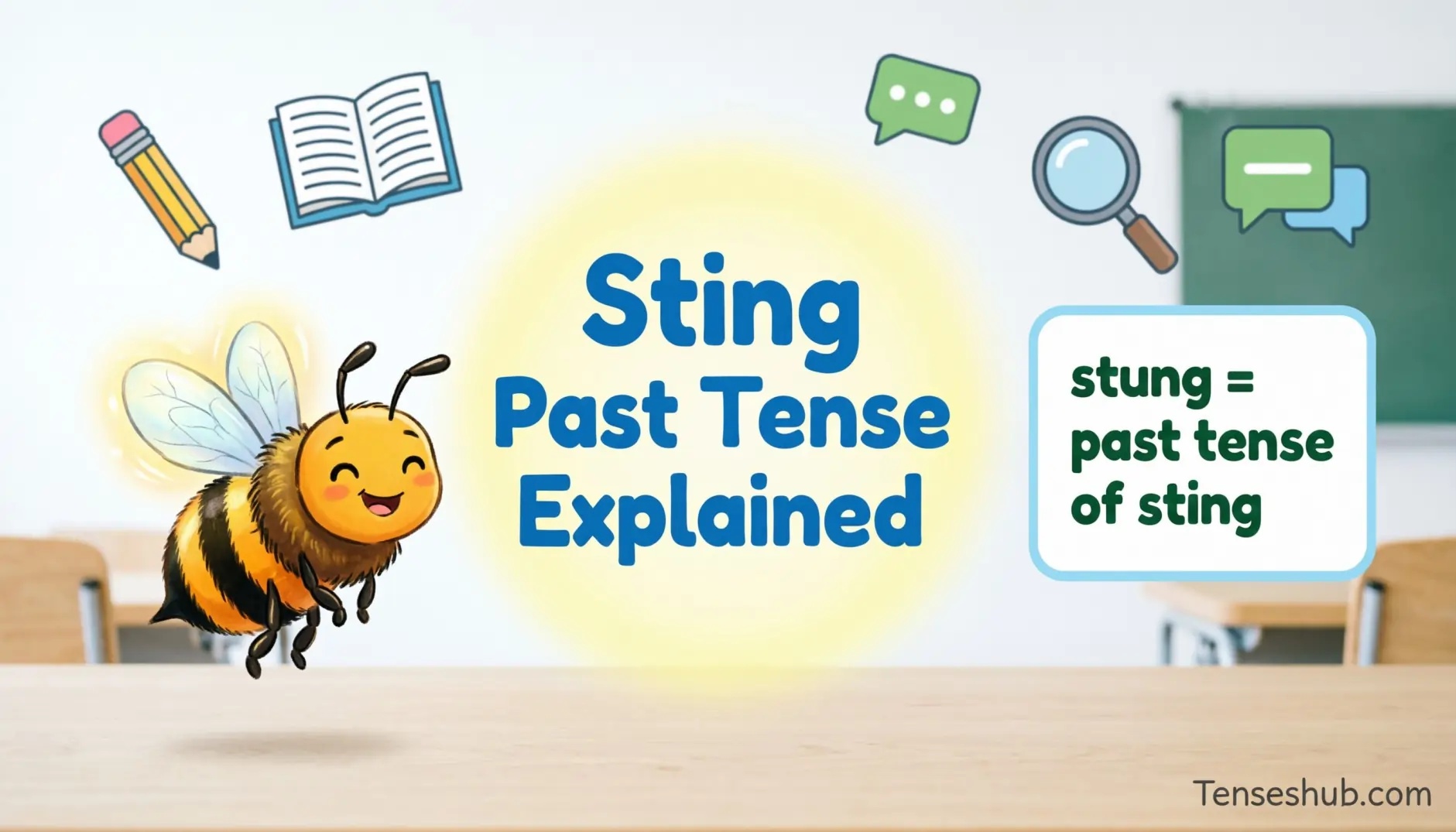
The past tense of sting is stung. It is an irregular verb, so it does not follow the regular “ ed” rule.
| Base Verb | Past Tense | Past Participle |
|---|---|---|
| sting | stung | stung |
Example: The bee stung me yesterday.
What Is Sting Past Tense?
The sting past tense refers to the word “stung,” which is the past form of the verb “sting.” It is an irregular verb in English grammar, meaning it changes its form completely instead of just adding “ ed.”
Function in English Grammar
We use “sting” when something sharp or painful hurts the skin or feelings. In past tense, we use “stung” to show that the action already happened.
Basic Usage Examples
- A bee stung my hand.
- The comment really stung him.
- She was stung by a jellyfish.
So, “stung” can be used for both physical pain and emotional pain.
Structure of Sentences of Sting Past Tense
Understanding sentence structure helps you use the sting past tense correctly in speaking and writing.
Positive Sentences
Formula:
Subject + stung + object
Examples:
- The bee stung the child.
- The jellyfish stung my leg.
Negative Sentences
Formula:
Subject + did not + sting + object
Examples:
- The bee did not sting me.
- The insect did not sting anyone.
Question Sentences
Formula:
Did + subject + sting + object?
Examples:
- Did the bee sting you?
- Did the wasp sting him?
Formation of Sting Past Tense
The sting past tense is formed using an irregular verb pattern. Instead of adding “ ed,” the word changes completely.
Verb Change Pattern
- Present: sting
- Past: stung
- Past Participle: stung
Helping Verb Usage
In negative and question forms, we use “did,” and the main verb returns to base form “sting.”
Examples:
- Did the bee sting you?
- The bee did not sting me.
This is different from regular verbs like “play → played.”
How to Use Sting Past Tense
The sting past tense is commonly used in daily conversations, storytelling, and descriptions of events.
1. Physical Pain
We use it when an insect or object causes pain.
- A bee stung my arm.
- A jellyfish stung the swimmer.
2. Emotional Pain
We also use it for hurt feelings.
- His words stung me deeply.
- The criticism stung her pride.
3. Storytelling
- Yesterday, a wasp stung my friend while we were playing.
Pronunciation Tip
“Stung” is pronounced as /stʌŋ/ (sounds like “stuhng”).
Conjugation Table: Sting → Stung
| Tense Form | Verb Form | Example Sentence |
|---|---|---|
| Present Simple | sting | “Bees sting when they feel danger.” |
| Past Simple | stung | “The bee stung me yesterday.” |
| Past Participle | stung | “I have been stung before.” |
| Negative | did not sting | “It did not sting anyone.” |
| Question | Did … sting? | “Did the bee sting you?” |
Real Life Examples
Here are 15 natural examples of the sting past tense:
- The bee stung my finger.
- A wasp stung him during the picnic.
- She was stung by a jellyfish.
- The comment stung his feelings.
- Did the insect sting you?
- The bee did not sting me.
- My arm was stung badly.
- The joke stung her pride.
- He said the words that stung deeply.
- Did the spider sting your hand?
- I think something stung me in the garden.
- The child cried after he was stung.
- It did not sting at all.
- The experience stung for a long time.
- She remembered when she was stung last summer.
Common Mistakes
Mistake 1: Using “stinged” ❌
- Wrong: The bee stinged me.
- Correct: The bee stung me.
Explanation: “Sting” is irregular, so “stinged” is incorrect.
Mistake 2: Using past tense with “did” ❌
- Wrong: Did the bee stung you?
- Correct: Did the bee sting you?
Explanation: After “did,” we always use base form.
Mistake 3: Forgetting verb change ❌
- Wrong: The bee sting me yesterday.
- Correct: The bee stung me yesterday.
Key Grammar Rules
- “Sting” is an irregular verb → sting → stung
- Never use “stinged” in English
- After “did,” always use base verb “sting”
- “Stung” is used for both physical and emotional pain
- Use “was/were stung” in passive voice
- Example: I was stung by a bee
- Past participle is also “stung”
- Context decides meaning (pain, emotion, or experience)
Comparisons with Similar Grammar Forms
Sting vs Stung vs Stinging
- Sting (present): Bees sting animals.
- Stung (past): The bee stung me.
- Stinging (continuous): The bee is stinging now.
Sting vs Regular Verbs
- Play → played (regular)
- Sting → stung (irregular)
This shows that sting past tense is not formed with “ ed.”
Exercises
Fill in the Blanks
- The bee ______ me yesterday.
- Did the insect ______ you?
- She was ______ by a jellyfish.
- The words ______ him deeply.
- The wasp did not ______ anyone.
Answers
- stung
- sting
- stung
- stung
- sting
Sentence Correction
- The bee stinged me.
- Did the bee stung you?
- He was sting by a wasp.
- The insect stunged her.
- I did not stung him.
Answers
- The bee stung me.
- Did the bee sting you?
- He was stung by a wasp.
- The insect stung her.
- I did not sting him.
Rewrite Tasks
- The bee stung me → (negative)
- Did the wasp sting him? → (statement)
- She was stung by a bee → (question)
- The insect did not sting me → (positive)
- The jellyfish stung him → (question)
Answers
- The bee did not sting me.
- The wasp stung him.
- Was she stung by a bee?
- The insect stung me.
- Did the jellyfish sting him?
MCQs
- What is the past tense of sting?
a) stinged
b) stang
c) stung
d) stinging
Answer: c - Sting is a ____ verb.
a) regular
b) irregular
Answer: b - Did the bee ___ you?
a) stung
b) sting
Answer: b - Correct sentence:
a) The bee stinged me
b) The bee stung me
Answer: b - Past participle of sting is:
a) stung
b) stinging
Answer: a
FAQs
1. What is the past tense of sting?
The past tense of sting is “stung.”
2. Is sting a regular or irregular verb?
It is an irregular verb.
3. Can we say stinged?
No, “stinged” is incorrect.
4. What is the past participle of sting?
It is also “stung.”
5. How do we make negative sentences?
Use “did not sting.”
6. How do we ask questions?
Use “Did + subject + sting?”
7. Can stung be used for emotions?
Yes, it can describe emotional pain.
8. What is pronunciation of stung?
It is pronounced /stʌŋ/.
9. Is stung used in passive voice?
Yes, like “I was stung.”
10. Why is sting confusing?
Because it is irregular and changes completely.
Conclusion
Learning the sting past tense is important because it helps you describe real life situations clearly, whether it is an insect bite or emotional pain.
The correct past form is “stung,” not “stinged,” and this small change makes a big difference in your English accuracy.
By understanding its structure, usage, and common mistakes, you can confidently use it in speaking and writing.
Remember, grammar becomes easy when you practice regularly. Try using “sting past tense” in your daily sentences, stories, and conversations.
The more you practice, the more natural it will feel. Keep learning step by step, and your English will improve faster than you think.

Hi, I’m Noah Bester, a tenses expert passionate about simplifying English grammar. I create practical, easy-to-understand guides to help learners master tenses with confidence. My goal is to make grammar clear, useful, and applicable in everyday communication. tenseshub.com