Have you ever written a sentence like “Yesterday I goed to school” and wondered if it sounded wrong? Many English learners struggle with irregular past tense verbs because they do not follow the normal ed rule.
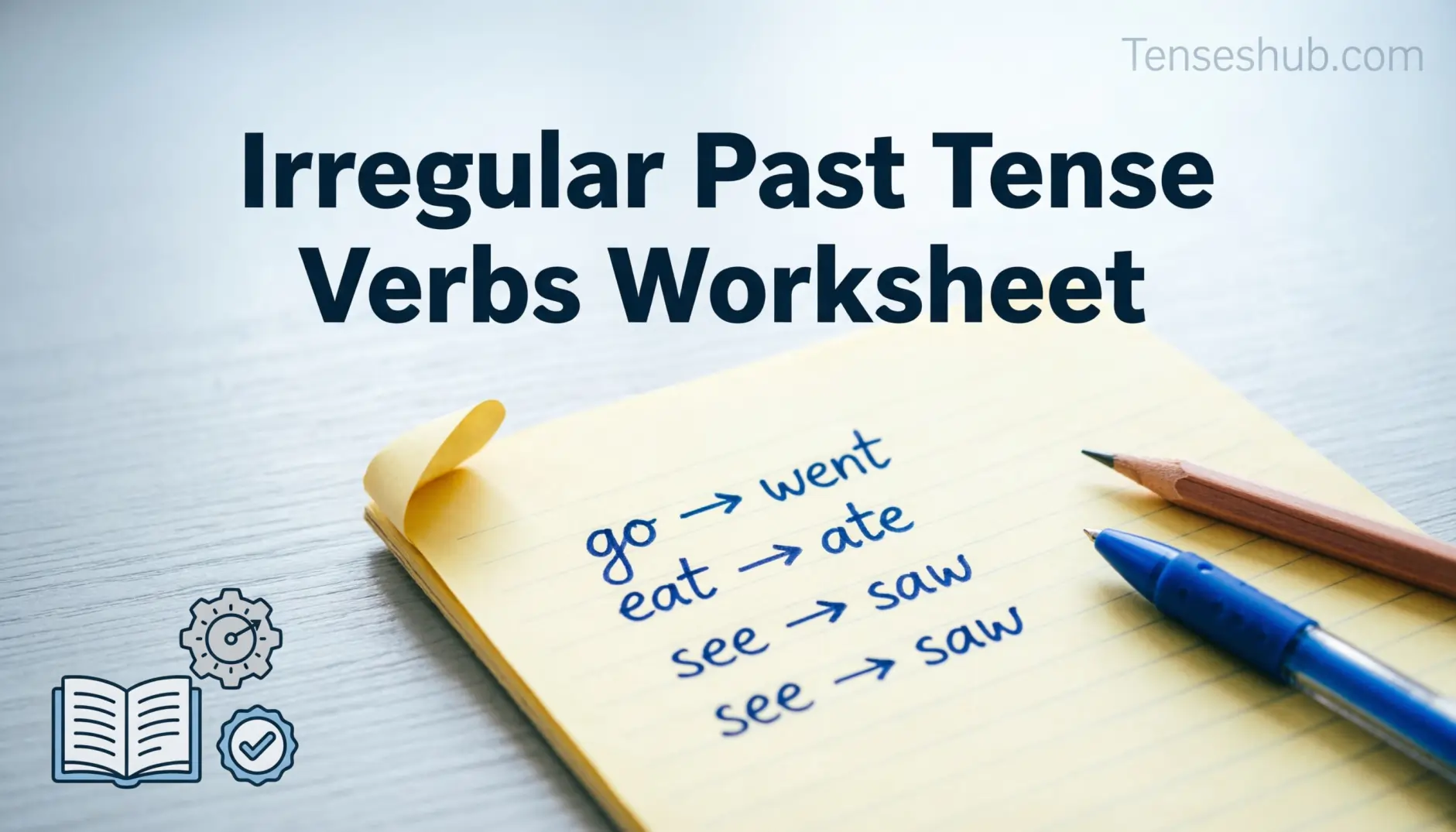
For regular verbs, it’s simple. Walk becomes walked. Jump becomes jumped. But irregular verbs are different. Go becomes went. Eat becomes ate. See becomes saw. That can feel confusing at first.
This irregular past tense verbs worksheet guide will help you understand how irregular past tense verbs work, how to use them in sentences, and how to practice them with simple exercises.
If you are a student, teacher, blogger, parent, or English learner, this guide gives you easy explanations, useful examples, and printable style practice to help you learn faster.
Quick Answer
An irregular past tense verb worksheet is a grammar practice activity that helps learners use verbs that do not follow the regular ed ending in the past tense.
| Base Verb | Past Tense | Example |
|---|---|---|
| go | went | I went home. |
| eat | ate | She ate lunch. |
| see | saw | We saw a movie. |
| take | took | He took the bus. |
What Is Irregular Past Tense Verbs Worksheet?
An irregular past tense verbs worksheet is a practice page used to learn and review irregular verbs in English.
Irregular verbs change form in the past tense, but not by simply adding ed.
For example:
- play → played ✅ regular
- walk → walked ✅ regular
- go → went ❌ irregular
- drink → drank ❌ irregular
Worksheets help learners:
- memorize common irregular verbs
- use them correctly in sentences
- avoid grammar mistakes
- improve speaking and writing
These worksheets often include:
- fill in the blanks
- matching exercises
- sentence correction
- multiple choice questions
- writing practice
Example:
Present: I eat breakfast at 8.
Past: I ate breakfast at 8.
Structure of Sentences of Irregular Past Tense Verbs Worksheet
Here are the basic sentence patterns using irregular past tense verbs.
Affirmative
Subject + irregular past tense verb + object
Example:
- I went to school.
- She ate dinner.
- They saw the teacher.
Negative
Subject + did not + base verb
Example:
- I did not go to school.
- She did not eat breakfast.
- They did not see him.
Notice:
We use did not, so the verb goes back to base form.
✅ She did not eat
❌ She did not ate
Interrogative
Did + subject + base verb?
Examples:
- Did you go home?
- Did she eat lunch?
- Did they see the game?
Formation of Irregular Past Tense Verbs Worksheet
Irregular verbs are formed by changing the verb itself instead of adding ed.
Examples:
- go → went
- come → came
- begin → began
- sing → sang
- drink → drank
Some stay the same:
- put → put
- cut → cut
- hit → hit
Some change completely:
- be → was / were
- do → did
- have → had
Common contractions
Negative contractions:
- did not = didn’t
Examples:
- I didn’t go.
- She didn’t eat.
- We didn’t see it.
There are no fixed spelling rules for irregular verbs, so the best way to learn them is through reading, listening, and repeated practice.
How to Use Irregular Past Tense Verbs Worksheet
Irregular past tense verbs are used when talking about actions completed in the past.
Common time expressions:
- yesterday
- last week
- last year
- this morning
- two days ago
Examples:
- I wrote an email yesterday.
- He bought a new phone last month.
- We came home late.
- She ran in the park this morning.
These verbs are very common in daily conversation.
You use them when telling stories:
- I woke up late.
- I forgot my keys.
- I took a taxi.
- Then I met my friend.
Because they appear often in everyday English, practicing with worksheets helps build confidence quickly.
Structure / Verb Pattern Table
| Sentence Type | Structure | Example |
|---|---|---|
| Affirmative | Subject + past tense verb | She ate pizza. |
| Negative | Subject + did not + base verb | She did not eat pizza. |
| Question | Did + subject + base verb? | Did she eat pizza? |
Real Life Examples
Here are natural examples using irregular past tense verbs.
- I went to the market after work.
- She bought fresh fruit.
- We saw our neighbors there.
- He took a photo.
- They came home late.
- I wrote a message to my teacher.
- My brother made dinner.
- We drank tea together.
Negative:
- I didn’t go to class.
- She didn’t bring her notebook.
- They didn’t eat breakfast.
Questions:
- Did you see the movie?
- Did he write the report?
- Did they come yesterday?
Informal:
- I went out last night.
- We saw him downtown.
Formal:
- The manager wrote the email yesterday.
- The team met in the office.
Common Mistakes
Here are mistakes learners often make.
Adding ed to irregular verbs
❌ I goed home.
✅ I went home.
Using past tense after did
❌ Did you went there?
✅ Did you go there?
Wrong negative structure
❌ She didn’t ate lunch.
✅ She didn’t eat lunch.
Confusing similar forms
❌ I have saw that movie.
✅ I have seen that movie.
Why?
Because:
- saw = simple past
- seen = past participle
Key Grammar Rules
Irregular verbs do not use ed
- eat → ate
- go → went
After did, always use the base verb
✅ Did you go?
❌ Did you went?
In negatives, use base verb after didn’t
✅ She didn’t come.
❌ She didn’t came.
Many irregular verbs must be memorized
There is no single rule for all.
Example:
- buy → bought
- teach → taught
- think → thought
Practice helps memorization
Reading and writing sentences with irregular verbs helps learners remember them faster.
Comparisons with Similar Grammar Forms
Irregular vs Regular Past Tense
| Regular Verb | Past | Irregular Verb | Past |
|---|---|---|---|
| walk | walked | go | went |
| jump | jumped | eat | ate |
| talk | talked | see | saw |
Regular verbs use ed.
Irregular verbs change differently.
Simple Past vs Present Perfect
Simple past:
- I saw the movie yesterday.
Present perfect:
- I have seen the movie.
Difference:
- saw = finished time
- seen = life experience or unfinished time
Exercises
Exercise 1: Fill in the blanks
Write the correct irregular past tense verb.
- Yesterday I ___ to the park. (go)
- She ___ breakfast at 7. (eat)
- We ___ a great movie. (see)
- He ___ a letter. (write)
- They ___ tea after dinner. (drink)
Answers
- went
- ate
- saw
- wrote
- drank
Exercise 2: Correct the sentence
- I goed to school.
- She didn’t ate lunch.
- Did he wrote the email?
- We buyed fruit.
- They comed late.
Answers
- I went to school.
- She didn’t eat lunch.
- Did he write the email?
- We bought fruit.
- They came late.
Exercise 3: Rewrite into negative
- She ate dinner.
- They went home.
- He saw the dog.
Answers
- She didn’t eat dinner.
- They didn’t go home.
- He didn’t see the dog.
Exercise 4: Multiple Choice
What is the past tense of “take”?
A) taked
B) took
C) take
✅ Answer: B
Which sentence is correct?
A) Did she went?
B) Did she go?
C) Did she gone?
✅ Answer: B
FAQs
What are irregular past tense verbs?
They are verbs that do not form the past tense by adding ed.
Example:
- go → went
- see → saw
Why are irregular verbs difficult?
Because they do not follow one spelling pattern. Learners usually need to memorize them through practice.
What is the best way to learn irregular past tense verbs?
The best methods include:
- worksheets
- flashcards
- reading stories
- speaking practice
- sentence writing
How many irregular verbs are there in English?
English has many irregular verbs, but around 100 150 are very common in daily use.
Are worksheets helpful for learning irregular verbs?
Yes. Worksheets help learners practice grammar patterns, notice mistakes, and remember verb changes more easily.
Conclusion
Learning irregular verbs can feel hard in the beginning because they do not follow the normal ed pattern. But with regular practice, they become much easier.
Using an irregular past tense verbs worksheet is one of the best ways to practice these verbs in real sentences. It helps you remember verb forms, avoid common grammar mistakes, and use English more naturally when speaking and writing.
Start with the most common verbs like go, eat, see, come, take, and write. Practice them often in short sentences.
The more you read, write, and repeat them, the easier they become.
Keep practicing a little every day, and soon irregular past tense verbs will feel natural.

Hi, I’m Robert Lowth, a passionate expert in English tenses and grammar. I specialize in simplifying complex tense rules to help learners understand and use English with confidence. My goal is to make grammar clear, practical, and easy for everyday communication. tenseshub.com