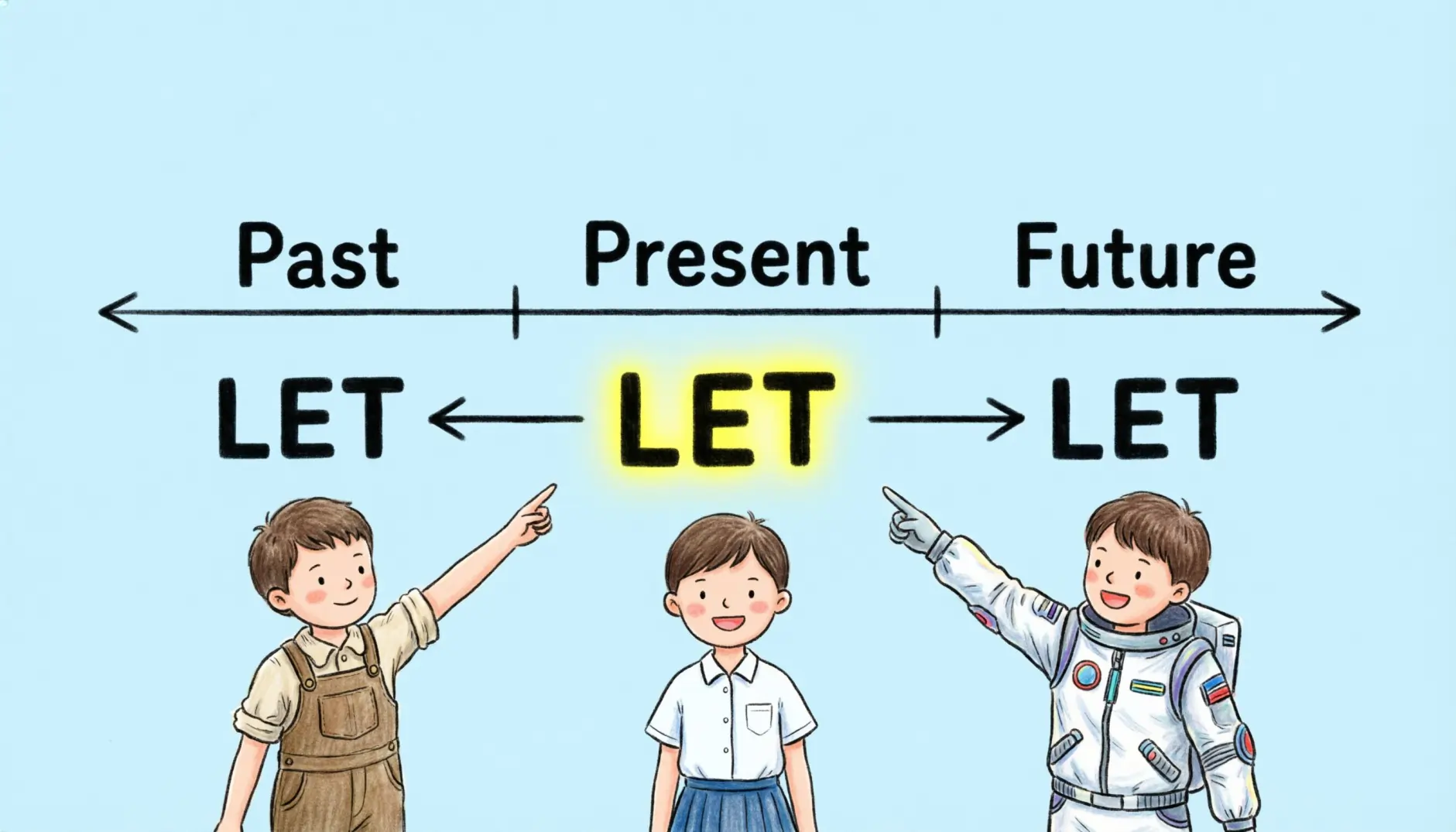
Have you ever heard someone say, “I let him go” and wondered why “let” does not change in the past tense? Many English learners feel confused because most verbs change form in the past tense, but “let” looks the same in present and past.
Understanding the past tense of “let” is very important because it is used in daily English conversations, instructions, permissions, and storytelling. Without knowing it, you may get confused when reading or speaking English.
In this article, you will learn everything about “let past tense” in a very simple and clear way. We will explain its meaning, forms, rules, examples, common mistakes, and practice exercises so you can master it easily.
Quick Answer (Featured Snippet)
The past tense of “let” is “let”.
It is an irregular verb that does not change in the past tense.
Simple Structure Table
| Base Form | Past Tense | Past Participle |
|---|---|---|
| let | let | let |
👉 Example:
- Present: I let him play.
- Past: I let him play.
- Past Perfect: I had let him play.
Explanation (Basic → Advanced)
Meaning of “Let”
The word “let” means to allow or give permission.
Basic Rule
“Let” is an irregular verb, so:
- It stays the same in present, past, and past participle form.
Usage of Let in Past Tense
We use “let” in past tense when talking about permission or actions allowed in the past.
Examples:
- My mother let me go to the park yesterday.
- The teacher let the students leave early.
- He let me borrow his book last week.
👉 Important Point:
Even in past time, we still say “let”, not “letted” (this is incorrect).
Forms / Conjugation
Full Table
| Form Type | Verb Form |
|---|---|
| Base Form | let |
| Present Simple | let |
| Past Simple | let |
| Past Participle | let |
| Present Participle | letting |
Example in Different Tenses:
- Present: She lets her dog sleep inside.
- Past: She let her dog sleep inside.
- Perfect: She has let her dog sleep inside.
- Continuous: She is letting her dog sleep inside.
Comparison Section
1. Let vs Lets
- Let (base/past): used for all subjects in past
- Lets (present): used with he/she/it
Examples:
- She lets me study.
- She let me study yesterday.
2. Let vs Allowed
- Let: informal permission
- Allowed: more formal
Examples:
- My dad let me drive.
- My dad allowed me to drive.
Comparison Table
| Tense | Example |
|---|---|
| Present | I let him go today. |
| Past | I let him go yesterday. |
👉 Difference: Time only, verb stays same.
4. Let vs Made
- Let = permission
- Made = forced
Examples:
- He let me leave early.
- He made me leave early.
5. Let vs Letting
- Let = simple past
- Letting = continuous action
Examples:
- She let me go.
- She is letting me go now.
Sentence Structure
1. Simple Sentence Formula
Subject + let + object + verb (base form)
Examples:
- She let me go.
- They let us play.
2. Negative Form
Subject + did not (didn’t) + let + object + verb
Examples:
- He didn’t let me go.
- They didn’t let us enter.
3. Question Form
Did + subject + let + object + verb?
Examples:
- Did she let you go?
- Did they let him speak?
Real Life Usage
Here are 15 simple daily life sentences using let past tense:
- My father let me use his phone.
- The teacher let us go early.
- She let her friend stay at her house.
- He let me borrow his car.
- They let the children play outside.
- The guard let us enter the building.
- My boss let me take a break.
- She let me choose the movie.
- He let his brother drive the bike.
- My parents let me travel alone.
- The coach let the team rest.
- They let us sit in front.
- She let me explain my problem.
- He let me join the meeting.
- The shopkeeper let me check the product first.
Common Mistakes
❌ Wrong vs ✔ Correct
- ❌ He letted me go.
✔ He let me go. - ❌ She didn’t let me to go.
✔ She didn’t let me go. - ❌ Did you let him to play?
✔ Did you let him play?
👉 Why?
Because “let” is an irregular verb and never changes.
Key Grammar Rules
- “Let” does not change in past tense.
- Always use base verb after “let” (not “to” form).
- Do not add “ ed” or “ ing” for past simple meaning.
- Use “did” for questions and negatives.
- “Let” always shows permission or allowance.
Advanced Usage
1. Continuous Form
Used for ongoing permission:
- She is letting me use her laptop.
2. Perfect Form
Used for completed past action:
- He has let me down many times.
3. Past Perfect
Used for earlier past action:
- She had let him go before I arrived.
4. Future Form
Used for future permission:
- They will let us join the event.
Practice Section
A. Fill in the blanks
- She ___ me go early.
- They ___ us enter.
- He didn’t ___ me speak.
- Did you ___ him play?
- My mom ___ me stay out late.
Answers:
- let
- let
- let
- let
- let
B. MCQs
- Past tense of let is:
- a) letted
- b) let ✔
- c) letting
- She ___ me go yesterday.
- a) lets
- b) let ✔
- c) letting
- Did they ___ you enter?
- a) let ✔
- b) lets
- c) letting
- Correct sentence:
- a) He letted me go
- b) He let me go ✔
- c) He letting me go
- “Let” means:
- a) force
- b) allow ✔
- c) stop
C. Error Correction
- ❌ He didn’t let me to go → ✔ He didn’t let me go
- ❌ She letted me stay → ✔ She let me stay
- ❌ Did you lets him play? → ✔ Did you let him play?
- ❌ They letted us in → ✔ They let us in
- ❌ He let me to drive → ✔ He let me drive
FAQs
1. What is the past tense of let?
It is let.
2. Is “letted” correct?
No, it is incorrect.
3. Does let change in past tense?
No, it stays the same.
4. What is the meaning of let?
It means to allow or give permission.
5. Is let regular or irregular verb?
It is an irregular verb.
Conclusion
The verb “let” is very simple but important in English grammar. Many learners get confused because it does not change in the past tense. Unlike regular verbs, you do not add “ ed” or change its form. You always use “let” for present, past, and perfect tenses.
By learning its structure, examples, and rules, you can easily use it in daily conversations. Practice is the key to mastering it. Try using “let” in your own sentences, especially when talking about permission.
Keep practicing, and soon you will use “let past tense” naturally and confidently in both speaking and writing.
Hi, I’m Robert Lowth, a passionate expert in English tenses and grammar. I specialize in simplifying complex tense rules to help learners understand and use English with confidence. My goal is to make grammar clear, practical, and easy for everyday communication. tenseshub.com