Have you ever written a sentence like “I losed my keys yesterday” and wondered if it sounded wrong? You are not alone.
Many English learners get confused about the past tense of lose because it is an irregular verb. Unlike regular verbs that simply add ed, the verb lose changes completely in the past tense.
This small grammar mistake can appear in school assignments, blog posts, emails, social media captions, and even daily conversations. Knowing the correct form helps your English sound more natural, clear, and professional.
The good news is that the past tense of lose is actually very easy once you understand the pattern and practice it with examples.
In this guide, you will learn the meaning, sentence structure, grammar rules, common mistakes, pronunciation tips, exercises, and real life examples in a simple beginner friendly way.
By the end, you will confidently know when to use lose, lost, and lost correctly in everyday English.
Quick Answer (Featured Snippet)
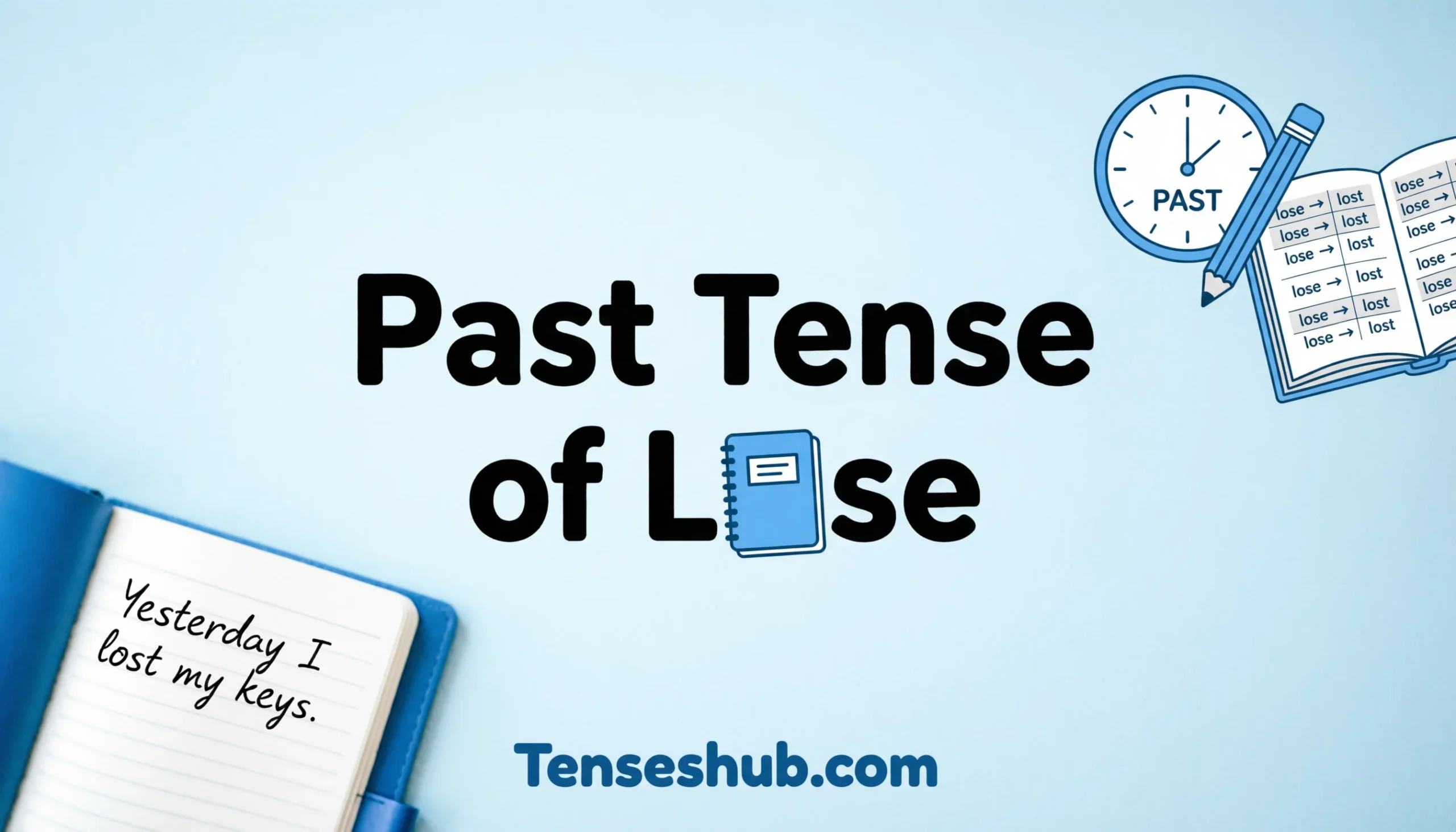
The past tense of lose is lost.
The past participle of lose is also lost.
Simple Table
| Base Verb | Past Tense | Past Participle |
|---|---|---|
| lose | lost | lost |
Examples:
- I lost my phone yesterday.
- She has lost her wallet before.
What Is Past Tense of Lose?
The past tense of lose is lost. It is used when talking about something that happened in the past.
The verb lose means:
- to no longer have something
- to fail to win
- to miss something
- to become unable to find something
Examples:
- I often lose my keys. (present tense)
- I lost my keys yesterday. (past tense)
The word lose is an irregular verb, which means it does not follow the normal “add ed” rule.
Incorrect:
- losed ❌
Correct:
- lost ✅
This verb is commonly used in:
- daily conversations
- exams
- storytelling
- sports discussions
- business communication
- social media posts
Examples:
- Our team lost the match.
- He lost his job last year.
- They lost their way in the city.
Structure of Sentences of Past Tense of Lose
The sentence structure is simple and easy to follow.
Positive Sentences
Formula:
Subject + lost + object
Examples:
- I lost my bag.
- She lost her ticket.
- They lost the game.
Negative Sentences
Formula:
Subject + did not + lose + object
Examples:
- I did not lose my phone.
- She didn’t lose her keys.
- We did not lose the match.
Notice that after did not, the verb returns to its base form lose.
Question Sentences
Formula:
Did + subject + lose + object?
Examples:
- Did you lose your wallet?
- Did he lose the race?
- Did they lose their luggage?
Short Answers
Examples:
- Yes, I did.
- No, she didn’t.
Formation of Past Tense of Lose
Complete Verb Table
| Verb Form | Word |
|---|---|
| Base Form | lose |
| Past Tense | lost |
| Past Participle | lost |
| Present Participle | losing |
How It Changes
Most regular verbs:
- walk → walked
- play → played
But irregular verbs change differently:
- lose → lost
This change must be memorized because there is no fixed spelling rule.
Using Helping Verbs
Simple Past
Use lost without helping verbs.
Example:
- I lost my wallet.
Negative Past
Use did not + lose
Example:
- I did not lose my wallet.
Present Perfect
Use has/have + lost
Example:
- She has lost her phone.
Past Perfect
Use had + lost
Example:
- They had lost the map before we arrived.
How to Use Past Tense of Lose
The past tense of lose is used when talking about completed actions in the past.
1. Losing Physical Objects
Examples:
- I lost my keys yesterday.
- She lost her glasses at school.
2. Losing Games or Competitions
Examples:
- Our team lost the final match.
- He lost the race by one second.
3. Missing Opportunities
Examples:
- I lost the chance to meet him.
- They lost an important client.
4. Losing Direction
Examples:
- We lost our way in the forest.
- She got lost in the market.
5. Emotional or Personal Loss
Examples:
- He lost his confidence.
- They lost hope after the accident.
Pronunciation Tip
The word lost is pronounced like:
/lɔːst/
It rhymes with:
- cost
- frost
Avoid pronouncing it as:
- loo st ❌
Conjugation of “Lose”
| Tense | Sentence Example |
|---|---|
| Present Simple | I lose my keys often. |
| Past Simple | I lost my keys yesterday. |
| Present Continuous | I am losing patience. |
| Present Perfect | I have lost my wallet. |
| Past Perfect | She had lost her phone earlier. |
| Future Simple | They will lose the match. |
Real Life Examples
Here are natural examples using the past tense of lose in daily life.
- I lost my mobile phone at the mall.
- She lost her homework before class.
- We lost the football match yesterday.
- He lost his temper during the meeting.
- They lost their luggage at the airport.
- Did you lose your ID card?
- I did not lose your book.
- My grandfather lost his glasses again.
- The company lost a lot of money last year.
- She lost interest in the movie halfway through.
- We got lost while driving home.
- He lost the election by a small margin.
- Have you ever lost your passport?
- They had lost hope before help arrived.
- I almost lost my balance on the stairs.
Common Mistakes
English learners often make these mistakes with the past tense of lose.
Mistake 1: Using “Losed”
Wrong:
- I losed my keys. ❌
Correct:
- I lost my keys. ✅
Explanation:
Lose is irregular, so it becomes lost.
Mistake 2: Using “Lost” After Did
Wrong:
- Did you lost your wallet? ❌
Correct:
- Did you lose your wallet? ✅
Explanation:
After did, always use the base verb.
Mistake 3: Confusing Lose and Loose
Wrong:
- I loose my phone yesterday. ❌
Correct:
- I lose my phone often. ✅
- I lost my phone yesterday. ✅
Explanation:
- Lose = to no longer have something
- Loose = not tight
Mistake 4: Incorrect Perfect Tense
Wrong:
- I have lose my keys. ❌
Correct:
- I have lost my keys. ✅
Explanation:
Present perfect uses the past participle lost.
Key Grammar Rules
Rule 1: “Lose” Is an Irregular Verb
It changes to lost, not losed.
Example:
- She lost her bag.
Rule 2: Use Base Verb After “Did”
Examples:
- Did you lose your wallet?
- I didn’t lose the file.
Rule 3: “Lost” Works as Past Tense and Past Participle
Examples:
- I lost my phone. (past tense)
- I have lost my phone. (past participle)
Rule 4: “Lose” and “Loose” Are Different Words
Examples:
- I lose my pen often.
- My shirt is loose.
Rule 5: Use Time Words With Past Tense
Common time expressions:
- yesterday
- last week
- last year
- two days ago
Examples:
- We lost the match yesterday.
- He lost his wallet last month.
Comparisons with Similar Grammar Forms
Lose vs Lost
| Word | Usage | Example |
|---|---|---|
| lose | present tense | I lose things often. |
| lost | past tense | I lost my keys yesterday. |
Lose vs Loose
| Word | Meaning | Example |
|---|---|---|
| lose | unable to find | I lose my phone often. |
| loose | not tight | These shoes are loose. |
Lost vs Missed
| Word | Meaning | Example |
|---|---|---|
| lost | unable to keep | I lost my wallet. |
| missed | failed to catch or attend | I missed the bus. |
Exercises
Fill in the Blanks
- I ______ my notebook yesterday.
- She has ______ her phone again.
- Did they ______ the game?
- We ______ our way in the city.
- He did not ______ the ticket.
Answers
- lost
- lost
- lose
- lost
- lose
Sentence Correction Exercises
Correct the mistakes.
- I losed my keys.
- Did you lost your wallet?
- She have lost her bag.
- We didn’t lost the game.
- He loose his phone often.
Answers
- I lost my keys.
- Did you lose your wallet?
- She has lost her bag.
- We didn’t lose the game.
- He loses his phone often.
Rewrite Tasks
Rewrite the sentences in past tense.
- I lose my pen.
- They lose the match.
- She loses her wallet.
- We do not lose hope.
- Do you lose your keys?
Answers
- I lost my pen.
- They lost the match.
- She lost her wallet.
- We did not lose hope.
- Did you lose your keys?
Multiple Choice Questions (MCQs)
1. What is the past tense of lose?
A. losed
B. lost
C. loose
D. losing
✅ Answer: B
2. Which sentence is correct?
A. I losed my phone.
B. I lost my phone.
C. I loose my phone.
D. I losing my phone.
✅ Answer: B
3. Which is the correct question form?
A. Did you lost it?
B. Did you lose it?
C. Do you lost it?
D. Did you losing it?
✅ Answer: B
4. “Lost” is:
A. a regular verb
B. an adjective only
C. an irregular verb form
D. a noun
✅ Answer: C
5. Choose the correct sentence.
A. She have lost her keys.
B. She has lost her keys.
C. She had lose her keys.
D. She losted her keys.
✅ Answer: B
6. Which word means “not tight”?
A. lose
B. lost
C. loose
D. losing
✅ Answer: C
7. Which sentence is negative?
A. I lost my bag.
B. Did you lose your bag?
C. I didn’t lose my bag.
D. She lost her bag.
✅ Answer: C
8. Which helping verb is used in present perfect?
A. did
B. has
C. was
D. will
✅ Answer: B
9. Choose the correct sentence.
A. We didn’t lost the game.
B. We didn’t lose the game.
C. We not lose the game.
D. We no lost the game.
✅ Answer: B
10. Which sentence uses past tense correctly?
A. He lose his wallet yesterday.
B. He lost his wallet yesterday.
C. He losing his wallet yesterday.
D. He loose his wallet yesterday.
✅ Answer: B
FAQs
What is the past tense of lose?
The past tense of lose is lost.
Is “losed” a real word?
No. Losed is incorrect in standard English.
Is lose a regular or irregular verb?
Lose is an irregular verb.
What is the past participle of lose?
The past participle is lost.
How do you use lost in a sentence?
Example:
- I lost my wallet yesterday.
What is the difference between lose and loose?
- Lose means to no longer have something.
- Loose means not tight.
Can “lost” be used in present perfect tense?
Yes.
Example:
- She has lost her keys.
Do we use “lost” after did?
No.
Correct:
- Did you lose it?
What is the pronunciation of lost?
It is pronounced like “lawst.”
Can lost describe feelings?
Yes.
Example:
- I felt lost after moving to a new city.
Conclusion
Learning the past tense of lose is important for speaking and writing correct English. The correct past form is lost, and it is also used as the past participle.
Because lose is an irregular verb, it does not follow the normal “ ed” pattern, which is why many learners make mistakes like losed or did lost.
The best way to master this grammar topic is through regular practice. Read examples, write your own sentences, and pay attention to how native speakers use the word in conversations, movies, books, and online content.

Hi, I’m Noah Bester, a tenses expert passionate about simplifying English grammar. I create practical, easy-to-understand guides to help learners master tenses with confidence. My goal is to make grammar clear, useful, and applicable in everyday communication. tenseshub.com