Have you ever wondered how to say “I stay at home yesterday” correctly in English? Many learners get confused when using the verb stay in the past tense. It looks simple, but small mistakes can change the meaning of your sentence.
The verb stay is very common in daily English. We use it when talking about living somewhere temporarily, remaining in a place, or not leaving.
But when we talk about the past, we must change it correctly to show time.
In this guide, you will learn everything about stay past tense in a very simple way. You will understand the meaning, rules, forms, sentence structures, real life usage, and common mistakes.
This article is designed for beginners and English learners who want clear, practical grammar knowledge.
Quick Answer (Featured Snippet)
Complete Verb Table
| Form | Verb |
|---|---|
| Base Form | stay |
| Past Tense | stayed |
| Past Participle | stayed |
👉 We use stayed to talk about something that happened in the past and is already finished.
Example:
- I stayed at my friend’s house last night.
- She stayed in London for two weeks.
Explanation of “Stay” (Basic to Advanced)
Meaning of “Stay”
The verb stay means:
- To remain in one place
- To live somewhere temporarily
- To not leave or go away
Past Tense Meaning
When we change stay → stayed, we talk about actions that already happened.
Example:
- Present: I stay at home.
- Past: I stayed at home yesterday.
How It Works
The verb stay is a regular verb, so we simply add ed to form the past tense:
- stay → stayed
No spelling change is needed.
Forms / Conjugation of “Stay”
Here is a simple table showing all forms:
Complete Tense Table
| Tense | Form | Example |
|---|---|---|
| Base Form | stay | I stay here. |
| Past Simple | stayed | I stayed here yesterday. |
| Past Participle | stayed | I have stayed here before. |
| Present Continuous | staying | I am staying here now. |
| Future | will stay | I will stay here tomorrow. |
Comparison Section (Stay in Different Tenses)
1. Present vs Past
- Present: I stay at home.
- Past: I stayed at home.
👉 Present is happening now, past is finished.
2. Past vs Present Perfect
- Past: I stayed in Delhi last year.
- Present Perfect: I have stayed in Delhi before.
👉 Past = specific time
👉 Present perfect = general experience
3. Past Simple vs Past Continuous
- Past Simple: I stayed at home.
- Past Continuous: I was staying at home when he called.
👉 Past continuous shows ongoing action.
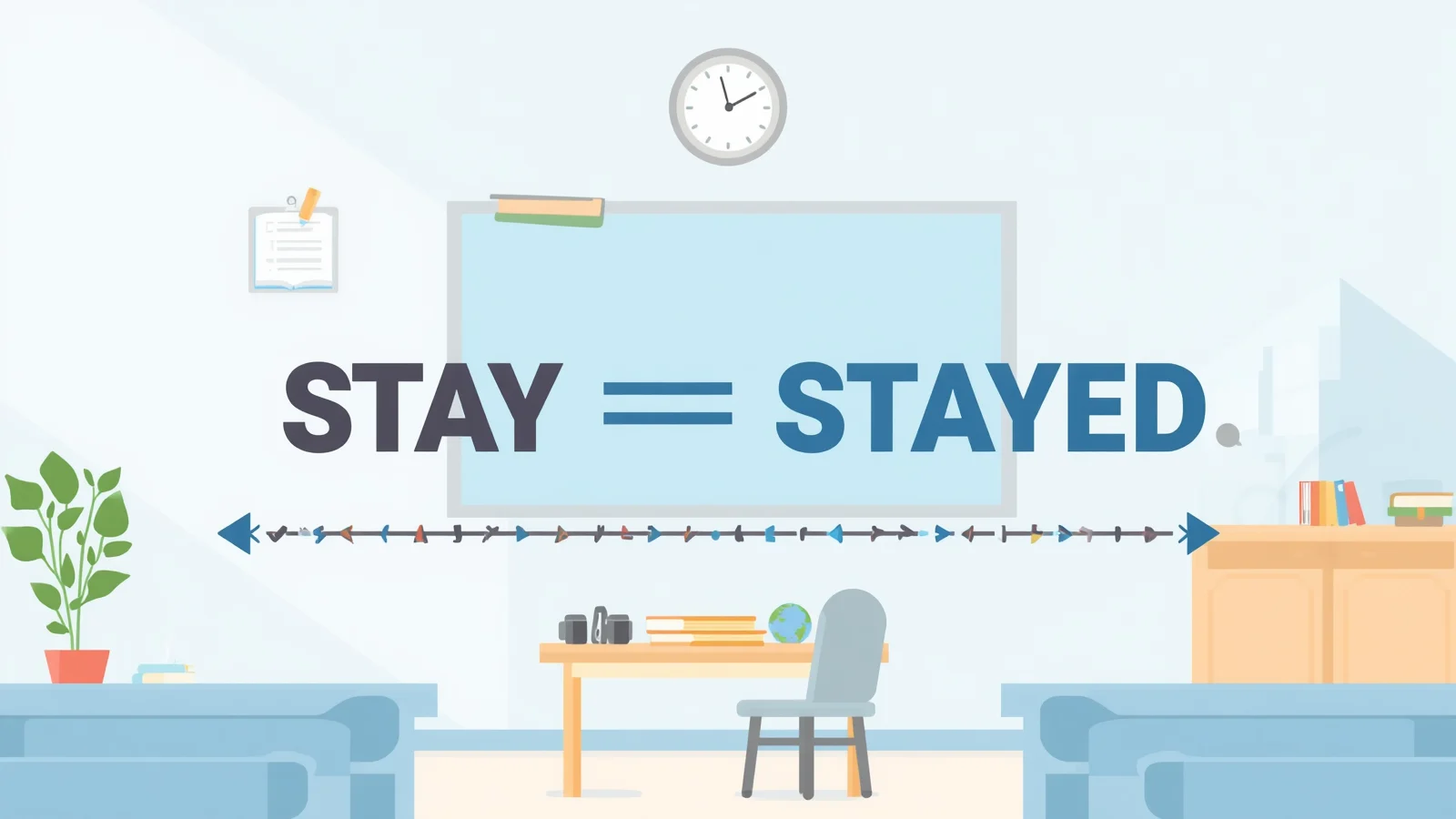
4. Stay vs Stayed
- Stay = present or future
- Stayed = completed action in past
5. Stayed vs Staying
- Stayed = finished action
- Staying = ongoing action
Sentence Structure of “Stayed”
1. Positive Sentence
Formula:
Subject + stayed + object/place
Examples:
- I stayed at a hotel.
- They stayed in Karachi.
- She stayed with her uncle.
2. Negative Sentence
Formula:
Subject + did not (didn’t) + stay
Examples:
- I didn’t stay at home.
- He didn’t stay long.
- We didn’t stay in Lahore.
3. Questions
Formula:
Did + subject + stay + object?
Examples:
- Did you stay here?
- Did she stay at your house?
- Did they stay in hotel?
Real Life Usage of “Stayed”
Here are 15 natural sentences used in daily English:
- I stayed at my cousin’s house last weekend.
- She stayed in bed because she was sick.
- They stayed in a hotel near the beach.
- We stayed home due to heavy rain.
- He stayed in school after class.
- I stayed up late studying.
- She stayed in London for work.
- They stayed together during the trip.
- I stayed calm during the interview.
- We stayed in touch after graduation.
- He stayed at the office until 9 PM.
- She stayed with her grandparents.
- I stayed for only one hour.
- They stayed silent during the meeting.
- We stayed at a friend’s wedding.
Common Mistakes with “Stay”
❌ Incorrect vs ✔ Correct
- ❌ I stay at home yesterday.
✔ I stayed at home yesterday. - ❌ She stay in hotel last night.
✔ She stayed in a hotel last night. - ❌ Did you stayed there?
✔ Did you stay there? - ❌ He didn’t stayed long.
✔ He didn’t stay long.
Why these mistakes happen?
Learners mix present and past forms or add “ ed” after “did,” which is not correct in English grammar.
Key Grammar Rules for “Stayed”
- “Stay” becomes “stayed” in past tense.
- Do not use “stayed” after “did” or “didn’t.”
- Use “stayed” for finished actions.
- Use “have stayed” for experiences.
- Time words like “yesterday, last night, ago” often appear with “stayed.”
Advanced Usage of “Stayed”
1. Past Continuous
Used for ongoing past actions:
- I was staying at a hotel when it rained.
- She was staying with friends during exams.
2. Present Perfect
Used for experience or life events:
- I have stayed in many cities.
- She has stayed here before.
3. Future Usage
Used with “will”:
- I will stay at home tomorrow.
- They will stay in Dubai next month.
Practice Section
A. Fill in the Blanks
- I ___ (stay) at home yesterday.
- She ___ (stay) in a hotel last night.
- They ___ (stay) in Lahore last week.
- We ___ (stay) with friends.
- He ___ (stay) calm.
Answers:
- stayed
- stayed
- stayed
- stayed
- stayed
B. MCQs
- Past tense of stay is:
- a) staying
- b) stayed ✔
- c) stays
- Which is correct?
- a) I stay yesterday
- b) I stayed yesterday ✔
- c) I staying yesterday
- Negative form is:
- a) didn’t stayed
- b) didn’t stay ✔
- c) not stayed
- Did you ___ there?
- a) stayed
- b) stay ✔
- c) stays
- She ___ in London.
- a) stayed ✔
- b) stay
- c) staying
C. Error Correction
- I didn’t stayed home → I didn’t stay home
- She stay there yesterday → She stayed there yesterday
- Did he stayed? → Did he stay?
- They stays in hotel → They stayed in hotel
- We stay there last night → We stayed there last night
FAQs
1. What is the past tense of stay?
It is stayed.
2. Is stay a regular verb?
Yes, it is a regular verb.
3. Can we say “did stayed”?
No, correct form is “did stay.”
4. What is past participle of stay?
It is also stayed.
5. How do we use stayed in a sentence?
We use it to show completed past actions.
Conclusion
Understanding the stay past tense is very important for speaking and writing correct English. The verb “stay” is simple because it is a regular verb, and its past form is stayed.
By learning its forms, rules, and examples, you can easily use it in daily conversations.
The key is practice. Try making your own sentences using “stayed” in different situations like travel, home life, or school. The more you practice, the more natural your English will become.
Keep learning, keep practicing, and you will master English grammar step by step.

Hi, I’m Robert Lowth, a passionate expert in English tenses and grammar. I specialize in simplifying complex tense rules to help learners understand and use English with confidence. My goal is to make grammar clear, practical, and easy for everyday communication. tenseshub.com