Have you ever wondered what the past tense of “split” is? Many English learners get confused because some verbs change in the past, while others stay the same. For example, “go” becomes “went,” but what about “split”?
This is an important grammar topic because the verb “split” is commonly used in daily English, storytelling, business conversations, and even emotional expressions like “they split the bill” or “the team split up.”
In this guide, you will clearly learn the past tense of split, how to use it correctly, common mistakes, and real life examples.
Everything is explained in very simple English so you can easily understand and remember.
Quick Answer
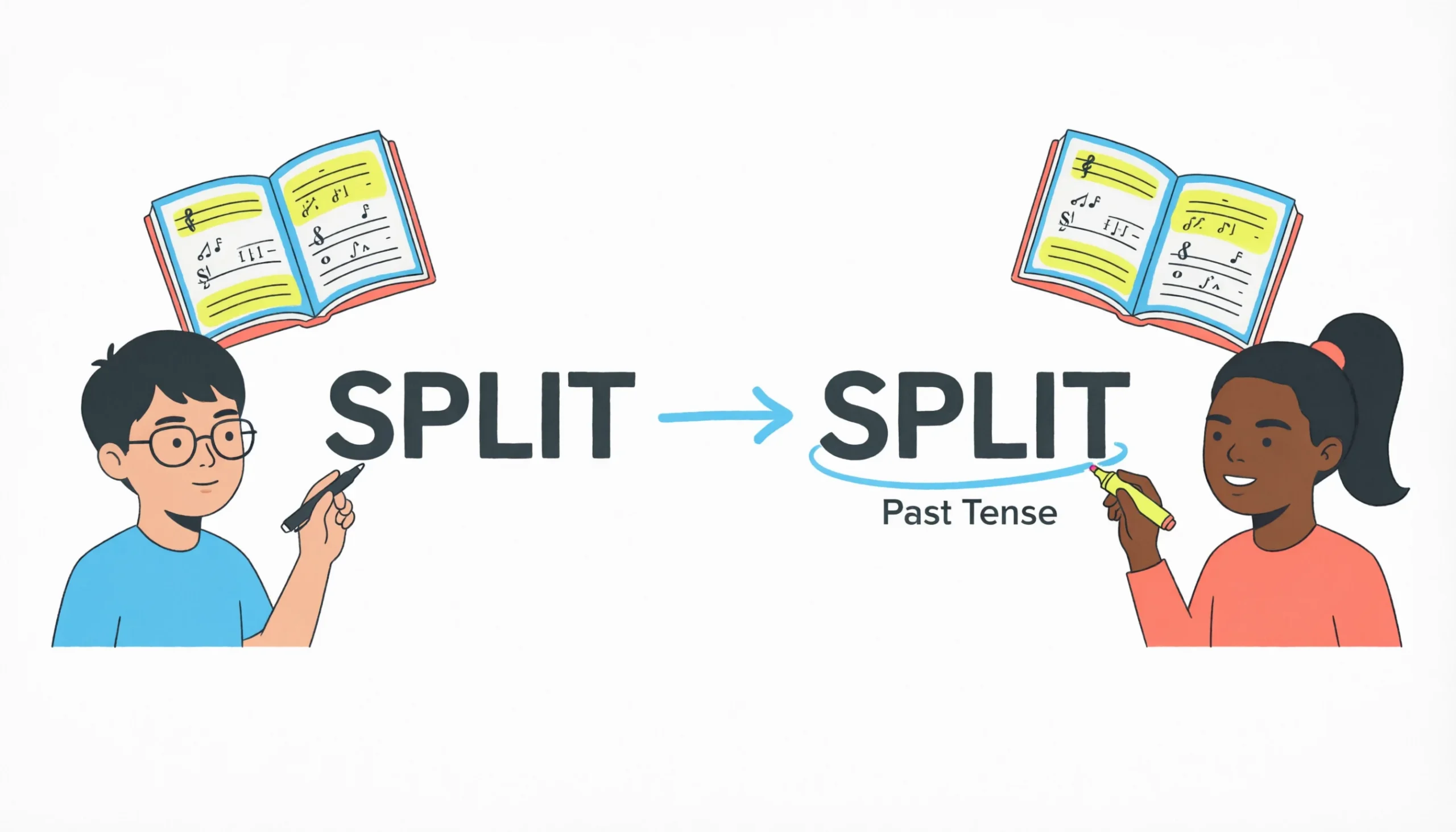
The past tense of “split” is “split.”
It is an irregular verb, so it does not change in the past form.
Verb Forms Table
| Form | Verb |
|---|---|
| Base Form | split |
| Past Simple | split |
| Past Participle | split |
Explanation (Basic → Advanced)
Meaning of “Split”
The word split means:
- To divide something into parts
- To separate or break into pieces
- To leave or separate from a group
Is “Split” Regular or Irregular?
“Split” is an irregular verb, but it is special because:
✔ Base form = split
✔ Past form = split
✔ Past participle = split
So, it stays the same in all forms.
How it is used
You can use “split” in different situations:
- Physical objects (split wood, split rope)
- Groups (split a team)
- Money (split the bill)
- Relationships (they split up)
Forms / Conjugation of “Split”
Verb Conjugation Table
| Tense Type | Form | Example |
|---|---|---|
| Base Form | split | I split the cake. |
| Present Simple | split / splits | She splits the bill. |
| Past Simple | split | They split the money. |
| Past Participle | split | We have split the work. |
| Future | will split | They will split the task. |
Comparison Section
1. Present vs Past
- Present: I split the paper.
- Past: I split the paper yesterday.
👉 Difference: Time changes, but verb stays same.
2. Past vs Present Perfect
- Past: She split the bill.
- Present Perfect: She has split the bill.
👉 Difference: Present perfect connects past with now.
3. Split vs Broke (Meaning Difference)
- Split: divide into parts
- Broke: damage something completely
Examples:
- I split the apple (two pieces).
- I broke the glass (damaged it).
4. Split vs Separate
- Split: usually informal
- Separate: more formal
Examples:
- They split the group.
- They separated the group.
5. Split in Physical vs Social Context
- Physical: I split the wood.
- Social: The team split after argument.
Sentence Structure
1. Simple Sentence
Formula: Subject + split + object
- I split the wood.
- She split the cake.
2. Negative Sentence
Formula: Subject + did not + split + object
- I did not split the bill.
- They did not split the group.
3. Question Sentence
Formula: Did + subject + split + object?
- Did you split the money?
- Did they split the team?
Real Life Usage Examples
Here are 15 daily life examples:
- I split the bill with my friend.
- She split the cake into two pieces.
- They split the group for the project.
- We split the money equally.
- He split the wood for fire.
- The company split into two parts.
- I split my time between work and study.
- They split up after the argument.
- We split the cost of the trip.
- She split the rope by mistake.
- The team split after the match.
- I have split the work already.
- They split the pizza evenly.
- He split the document into sections.
- We split the responsibilities fairly.
Common Mistakes
❌ Wrong vs ✔ Correct
❌ I splited the bill.
✔ I split the bill.
👉 Why? “Split” is irregular and does not become “splited.”
❌ She has splitted the cake.
✔ She has split the cake.
👉 “Split” never adds “ ed.”
❌ They did split the money yesterday (incorrect tone in some cases)
✔ They split the money yesterday.
👉 Use simple past for clear actions.
Key Grammar Rules
- “Split” stays the same in all forms.
- It is an irregular verb.
- Do not add “ ed” or “ ing” incorrectly.
- Use “did” for questions and negatives.
- Use context to understand meaning (physical or social).
Advanced Usage
1. Present Continuous
- I am splitting the bill now.
2. Present Perfect
- We have split the work already.
3. Past Perfect
- They had split the team before the match started.
4. Future Tense
- We will split the cost tomorrow.
Practice Section
Fill in the blanks
- I ___ the cake yesterday.
- They ___ the money equally.
- She has ___ the bill already.
- We ___ the group for the project.
- Did you ___ the wood?
Answers:
- split
- split
- split
- split
- split
MCQs
- What is the past tense of split?
A) splited
B) split
C) splitting
✔ Answer: B - Split is a:
A) Regular verb
B) Irregular verb
✔ Answer: B - Which sentence is correct?
A) I split the cake
B) I splited the cake
✔ Answer: A - Past participle of split is:
A) split
B) splitted
✔ Answer: A - “They ___ the money yesterday.”
A) split
B) splits
✔ Answer: A
Error Correction
- I splited the paper. → I split the paper.
- She has splitted the bill. → She has split the bill.
- They splits the group. → They split the group.
- Did you splitted it? → Did you split it?
- We have splited it already. → We have split it already.
FAQs
1. What is the past tense of split?
It is split.
2. Is split a regular verb?
No, it is an irregular verb.
3. Does split change in past participle?
No, it remains split.
4. Can we say “splitted”?
No, it is incorrect.
5. What does split mean?
It means to divide or separate into parts.
Conclusion
Understanding the past tense of split is very simple once you remember one key rule: it does not change.
The verb stays split in all forms, whether present, past, or past participle. This makes it easier than many other English verbs.
By practicing daily examples, sentence structures, and exercises, you can easily master its usage.
Try using “split” in your daily conversations like splitting bills, splitting tasks, or splitting groups. The more you practice, the more natural it becomes.
Keep learning and practicing English grammar step by step, and you will become more confident in speaking and writing.