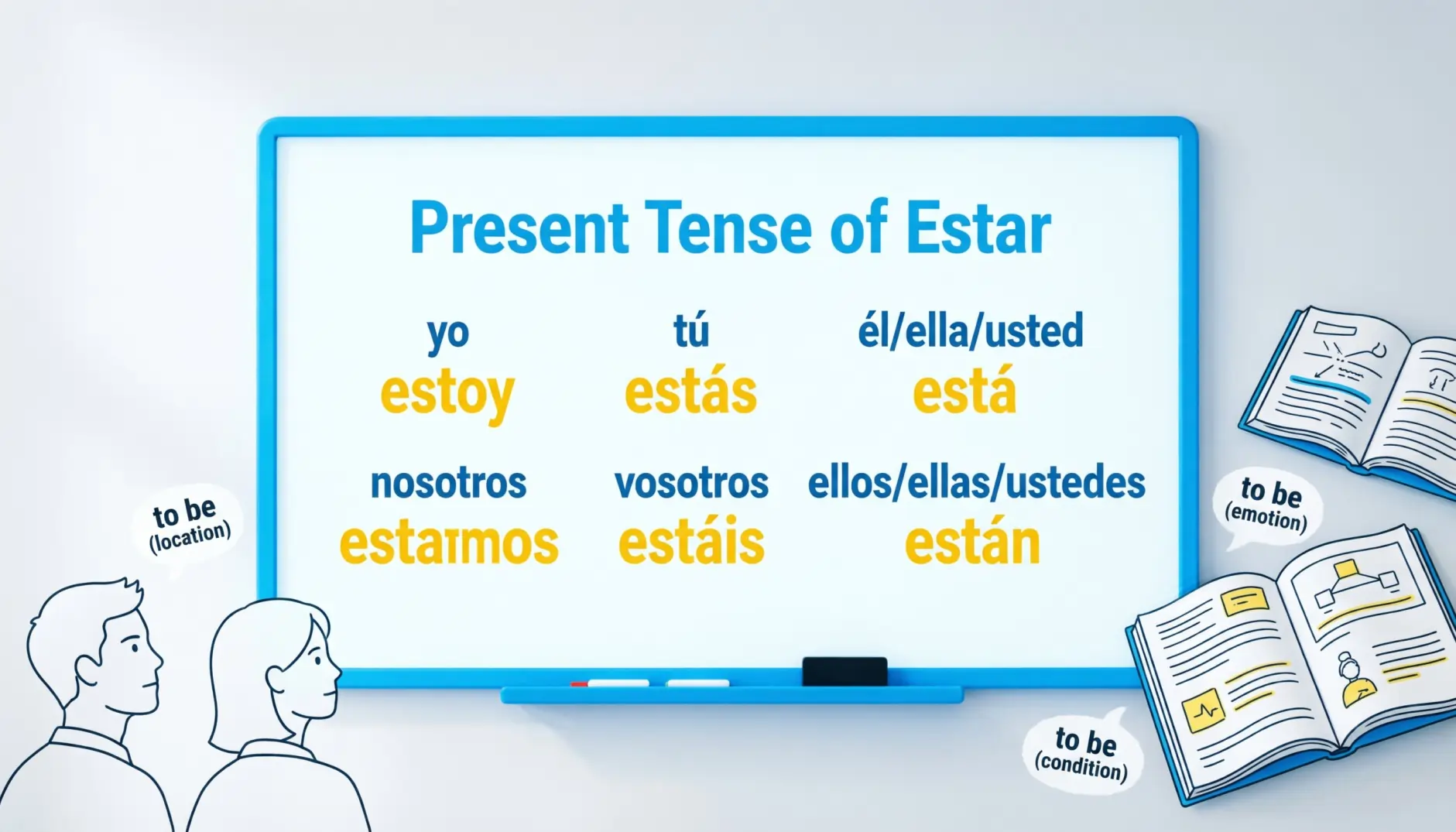
Many English and Spanish learners get confused when they first see the present tense of estar. They often ask: “Why do we need another verb for ‘to be’ in Spanish when English already has ‘am, is, are’?”
This is a very common question. The truth is, the present tense of estar is one of the most important building blocks in Spanish grammar because it helps you talk about feelings, locations, and temporary situations.
If you are learning Spanish, you will notice that using the present tense of estar correctly makes your sentences sound natural and fluent.
But beginners often mix it up with another verb, ser, which creates mistakes in speaking and writing. Don’t worry this guide will make everything simple, clear, and practical.
In this article, you will learn how the present tense of estar works, how to use it in real life, common mistakes, and easy practice exercises. By the end, you will feel more confident using it in daily conversations.
Quick Answer (Featured Snippet)
The present tense of estar is used to describe temporary states, locations, emotions, and conditions in Spanish. It means “to be” in a temporary sense.
| Subject | Present Tense of Estar |
|---|---|
| Yo | estoy |
| Tú | estás |
| Él/Ella/Usted | está |
| Nosotros | estamos |
| Vosotros | estáis |
| Ellos/Ellas/Ustedes | están |
What Is present tense of estar?
The present tense of estar is a Spanish verb form used to express how someone or something is at the present moment. It is part of the verb estar, which means “to be.”
However, unlike the verb ser (another “to be” verb), the present tense of estar is used for temporary conditions.
For example:
- I am happy → Yo estoy feliz
- She is in the school → Ella está en la escuela
Here, happiness and location are temporary, so we use the present tense of estar.
Function in Grammar
The present tense of estar helps you:
- Talk about locations
- Describe emotions
- Express temporary conditions
- Talk about actions happening right now
It is one of the most frequently used verbs in Spanish conversation.
Structure of Sentences of present tense of estar
Understanding sentence structure is the key to mastering the present tense of estar.
1. Positive Sentences
Formula:
Subject + estar (present tense) + complement
Examples:
- I am tired → Yo estoy cansado
- They are at home → Ellos están en casa
2. Negative Sentences
Formula:
Subject + no + estar (present tense) + complement
Examples:
- I am not happy → Yo no estoy feliz
- She is not at school → Ella no está en la escuela
3. Questions
Formula:
¿+ estar (present tense) + subject + complement?
Examples:
- Are you okay? → ¿Estás bien?
- Are they at work? → ¿Están en el trabajo?
Formation of present tense of estar
The present tense of estar is an irregular verb, which means it does not follow a normal pattern like regular verbs.
Instead, it changes completely in each form:
- Yo → estoy
- Tú → estás
- Él/Ella → está
- Nosotros → estamos
- Vosotros → estáis
- Ellos → están
Key Point
You must memorize these forms because they do not follow regular verb rules.
How to Use present tense of estar
The present tense of estar is used in real life situations where things are not permanent.
1. Talking about Location
- The book is on the table → El libro está en la mesa
- We are in the park → Nosotros estamos en el parque
2. Talking about Feelings
- I am sad → Yo estoy triste
- They are excited → Ellos están emocionados
3. Talking about Temporary Conditions
- The food is hot → La comida está caliente
- She is busy → Ella está ocupada
4. Ongoing Actions
- I am studying → Yo estoy estudiando
- They are working → Ellos están trabajando
Conjugation or Structure Table
| Subject | Present Tense of Estar | Example |
|---|---|---|
| Yo | estoy | Yo estoy feliz |
| Tú | estás | Tú estás cansado |
| Él/Ella | está | Ella está en casa |
| Nosotros | estamos | Nosotros estamos listos |
| Vosotros | estáis | Vosotros estáis ocupados |
| Ellos/Ellas | están | Ellos están en la escuela |
Real Life Examples
Here are natural examples using the present tense of estar:
- Yo estoy en casa.
- Ella está feliz hoy.
- Nosotros estamos cansados.
- Tú estás en la escuela.
- Ellos están trabajando ahora.
- El café está caliente.
- Mis amigos están en el parque.
- Yo no estoy listo.
- ¿Estás ocupado?
- Ella está muy triste.
- Nosotros estamos aprendiendo español.
- Ellos no están en casa.
- ¿Dónde estás tú?
- Estoy muy feliz hoy.
- Ustedes están aquí.
Common Mistakes
1. Mixing ser and estar
❌ Yo soy feliz ahora
✔ Yo estoy feliz ahora
2. Wrong form of verb
❌ Yo esta cansado
✔ Yo estoy cansado
3. Forgetting accent marks
❌ El esta en casa
✔ Él está en casa
4. Using estar for permanent facts
❌ La capital está Madrid
✔ La capital es Madrid
Key Grammar Rules
- The present tense of estar is irregular and must be memorized.
- It is used for temporary situations only.
- It often describes emotions and locations.
- It changes depending on the subject (yo, tú, él, etc.).
- It is not used for permanent facts or identity.
- It is commonly used with adjectives.
- It is very important in daily Spanish conversation.
Comparisons with Similar Grammar Forms
Estar vs Ser
| Estar | Ser |
|---|---|
| Temporary states | Permanent identity |
| Emotions, locations | Facts, descriptions |
| Estoy feliz (I am happy now) | Soy feliz (I am a happy person) |
Present Tense of Estar vs English “to be”
- English uses: am, is, are
- Spanish uses: estoy, estás, está, etc.
Example:
- I am tired → Yo estoy cansado
Exercises
Fill in the blanks
- Yo ___ feliz.
- Ella ___ en casa.
- Nosotros ___ cansados.
- Tú ___ ocupado.
- Ellos ___ en la escuela.
Answers: estoy, está, estamos, estás, están
Sentence Correction
- Yo esta feliz → Yo estoy feliz
- Ella es en casa → Ella está en casa
- Nosotros está cansado → Nosotros estamos cansados
- Tú estoy ocupado → Tú estás ocupado
- Ellos esta en la escuela → Ellos están en la escuela
Rewrite Tasks
- I am sad → (Spanish)
- She is at school → (Spanish)
- We are busy → (Spanish)
- They are happy → (Spanish)
- You are tired → (Spanish)
Answers:
- Yo estoy triste
- Ella está en la escuela
- Nosotros estamos ocupados
- Ellos están felices
- Tú estás cansado
MCQs
- What is “I am” in present tense of estar?
A) soy B) estoy C) eres D) estás → B - Estar is used for:
A) permanent facts B) temporary states C) numbers D) names → B - “They are happy” =
A) Ellos son felices B) Ellos están felices → B - “You are in school” =
A) Tú estás en la escuela B) Tú eres en la escuela → A - Which is correct?
A) Yo está B) Yo estoy → B
FAQs
1. What is the present tense of estar?
It is the form of “estar” used to describe temporary states, feelings, and locations.
2. Is estar regular or irregular?
It is an irregular verb.
3. When do we use estar?
We use it for emotions, locations, and temporary conditions.
4. What is the difference between ser and estar?
Ser is for permanent things, estar is for temporary things.
5. Is “yo estoy” correct?
Yes, it means “I am.”
6. Can estar describe feelings?
Yes, like “estoy feliz” (I am happy).
7. Do we use estar for professions?
No, we use ser for professions.
8. Why is estar important?
It is very common in daily Spanish conversations.
9. Is present tense of estar hard?
No, it becomes easy with practice.
10. How can I learn it fast?
By memorizing forms and practicing daily sentences.
Conclusion
The present tense of estar is one of the most important verbs in Spanish grammar. It helps you describe how people feel, where they are, and what they are doing right now.
Although it is irregular, it becomes easy when you practice regularly and understand its basic patterns.
Remember, the key to mastering the present tense of estar is practice, not memorization alone. Try using it in daily sentences, conversations, and exercises.
Over time, it will become natural and automatic for you. Keep learning step by step, and don’t rush. Every small practice brings you closer to fluency in Spanish grammar.
Hi, I’m Robert Lowth, a passionate expert in English tenses and grammar. I specialize in simplifying complex tense rules to help learners understand and use English with confidence. My goal is to make grammar clear, practical, and easy for everyday communication. tenseshub.com