Have you ever gotten confused while writing sentences like “I go,” “I went,” or “I will go”? You are not alone.
Many English learners struggle to choose the correct verb form when talking about past, present, or future actions. This is where a verb tense chart becomes extremely helpful.
A verb tense chart shows how verbs change depending on time. It helps you understand when an action happens and how to express it correctly in speaking and writing.
If you are writing an essay, speaking in class, or sending an email, using the right tense makes your English clear and professional.
In this article, you will learn everything about the verb tense chart in a very simple way. We will break down structures, rules, examples, mistakes, and practice exercises so you can master English tenses step by step.
Quick Answer (Featured Snippet)
A verb tense chart is a table that shows how verbs change according to time past, present, and future. It helps learners understand correct verb forms easily.
| Tense Type | Example Verb (Go) |
|---|---|
| Present | I go / I am going |
| Past | I went / I was going |
| Future | I will go / I will be going |
What Is Verb Tense Chart?
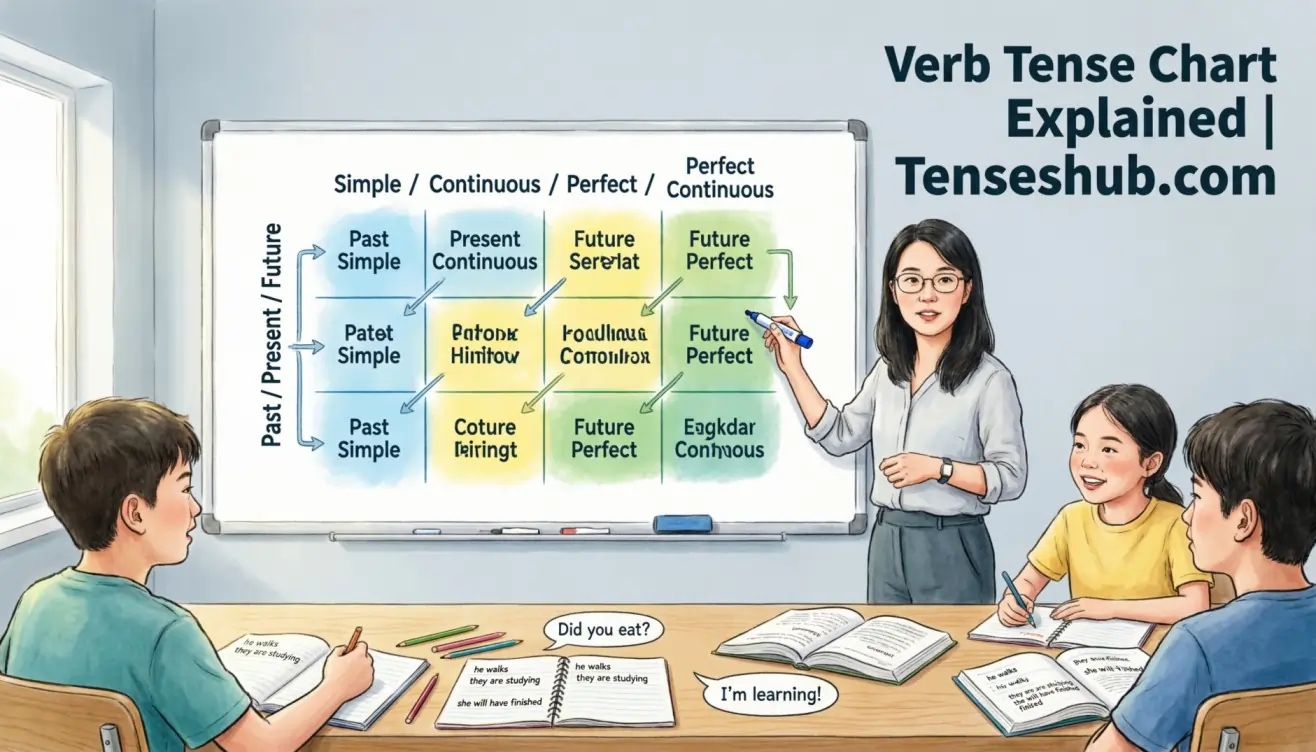
A verb tense chart is a grammar tool that organizes all English tenses in one place. It shows how verbs change based on time and action.
Its main function in English grammar is to help learners:
- Understand time (past, present, future)
- Use correct verb forms
- Build accurate sentences
For example:
- Present: I eat rice.
- Past: I ate rice.
- Future: I will eat rice.
Without a verb tense chart, learners often mix up verb forms. With it, English becomes easier and more structured.
Structure of Sentences of Verb Tense Chart
The verb tense chart helps us understand how sentences are formed in different tenses.
1. Positive Sentences
Subject + Verb + Object
- I play football.
- She eats apples.
2. Negative Sentences
Subject + Do/Does/Did + Not + Verb
- I do not play football.
- She does not eat apples.
3. Question Sentences
Do/Does/Did + Subject + Verb?
- Do you play football?
- Did she eat apples?
The verb tense chart helps you see how these patterns change in past, present, and future tenses.
Formation of Verb Tense Chart
The verb tense chart is formed using different helping verbs and verb changes.
1. Present Tense
- Base verb or “ ing” form
- Example: I play / I am playing
2. Past Tense
- Second form of verb (V2)
- Example: I played / I went
3. Future Tense
- “Will” + base verb
- Example: I will play
Helping Verbs Used:
- Present: am, is, are, do, does
- Past: was, were, did
- Future: will, shall
This structure is the backbone of the verb tense chart.
How to Use Verb Tense Chart
Using a verb tense chart is very simple once you understand the pattern.
Step 1: Identify Time
Ask yourself:
- Is it past?
- Is it present?
- Is it future?
Step 2: Choose Verb Form
Use the chart to select:
- Base form (present)
- Past form (V2)
- Future form (will + verb)
Step 3: Build Sentence
- I go to school (present)
- I went to school (past)
- I will go to school (future)
The verb tense chart helps you avoid mistakes and speak naturally.
Conjugation or Structure Table
| Tense | Structure | Example |
|---|---|---|
| Present Simple | Subject + V1 | I eat rice |
| Present Continuous | Subject + am/is/are + V ing | I am eating rice |
| Past Simple | Subject + V2 | I ate rice |
| Past Continuous | Subject + was/were + V ing | I was eating rice |
| Future Simple | Subject + will + V1 | I will eat rice |
| Present Perfect | Subject + has/have + V3 | I have eaten rice |
Real Life Examples
Here are 15 real life examples using a verb tense chart:
- I wake up early every day.
- She goes to school by bus.
- They are playing cricket now.
- He visited Lahore last year.
- We will travel tomorrow.
- I do not like spicy food.
- Did you call me yesterday?
- She is reading a book.
- They watched a movie last night.
- I will finish my homework.
- He does not work on Sunday.
- Are you coming with us?
- I have completed my task.
- She was cooking dinner.
- We will be waiting for you.
Common Mistakes
1. Wrong: I go to school yesterday
Correct: I went to school yesterday
Past time needs past verb.
2. Wrong: She eat rice now
Correct: She is eating rice now
Use present continuous for now.
3. Wrong: He will goes tomorrow
Correct: He will go tomorrow
After “will,” use base verb.
4. Wrong: They was happy
Correct: They were happy
“They” uses “were.”
5. Wrong: I am go to market
Correct: I am going to market
Use “ ing” form in continuous tense.
Key Grammar Rules
- Use V2 for past tense
- I went home.
- Use “will + verb” for future
- I will study.
- Use helping verbs in continuous tense
- She is running.
- Never add “ s” after “will”
- He will go (not goes)
- “Do/Does/Did” help in questions and negatives
- Do you like tea?
Comparisons with Similar Grammar Forms
Present vs Past
- Present: I eat rice (daily habit)
- Past: I ate rice (completed action)
Present Continuous vs Present Simple
- Simple: I play football (habit)
- Continuous: I am playing football (now)
Future Simple vs Present Continuous (Future meaning)
- Future Simple: I will go tomorrow
- Present Continuous: I am going tomorrow (planned)
The verb tense chart helps you clearly see these differences.
Exercises
Fill in the Blanks
- I ___ (go) to school yesterday.
- She ___ (eat) breakfast now.
- They ___ (visit) us tomorrow.
- He ___ (play) football every day.
- We ___ (watch) a movie last night.
Answers: went, is eating, will visit, plays, watched
Sentence Correction
- He go to market yesterday
- I will goes home
- She eat rice now
- They was happy
- I am go to school
Answers: went, will go, is eating, were, am going
Rewrite Tasks
- I eat rice (past)
- She went to school (future)
- They are playing (simple present)
- He will study (past)
- We watched movie (present)
Answers: I ate rice, She will go to school, They play, He studied, We watch movies
MCQs
- What is past tense of go?
A) goed B) went C) going D) goes
Answer: B - “I will ___”
A) goes B) go C) going D) went
Answer: B - Present continuous uses:
A) was/were B) am/is/are + ing C) will + verb D) V2
Answer: B - She ___ rice now
A) eat B) eats C) is eating D) ate
Answer: C - Future tense marker is:
A) did B) will C) was D) is
Answer: B
FAQs
1. What is a verb tense chart?
It is a table showing verb forms in past, present, and future.
2. Why is it important?
It helps you use correct grammar in speaking and writing.
3. How many tenses are in English?
There are 12 main tenses.
4. Can beginners use it easily?
Yes, it is very beginner friendly.
5. What is V1, V2, V3?
They are base, past, and past participle forms of verbs.
6. Is it useful for exams?
Yes, it helps in grammar tests and writing exams.
7. What is the easiest tense?
Present simple tense is the easiest.
8. How can I learn tenses fast?
Practice using a verb tense chart daily.
Conclusion
The verb tense chart is one of the most powerful tools in English grammar learning. It helps you understand how verbs change according to time and how to build correct sentences without confusion.
Once you learn how to read and use a verb tense chart, your speaking and writing skills improve quickly.
Instead of memorizing rules blindly, use the chart to see patterns. Practice daily with simple sentences, and you will soon notice big improvement in your English.
Remember, grammar is not about difficulty it is about practice and consistency. Keep using examples, exercises, and real life communication to master it step by step

Hi, I’m Noah Bester, a tenses expert passionate about simplifying English grammar. I create practical, easy-to-understand guides to help learners master tenses with confidence. My goal is to make grammar clear, useful, and applicable in everyday communication. tenseshub.com