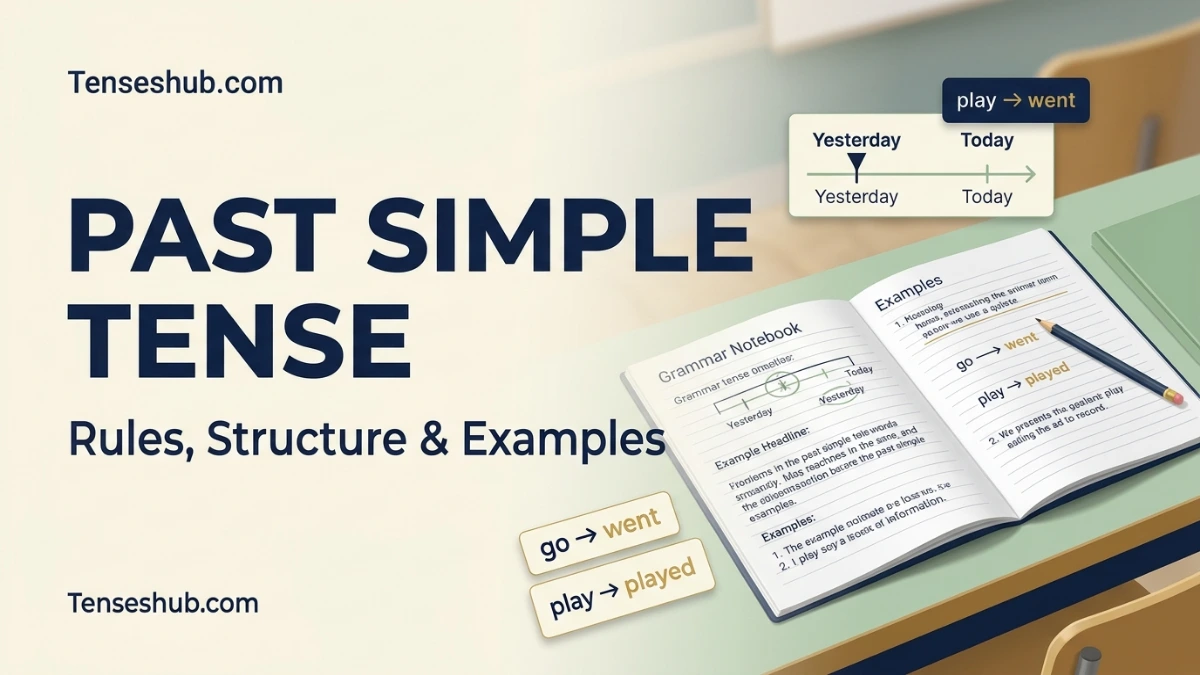
Have you ever tried to describe what you did yesterday but felt confused about which verb form to use? Should you say “I go to school yesterday” or “I went to school yesterday”? The correct sentence is “I went to school yesterday.” This is a simple example of how the past simple tense helps us talk about completed actions.
We use this tense every day when we share our experiences, tell stories, describe past events, discuss school activities, or explain what happened at work. It is one of the most important English grammar topics for beginners because it helps us communicate about things that are no longer happening in the present.
However, learners often make mistakes with irregular verbs, helping verbs such as did, and negative or question forms. The good news is that the rules are easy to understand with clear explanations and regular practice.
In this guide, you will learn the meaning, sentence structure, formation rules, practical uses, and common mistakes associated with this tense. You will also find real life examples, comparisons, exercises, and answers to help you use it confidently in everyday English.
Quick Answer
The past simple tense describes an action or situation that started and finished in the past. It is commonly used with expressions such as yesterday, last week, and two days ago.
| Sentence Type | Example |
|---|---|
| Affirmative | I watched a movie yesterday. |
| Negative | I did not watch a movie yesterday. |
| Question | Did you watch a movie yesterday? |
What Is the Past Simple Tense?
The past simple tense, also called the simple past tense, is used to describe completed actions, past events, and situations that existed at a particular time in the past.
For example:
- I visited my grandmother last Sunday.
- Sarah finished her homework yesterday.
- They played football after school.
- We lived in Lahore five years ago.
- He was tired after the journey.
In each example, the speaker talks about a past action or situation rather than something happening now.
The past simple tense is especially useful when the time of an event is known, understood, or made clear by the context.
Consider these sentences:
- I clean my room every day. A regular habit in the present.
- I cleaned my room yesterday. A completed action in the past.
The verb changes from clean to cleaned to show that the action happened in the past.
Remember that not every past sentence needs a specific time expression. You can say “I met your brother” when the past time is already clear from the conversation.
Structure of Sentences of the Past Simple Tense
The sentence structure depends on if you are making a positive statement, a negative statement, or a question.
1. Affirmative Sentences
An affirmative sentence tells us that an action happened or a situation existed in the past.
Formula:
Subject + past form of the verb (V2) + object or other information
Examples:
- I studied English last night.
- She bought a new bag.
- They visited the museum.
- We watched a documentary.
- He was happy with the result.
For most action verbs, use the past form directly in an affirmative sentence. Do not add did before the main verb.
2. Negative Sentences
A negative sentence tells us that an action did not happen or was not the case.
Formula:
Subject + did not + base form of the verb (V1) + object
Examples:
- I did not attend the meeting.
- She did not buy a new bag.
- They did not visit the museum.
- We did not watch the match.
The main verb stays in its base form after did not.
You can use the contraction didn’t in everyday conversation:
- I didn’t attend the meeting.
- She didn’t call me.
- They didn’t finish their work.
With the verb be, use was not or were not instead of did not.
Examples:
- He was not ready.
- They were not at home.
3. Interrogative Sentences
An interrogative sentence asks a question about a past action or situation.
Formula:
Did + subject + base form of the verb (V1) + object?
Examples:
- Did you finish your homework?
- Did she call her friend?
- Did they arrive on time?
- Did he understand the lesson?
For questions with be, place was or were before the subject.
Examples:
- Was she at school?
- Were they happy?
- Was your teacher absent?
For questions that begin with what, where, when, why, or how, place the question word before the question structure.
Examples:
- Where did you go?
- What did he say?
- Why did they leave early?
- When did the train arrive?
Formation of the Past Simple Tense
The past simple tense is formed differently depending on if the verb is regular, irregular, or the verb be.
1. Regular Verbs
Most regular verbs form the past tense by adding ed to the base verb.
| Base Verb (V1) | Past Form (V2) | Example |
|---|---|---|
| Walk | Walked | I walked home. |
| Clean | Cleaned | She cleaned her desk. |
| Open | Opened | He opened the door. |
| Help | Helped | They helped us. |
| Start | Started | The class started early. |
2. Spelling Rules for Regular Verbs
Some regular verbs require spelling changes before adding ed.
Rule 1: Add d when the verb ends in e.
- Live → Lived
- Love → Loved
- Dance → Danced
Example: We lived near the park.
Rule 2: Change a consonant + y to ied.
- Study → Studied
- Carry → Carried
- Try → Tried
Example: She studied for the exam.
If a verb ends in a vowel + y, simply add ed.
- Play → Played
- Enjoy → Enjoyed
Example: They played outside.
Rule 3: Double the final consonant in certain verbs.
Some short verbs double their final consonant before adding ed.
- Stop → Stopped
- Plan → Planned
- Drop → Dropped
This rule depends on the verb’s spelling and stress pattern. Not every verb ending in a consonant follows it.
Rule 4: Learn exceptions individually.
Some verbs have special spelling patterns. For example, travel can become traveled in American English and travelled in British English.
3. Irregular Verbs
Irregular verbs do not follow the usual ed rule. Their past forms must be learned individually.
| Base Verb (V1) | Past Form (V2) | Example |
|---|---|---|
| Go | Went | We went home. |
| Eat | Ate | I ate breakfast. |
| See | Saw | She saw a bird. |
| Write | Wrote | He wrote a letter. |
| Buy | Bought | They bought some fruit. |
| Come | Came | My friend came early. |
| Take | Took | I took a taxi. |
| Speak | Spoke | She spoke clearly. |
| Make | Made | We made dinner. |
| Have | Had | He had a headache. |
A common mistake is adding ed to an irregular verb. For example, goed is incorrect; the correct past form is went.
4. The Past Forms of Be
The verb be is special because it uses was and were, not did, in ordinary past statements and questions.
| Subject | Past Form of Be | Example |
|---|---|---|
| I | Was | I was busy. |
| He / She / It | Was | She was happy. |
| You | Were | You were right. |
| We | Were | We were ready. |
| They | Were | They were outside. |
Negative forms include was not (wasn’t) and were not (weren’t).
Examples:
- I wasn’t late.
- He wasn’t at work.
- We weren’t hungry.
- Were you tired?
5. Do We Use V1, V2, V3, or ing?
Understanding verb forms makes past tense sentences much easier.
- V1: Base form, such as go, eat, and write.
- V2: Past form, such as went, ate, and wrote.
- V3: Past participle, such as gone, eaten, and written.
- ing form: Such as going, eating, and writing.
In the simple past, affirmative action sentences generally use V2. Negative sentences and questions with did use V1.
Examples:
- She wrote a letter.
- She did not write a letter.
- Did she write a letter?
V3 is used in perfect tenses, while the ing form is used in continuous constructions. Neither is normally used alone as the main verb in an ordinary simple past sentence.
How to Use the Past Simple Tense
The simple past has several important uses in everyday English.
1. To Describe Completed Actions
Use it when an action started and finished in the past.
Examples:
- I washed the dishes after dinner.
- He repaired his bicycle yesterday.
- We completed the project last month.
The actions are presented as completed events.
2. To Talk About Past Habits
Use the simple past to describe habits or repeated activities that happened in an earlier period.
Examples:
- I walked to school every morning.
- My grandfather read the newspaper after breakfast.
- We visited our cousins every summer.
These habits belonged to the past and may no longer continue.
3. To Describe Past States
Use it for feelings, conditions, relationships, and situations that existed in the past.
Examples:
- She was nervous before the interview.
- I knew the answer.
- They lived in a small village.
- He liked drawing when he was a child.
4. To Tell Stories or Describe Events in Sequence
The simple past is common in stories because it helps readers understand what happened first and what followed.
Examples:
- I woke up, took a shower, and prepared breakfast.
- The door opened, and a small dog ran inside.
- She entered the room, greeted everyone, and sat down.
The sequence of past verbs makes the events easy to follow.
5. To Report Past Experiences at a Definite Time
Use the simple past when referring to an experience that happened at a specific or understood past time.
Examples:
- I met the principal yesterday.
- We traveled to Islamabad last summer.
- She called me an hour ago.
Compare “I visited Karachi last year” with “I have visited Karachi.” The first identifies a finished past time; the second uses the present perfect and does not specify a finished time.
6. To Make Polite Requests or Ask Questions
The simple past can sometimes make a question sound less direct or more polite.
Examples:
- Did you want to ask a question?
- I wondered if you could help me.
- Did you need anything else?
These forms can soften the tone, although the intended meaning depends on the situation. The action or request may concern the present rather than a completed past event.
Structure or Verb Pattern Table
Use this compact table to review the main sentence patterns.
| Sentence Type | Pattern | Example |
|---|---|---|
| Affirmative action | Subject + V2 | She wrote a note. |
| Negative action | Subject + didn’t + V1 | She didn’t write a note. |
| Yes/no question | Did + subject + V1? | Did she write a note? |
| WH question | WH word + did + subject + V1? | What did she write? |
| Affirmative with be | Subject + was/were | They were tired. |
| Negative with be | Subject + wasn’t/weren’t | They weren’t tired. |
| Question with be | Was/Were + subject? | Were they tired? |
Real Life Examples of the Past Simple Tense
Here are examples from common situations to help you recognize how the tense works.
Everyday Activities
- I cooked rice for lunch.
- My sister cleaned her bedroom.
- We watched television after dinner.
- He missed the bus this morning.
- They played chess during the break.
School and Education
- The teacher explained the lesson.
- I completed my assignment last night.
- She passed her English test.
- We learned five new words.
- Did you understand the instructions?
Work and Professional Communication
- I sent the report yesterday.
- The manager approved the request.
- We discussed the new schedule.
- I did not receive your email.
- Did you attend the training session?
Travel and Special Events
- We visited the museum on Saturday.
- She traveled to London last year.
- They arrived at the airport early.
- I took several photographs.
- Where did you stay during your trip?
Informal Conversation
- I saw Ali at the market.
- We had a great time.
- Did you watch that movie?
- I didn’t know about the party.
- What did you eat for breakfast?
Formal Communication
- The committee reviewed the proposal.
- The company announced the results on Monday.
- The team completed the assignment before the deadline.
- The applicant did not provide the required document.
These examples show that the same tense works in everyday conversation, academic writing, and professional communication
.
Common Mistakes in the Past Simple Tense
Beginners often understand the meaning of the simple past but make mistakes when building sentences. The following examples explain how to avoid the most common problems.
| Incorrect Sentence | Correct Sentence | Explanation |
|---|---|---|
| I go to school yesterday. | I went to school yesterday. | Use V2 for a completed past action. |
| She didn’t went home. | She didn’t go home. | Use V1 after didn’t. |
| Did you saw him? | Did you see him? | Use V1 after did. |
| He buyed a phone. | He bought a phone. | Buy is irregular. |
| They was tired. | They were tired. | Use were with they. |
| I didn’t was ready. | I wasn’t ready. | Use wasn’t or weren’t with be. |
| Did she studied English? | Did she study English? | The main verb stays in V1 after did. |
| She not called me. | She did not call me. | Add did not for a standard negative action sentence. |
One useful trick is to remember that did already marks the past. Therefore, you do not need to change the main verb to V2 after it.
Key Grammar Rules to Remember
Rule 1: Use V2 in affirmative action sentences
For regular verbs, add the appropriate ed ending. For irregular verbs, learn the correct past form.
- I worked late.
- She went home.
Rule 2: Use V1 after did and didn’t
Do not combine did with a second past tense verb.
- Correct: Did he call you?
- Incorrect: Did he called you?
Rule 3: Use was and were with the verb be
The verb be does not normally take did in simple past statements or questions.
- She was busy.
- They weren’t ready.
- Was he at home?
Rule 4: Use past time expressions naturally
Common expressions include:
- Yesterday
- Last night
- Last week
- Two days ago
- In 2020
- When I was young
Examples:
- We moved here in 2020.
- He called me two days ago.
These expressions are common but not compulsory in every past tense sentence.
Rule 5: Do not use the simple past for every past related meaning
Choose the tense that matches the meaning.
- I finished the report yesterday. (Simple past)
- I have finished the report. (Present perfect)
The first sentence identifies a completed event at a definite past time. The second emphasizes the present relevance of the completed action.
Rule 6: Keep the verb form consistent with the sentence pattern
Compare:
- She wrote a letter.
- She did not write a letter.
- Did she write a letter?
The verb changes to V1 after did or did not.
Comparisons with Similar Grammar Forms
Understanding the difference between related tenses helps you choose the right form when speaking and writing.
Past Simple vs. Present Simple
The present simple describes habits, general truths, and regular activities. The past simple describes completed past actions or earlier situations.
| Present Simple | Past Simple |
|---|---|
| I play football every Sunday. | I played football last Sunday. |
| She works in a bank. | She worked in a bank last year. |
| They live here. | They lived here in 2022. |
Past Simple vs. Present Perfect
The simple past usually refers to a finished past event or a definite past time. The present perfect connects a past event with the present or describes experience without specifying a finished time.
- I lost my keys yesterday. (Past simple)
- I have lost my keys. (Present perfect)
The second sentence often suggests that losing the keys matters now, perhaps because they are still missing.
Avoid using the present perfect with a finished time expression such as yesterday in standard English.
Past Simple vs. Past Continuous
The past continuous describes an action that was in progress at a particular time in the past. The simple past often describes a completed event or an action that interrupted another action.
- I cooked dinner last night. (Past simple)
- I was cooking dinner at 7 p.m. (Past continuous)
- I was cooking dinner when the phone rang. (Both tenses)
In the last example, cooking was in progress when the phone rang.
Past Simple vs. Past Perfect
The past perfect describes an action completed before another past event. The simple past describes the past events themselves.
- When I arrived, the train left. (The train left around the time I arrived; context matters.)
- When I arrived, the train had left. (The train left before I arrived.)
The past perfect is useful when you need to make the order of two past events clear.
Exercises: Practice the Past Simple Tense
Test your understanding with these short exercises. Try answering them before checking the answer key.
Exercise 1: Fill in the Blanks
Complete each sentence using the correct past form of the verb in brackets.
- We ________ (visit) our uncle last weekend.
- She ________ (go) to the library yesterday.
- I ________ (not/watch) the match last night.
- ________ you ________ (finish) your homework?
- They ________ (be) happy with the results.
- He ________ (buy) a new laptop last month.
- My brother ________ (study) for two hours.
- Where ________ she ________ (put) the keys?
Exercise 2: Correct the Sentences
Rewrite each sentence correctly.
- She didn’t went to work.
- Did they watched the movie?
- I buyed a new book yesterday.
- We was late for class.
- He didn’t finished his assignment.
Exercise 3: Rewrite the Sentences
Follow the instruction in parentheses.
- She cleaned the kitchen. (Make it negative.)
- They visited the park. (Make it a yes/no question.)
- He was tired. (Make it negative.)
- You were at home. (Make it a question.)
- I saw a bird. (Make it a WH question asking what you saw.)
Exercise 4: Multiple Choice Questions
Choose the correct answer.
- Yesterday, I ________ a letter.
- A. write
- B. wrote
- C. written
- Did she ________ the door?
- A. opened
- B. open
- C. opens
- They ________ at school yesterday.
- A. was
- B. were
- C. is
- He didn’t ________ breakfast.
- A. ate
- B. eat
- C. eaten
- Which sentence is correct?
- A. Did you saw him?
- B. Did you see him?
- C. Did you seen him?
Answer Key
Exercise 1
- visited
- went
- did not watch / didn’t watch
- Did, finish
- were
- bought
- studied
- did, put
Exercise 2
- She didn’t go to work.
- Did they watch the movie?
- I bought a new book yesterday.
- We were late for class.
- He didn’t finish his assignment.
Exercise 3
- She did not clean the kitchen.
- Did they visit the park?
- He was not tired.
- Were you at home?
- What did you see?
Exercise 4
- B. wrote
- B. open
- B. were
- B. eat
- B. Did you see him?
FAQs
1. What is the past simple tense?
The past simple tense describes completed actions, past events, and situations that existed in the past. For example, “I visited my friend yesterday.”
2. What is the formula for the past simple tense?
For affirmative action sentences, use subject + V2. For negative sentences, use subject + did not + V1. For yes/no questions, use did + subject + V1.
3. What are 10 examples of the past simple tense?
- I walked to school.
- She cooked dinner.
- He bought a phone.
- We visited our cousins.
- They played football.
- I saw a rainbow.
- She wrote a letter.
- He drank some water.
- We watched a film.
- They arrived early.
4. Is the past simple the same as the simple past?
Yes. Past simple and simple past are two names for the same tense.
5. Do we use V1 or V2 after did?
Use V1 after did and didn’t.
- Correct: Did you eat?
- Incorrect: Did you ate?
6. What is the difference between regular and irregular verbs?
Regular verbs generally form the past tense with ed, such as work → worked. Irregular verbs change in different ways, such as go → went and buy → bought.
7. Can we use the past simple without a time word?
Yes. You can say “I met your teacher” when the past time is clear from the conversation or context.
8. How do we make negative sentences in the past simple?
Use did not or didn’t followed by the base verb.
Example: “She didn’t call me.” With be, use wasn’t or weren’t.
9. What is the difference between the past simple and the past continuous?
The past simple often describes a completed event. The past continuous describes an action that was in progress at a past time.
- I read the book yesterday.
- I was reading the book at 8 p.m.
10. What are common past simple time expressions?
Common expressions include yesterday, last night, last week, two days ago, and in 2020. They often help identify when an event happened.
Conclusion
The past simple tense is an essential part of English grammar because it helps you describe completed actions, past habits, earlier situations, and events in stories. Once you understand its basic patterns, you can use it in everyday conversations, school assignments, emails, and professional writing.
Remember the most important rule: use the past form of the verb in affirmative action sentences, but use the base form after did and didn’t. Also, learn the difference between was and were, and practice irregular verbs such as go, see, buy, and write.
Hi, I’m Robert Lowth, a passionate expert in English tenses and grammar. I specialize in simplifying complex tense rules to help learners understand and use English with confidence. My goal is to make grammar clear, practical, and easy for everyday communication. tenseshub.com