Have you ever wanted to explain that you started doing something in the past and are still doing it now? For example, you may want to say, “I have been studying English for two hours.” This sentence tells us when the activity started and how long it has continued.
English learners often confuse this tense with the present perfect tense and the present continuous tense. Although these tenses are related, they do not always express the same meaning. Choosing the correct tense helps you explain ongoing activities, describe how long something has lasted, and talk about recent actions that have visible results.
The present perfect continuous tense is useful in everyday conversations, school assignments, emails, interviews, and professional writing. You can use it to discuss work, learning, exercise, waiting, and many other activities.
In this guide, you will learn the meaning of this tense, its sentence structure, formation rules, and common uses. You will also find practical examples, comparisons with similar tenses, common mistakes, and exercises with answers to help you improve your English grammar step by step.
Quick Answer
The present perfect continuous tense describes an activity that started in the past and is still continuing or has recently stopped, often with a focus on its duration or ongoing process.
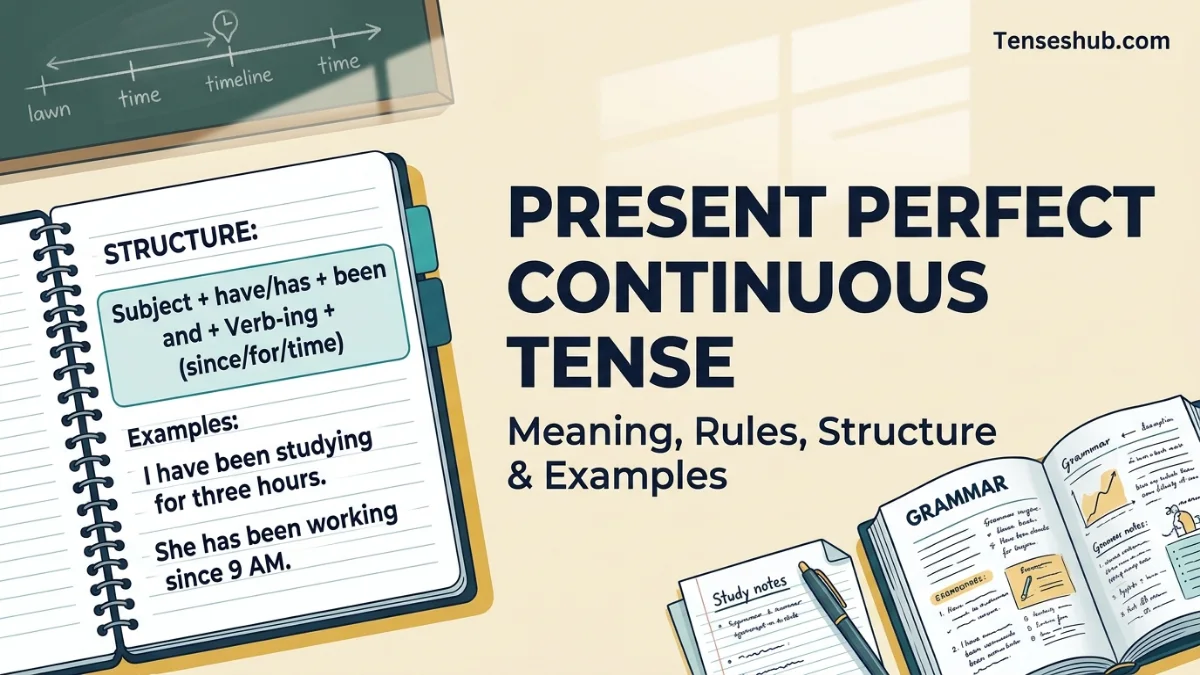
Formula: Subject + has/have + been + verb ing.
| Subject | Helping verb | Example |
|---|---|---|
| I, you, we, they | have been | I have been reading. |
| He, she, it | has been | She has been reading. |
What Is the Present Perfect Continuous Tense?
The present perfect continuous tense is a verb tense that connects an activity in the past with the present. It emphasizes the continuation, duration, or recent activity of an action.
For example:
- I have been learning English for six months.
- She has been working since morning.
- They have been playing football for an hour.
- It has been raining all afternoon.
In these examples, the actions began in the past. Some may still be happening, while others may have just stopped.
This tense is especially useful when you want to answer questions such as:
- How long have you been studying?
- What have you been doing?
- Why are you tired?
- How long has she been working here?
Consider this example:
“I have been cleaning the house for two hours.”
The sentence focuses on the activity of cleaning and how long it has continued. It does not necessarily tell us if the house is completely clean.
What Does This Tense Emphasize?
The present perfect continuous tense usually emphasizes the process or duration of an activity rather than its completion.
For example:
- I have been writing my assignment for three hours.
- He has been repairing the car since noon.
- We have been discussing the project all morning.
These sentences focus on the activities and the time spent doing them.
Structure of Sentences of the Present Perfect Continuous Tense
The sentence structure changes depending on if you are making an affirmative statement, a negative statement, or a question.
1. Affirmative Sentences
Use this structure to say that an activity has been continuing.
Formula: Subject + has/have + been + verb ing + object or other information.
Examples:
- I have been studying English for an hour.
- She has been cooking dinner since 5 p.m.
- They have been playing outside all afternoon.
- We have been waiting for the bus for twenty minutes.
Use has with he, she, and it. Use have with I, you, we, and they.
2. Negative Sentences
Use a negative sentence when an activity has not been happening during a particular period.
Formula: Subject + has/have + not + been + verb ing + object or other information.
Examples:
- I have not been sleeping well lately.
- He has not been attending classes regularly.
- They have not been working on the project.
- We have not been exercising this week.
Common contractions include haven’t been and hasn’t been.
For example:
- I haven’t been feeling well.
- She hasn’t been practicing regularly.
3. Interrogative Sentences
Use questions to ask if an activity has been happening or how long it has continued.
Formula: Has/Have + subject + been + verb ing + other information?
Examples:
- Have you been studying all morning?
- Has she been working here for five years?
- Have they been waiting long?
- Has it been raining since noon?
For questions beginning with words such as how long, why, or what, put the question word before the helping verb.
Examples:
- How long have you been learning English?
- Why has he been shouting?
- What have they been doing?
Formation of the Present Perfect Continuous Tense
To form this tense correctly, you need a helping verb, the word been, and the ing form of the main verb.
1. Use Has or Have
Choose the helping verb according to the subject.
| Subject | Helping verb | Example |
|---|---|---|
| I | have | I have been working. |
| You | have | You have been reading. |
| We | have | We have been studying. |
| They | have | They have been playing. |
| He | has | He has been running. |
| She | has | She has been writing. |
| It | has | It has been raining. |
Remember that has and have depend on the subject, not on the main verb.
2. Add Been
The word been is the past participle of the verb be. It remains the same with every subject in this tense.
Examples:
- I have been waiting.
- She has been waiting.
- They have been waiting.
Do not replace been with being.
Incorrect: She has being working.
Correct: She has been working.
3. Use the ing Form of the Main Verb
The main verb takes its ing form. The following rules explain how to form it.
Most verbs: Add ing.
- Work → working
- Read → reading
- Play → playing
- Talk → talking
Verbs ending in silent e: Usually remove the final e and add ing.
- Make → making
- Write → writing
- Dance → dancing
- Drive → driving
Some short verbs ending in consonant vowel consonant: Double the final consonant before adding ing.
- Run → running
- Sit → sitting
- Swim → swimming
- Stop → stopping
This rule depends on the verb’s spelling and pronunciation. It does not apply to every verb ending in a consonant.
Verbs ending in ie: Change ie to y and add ing.
- Lie → lying
- Die → dying
- Tie → tying
4. Understand Verb Forms
English grammar books often label verb forms as V1, V2, V3, and V ing.
| Verb form | Meaning | Example: write |
|---|---|---|
| V1 | Base form | write |
| V2 | Simple past | wrote |
| V3 | Past participle | written |
| V ing | ing form (present participle) | writing |
For the present perfect continuous tense, you use V ing, not V2 or V3, as the main verb.
Correct: I have been writing.
Incorrect: I have been wrote.
5. Learn Common Contractions
Contractions make everyday English sound more natural.
- I have been → I’ve been
- You have been → You’ve been
- We have been → We’ve been
- They have been → They’ve been
- He has been → He’s been
- She has been → She’s been
- It has been → It’s been
Be careful with contractions such as he’s and she’s. Depending on the sentence, they can mean he has or he is, and the words that follow help you understand the meaning.
For example, “She’s been working” means “She has been working.”
How to Use the Present Perfect Continuous Tense
There are several important situations in which this tense is useful.
1. To Describe an Activity That Started in the Past and Continues Now
Use this tense when an activity began earlier and is still happening.
Examples:
- I have been learning Spanish for three months.
- She has been working at this company since 2022.
- We have been living in this town for a long time.
- He has been studying for his final exams all week.
The activity has a connection to the present because it is still continuing.
2. To Emphasize How Long an Activity Has Continued
This is one of the most common uses of the present perfect continuous tense.
Examples:
- I have been waiting for thirty minutes.
- She has been teaching for ten years.
- They have been practicing for two hours.
- How long have you been working on this assignment?
The tense highlights the time spent doing an activity.
3. To Describe a Recently Stopped Activity
An activity does not have to be happening at the exact moment of speaking. It may have stopped recently, but its effects are still noticeable.
Examples:
- I am tired because I have been running.
- Your clothes are wet. Have you been walking in the rain?
- She has been crying, so her eyes are red.
- The kitchen smells wonderful because Dad has been cooking.
These examples connect recent activities with present results.
4. To Talk About Repeated Activities Over a Period
You can use this tense when an activity has happened repeatedly or regularly over a recent period.
Examples:
- I have been calling the customer all morning.
- She has been practicing the piano every evening.
- They have been asking the same question all week.
- We have been meeting regularly to discuss the plan.
The focus is on the repeated activity over a period, not simply on one completed event.
5. To Explain Temporary Situations
This tense can describe activities or situations that have been happening for a limited period.
Examples:
- I have been staying with my uncle this week.
- He has been working from home recently.
- We have been using a different classroom this month.
- She has been taking extra lessons before her exam.
These examples suggest that the situations may change later.
6. To Use Since and For Correctly
Since identifies the starting point of an activity.
Examples:
- since Monday
- since 8 a.m.
- since last summer
- since I joined the school
Sentences:
- I have been studying since 8 a.m.
- She has been working here since 2021.
- We have been waiting since lunchtime.
For identifies the length of time an activity has continued.
Examples:
- for two hours
- for three days
- for six months
- for a long time
Sentences:
- I have been studying for two hours.
- She has been working here for five years.
- We have been waiting for thirty minutes.
A simple way to remember the difference is that since tells you when an activity started, while for tells you how long it has continued.
Structure or Verb Pattern Table
The following table summarizes the main sentence patterns.
| Sentence type | Structure | Example |
|---|---|---|
| Affirmative | Subject + has/have + been + V ing | She has been reading. |
| Negative | Subject + has/have + not + been + V ing | She has not been reading. |
| Yes/no question | Has/Have + subject + been + V ing? | Has she been reading? |
| Wh question | Question word + has/have + subject + been + V ing? | What has she been reading? |
| Negative question | Hasn’t/Haven’t + subject + been + V ing? | Haven’t you been studying? |
Remember that the main verb uses its ing form in every pattern.
Real Life Examples of the Present Perfect Continuous Tense
These examples show how the tense works in daily conversations, school, work, and formal situations.
Everyday Life
- I have been cleaning my room since morning.
- My brother has been playing video games for two hours.
- We have been watching this series all weekend.
- It has been raining since last night.
- The children have been playing in the garden.
School and Learning
- I have been preparing for my English exam all week.
- She has been reading the same book for three days.
- The students have been practicing their presentations.
- How long have you been learning grammar?
- We have been working on our science project since Monday.
Work and Professional Situations
- I have been working on the report since 9 a.m.
- Our team has been discussing the new proposal.
- She has been managing customer accounts for three years.
- We have been reviewing your application.
- The company has been improving its customer service.
Negative Examples
- I haven’t been sleeping well recently.
- He hasn’t been attending meetings regularly.
- They haven’t been practicing enough.
- We haven’t been using this software for very long.
- She hasn’t been feeling comfortable at work lately.
Questions and Informal Conversation
- Have you been waiting long?
- What have you been doing all afternoon?
- Has your sister been studying for her test?
- Why have you been avoiding my calls?
- Have they been working on the new website?
Formal and Polite Communication
- We have been reviewing the information you provided.
- Our department has been investigating the issue.
- I have been trying to contact you regarding the meeting.
- The team has been evaluating several possible solutions.
- We have been monitoring the situation closely.
These examples show that the tense works in both casual conversation and professional communication.
Common Mistakes in the Present Perfect Continuous Tense
Learners often make mistakes with helping verbs, verb forms, and time expressions. Here are some common errors and their corrections.
Mistake 1: Using the Wrong Helping Verb
She have been working all day.
Correct: She has been working all day.
Explanation: Use has with he, she, and it. Use have with I, you, we, and they.
Mistake 2: Leaving Out Been
Incorrect: I have studying for two hours.
Correct: I have been studying for two hours.
Explanation: The word been is necessary between has/have and the main verb’s ing form.
Mistake 3: Using the Past Form Instead of the ing Form
Incorrect: He has been played football.
Correct: He has been playing football.
Explanation: The main verb must be in its ing form.
Mistake 4: Using Since With a Duration
Incorrect: I have been waiting since three hours.
Correct: I have been waiting for three hours.
Explanation: Use for with a length of time and since with a starting point.
Mistake 5: Using For With a Starting Point
Incorrect: She has been working here for 2021.
Correct: She has been working here since 2021.
Explanation: The year 2021 is the starting point, so use since.
Mistake 6: Confusing Has Been and Have Been
Incorrect: They has been studying.
Correct: They have been studying.
Explanation: The subject they takes have.
Mistake 7: Using This Tense With Every Verb
Incorrect: I have been knowing him for five years.
Correct: I have known him for five years.
Explanation: Verbs that describe states, such as know, believe, own, and understand, are not normally used in continuous forms with these meanings.
Mistake 8: Confusing a Completed Action With an Ongoing Process
Incorrect: I have been finishing my homework. (when you simply mean the homework is complete)
Better: I have finished my homework.
Explanation: Use the present perfect when the important point is that the work is completed. The continuous form is more suitable when emphasizing the activity or its duration.
Key Grammar Rules
Remember these essential rules when using the present perfect continuous tense.
Rule 1: Use Has or Have According to the Subject
- He has been running.
- We have been running.
Rule 2: Always Include Been
The usual pattern is has/have + been + verb ing.
- Correct: She has been cooking.
- Incorrect: She has cooking.
Rule 3: Use the ing Form of the Main Verb
- study → studying
- make → making
- run → running
Do not use V2 or V3 as the main verb in this construction.
Rule 4: Use Since for Starting Points and For for Durations
- I have been reading since noon.
- I have been reading for two hours.
Rule 5: Use the Tense for Activities and Processes
It is useful when you want to emphasize how long an activity has lasted or what someone has been doing.
- She has been painting the wall all morning.
Rule 6: Avoid Continuous Forms of Stative Verbs When They Describe States
Some verbs generally describe a condition rather than an activity.
- Correct: I have known her for years.
- Usually incorrect: I have been knowing her for years.
Rule 7: Do Not Assume Every Action Is Still Happening
The activity may have stopped recently.
- He is sweaty because he has been exercising.
This sentence is correct even if he has stopped exercising.
Comparisons With Similar Grammar Forms
The present perfect continuous tense is easier to understand when you compare it with related tenses.
1. Present Perfect Continuous vs. Present Perfect
The present perfect often emphasizes a result, completion, or experience. The present perfect continuous usually emphasizes an activity or its duration.
| Present perfect | Present perfect continuous | |
|---|---|---|
| Example 1 | I have written five emails. | I have been writing emails for an hour. |
| Example 2 | She has cleaned the kitchen. | She has been cleaning the kitchen all morning. |
| Example 3 | They have completed the project. | They have been working on the project all week. |
The first column focuses on the result or completed work. The second focuses on the activity and the time spent doing it.
Some verbs can be used in both tenses, with a change in emphasis.
- I have read the book. (The book is finished.)
- I have been reading the book. (The activity is emphasized; the book may not be finished.)
2. Present Perfect Continuous vs. Present Continuous
The present continuous describes an activity happening now or around the present time. The present perfect continuous connects an activity that began earlier with the present.
Examples:
- I am studying English now.
- I have been studying English for two hours.
The first sentence focuses on what is happening now. The second emphasizes the activity’s duration.
3. Present Perfect Continuous vs. Past Continuous
The past continuous describes an activity in progress at a particular time in the past. It does not, by itself, connect that activity to the present.
Examples:
- I was studying at 8 p.m. yesterday.
- I have been studying since 8 p.m.
The first sentence describes a past situation. The second connects the starting point to the present and usually suggests the activity continues.
4. Present Perfect Continuous vs. Simple Past
The simple past describes a completed action or event at a past time. The present perfect continuous emphasizes an activity continuing over a period connected to now.
Examples:
- I worked for three hours yesterday.
- I have been working for three hours.
The first sentence refers to a finished period in the past. The second suggests the work has continued for three hours up to the present or has recently stopped.
5. Present Perfect Continuous vs. Future Perfect Continuous
These tenses describe duration from different time perspectives.
- Present perfect continuous: I have been working here for two years.
- Future perfect continuous: By June, I will have been working here for three years.
The present perfect continuous connects the activity to now. The future perfect continuous describes how long it will have continued by a future point.
Exercises on the Present Perfect Continuous Tense
Test your understanding with the exercises below. Try answering them before checking the answer key.
Exercise 1: Fill in the Blanks
Complete each sentence using the present perfect continuous tense of the verb in parentheses.
- I __________ English for two hours. (study)
- She __________ since early morning. (work)
- They __________ for the bus for thirty minutes. (wait)
- He __________ football all afternoon. (play)
- We __________ for our exams this week. (prepare)
- It __________ since midnight. (rain)
- You __________ very hard lately. (work)
- My brother __________ computer programming for six months. (learn)
Exercise 2: Choose the Correct Answer
- She ________ cooking since 5 p.m.
- A. have been
- B. has been
- C. has being
- They have been ________ for an hour.
- A. wait
- B. waited
- C. waiting
- I have been studying ________ Monday.
- A. for
- B. since
- C. during
- He ________ been sleeping well recently.
- A. have
- B. has
- C. having
- How long ________ you been learning English?
- A. have
- B. has
- C. are
- She has been living here ________ five years.
- A. since
- B. for
- C. from
Exercise 3: Correct the Mistakes
Rewrite each sentence correctly.
- He have been working all day.
- I have been study English for a month.
- They has been playing outside.
- She has being learning French.
- We have been waiting since two hours.
- I have been knowing him for years.
Exercise 4: Rewrite the Sentences
Follow the instruction for each sentence.
- Change into a negative sentence: “She has been reading for an hour.”
- Change into a question: “They have been practicing.”
- Add for three days: “I have been feeling tired.”
- Add since Monday: “He has been working here.”
- Make a question using how long: “You have been learning English.”
Answer Key
Exercise 1
- have been studying
- has been working
- have been waiting
- has been playing
- have been preparing
- has been raining
- have been working
- has been learning
Exercise 2
- B. has been
- C. waiting
- B. since
- B. has
- A. have
- B. for
Exercise 3
- He has been working all day.
- I have been studying English for a month.
- They have been playing outside.
- She has been learning French.
- We have been waiting for two hours.
- I have known him for years.
Exercise 4
- She has not been reading for an hour.
- Have they been practicing?
- I have been feeling tired for three days.
- He has been working here since Monday.
- How long have you been learning English?
Frequently Asked Questions (FAQs)
1. What is the present perfect continuous tense?
It is a tense used to describe an activity that started in the past and continues into the present, or an activity that has recently stopped but has a present effect.
Example: I have been studying for two hours.
2. What is the formula for the present perfect continuous tense?
The formula is:
Subject + has/have + been + verb ing.
Example: She has been working all day.
3. When should I use the present perfect continuous tense?
Use it to emphasize the duration or process of an activity that began in the past and continues now, or to explain a recent activity with a present result.
Example: He is tired because he has been running.
4. What is the difference between since and for?
Use since for the starting point and for for the duration.
- Since Monday
- For three days
Example: I have been studying since Monday for three days. (Use this only if Monday was three days ago.)
5. Can I use the present perfect continuous tense for a finished action?
Yes. You can use it when an activity has recently stopped and you want to emphasize the process or its effects.
Example: She has been crying, so her eyes are red.
However, use the present perfect when completion is the main point.
6. Can I use stative verbs in the present perfect continuous tense?
Stative verbs such as know, believe, own, and understand are generally not used in the continuous form when describing states.
Correct: I have known him for ten years.
7. Is the present perfect continuous tense used with how long?
Yes. How long is commonly used to ask about the duration of an activity.
Example: How long have you been waiting?
8. Can I use this tense without since or for?
Yes. You do not always need a time expression.
Examples:
- Why are you tired? Have you been running?
- It has been raining.
- What have you been doing?
9. Is “I have been working” correct English?
Yes. It is a correct present perfect continuous sentence. It usually emphasizes an activity that started earlier and continues now or has recently stopped.
10. What is the difference between “I have worked” and “I have been working”?
“I have worked” often emphasizes the result, experience, or amount of work completed. “I have been working” emphasizes the activity or its duration. The exact difference depends on the context and the verb.
Conclusion
The present perfect continuous tense helps you describe activities that began in the past and continue into the present, as well as recent activities that have visible effects. Its basic formula is subject + has/have + been + verb ing. Once you understand this pattern, you can use the tense to discuss studying, working, waiting, practicing, and many other everyday activities.
Remember to choose has or have according to the subject, use the ing form of the main verb, and distinguish between since and for. Also, compare this tense with the present perfect and present continuous to understand when each form is more suitable.