Learning Spanish can be confusing when one verb has several different forms. The verb ser is a good example. If you want to say “I am a student,” “She is a teacher,” or “We are friends” in Spanish, you need to know how to use ser correctly in the present tense.
The verb ser means “to be” in English. It is one of the most important Spanish verbs because it helps you talk about identity, personality, professions, origin, relationships, and other characteristics. However, ser does not follow the regular conjugation patterns that many Spanish verbs use. Instead, you must learn its six present tense forms.
In this guide, you will learn how to conjugate ser in present tense, when to use each form, and how to build affirmative, negative, and question sentences. You will also discover the difference between ser and estar, two Spanish verbs that both mean “to be” but are used in different situations.
By the end, you will be able to use ser more confidently in everyday Spanish conversations, school assignments, and writing.
Quick Answer: What Is Ser in Present Tense?
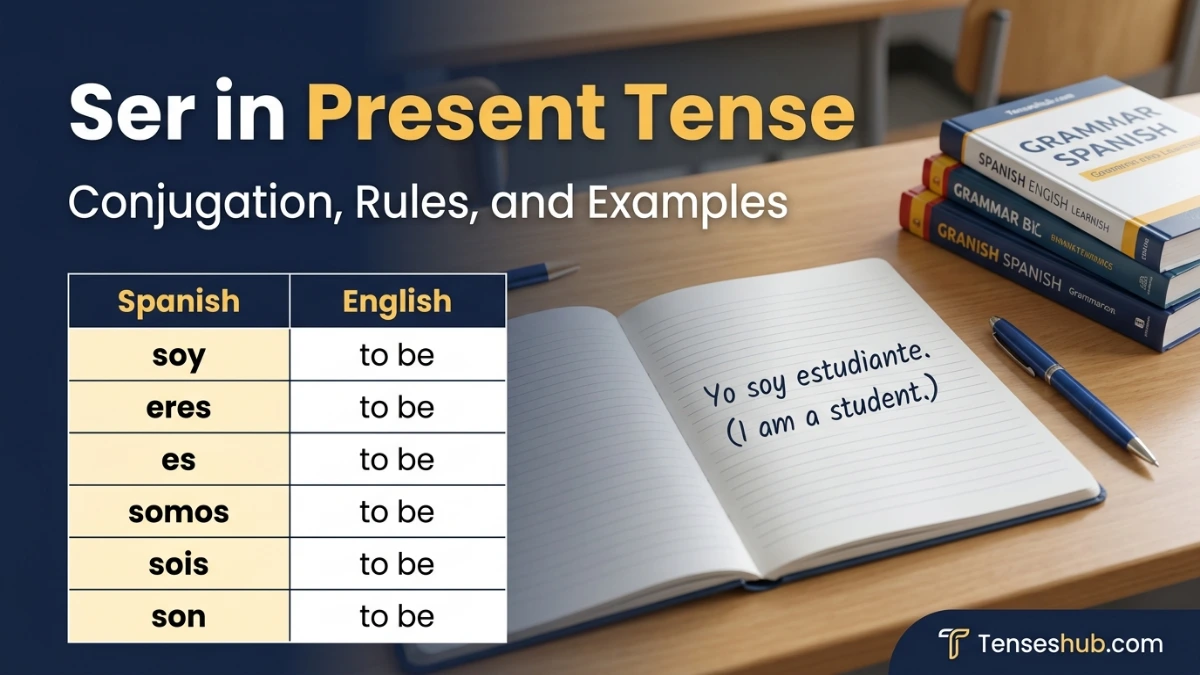
The present tense forms of ser are soy, eres, es, somos, sois, and son. The correct form depends on the subject of the sentence.
| Spanish Subject | Ser Conjugation | English Meaning |
|---|---|---|
| Yo | soy | I am |
| Tú | eres | You are |
| Él / Ella / Usted | es | He / She / You are |
| Nosotros / Nosotras | somos | We are |
| Vosotros / Vosotras | sois | You all are |
| Ellos / Ellas / Ustedes | son | They / You all are |
Example: Yo soy estudiante. means “I am a student.”
What Is Ser in Present Tense?
The present tense of ser is used to describe who someone is, what something is, or where a person or thing comes from. In English, its meaning is usually expressed through the verb “to be.”
For example:
- Yo soy Ana. I am Ana.
- Tú eres amable. You are kind.
- Él es médico. He is a doctor.
- Nosotros somos amigos. We are friends.
- Ellas son españolas. They are Spanish.
Spanish verbs change their forms according to the subject. This process is called conjugation. Instead of using ser with every subject, you select the correct form.
For example, you say yo soy but ella es. Both mean “I am” and “she is,” respectively, but the verb changes to match the subject.
Unlike regular Spanish verbs such as hablar (to speak), ser is irregular. Its present tense forms must be memorized because they do not follow the usual endings for regular verbs.
Structure of Sentences of Ser in Present Tense
Spanish sentence structure is often similar to English. A basic sentence usually places the subject before the conjugated verb, followed by information about the subject.
1. Affirmative sentences
Use this pattern to make a positive statement:
Subject + ser conjugation + complement
Examples:
- Yo soy feliz. I am happy.
- María es profesora. María is a teacher.
- Nosotros somos vecinos. We are neighbors.
Spanish speakers often leave out the subject pronoun when the meaning is clear from the verb.
For example, Soy estudiante means “I am a student.” You do not always need to say yo because soy already identifies the speaker.
2. Negative sentences
To make a sentence negative, place no immediately before the conjugated verb.
Subject + no + ser conjugation + complement
Examples:
- Yo no soy médico. I am not a doctor.
- Ella no es tímida. She is not shy.
- Ellos no son hermanos. They are not siblings.
In Spanish, no comes before the verb, unlike the English structure “am not” or “is not.”
3. Interrogative sentences
To ask a yes or no question, use the same basic word order as a statement and add question marks. Spanish uses an opening question mark (¿) and a closing question mark (?).
¿ + subject + ser conjugation + complement + ?
Examples:
- ¿Tú eres estudiante? Are you a student?
- ¿Ella es tu hermana? Is she your sister?
- ¿Ustedes son de México? Are you all from Mexico?
You can also place the verb before the subject for a natural question:
- ¿Es Ana tu profesora? Is Ana your teacher?
- ¿Son ellos tus amigos? Are they your friends?
Formation of Ser in Present Tense
The verb ser is irregular in the present tense. You cannot create its forms simply by removing the ending and adding the regular present tense endings.
Instead, learn each form with its matching subject.
Present tense conjugation
- Soy is used with yo (I).
- Eres is used with tú (you, informal singular).
- Es is used with él, ella, and usted (he, she, and you, formal singular).
- Somos is used with nosotros and nosotras (we).
- Sois is used with vosotros and vosotras (you all, informal plural in Spain).
- Son is used with ellos, ellas, and ustedes (they and you all).
The infinitive ser does not change to seres or seres when used with these subjects. You must use the correct conjugated form.
Contractions and shortened forms
Spanish does not normally contract ser with subject pronouns in the way English combines “I am” into “I’m.”
For example:
- Yo soy estudiante. I am a student.
- Él es mi amigo. He is my friend.
- Nosotros somos de Colombia. We are from Colombia.
In casual conversation, Spanish speakers often omit subject pronouns, but the verb itself remains correctly conjugated.
Examples:
- Soy de Perú. I am from Peru.
- Es muy inteligente. He, she, or it is very intelligent, depending on context.
- Somos compañeros. We are classmates.
How to Use Ser in Present Tense
The verb ser has several important uses. A helpful way to remember them is to focus on identity and defining information rather than simply asking if something is permanent.
1. Talking about identity
Use ser to identify people or introduce yourself.
Examples:
- Yo soy Daniel. I am Daniel.
- Ella es Laura. She is Laura.
- Somos estudiantes. We are students.
2. Describing personality and characteristics
Use ser for qualities and characteristics that describe a person, place, or thing.
Examples:
- Mi hermano es amable. My brother is kind.
- La casa es grande. The house is big.
- Tus ideas son interesantes. Your ideas are interesting.
Remember that ser is not limited to characteristics that never change. The important point is how the characteristic is presented.
3. Talking about professions
Use ser when stating someone’s profession or occupation. In Spanish, professions generally do not need an indefinite article (un or una) after ser.
Examples:
- Mi madre es doctora. My mother is a doctor.
- Carlos es profesor. Carlos is a teacher.
- Somos ingenieros. We are engineers.
Compare Ella es doctora (“She is a doctor”) with Ella es una doctora excelente (“She is an excellent doctor”). An article can appear when the noun has an added description.
4. Expressing origin and nationality
Use ser to explain where someone is from or their nationality.
Examples:
- Soy de Pakistán. I am from Pakistan.
- Mi amigo es mexicano. My friend is Mexican.
- Ellas son de España. They are from Spain.
Use de to identify the place of origin: ser de Pakistán, ser de Madrid, or ser de Colombia.
5. Describing relationships
Use ser to identify family members, friends, and other relationships.
Examples:
- Ana es mi hermana. Ana is my sister.
- Tú eres mi mejor amigo. You are my best friend.
- Ellos son mis primos. They are my cousins.
6. Giving the date and time
Spanish uses ser to tell the time and state the day or date.
Examples:
- Es la una. It is one o’clock.
- Son las tres. It is three o’clock.
- Hoy es lunes. Today is Monday.
- Mañana es el veinte de octubre. Tomorrow is October twentieth.
Notice that Spanish uses es la una for one o’clock but son las dos for two o’clock and other plural hours.
7. Describing materials and ownership
Use ser to identify what something is made of or who something belongs to.
Examples:
- La mesa es de madera. The table is made of wood.
- El libro es de María. The book belongs to María.
- Los anillos son de oro. The rings are made of gold.
Context helps distinguish material from ownership. Es de María usually means “It belongs to María,” while es de madera means “It is made of wood.”
8. Talking about events
Use ser to identify when or where an event takes place.
Examples:
- La reunión es en la oficina. The meeting is at the office.
- La fiesta es el sábado. The party is on Saturday.
- El concierto es a las ocho. The concert is at eight.
This is an important exception to the simple idea that ser describes identity while estar describes location. For events, ser commonly identifies where something takes place.
Ser in Present Tense: Conjugation and Verb Pattern Table
The following table summarizes the forms you should learn first.
| Subject | Present Form | Example |
|---|---|---|
| Yo | soy | Soy de Lahore. |
| Tú | eres | Eres muy amable. |
| Él / Ella / Usted | es | Ella es mi amiga. |
| Nosotros / Nosotras | somos | Somos estudiantes. |
| Vosotros / Vosotras | sois | Sois muy simpáticos. |
| Ellos / Ellas / Ustedes | son | Son profesores. |
Regional note: Vosotros and sois are commonly used in Spain for informal plural “you.” In most of Latin America, speakers use ustedes with son for both formal and informal plural “you.”
Real Life Examples of Ser in Present Tense
Here are examples from everyday situations to help you see how the verb works naturally.
Everyday affirmative sentences
- Soy estudiante de español. I am a Spanish student.
- Mi padre es conductor. My father is a driver.
- Tú eres muy inteligente. You are very intelligent.
- Somos buenos amigos. We are good friends.
- La clase es interesante. The class is interesting.
Negative sentences
- No soy de España. I am not from Spain.
- Mi hermana no es profesora. My sister is not a teacher.
- No somos vecinos. We are not neighbors.
- Ellos no son mis compañeros. They are not my classmates.
Questions and answers
Question: ¿Eres estudiante?
Answer: Sí, soy estudiante. Yes, I am a student.
Question: ¿Es tu padre médico?
Answer: No, es ingeniero. No, he is an engineer.
Question: ¿Son ustedes de México?
Answer: Sí, somos de México. Yes, we are from Mexico.
Formal and informal examples
Informal:
- Tú eres mi amigo. You are my friend.
- ¿Eres de aquí? Are you from here?
Formal:
- Usted es muy amable. You are very kind.
- ¿Es usted el director? Are you the director?
Both tú and usted mean “you,” but they require different forms of ser: tú eres and usted es.
Common Mistakes When Using Ser
Learners often make mistakes because English uses the same basic verb “to be” where Spanish distinguishes ser and estar. Other errors come from choosing the wrong conjugation.
| Incorrect | Correct | Explanation |
|---|---|---|
| Yo es estudiante. | Yo soy estudiante. | Use soy with yo. |
| Tú soy amable. | Tú eres amable. | Use eres with tú. |
| Ella son doctora. | Ella es doctora. | Use es with ella. |
| Nosotros es amigos. | Nosotros somos amigos. | Use somos with nosotros. |
| Ellos eres altos. | Ellos son altos. | Use son with ellos. |
| Soy en casa. | Estoy en casa. | Use estar for a person’s location. |
| Soy cansado. | Estoy cansado. | Estar usually describes a current state of tiredness. |
| Ella es una doctora. | Ella es doctora. | For a simple profession, the article is usually omitted. |
The last example is a general rule rather than an absolute ban. You can use an article when the profession is further described, such as Es una doctora excelente.
Key Grammar Rules for Ser in Present Tense
Remember these six practical rules as you practise.
Rule 1: Match the verb to the subject
Each subject has a particular form.
- Yo soy.
- Tú eres.
- Ella es.
- Nosotros somos.
- Ellos son.
Rule 2: Memorize the irregular forms
Do not try to conjugate ser like a regular ar, er, or ir verb. Learn all six forms as a group.
Rule 3: Put no before the verb
To say “I am not a teacher,” write No soy profesor or No soy profesora, depending on the speaker.
Rule 4: Use ser for identity and defining descriptions
Examples include Soy Ana, Es alto, and Somos estudiantes.
Rule 5: Use ser with time and dates
Say Son las cinco for “It is five o’clock” and Hoy es martes for “Today is Tuesday.”
Rule 6: Remember regional differences
Use vosotros sois when speaking informally to several people in Spain. In most of Latin America, use ustedes son.
Ser vs. Estar: What Is the Difference?
Both ser and estar mean “to be” in English, but Spanish uses them differently. Choosing between them is one of the most common challenges for beginners.
| Ser | Estar |
|---|---|
| Identity: Soy Ana. | Location: Estoy en casa. |
| Profession: Es médico. | Current condition: Está cansado. |
| Origin: Somos de Perú. | Current emotion: Estoy feliz. |
| Defining description: La casa es grande. | Temporary state: La puerta está abierta. |
A common beginner’s shortcut is that ser describes permanent things and estar describes temporary things. This can help at first, but it is not a complete rule.
For example, está muerto uses estar even though death is not temporary. Likewise, a person can say es joven even though youth changes over time.
Focus on the type of information being expressed. Use ser for identity, origin, profession, characteristics, time, and events. Use estar for location of people and objects, current conditions, and many emotional or physical states.
Compare these sentences:
- María es aburrida. María is boring.
- María está aburrida. María is bored.
The first describes a characteristic; the second describes how María feels at that moment.
Exercises: Practise Ser in Present Tense
Test your understanding with the exercises below. Try answering without looking at the conjugation table first.
Exercise 1: Fill in the blanks
Complete each sentence with the correct present tense form of ser.
- Yo _____ de Pakistán.
- Tú _____ mi mejor amigo.
- Mi hermana _____ profesora.
- Nosotros _____ estudiantes.
- Ellos _____ muy simpáticos.
- Usted _____ muy amable.
Exercise 2: Correct the sentences
Rewrite each sentence correctly.
- Yo eres estudiante.
- Ella son mi amiga.
- Nosotros es de Colombia.
- Tú soy muy inteligente.
- Ellos es profesores.
Exercise 3: Choose the correct answer
- Which sentence is correct?
A. Yo es Ana.
B. Yo soy Ana.
C. Yo son Ana. - Which form goes with nosotros?
A. Somos
B. Eres
C. Son - Which sentence means “She is a doctor”?
A. Ella son doctora.
B. Ella eres doctora.
C. Ella es doctora. - Which verb is normally used to say “I am at home”?
A. Soy
B. Estoy
C. Eres
Exercise 4: Translate into Spanish
- I am a student.
- We are good friends.
- She is from Mexico.
- They are not teachers.
- Are you (informal singular) happy?
Answer key
Exercise 1
- soy
- eres
- es
- somos
- son
- es
Exercise 2
- Yo soy estudiante.
- Ella es mi amiga.
- Nosotros somos de Colombia.
- Tú eres muy inteligente.
- Ellos son profesores.
Exercise 3
- B Yo soy Ana.
- A Somos.
- C Ella es doctora.
- B Estoy.
Exercise 4
- Soy estudiante.
- Somos buenos amigos.
- Ella es de México.
- Ellos no son profesores.
- ¿Estás feliz?
Note that estás is used in the last answer because it asks about a current feeling. If you want to describe someone’s general personality as happy or cheerful, eres feliz may be appropriate in a different context.
FAQs
1. What are the six forms of ser in present tense?
The six forms are soy, eres, es, somos, sois, and son. Each form matches a particular subject or group of subjects.
2. What does ser mean in English?
Ser means “to be.” It is used to express identity, origin, profession, relationships, characteristics, time, and other defining information.
3. Is ser a regular or irregular verb?
Ser is an irregular Spanish verb. Its present tense forms do not follow the regular conjugation patterns, so you need to memorize them.
4. What is the difference between soy and estoy?
Both can translate as “I am,” but they are used in different contexts. Soy is a form of ser and often describes identity or characteristics. Estoy is a form of estar and commonly describes location, current conditions, and feelings.
Examples: Soy estudiante means “I am a student.” Estoy cansado means “I am tired.”
5. When should I use es instead of son?
Use es with él, ella, and usted, as well as singular nouns. Use son with ellos, ellas, and ustedes, as well as plural nouns.
Examples: Ella es amable and Ellos son amables.
6. Can I leave out subject pronouns in Spanish?
Yes. Spanish often omits subject pronouns because the conjugated verb makes the subject clear. For example, Soy profesor means “I am a teacher” without needing to say yo.
7. Is vosotros sois used in Latin America?
Generally, no. Vosotros sois is commonly used for informal plural “you” in Spain. Most Latin American speakers use ustedes son for plural “you,” if the situation is formal or informal.
8. How do I make a negative sentence with ser?
Place no directly before the conjugated verb.
Example: Ella no es doctora means “She is not a doctor.”
9. How do I ask a question using ser?
Use Spanish question marks and the correct conjugation. For example, ¿Eres estudiante? means “Are you a student?” You can also use a verb first order, as in ¿Es Ana tu hermana?
10. How can I memorize ser conjugations quickly?
Practise the forms in subject groups: yo soy, tú eres, él/ella/usted es, nosotros somos, vosotros sois, and ellos/ellas/ustedes son. Then write short sentences about yourself, family, friends, and daily life.
Conclusion
Learning ser in present tense is an important step toward speaking and writing Spanish with confidence. The six formssoy, eres, es, somos, sois, and sonhelp you talk about identity, professions, origin, relationships, characteristics, dates, and time. Since ser is irregular, practising its forms regularly is the best way to remember them.
Pay close attention to the subject of each sentence so you can choose the correct conjugation. Also, learn the difference between ser and estar. Although both mean “to be,” they serve different purposes in Spanish. For example, soy estudiante describes your role, while estoy cansado describes how you feel.