Have you ever wanted to say “I follow,” “She follows,” or “We continue” in Spanish but felt confused about which verb form to use? If so, learning the verb seguir will help you speak Spanish more naturally. This verb is common in everyday conversations because it describes following someone, continuing an activity, or keeping something going.
The Spanish verb seguir means “to follow” or “to continue.” However, its present tense forms do not follow the regular pattern for verbs ending in ir. The most important change happens in the first person singular form: yo sigo, which means “I follow” or “I continue.” Other forms also change their spelling, so it is helpful to learn the complete conjugation table.
In this guide, you will learn the seguir conjugation in present tense, including its forms, sentence patterns, practical uses, common mistakes, and real life examples. You will also practice using seguir in affirmative, negative, and question forms so you can build confidence when speaking and writing in Spanish.
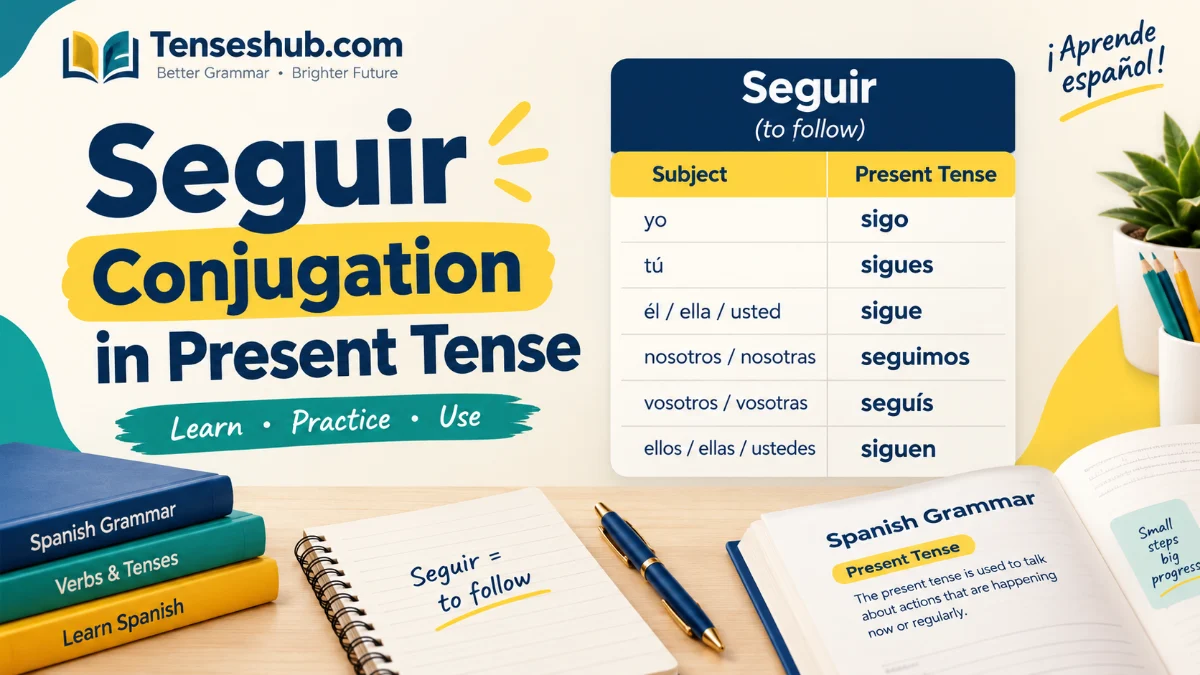
Quick Answer: What Is Seguir in the Present Tense?
The present tense conjugation of seguir is used to talk about following someone, continuing an activity, or describing something that is still happening.
| Subject | Present form | English |
|---|---|---|
| Yo | sigo | I follow / continue |
| Tú | sigues | You follow / continue |
| Él / Ella / Usted | sigue | He / she / you (formal) follow(s) / continue(s) |
| Nosotros / Nosotras | seguimos | We follow / continue |
| Vosotros / Vosotras | seguís | You all follow / continue (Spain) |
| Ellos / Ellas / Ustedes | siguen | They / you all follow / continue |
Remember the key irregular form: yo sigo, not yo seguo. The other important forms include sigues, sigue, and siguen.
What Is Seguir Conjugation in the Present Tense?
Seguir is a Spanish verb that belongs to the ir verb group. It usually means “to follow,” but it can also mean “to continue,” “to keep doing something,” or “to remain in a particular state.”
Conjugation means changing a verb’s form to match its subject. In Spanish, the form of seguir changes depending on if the subject is yo, tú, él, nosotros, or another pronoun.
For example:
- Yo sigo a mi profesor. I follow my teacher.
- Tú sigues estudiando. You keep studying.
- Ella sigue las instrucciones. She follows the instructions.
- Nosotros seguimos trabajando. We continue working.
- Ellos siguen aquí. They are still here.
These sentences show that seguir has several useful meanings. Its exact English translation depends on the context.
Unlike regular ir verbs such as vivir (to live), seguir has an irregular stem change in several present tense forms. Learning its conjugation table will help you recognize and use these forms correctly.
Structure of Sentences Using Seguir in the Present Tense
The present tense forms of seguir can be used in affirmative sentences, negative sentences, and questions. The sentence pattern is straightforward once you know the correct verb form.
1. Affirmative sentences
Use the subject followed by the correct form of seguir and the rest of the sentence.
Formula: Subject + seguir (present tense) + complement
Examples:
- Yo sigo la ruta. I follow the route.
- Ella sigue las reglas. She follows the rules.
- Nosotros seguimos el plan. We follow the plan.
In Spanish, you can often omit the subject pronoun because the verb ending identifies the subject.
- Sigo la ruta. I follow the route.
- Seguimos el plan. We follow the plan.
2. Negative sentences
Place no immediately before the conjugated verb.
Formula: Subject + no + seguir (present tense) + complement
Examples:
- Yo no sigo esa cuenta. I do not follow that account.
- Él no sigue las instrucciones. He does not follow the instructions.
- Nosotros no seguimos esa ruta. We do not follow that route.
3. Interrogative sentences
For a basic yes or no question, Spanish often uses the same word order as a statement, with question marks around the sentence and an appropriate questioning intonation.
Formula: ¿ + Subject + seguir (present tense) + complement + ?
Examples:
- ¿Sigues esta página? Do you follow this page?
- ¿Sigue ella trabajando? Is she still working?
- ¿Siguen ustedes aquí? Are you all still here?
Spanish uses an opening question mark (¿) as well as a closing one (?).
Formation of Seguir in the Present Tense
The verb seguir is irregular in the present tense. To understand how it changes, it helps to compare it with a regular ir verb.
A regular verb such as vivir follows this pattern:
- Yo vivo
- Tú vives
- Él vive
- Nosotros vivimos
- Vosotros vivís
- Ellos viven
However, seguir has two important changes: a spelling change in the first person singular and a stem change from e to i in several forms.
1. The yo form changes to sigo
The infinitive seguir has the stem segu when the ending is removed. However, its first person singular form is sigo.
- Correct: Yo sigo aprendiendo español.
- Incorrect: Yo seguo aprendiendo español.
The spelling changes from gu to g in this form.
2. The stem changes from e to i
In the forms tú, él/ella/usted, and ellos/ellas/ustedes, the stem vowel changes from e to i.
- Tú: sigues
- Él/Ella/Usted: sigue
- Ellos/Ellas/Ustedes: siguen
This is sometimes called an e → i stem changing verb pattern.
3. Nosotros and vosotros keep the e
The nosotros and vosotros forms do not have the stem change.
- Nosotros seguimos
- Vosotros seguís
Notice that both forms retain the letter e in the stem.
4. Seguir + gerund
When seguir means “to keep doing something” or “to continue doing something,” it is often followed by a gerund, which is the Spanish ando or iendo form.
Examples:
- Sigo estudiando. I keep studying.
- Sigue hablando. they keeps talking.
- Seguimos aprendiendo. We keep learning.
For seguir, the gerund is siguiendo, not seguendo.
How to Use Seguir in the Present Tense
The present tense verb seguir has several common uses. Understanding the meaning of each sentence will help you choose the right English translation.
1. To follow a person or account
Use seguir when talking about following someone physically, following a person online, or keeping up with someone’s updates.
Examples:
- Sigo a mi hermano. I follow my brother.
- Ella sigue a muchos profesores en Instagram. She follows many teachers on Instagram.
- ¿Sigues este canal? Do you follow this channel?
When seguir refers to following a person, Spanish commonly uses the personal a: Sigo a María.
2. To follow directions or instructions
Use seguir when someone follows a plan, a route, a rule, or instructions.
Examples:
- Sigo las instrucciones del profesor. I follow the teacher’s instructions.
- Debes seguir las reglas. You must follow the rules.
- Seguimos el mapa para llegar al hotel. We follow the map to reach the hotel.
This use is common in schools, workplaces, travel, and daily conversations.
3. To continue doing something
One of the most useful patterns is seguir + gerund. It describes an action that continues.
Examples:
- Sigo trabajando. I am still working.
- Mi hermana sigue estudiando. My sister continues studying.
- Seguimos esperando el autobús. We are still waiting for the bus.
In these examples, seguir is conjugated, while the gerund remains unchanged.
4. To say that someone or something is still in a state
Seguir can also describe a situation that has not changed.
Examples:
- Sigo cansado. I am still tired. (Speaker is masculine.)
- Ella sigue enferma. She is still sick.
- El restaurante sigue cerrado. The restaurant is still closed.
Here, seguir is followed by an adjective rather than a gerund.
5. To ask if an action is continuing
Use seguir in questions to find out if someone is still doing something or if a situation remains the same.
Examples:
- ¿Sigues viviendo en Madrid? Do you still live in Madrid?
- ¿Sigue lloviendo? Is it still raining?
- ¿Siguen abiertos los bancos? Are the banks still open?
These questions are useful in everyday conversations because they ask about an ongoing activity or situation.
Seguir Present Tense Conjugation Table
Use this compact table to review all six present tense forms.
| Subject pronoun | Conjugation | Example |
|---|---|---|
| Yo | sigo | Sigo la ruta. (I follow the route.) |
| Tú | sigues | Sigues estudiando. (You keep studying.) |
| Él / Ella / Usted | sigue | Sigue las reglas. (They follows the rules.) |
| Nosotros / Nosotras | seguimos | Seguimos adelante. (We keep going.) |
| Vosotros / Vosotras | seguís | Seguís el camino. (You all follow the path.) |
| Ellos / Ellas / Ustedes | siguen | Siguen trabajando. (They keep working.) |
Study tip: Memorize sigo, sigues, sigue, seguimos, seguís, siguen in order. Pay special attention to the forms that contain i and the two forms that retain e: seguimos and seguís.
Real Life Examples of Seguir in the Present Tense
The following examples show how the verb works in different situations.
Affirmative examples
- Yo sigo a mi cantante favorito. I follow my favorite singer.
- Tú sigues una dieta saludable. You follow a healthy diet.
- Mi padre sigue trabajando en esa empresa. My father continues working at that company.
- Nosotros seguimos el mismo horario. We follow the same schedule.
- Los estudiantes siguen las instrucciones. The students follow the instructions.
- La tienda sigue abierta. The store is still open.
Negative examples
- No sigo a ese influencer. I do not follow that influencer.
- Tú no sigues el plan. You do not follow the plan.
- Ella no sigue estudiando francés. She is no longer continuing to study French.
- No seguimos esa carretera. We do not follow that road.
In example 9, the negative form means that she does not continue studying French. Depending on context, a more natural English translation may be “She is not still studying French.”
Question examples
- ¿Sigues trabajando aquí? Do you still work here?
- ¿Sigue tu hermano en la escuela? Is your brother still at school?
- ¿Seguimos por este camino? Do we continue along this road?
- ¿Siguen ustedes las noticias? Do you all follow the news?
Formal and informal examples
- Informal: ¿Sigues esta cuenta? Do you follow this account?
- Formal: ¿Sigue usted las instrucciones? Do you follow the instructions?
- Informal: Sigue practicando y mejorarás. Keep practicing, and you will improve.
- Formal: Por favor, siga las indicaciones. Please follow the directions.
The last two examples illustrate an important distinction: sigue can be an informal command, while siga is the formal command form. These are commands, not ordinary present tense statements.
Common Mistakes When Conjugating Seguir
Learners often confuse seguir with regular ir verbs. Here are the most important mistakes to avoid.
Mistake 1: Using seguo instead of sigo
Incorrect: Yo seguo a mi profesor.
Correct: Yo sigo a mi profesor.
Explanation: The yo form is irregular. Memorize sigo rather than trying to apply the regular stem pattern.
Mistake 2: Forgetting the stem change
Incorrect: Tú segues las reglas.
Correct: Tú sigues las reglas.
Explanation: The vowel changes from e to i in sigues, sigue, and siguen.
Mistake 3: Changing nosotros to sigimos
Incorrect: Nosotros sigimos estudiando.
Correct: Nosotros seguimos estudiando.
Explanation: The nosotros form retains the e. It does not follow the stem change.
Mistake 4: Using the wrong gerund
Incorrect: Sigo seguendo las instrucciones.
Correct: Sigo siguiendo las instrucciones.
Explanation: The gerund of seguir is siguiendo.
Mistake 5: Forgetting no in negative sentences
Incorrect: Yo sigo esa cuenta. (when you mean you do not follow it)
Correct: Yo no sigo esa cuenta.
Explanation: Place no before the conjugated verb to make a negative sentence.
Mistake 6: Confusing seguir with ser
Incorrect: Yo soy trabajando.
Correct: Yo sigo trabajando. I keep working.
Explanation: Ser means “to be,” while seguir can mean “to continue.” If you want to express an ongoing action with this pattern, use seguir + gerund.
Key Grammar Rules for Seguir
Remember these essential rules when using seguir in the present tense.
1. Use sigo with yo. The first person singular form is irregular. Example: Yo sigo las instrucciones.
2. Remember the e → i stem change. Use sigues, sigue, and siguen. Example: Ella sigue el plan.
3. Keep the e in nosotros and vosotros. The correct forms are seguimos and seguís.
4. Use seguir + gerund for continuing an action. Example: Seguimos aprendiendo español.
5. Use seguir + adjective for an unchanged state. Example: El niño sigue contento. The boy is still happy.
6. Put no before the verb in negative statements. Example: No sigo esa cuenta.
7. Use the correct subject form. For example, usted sigue and ustedes siguen. In much of Latin America, ustedes is used for plural “you.”
Seguir vs. Similar Spanish Verbs
Several Spanish verbs have meanings similar to seguir, but they are not always interchangeable.
| Verb | Main meaning | Example |
|---|---|---|
| seguir | to follow, to continue | Sigo estudiando. (I keep studying.) |
| continuar | to continue | Continúo estudiando. (I continue studying.) |
| perseguir | to chase, to pursue | El perro persigue al gato. (The dog chases the cat.) |
| proseguir | to proceed, to carry on | El juez prosigue con el caso. (The judge proceeds with the case.) |
| mantener | to maintain, to keep | Mantengo la puerta abierta. (I keep the door open.) |
Seguir vs. continuar
Both verbs can mean “to continue.” However, seguir + gerund is especially common when describing an action that continues.
- Sigo trabajando. I keep working.
- Continúo trabajando. I continue working.
Both sentences are correct.
Seguir vs. perseguir
Seguir can mean to follow someone, while perseguir usually means to chase or pursue someone or something.
- Sigo al profesor por el pasillo. I follow the teacher down the hallway.
- El perro persigue la pelota. The dog chases the ball.
The second sentence describes chasing, not simply following.
Seguir vs. quedarse
When you want to say that someone stays in a place, quedarse may be more suitable than seguir.
- Me quedo en casa. I stay at home.
- Sigo en casa. I am still at home.
The first emphasizes staying; the second emphasizes that the situation continues.
Exercises: Practice Seguir in the Present Tense
Test your knowledge with these beginner friendly exercises. Try to answer them before checking the answer key.
Exercise 1: Fill in the blanks
Complete each sentence with the correct present tense form of seguir.
- Yo ______ las instrucciones.
- Tú ______ aprendiendo español.
- Ella ______ trabajando hoy.
- Nosotros ______ el mapa.
- Vosotros ______ la misma ruta.
- Ellos ______ estudiando para el examen.
Exercise 2: Choose the correct answer
1. Which form is correct for yo?
a) Seguo
b) Sigo
c) Segues
2. Which sentence means “We continue studying”?
a) Nosotros sigimos estudiando.
b) Nosotros seguimos estudiando.
c) Nosotros siguen estudiando.
3. What is the gerund of seguir?
a) Seguiendo
b) Siguiendo
c) Seguido
4. Which sentence means “She is still here”?
a) Ella sigue aquí.
b) Ella sigo aquí.
c) Ella siguen aquí.
Exercise 3: Correct the mistakes
Rewrite each sentence correctly.
- Yo seguo a mi profesor.
- Tú segues las reglas.
- Nosotros sigimos trabajando.
- Ellos sigue estudiando.
- Sigo seguendo el mapa.
Exercise 4: Rewrite the sentences
Follow the instructions in each question.
- Make this sentence negative: Yo sigo esa cuenta.
- Change the subject from yo to ella: Yo sigo trabajando.
- Turn this statement into a question: Tú sigues estudiando.
- Translate into Spanish: “They continue working.”
- Translate into Spanish: “We follow the instructions.”
Answer Key
Exercise 1
- sigo
- sigues
- sigue
- seguimos
- seguís
- siguen
Exercise 2
- b) Sigo
- b) Nosotros seguimos estudiando.
- b) Siguiendo
- a) Ella sigue aquí.
Exercise 3
- Yo sigo a mi profesor.
- Tú sigues las reglas.
- Nosotros seguimos trabajando.
- Ellos siguen estudiando.
- Sigo siguiendo el mapa.
Exercise 4
- Yo no sigo esa cuenta.
- Ella sigue trabajando.
- ¿Tú sigues estudiando?
- Ellos siguen trabajando.
- Nosotros seguimos las instrucciones.
FAQs
1. What is the present tense conjugation of seguir?
The forms are sigo, sigues, sigue, seguimos, seguís, and siguen. They correspond to yo, tú, él/ella/usted, nosotros/as, vosotros/as, and ellos/ellas/ustedes.
2. Is seguir an irregular verb?
Yes. Seguir is irregular in the present tense. The yo form is sigo, and several other forms have an e → i stem change.
3. What does seguir mean in English?
It commonly means “to follow” or “to continue.” It can also mean “to keep doing something” or “to still be” in a particular state, depending on the sentence.
4. What is the yo form of seguir?
The yo form is sigo, meaning “I follow” or “I continue.” The form seguo is incorrect.
5. Why is it sigo instead of seguo?
The first person singular form has an irregular spelling change. Instead of seguo, Spanish uses sigo.
6. What is the gerund of seguir?
The gerund is siguiendo. It is used with a conjugated form of seguir to express continuing an activity, as in Sigo aprendiendo (“I keep learning”).
7. What is the difference between sigue and siguen?
Sigue is used with él, ella, and usted. Siguen is used with ellos, ellas, and ustedes.
- Ella sigue trabajando. She continues working.
- Ellos siguen trabajando. They continue working.
8. How do you say “I am still learning” in Spanish?
You can say Sigo aprendiendo. This expression means “I am still learning” or “I keep learning.”
9. Is seguir used in everyday Spanish?
Yes. It is common when talking about following people, instructions, routes, news, and social media accounts. It is also frequently used to describe continuing activities and unchanged situations.
10. What is the difference between seguir and continuAR?
Both seguir and continuar can mean “to continue.” For example, Sigo estudiando and Continúo estudiando both mean “I continue studying.” The most natural choice depends on context and personal expression.
Conclusion
Learning the present tense forms of seguir will help you communicate more naturally in Spanish. This verb is useful for talking about following people, instructions, and routes, as well as continuing activities and describing situations that remain unchanged.
The most important forms to remember are sigo, sigues, sigue, seguimos, seguís, and siguen. Pay special attention to the irregular yo form, the e → i stem change, and the unchanged vowel in seguimos and seguís. Also, practice the pattern seguir + gerund, as in sigo estudiando, to express an action that continues.

Hi, I’m Robert Lowth, a passionate expert in English tenses and grammar. I specialize in simplifying complex tense rules to help learners understand and use English with confidence. My goal is to make grammar clear, practical, and easy for everyday communication. tenseshub.com