Have you ever wondered if the past tense of seek is seeked or sought? Many English learners make this mistake because most regular verbs form their past tense by adding ed. However, some verbs follow different patterns, and seek is one of them.
The correct past tense of seek is sought. We use it when talking about something someone looked for, tried to find, or attempted to obtain in the past. For example, “She sought advice from her teacher” means that she asked her teacher for advice at an earlier time.
Learning this verb is useful in everyday conversations, school assignments, professional writing, and English grammar exercises. You may encounter it in sentences about seeking help, finding information, looking for opportunities, or searching for solutions.
In this guide, you will learn the meaning of seek, its past tense and past participle, sentence structures, practical examples, common mistakes, and simple exercises to help you use the verb correctly.
Quick Answer: What Is the Past Tense of Seek?
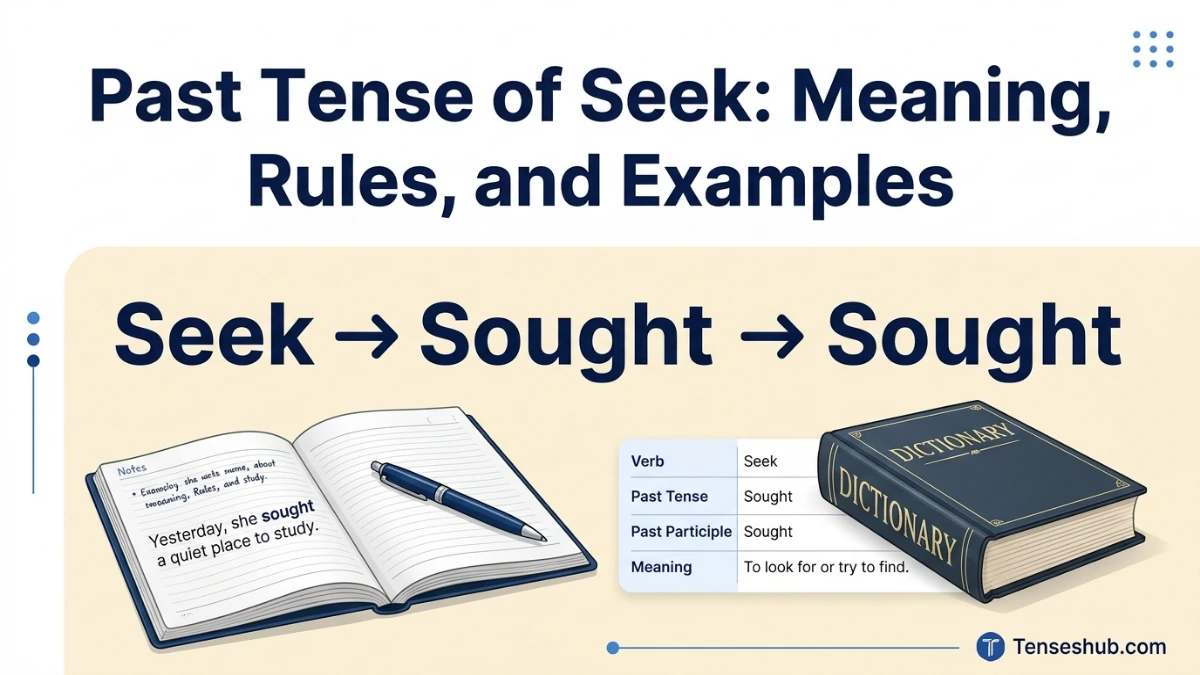
The past tense of seek is sought. The past participle is also sought. The verb seek means to look for, search for, or try to obtain something.
| Verb Form | Word |
|---|---|
| Base form (V1) | seek |
| Simple past (V2) | sought |
| Past participle (V3) | sought |
| ing form | seeking |
| Third person singular | seeks |
Example: I sought help from my teacher yesterday.
What Is the Past Tense of Seek?
The past tense of seek is sought, an irregular verb form used to describe an action that happened in the past.
The verb seek means to look for something, try to find an answer, request help, or attempt to achieve a goal. We use sought when that action took place before the present time.
Consider these examples:
- I sought advice before making my decision.
- She sought a better job last year.
- They sought shelter during the storm.
- The student sought an answer to the difficult question.
- We sought help when the problem became serious.
In each sentence, the search or attempt happened in the past.
Is Seek a Regular or Irregular Verb?
Seek is an irregular verb because its past tense does not follow the usual pattern of adding ed. Instead, seek changes to sought.
- Regular verb: look → looked
- Regular verb: ask → asked
- Irregular verb: seek → sought
The past tense and past participle of seek are identical. Therefore, you use sought for both forms, although the grammar around the word may differ.
Structure of Sentences Using the Past Tense of Seek
The simple past tense can appear in affirmative, negative, and interrogative sentences. The sentence structure changes depending on if you are making a statement, expressing a negative idea, or asking a question.
1. Affirmative Sentences
Formula: Subject + sought + object or complement.
Use this structure to describe a completed search, request, or attempt.
Examples:
- I sought a solution to the problem.
- She sought medical advice.
- They sought new opportunities abroad.
- The company sought experienced workers.
2. Negative Sentences
Formula: Subject + did not + seek + object or complement.
In negative simple past sentences, use the base form seek after did not. Do not use sought after didn’t.
Examples:
- I did not seek help.
- She didn’t seek permission.
- They did not seek another opportunity.
- He didn’t seek professional advice.
3. Interrogative Sentences
Formula: Did + subject + seek + object or complement?
For questions in the simple past, use did before the subject and the base form seek after it.
Examples:
- Did you seek help?
- Did she seek another job?
- Did they seek legal advice?
- Why did he seek assistance?
Formation of the Past Tense of Seek
English verbs have different forms for different grammatical purposes. Understanding these forms helps you use seek accurately in sentences.
Verb Forms of Seek
| Form | Verb | Example |
|---|---|---|
| V1: Base form | seek | I seek advice. |
| V2: Simple past | sought | I sought advice yesterday. |
| V3: Past participle | sought | I have sought advice. |
| V ing: Present participle | seeking | I am seeking advice. |
| Third person singular | seeks | She seeks advice. |
Why Does Seek Change to Sought?
Seek is an irregular verb. Unlike regular verbs such as walk and talk, it does not form the past tense by adding ed.
Instead:
- Present: seek
- Past: sought
- Past participle: sought
The word sought is the correct form in standard modern English. “Seeked” is not the standard past tense of seek.
Using Sought with Helping Verbs
Some tenses require helping verbs. The form of the main verb depends on the tense.
- Simple past: She sought a solution.
- Present perfect: She has sought a solution.
- Past perfect: She had sought a solution.
- Future perfect: She will have sought a solution.
Notice that sought stays the same after has, had, and will have because it is the past participle as well as the simple past form.
How to Use the Past Tense of Seek
Use sought when describing a search, request, or attempt that happened in the past. The meaning depends on the words that follow it.
1. To Describe Looking for Something
Use sought when someone tried to find a person, place, object, or opportunity.
Examples:
- He sought his missing keys everywhere.
- We sought a quiet place to study.
- The travelers sought a safe route through the mountains.
- She sought a new apartment near her workplace.
2. To Describe Asking for Help or Advice
Seek is often used with words such as help, advice, guidance, and permission.
Examples:
- I sought advice from an experienced teacher.
- She sought help with her homework.
- The employee sought permission to leave early.
- They sought guidance before starting their business.
3. To Describe Trying to Achieve Something
The verb can also describe an attempt to gain a result, position, or opportunity.
Examples:
- He sought a promotion at work.
- The team sought victory in the final match.
- The organization sought support from local communities.
- She sought a better understanding of the subject.
4. To Describe Searching for Information
Use sought when someone tried to discover information or understand a situation.
Examples:
- The researcher sought answers to important questions.
- I sought information about the university.
- The journalist sought the truth about the incident.
- The students sought more details about the assignment.
5. To Use Seek in Formal Writing
Sought is common in formal, academic, legal, and professional writing. In casual conversations, people may use expressions such as looked for or asked for instead.
Formal: The applicant sought permission to extend the deadline.
Simple: The applicant asked for permission to extend the deadline.
Both sentences are correct, but their tone differs.
Past Tense of Seek: Structure and Verb Pattern Table
The following table summarizes the main sentence patterns and shows when to use each form.
| Sentence Type | Structure | Example |
|---|---|---|
| Affirmative | Subject + sought | She sought help. |
| Negative | Subject + didn’t + seek | She didn’t seek help. |
| Question | Did + subject + seek? | Did she seek help? |
| Wh question | Wh word + did + subject + seek? | Why did she seek help? |
| Present perfect | Subject + has/have + sought | She has sought help. |
| Past perfect | Subject + had + sought | She had sought help. |
Remember: use sought in affirmative simple past sentences, but use seek after did in negative sentences and questions.
Real Life Examples of Sought in Sentences
These examples show how the past tense of seek works in different situations.
Everyday Examples
- I sought my friend’s advice before buying a laptop.
- She sought a quiet place to read.
- We sought shelter when it started raining.
- He sought his parents’ approval.
- They sought a solution to the traffic problem.
School and Education Examples
- The student sought help with a difficult math problem.
- I sought information about the scholarship.
- The teacher sought new ways to explain the lesson.
- The students sought answers in their textbooks.
- She sought guidance from her academic adviser.
Work and Professional Examples
- The company sought an experienced designer.
- He sought a promotion after completing the project.
- The applicant sought permission to work remotely.
- Our team sought feedback from the client.
- The manager sought a better way to organize the schedule.
Negative Examples
- I didn’t seek attention during the meeting.
- She did not seek help until the problem became serious.
- They didn’t seek another supplier.
- He did not seek permission before using the equipment.
- We didn’t seek outside assistance.
Questions
- Did you seek advice before making the decision?
- Why did she seek a new job?
- Did they seek shelter during the storm?
- Where did he seek information?
- When did the organization seek additional funding?
Formal and Reflective Examples
- The lawyer sought clarification about the agreement.
- The researchers sought evidence to support their findings.
- She sought peace after a difficult period in her life.
- The organization sought cooperation from its partners.
- He sought to improve his writing skills.
In the final example, sought to improve means tried or attempted to improve.
Common Mistakes When Using the Past Tense of Seek
English learners sometimes apply regular verb rules to irregular verbs. The following mistakes are easy to avoid once you understand the correct patterns.
Mistake 1: Using Seeked Instead of Sought
Incorrect: I seeked help yesterday.
Correct: I sought help yesterday.
Explanation: Seek is irregular, so its past tense is sought, not seeked.
Mistake 2: Using Sought After Did
Incorrect: Did you sought help?
Correct: Did you seek help?
Explanation: The helping verb did already marks the past tense. Use the base form seek after it.
Mistake 3: Using Sought After Didn’t
Incorrect: She didn’t sought advice.
Correct: She didn’t seek advice.
Explanation: Always use the base form of the main verb after didn’t.
Mistake 4: Using Seek Instead of Sought in an Affirmative Past Sentence
Incorrect: They seek a better opportunity last year.
Correct: They sought a better opportunity last year.
Explanation: The phrase last year indicates a completed past action, so the simple past form is needed.
Mistake 5: Confusing Sought and Seeking
Incorrect: She was sought advice from her teacher.
Correct: She sought advice from her teacher.
Another correct sentence: She was seeking advice from her teacher.
Explanation: Use sought for the simple past. Use was seeking for an action in progress at a particular time in the past.
Mistake 6: Using the Wrong Past Participle
Incorrect: I have seeked an answer.
Correct: I have sought an answer.
Explanation: The present perfect uses have or has plus the past participle. The past participle of seek is sought.
Key Grammar Rules for Seek
Remember these essential rules to use the verb correctly.
Rule 1: The simple past of seek is sought.
Example: We sought a better solution yesterday.
Rule 2: The past participle is also sought.
Example: She has sought professional advice.
Rule 3: Use seek after did and didn’t.
Examples:
- Did you seek help?
- I didn’t seek help.
Rule 4: Use sought for completed actions in the past.
Example: The family sought shelter during the storm.
Rule 5: Use seeking for continuous verb forms.
Example: They were seeking a new home.
Rule 6: Use sought to when describing an attempt or goal.
Example: He sought to improve his performance.
Rule 7: Choose the verb form according to the helping verb.
Examples:
- Has sought
- Had sought
- Is seeking
- Was seeking
These patterns help you build correct sentences without memorizing every sentence separately.
Comparisons with Similar Grammar Forms
Comparing seek with related verbs and tenses can help you understand its meaning and use.
Seek vs. Sought
| Word | Use | Example |
|---|---|---|
| seek | Base or present form | I seek advice. |
| sought | Simple past or past participle | I sought advice yesterday. |
Use seek for the base form and present tense situations. Use sought for past actions or with perfect tense helping verbs.
Seek vs. Look For
Both expressions can describe searching for something, but they have slightly different tones.
- Seek: She sought employment after graduation.
- Look for: She looked for a job after graduation.
Seek often sounds more formal, while look for is common in everyday conversation.
Seek vs. Search
Seek often focuses on trying to obtain or achieve something. Search emphasizes looking carefully for something.
- The students sought an explanation.
- The students searched the library for information.
These meanings can overlap, depending on the context.
Sought vs. Seeking
Sought is the simple past and past participle. Seeking is the ing form, used in continuous tenses or as a gerund.
- Past: She sought a solution.
- Continuous: She was seeking a solution.
- Present continuous: She is seeking a solution.
Sought vs. Had Sought
Both forms refer to past events, but they are used differently.
- Simple past: He sought advice yesterday.
- Past perfect: He had sought advice before he made the decision.
Use the past perfect when you want to show that one past action happened before another past event.
Exercises: Practice the Past Tense of Seek
Test your understanding with these beginner friendly exercises. Try answering them before checking the answer key.
Exercise 1: Fill in the Blanks
Complete each sentence using the correct form of seek.
- She ______ advice from her teacher yesterday.
- They didn’t ______ permission before leaving.
- Have you ever ______ help from a counselor?
- We were ______ a place to stay.
- Did he ______ an answer to the question?
- The company ______ a new manager last month.
Exercise 2: Correct the Mistakes
Rewrite each sentence correctly.
- I seeked help yesterday.
- Did she sought a new job?
- They didn’t sought advice.
- He has seeked a solution.
- We seek a better opportunity last year.
Exercise 3: Rewrite the Sentences
Follow the instructions in parentheses.
- She seeks advice. (Change to simple past.)
- They sought help. (Make it negative.)
- He sought a job. (Change to a question.)
- I am seeking information. (Change to past continuous.)
- We sought guidance. (Use the present perfect.)
Exercise 4: Multiple Choice Questions
1. What is the simple past tense of seek?
A. Seeked
B. Sought
C. Seeking
D. Seeks
2. Which sentence is correct?
A. Did you sought help?
B. Did you seek help?
C. Did you seeking help?
D. Did you seeks help?
3. Choose the correct word: She has ______ advice.
A. seek
B. seeks
C. sought
D. seeking
4. Which sentence is negative and grammatically correct?
A. He didn’t sought help.
B. He didn’t seek help.
C. He doesn’t sought help yesterday.
D. He not seeked help.
5. Which sentence uses the past continuous correctly?
A. They were sought a solution.
B. They were seeking a solution.
C. They was seeking a solution.
D. They did seeking a solution.
Answer Key
Exercise 1
- sought
- seek
- sought
- seeking
- seek
- sought
Exercise 2
- I sought help yesterday.
- Did she seek a new job?
- They didn’t seek advice.
- He has sought a solution.
- We sought a better opportunity last year.
Exercise 3
- She sought advice.
- They didn’t seek help.
- Did he seek a job?
- I was seeking information.
- We have sought guidance.
Exercise 4
- B. Sought
- B. Did you seek help?
- C. Sought
- B. He didn’t seek help.
- B. They were seeking a solution.
FAQs
1. What is the past tense of seek?
The past tense of seek is sought. For example, “I sought help yesterday.”
2. Is seeked a correct word?
Seeked is not the standard past tense of seek in modern English. The correct form is sought.
3. What is the past participle of seek?
The past participle is also sought. Example: “She has sought professional advice.”
4. Is seek a regular or irregular verb?
Seek is an irregular verb because it changes to sought rather than adding ed.
5. What are the five forms of seek?
The main forms are seek, seeks, sought, sought, and seeking. They represent the base form, third person singular, simple past, past participle, and ing form.
6. How do you use seek in a past tense question?
Use did followed by the subject and the base form seek. Example: “Did you seek help?”
7. What is the difference between sought and seeking?
Sought describes a completed past action or works as a past participle. Seeking is used in continuous verb forms, such as “She was seeking advice.”
8. Can I use sought in formal writing?
Yes. Sought is common in academic, business, legal, and professional writing. For example, “The organization sought additional funding.”
9. What does sought mean?
Sought means looked for, tried to find, requested, or attempted to obtain something. Its exact meaning depends on the sentence.
10. What is the past tense of seek help?
The phrase becomes sought help. Example: “He sought help from his teacher.” In a negative sentence, write “He didn’t seek help.”
Conclusion
The past tense of seek is sought, and its past participle is also sought. Because seek is an irregular verb, you should not use seeked in standard English. Once you learn this change, using the verb becomes much easier.
Remember the main patterns: use sought in affirmative simple past sentences, use seek after did or didn’t, and use sought after helping verbs such as has, have, and had. You can also use seeking in continuous tenses when an action is in progress.

Hi, I’m Noah Bester, a tenses expert passionate about simplifying English grammar. I create practical, easy-to-understand guides to help learners master tenses with confidence. My goal is to make grammar clear, useful, and applicable in everyday communication. tenseshub.com