Have you ever wondered if the past tense of sit is sitted or sat? Many English learners make this mistake because they try to follow the usual rule of adding ed to a verb. However, some English verbs are irregular and change their spelling in the past tense.
The correct past tense of sit is sat. We use sat to describe someone who took a seat or was in a sitting position in the past. For example, “I sat beside my friend yesterday” describes an action that happened earlier.
Learning the correct forms of sit is important for everyday conversations, schoolwork, professional writing, and English grammar exercises. You may need this verb when talking about sitting in a classroom, waiting at a bus stop, having dinner with family, or describing where someone was during an event.
In this guide, you will learn the meaning of sit, its verb forms, sentence structures, practical uses, common mistakes, and examples. You will also find exercises to help you use sit and sat correctly and confidently.
Quick Answer: What Is the Past Tense of Sit?
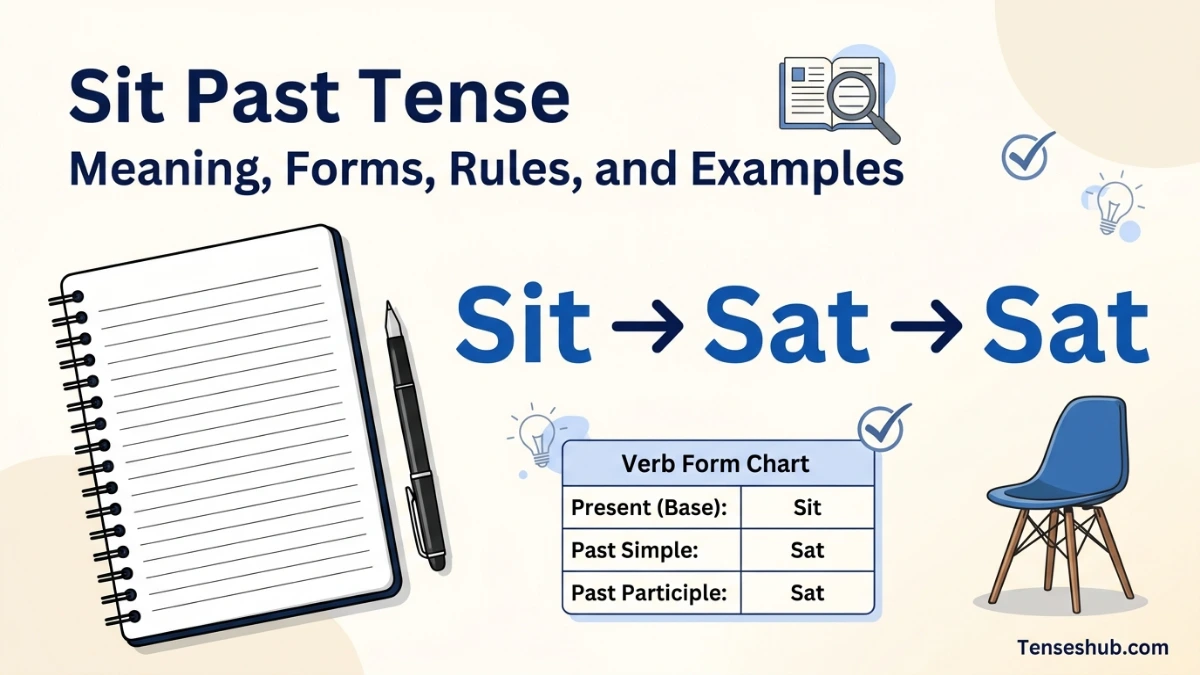
The past tense of sit is sat. Its past participle is also sat, while the ing form is sitting.
| Verb Form | Word |
|---|---|
| Base form (V1) | sit |
| Simple past (V2) | sat |
| Past participle (V3) | sat |
| ing form | sitting |
| Third person singular | sits |
Example: She sat near the window yesterday.
What Is the Past Tense of Sit?
The past tense of sit is sat. It is an irregular verb that describes the action of taking a seat or being in a sitting position.
We use sat when an action happened and finished in the past. It can describe where a person sat, how long someone remained seated, or what someone did while sitting.
Consider these examples:
- I sat on the sofa after work.
- She sat beside her best friend.
- The students sat quietly in the classroom.
- We sat under a tree during lunch.
- He sat near the door and waited.
Each sentence describes a situation that occurred in the past.
Is Sit a Regular or Irregular Verb?
Sit is an irregular verb because it does not form its past tense by adding ed. Instead, the vowel changes from i to a.
Compare these verbs:
- Walk → walked
- Play → played
- Sit → sat
- Run → ran
The correct forms are sit, sat, and sat. The word sitted is not the standard past tense of sit.
It is also important to understand that sit and set are different verbs. Sit usually means to take a seat, while set often means to put or place something somewhere.
Structure of Sentences Using the Past Tense of Sit
The simple past tense can be used in affirmative, negative, and interrogative sentences. Each type follows a different word order.
1. Affirmative Sentences
Formula: Subject + sat + place or other information.
Use this pattern to describe a completed past action.
Examples:
- I sat near the entrance.
- She sat beside her mother.
- They sat in the front row.
- The children sat on the floor.
2. Negative Sentences
Formula: Subject + did not + sit + place or other information.
In negative sentences, use the base form sit after did not or didn’t.
Examples:
- I did not sit near the window.
- She didn’t sit with us.
- They did not sit in the front row.
- He didn’t sit down during the meeting.
3. Interrogative Sentences
Formula: Did + subject + sit + place or other information?
Use did before the subject when asking a simple past question.
Examples:
- Did you sit beside Ali?
- Did she sit in the classroom?
- Did they sit together?
- Where did he sit?
Formation of the Past Tense of Sit
The verb sit has several forms that are used in different tenses. Learning them will help you choose the correct word when speaking and writing.
Main Verb Forms
- V1 (base form): sit
- V2 (simple past): sat
- V3 (past participle): sat
- Ving form: sitting
- Thirdperson singular: sits
Unlike regular verbs, sit changes its vowel in the simple past and past participle. Its ing form follows a spelling rule: the final consonant is doubled before adding ing.
Therefore, we write sitting, not siting, when we mean the action of sitting.
Using Sit with Helping Verbs
Helping verbs determine which form of sit is needed.
| Tense | Structure | Example |
|---|---|---|
| Simple present | sit / sits | She sits here. |
| Simple past | sat | She sat here. |
| Present continuous | am / is / are + sitting | She is sitting here. |
| Past continuous | was / were + sitting | She was sitting here. |
| Present perfect | has / have + sat | She has sat here before. |
| Past perfect | had + sat | She had sat there before lunch. |
| Future | will + sit | She will sit here tomorrow. |
Remember that did takes the base form sit, while perfect tenses use the past participle sat.
How to Use the Past Tense of Sit
The word sat has several common uses in everyday English. Understanding these uses will help you create more natural sentences.
1. To Describe Taking a Seat
Use sat when someone took a seat in the past.
Examples:
- I sat on the chair near the desk.
- She sat beside her sister at dinner.
- The teacher sat at the front of the room.
- We sat on a bench in the park.
These sentences focus on the action or position in the past.
2. To Describe a Past Position
You can use sat to explain where a person or animal was positioned.
Examples:
- The cat sat on the windowsill.
- My grandfather sat near the fireplace.
- The guests sat around the dining table.
- A little bird sat on the fence.
3. To Describe Remaining Seated for a Period
Use sat with time expressions to explain how long someone remained seated.
Examples:
- I sat in the waiting room for thirty minutes.
- She sat beside her sick friend all afternoon.
- We sat through the entire presentation.
- The students sat quietly for an hour.
4. To Describe a Past Activity
The verb sat can also appear with other activities or situations.
Examples:
- He sat and read his favorite book.
- They sat together and discussed their plans.
- We sat around the table and ate dinner.
- She sat by the window and watched the rain.
5. To Use Sit in Questions and Negative Sentences
When using did or didn’t, always use sit, not sat.
Correct examples:
- Did you sit here yesterday?
- Why did she sit alone?
- I didn’t sit near the door.
- They didn’t sit together during lunch.
The helping verb did already shows that the sentence refers to the past.
Sit Past Tense: Verb Pattern Table
This compact table summarizes the most useful sentence patterns for beginners.
| Sentence Type | Structure | Example |
|---|---|---|
| Affirmative | Subject + sat | I sat near the door. |
| Negative | Subject + didn’t + sit | I didn’t sit near the door. |
| Question | Did + subject + sit? | Did you sit near the door? |
| Wh question | Wh word + did + subject + sit? | Where did you sit? |
| Past continuous | Subject + was/were + sitting | I was sitting outside. |
| Present perfect | Subject + has/have + sat | I have sat here before. |
RealLife Examples of Sat in Sentences
Here are examples of sat in everyday, academic, informal, and professional situations.
Everyday Examples
- I sat on the sofa after dinner.
- She sat beside me on the bus.
- We sat under a tree to rest.
- He sat near the window and drank his tea.
- The children sat on the carpet.
School and Education Examples
- The students sat quietly during the examination.
- I sat next to my classmate.
- She sat in the front row during the lecture.
- The teacher sat at her desk.
- We sat in the library and studied together.
Work and Formal Examples
- The manager sat at the head of the table.
- The committee sat together to discuss the proposal.
- The guests sat in their assigned seats.
- The interview panel sat across from the applicant.
- The participants sat through the training session.
Negative Examples
- I didn’t sit beside him.
- She did not sit down during the break.
- They didn’t sit in the reserved section.
- He did not sit with the other guests.
- We didn’t sit outside because it was raining.
Question Examples
- Did you sit near the teacher?
- Where did they sit during the show?
- Why did she sit alone?
- Did he sit in the front row?
- How long did you sit in the waiting room?
Past Continuous Examples
- I was sitting on the balcony when the phone rang.
- They were sitting together when the teacher arrived.
- She was sitting in the car while her brother bought groceries.
- We were sitting in the garden when it started raining.
- He was sitting at his desk when the meeting began.
Common Mistakes When Using Sit and Sat
Some mistakes happen because learners apply regular verb rules or confuse different verb forms. Here are the most common problems and how to correct them.
Mistake 1: Using Sitted Instead of Sat
Incorrect: I sitted on the chair yesterday.
Correct: I sat on the chair yesterday.simple past form is sat, not sitted.
Mistake 2: Using Sat After Did
Incorrect: Did you sat beside her?
Explanation: Sit is irregular. Its
Correct: Did you sit beside her?
Explanation: After did, use the base form of the main verb. The helping verb already marks the past tense.
Mistake 3: Using Sat After Didn’t
Incorrect: He didn’t sat on the sofa.
Correct: He didn’t sit on the sofa.
Explanation: Use sit after didn’t, not sat.
Mistake 4: Confusing Sit with Set
Incorrect: I sat the books on the table.
Correct: I set the books on the table.
Explanation: Sit usually describes a person or animal taking a seat. Set often means to put something in a particular place.
Compare:
- I sat on the chair.
- I set my bag on the chair.
Mistake 5: Forgetting to Double the Final Consonant
Incorrect: She is siting beside me.
Correct: She is sitting beside me.
Explanation: The ing form of sit is sitting. Double the final t before adding ing.
Mistake 6: Using Sit Instead of Sat in an Affirmative Past Sentence
Incorrect: We sit near the stage yesterday.
Correct: We sat near the stage yesterday.
Explanation: The word yesterday indicates a completed past action, so use sat.
Key Grammar Rules for Sit
Remember these six rules to use sit correctly.
Rule 1: The simple past tense of sit is sat.
Example: She sat beside her friend yesterday.
Rule 2: The past participle is also sat.
Example: He has sat in this classroom before.
Rule 3: Use sit after did and didn’t.
Examples:
- Did you sit here?
- I didn’t sit there.
Rule 4: The ing form is sitting.
Example: They were sitting outside.
Rule 5: Use was or were with sitting for the past continuous.
Examples:
- I was sitting near the window.
- They were sitting in the garden.
Rule 6: Do not confuse sit with set.
Examples:
- I sat on the sofa.
- I set the cup on the table.
Comparisons with Similar Grammar Forms
Understanding the differences between related verbs and tenses makes it easier to choose the correct form.
Sit vs. Sat
Sit is the base form, while sat is the simple past and past participle.
- Present: I sit near the window every morning.
- Past: I sat near the window yesterday.
Sat vs. Sitting
Sat is used for completed past actions and perfect tenses. Sitting is used in continuous tenses or as a nounlike verb form.
- She sat on the bench.
- She was sitting on the bench.
The first sentence describes a past action. The second emphasizes an action that was in progress.
Sit vs. Set
These verbs have different meanings.
| Verb | Meaning | Example |
|---|---|---|
| sit | to take a seat or be seated | I sit on the chair. |
| sat | past tense (and past participle) of sit | I sat on the chair. |
| set | to put or place something | I set the book on the desk. |
Remember that people usually sit, while people set objects somewhere.
Sit vs. Seat
Sit describes the action of being or becoming seated. Seat can mean to provide someone with a place to sit.
- Please sit beside me.
- The host seated the guests near the stage.
In everyday speech, people may also say, “Please have a seat.”
Sat vs. Had Sat
Both forms refer to the past, but they serve different purposes.
- Simple past: She sat down before the lesson began.
- Past perfect: She had sat down before the lesson began.
The past perfect is useful when you want to emphasize that one past action happened before another past event.
Exercises: Practice the Past Tense of Sit
Try the following exercises to check your understanding. Complete each activity before reviewing the answers.
Exercise 1: Fill in the Blanks
Use the correct form of sit.
- I beside my friend yesterday.
- She didn’t near the window.
- They were in the classroom.
- Did you on this chair?
- He has here many times.
- We in the park last Sunday.
Exercise 2: Correct the Mistakes
Rewrite each sentence correctly.
- She sitted on the sofa.
- Did he sat near the door?
- They didn’t sat together.
- I am siting beside my brother.
- We sit in the front row yesterday.
Exercise 3: Rewrite the Sentences
Follow the instructions in parentheses.
- I sit beside my sister. (Change to simple past.)
- She sat near the door. (Make it negative.)
- They sat in the garden. (Change to a question.)
- He is sitting on the bench. (Change to past continuous.)
- We sat here before. (Use the present perfect.)
Exercise 4: MultipleChoice Questions
1. What is the simple past tense of sit?
A. Sitted
B. Sat
C. Sitting
D. Sets
2. Which sentence is correct?
A. Did she sat here?
B. Did she sit here?
C. Did she sitting here?
D. Did she sits here?
3. Choose the correct word: They were on the bench.
A. sat
B. sit
C. sitting
D. sits
4. Which sentence is correct?
A. I didn’t sat down.
B. I didn’t sitting down.
C. I didn’t sit down.
D. I not sat down.
5. Which sentence uses set correctly?
A. I set on the chair yesterday.
B. I sat the book on the desk.
C. I set the book on the desk.
D. I sitting the book on the desk.
Answer Key
Exercise 1
- sat
- sit
- sitting
- sit
- sat
- sat
Exercise 2
- She sat on the sofa.
- Did he sit near the door?
- They didn’t sit together.
- I am sitting beside my brother.
- We sat in the front row yesterday.
Exercise 3
- I sat beside my sister.
- She didn’t sit near the door.
- Did they sit in the garden?
- He was sitting on the bench.
- We have sat here before.
Exercise 4
- B. Sat
- B. Did she sit here?
- C. Sitting
- C. I didn’t sit down.
- C. I set the book on the desk.
FAQs
1. What is the past tense of sit?
The past tense of sit is sat. For example, “I sat beside my friend yesterday.”
2. Is it sat or sitted?
Sat is correct. Sitted is not the standard past tense of sit.
3. What is the past participle of sit?
The past participle is also sat. For example, “She has sat here before.”
4. Is sit a regular or irregular verb?
Sit is an irregular verb because its past tense changes to sat rather than adding ed.
5. What are the five forms of sit?
The main forms are sit, sits, sat, sat, and sitting. They represent the base form, thirdperson singular, simple past, past participle, and ing form.
6. What is the past tense of sit down?
The past tense of sit down is sat down. Example: “He sat down near the door.”
7. Do I use sit or sat after did?
Use sit after did. For example, “Did you sit beside her?” is correct, while “Did you sat beside her?” is incorrect.
8. What is the difference between sit and set?
Sit usually means to take a seat. Set often means to put something somewhere. For example, “I sat on the chair” and “I set my bag on the chair.”
9. What is the past continuous form of sit?
The past continuous form is was sitting or were sitting. Example: “They were sitting in the classroom.”
10. What is the past tense of sitting?
Sitting is the ing form of sit. The simple past form is sat. For example, “I was sitting outside” becomes “I sat outside” when expressed in the simple past.
Conclusion
The past tense of sit is sat, and its past participle is also sat. Because sit is an irregular verb, you should not write sitted in standard English. Learning the correct forms will help you describe past actions, ask questions, and write clear sentences.
Remember the most important patterns: use sat in affirmative simple past sentences, use sit after did and didn’t, and use sitting in continuous tenses. Also, keep the difference between sit and set in mind because they have different meanings.

Hi, I’m Robert Lowth, a passionate expert in English tenses and grammar. I specialize in simplifying complex tense rules to help learners understand and use English with confidence. My goal is to make grammar clear, practical, and easy for everyday communication. tenseshub.com