Have you ever wanted to say “I put the book on the table” or “She puts her phone in her bag” in Spanish but felt unsure which verb form to use? The Spanish verb poner can be confusing because it does not follow the regular present tense pattern used by verbs such as comer and beber.
The verb poner means “to put” or “to place.” It is useful when talking about everyday activities, arranging objects, setting the table, putting on music, or explaining where something belongs. Learning how to conjugate poner in the present tense will help you build natural Spanish sentences and communicate more confidently.
In this guide, you will learn all six present tense forms of poner, understand why yo pongo is different from the other forms, and discover how to use the verb in affirmative sentences, negative statements, and questions.
You will also explore common mistakes, practical examples, comparisons with related Spanish verbs, and exercises with answers to help you practice.
Quick Answer: Poner Present Tense
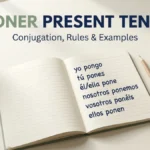
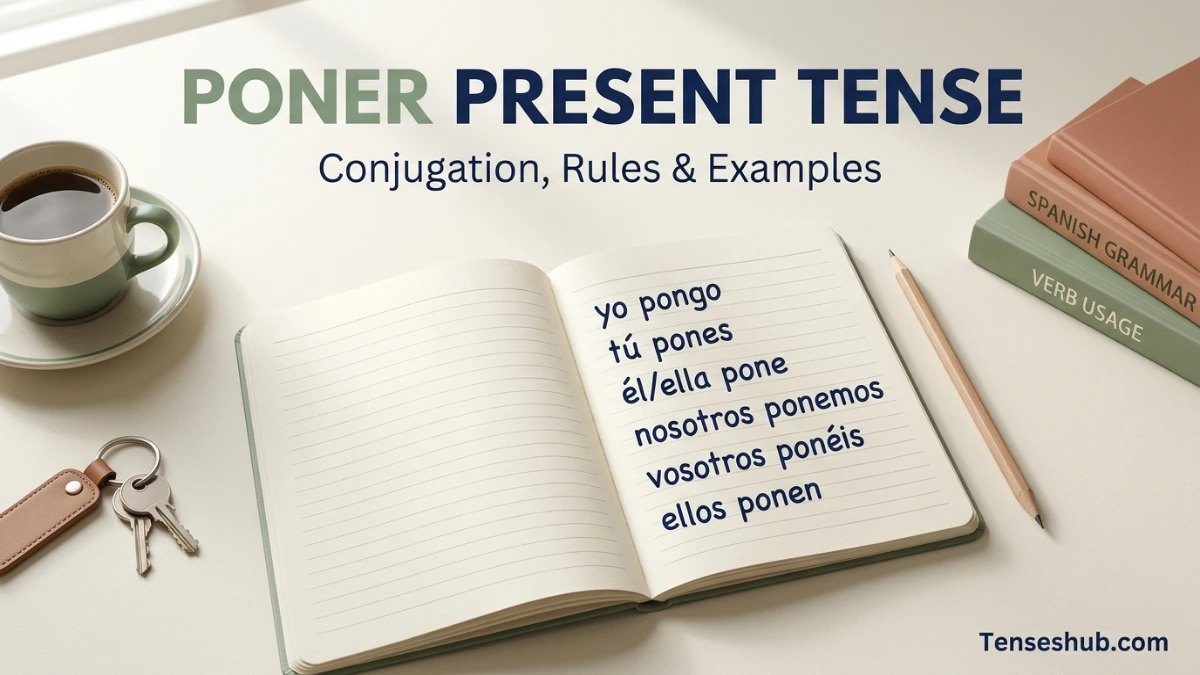
The present tense of poner means “put,” “puts,” or “place,” depending on the subject and context. Its conjugations are pongo, pones, pone, ponemos, ponéis, and ponen.
| Subject | Present Tense | English |
|---|---|---|
| Yo | Pongo | I put |
| Tú | Pones | You put |
| Él/Ella/Usted | Pone | They puts; you put |
| Nosotros/as | Ponemos | We put |
| Vosotros/as | Ponéis | You all put |
| Ellos/Ellas/Ustedes | Ponen | They put; you all put |
Important: Poner is irregular in the first person singular. Say yo pongo, not yo pono. The other present tense forms follow the regular endings of an er verb.
What Is Poner in the Present Tense?
Poner is a Spanish verb that usually means “to put,” “to place,” or “to set.” Its present tense describes actions, routines, and situations related to placing something somewhere or making something available.
For example:
- Yo pongo el libro en la mesa. I put the book on the table.
- Tú pones las llaves aquí. You put the keys here.
- Ella pone la comida en el refrigerador. She puts the food in the refrigerator.
- Nosotros ponemos la mesa. We set the table.
- Ellos ponen música en la fiesta. They play music at the party.
The meaning of poner changes slightly depending on the expression. For example, poner la mesa means “to set the table,” while poner música means “to put on or play music.”
The verb is especially useful because it appears in many everyday Spanish expressions. You can use it to describe where you place objects, how you prepare a room, or what you do before an activity.
It is also the base verb for related expressions such as ponerse, which can mean “to put on” clothing or “to become” in certain contexts.
Structure of Sentences Using Poner in the Present Tense
Spanish sentence structure is generally similar to English. You can use poner in affirmative statements, negative statements, and questions.
1. Affirmative Sentences
Use an affirmative sentence to explain what someone puts, places, or sets.
Pattern: Subject + conjugated verb + object or complement
Examples:
- Yo pongo el teléfono en mi mochila. I put the phone in my backpack.
- Carlos pone las sillas en el jardín. Carlos puts the chairs in the garden.
- Nosotros ponemos los platos en la mesa. We put the plates on the table.
You can leave out the subject pronoun when the verb ending makes the subject clear.
- Pongo el teléfono aquí. I put the phone here.
- Ponemos la mesa. We set the table.
2. Negative Sentences
To make a negative statement, place no directly before the conjugated verb.
Pattern: Subject + no + conjugated verb + object or complement
Examples:
- Yo no pongo mis zapatos aquí. I do not put my shoes here.
- Ella no pone azúcar en el café. She does not put sugar in the coffee.
- Nosotros no ponemos la televisión por la mañana. We do not turn on the television in the morning.
Spanish does not require the English helping verb “do” or “does” to form these negative statements.
3. Interrogative Sentences
Questions can follow a similar word order to statements. Spanish uses an opening question mark and a closing question mark.
Patterns:
- ¿Conjugated verb + subject + complement?
- ¿Subject + conjugated verb + complement?
Examples:
- ¿Pones el libro aquí? Do you put the book here?
- ¿Qué pone Ana en la bolsa? What does Ana put in the bag?
- ¿Dónde ponemos las sillas? Where do we put the chairs?
- ¿Ustedes ponen música en las fiestas? Do you all play music at parties?
Question words such as qué (what), dónde (where), and cuándo (when) help you ask more specific questions.
Formation of Poner in the Present Tense
The verb poner belongs to the Spanish er verb group, but its first person singular form is irregular. Understanding this one important change makes the full conjugation easier to remember.
Step 1: Identify the Infinitive and Stem
The infinitive is:
poner to put
Remove the ending er to find the stem:
pon
For most present tense forms, you add the usual er endings to this stem.
Step 2: Learn the Six Conjugations
| Subject | Ending or Form | Conjugated Verb |
|---|---|---|
| Yo | go (irregular) | Pongo |
| Tú | es | Pones |
| Él/Ella/Usted | e | Pone |
| Nosotros/as | emos | Ponemos |
| Vosotros/as | éis | Ponéis |
| Ellos/Ellas/Ustedes | en | Ponen |
The main irregularity is yo pongo. The remaining forms use the regular present tense endings attached to pon .
Compare these forms:
- Yo pongo la taza aquí. I put the cup here.
- Tú pones la taza aquí. You put the cup here.
- Ella pone la taza aquí. She puts the cup here.
Notice that the stem changes to pong only in the yo form.
Step 3: Understand the Other Verb Forms
Although this guide focuses on the present tense, related forms help you recognize poner in different sentences.
| Verb Form | Spanish | English |
|---|---|---|
| Infinitive | Poner | To put |
| Present, yo | Pongo | I put |
| Present participle | Poniendo | Putting |
| Past participle | Puesto | Put |
| Preterite, yo | Puse | I put (past) |
The past participle puesto is irregular. For example, He puesto el libro aquí means “I have put the book here.”
The gerund poniendo is used with estar to describe an action in progress:
Estoy poniendo los platos en la mesa. I am putting the plates on the table.
Remember that pongo is the present tense form for yo, while puse is the first person singular preterite form.
How to Use Poner in the Present Tense
The present tense of poner has several common uses. Learning the expressions in which it appears will help you understand real Spanish conversations.
1. Placing Objects Somewhere
Use poner to explain where you place an object.
Examples:
- Pongo las llaves en el cajón. I put the keys in the drawer.
- Mi hermano pone el vaso sobre la mesa. My brother puts the glass on the table.
- ¿Dónde pones tu mochila? Where do you put your backpack?
These sentences often include location words such as en (in/on), sobre (on), and debajo de (under).
2. Talking About Daily Routines
You can use poner when describing things you do regularly.
Examples:
- Pongo mi teléfono a cargar por la noche. I put my phone on charge at night.
- Mi madre pone la mesa antes de cenar. My mother sets the table before dinner.
- Nosotros ponemos las sillas en el patio cada mañana. We put the chairs on the patio every morning.
These examples show how poner can describe a repeated action rather than something happening only once.
3. Using Poner With Music and Entertainment
In Spanish, poner is often used when someone selects or plays music, a film, or a television program.
Examples:
- Pongo música mientras estudio. I put on music while I study.
- Mi padre pone las noticias por la mañana. My father puts on the news in the morning.
- ¿Puedes poner una película? Can you put on a movie?
In these expressions, translating poner as “place” would sound unnatural in English. The best translation depends on the situation.
4. Talking About Setting the Table
The expression poner la mesa means “to set the table.” It is a common phrase in everyday Spanish.
Examples:
- Yo pongo la mesa. I set the table.
- Mi hermana pone los platos. My sister puts out the plates.
- Nosotros ponemos la mesa antes de comer. We set the table before eating.
Do not translate this expression word for word as “put the table.” In English, “set the table” is the natural expression.
5. Describing Feelings or Changes With Ponerse
The reflexive verb ponerse is related to poner, but it often means “to become” when talking about a change in mood or condition.
Examples:
- Me pongo nervioso antes de un examen. I get nervous before an exam.
- Ella se pone feliz cuando escucha música. She becomes happy when she listens to music.
- Nos ponemos cansados después de caminar. We get tired after walking.
The reflexive pronouns me, te, se, nos, and os are used with ponerse. Do not confuse pongo (“I put”) with me pongo (“I put on” or “I become”), because the meaning depends on the expression.
For clothing, me pongo la chaqueta means “I put on the jacket.”
6. Making Plans or Giving Instructions
You may encounter poner when discussing what someone should place somewhere or what to play.
Examples:
- Ponemos las bebidas en el refrigerador. We put the drinks in the refrigerator.
- ¿Qué ponemos en la lista? What do we put on the list?
- Pongo el documento sobre tu escritorio. I put the document on your desk.
When giving a direct command to one person, the form changes: Pon el libro aquí means “Put the book here.” This is an affirmative command, not the present indicative form pones.
Poner Present Tense Conjugation Table
Use this table as a quick reference when writing or speaking Spanish.
| Subject | Conjugation | Example |
|---|---|---|
| Yo | Pongo | Pongo el libro aquí. |
| Tú | Pones | Pones el libro aquí. |
| Él/Ella/Usted | Pone | Pone el libro aquí. |
| Nosotros/as | Ponemos | Ponemos el libro aquí. |
| Vosotros/as | Ponéis | Ponéis el libro aquí. |
| Ellos/Ellas/Ustedes | Ponen | Ponen el libro aquí. |
The English translation of each example is “I/you/they/we/you all/they put the book here,” depending on the subject.
In Spain, vosotros ponéis is commonly used for informal plural “you put.” Across most of Latin America, speakers generally use ustedes ponen instead.
Real Life Examples of Poner in the Present Tense
The following examples show how the verb works in different everyday situations.
Affirmative Examples
- Yo pongo mi mochila junto a la puerta. I put my backpack next to the door.
- Tú pones el agua en el refrigerador. You put the water in the refrigerator.
- Mi hermana pone flores en la sala. My sister puts flowers in the living room.
- Nosotros ponemos la mesa para seis personas. We set the table for six people.
- Ustedes ponen los libros en el estante. You all put the books on the shelf.
- Los profesores ponen ejemplos en la pizarra. The teachers put examples on the board.
Negative Examples
- No pongo azúcar en mi té. I do not put sugar in my tea.
- Tú no pones los zapatos en la cama. You do not put the shoes on the bed.
- Mi padre no pone música por la noche. My father does not play music at night.
- No ponemos los platos en ese armario. We do not put the plates in that cupboard.
Question Examples
- ¿Dónde pones tu teléfono? Where do you put your phone?
- ¿Qué pone ella en la caja? What does she put in the box?
- ¿Ponemos las sillas afuera? Shall we put the chairs outside?
- ¿Usted pone la mesa todos los días? Do you set the table every day?
- ¿Ellos ponen música durante la cena? Do they play music during dinner?
Formal and Informal Examples
Informal:
- ¿Tú pones la mesa? Do you set the table?
- Pones tus libros aquí. You put your books here.
Formal:
- ¿Usted pone los documentos en esta carpeta? Do you put the documents in this folder?
- ¿Ustedes ponen las sillas en el salón? Do you all put the chairs in the room?
The verb ending depends on the grammatical subject. Usted uses pone, while ustedes uses ponen.
Common Mistakes When Using Poner
Mistake 1: Saying Pono Instead of Pongo
Incorrect: Yo pono el libro en la mesa.
Correct: Yo pongo el libro en la mesa.
Explanation: The yo form is irregular. Memorize pongo rather than trying to apply the regular er pattern.
Mistake 2: Using Pongo With Every Subject
Incorrect: Ella pongo las llaves aquí.
Correct: Ella pone las llaves aquí.
Explanation: Pongo is used with yo. Use pone with él, ella, and usted.
Mistake 3: Using Poner Instead of Ponemos
Incorrect: Nosotros poner la mesa.
Correct: Nosotros ponemos la mesa.
Explanation: Poner is the infinitive “to put.” A normal present tense statement requires the conjugated form ponemos.
Mistake 4: Confusing Pones and Ponen
Incorrect: Ellos pones los libros en el estante.
Correct: Ellos ponen los libros en el estante.
Explanation: Pones is used with tú. Ponen is used with ellos, ellas, and ustedes.
Mistake 5: Forgetting No in a Negative Sentence
Incorrect: Yo pongo azúcar en el café, when you mean “I do not put sugar in the coffee.”
Correct: Yo no pongo azúcar en el café.
Explanation: Place no immediately before the conjugated verb to make the statement negative.
Mistake 6: Confusing Poner With Ponerse
Incorrect: Pongo la chaqueta, when you specifically mean “I put on the jacket.”
More natural: Me pongo la chaqueta.
Explanation: Poner often describes placing something somewhere, while ponerse is commonly used for putting on clothing or describing a change of state. Context matters.
Mistake 7: Using the Present Tense for a Completed Past Action
Incorrect: Ayer pongo el libro en la mesa.
Correct: Ayer puse el libro en la mesa.
Explanation: Ayer means “yesterday,” so a completed past action normally takes the preterite. The yo preterite form is puse.
Key Grammar Rules for Poner in the Present Tense
Keep these rules in mind as you practice.
- Memorize the irregular yo form. The correct form is pongo, not pono.
- Use the correct ending for each subject. The forms are pongo, pones, pone, ponemos, ponéis, and ponen.
- Put no before the conjugated verb. For example, No pongo el libro aquí means “I do not put the book here.”
- Remember that subject pronouns can be omitted. Pongo la mesa is a complete sentence meaning “I set the table.”
- Learn common expressions as complete phrases. Poner la mesa means “to set the table,” and poner música means “to put on music.”
- Distinguish poner from ponerse. Pongo el libro en la mesa means “I put the book on the table,” while me pongo el abrigo means “I put on my coat.”
- Use the appropriate tense for the time. Pongo is present tense, while puse is the preterite form for yo.
Poner Present Tense vs. Similar Spanish Verb Forms
Several Spanish verbs and forms are related to poner. Understanding the differences will help you use them correctly.
Poner vs. Ponerse
Poner generally means “to put” or “to place.” Ponerse is its reflexive form and is commonly used for putting on clothes or becoming a certain way.
| Spanish | English |
|---|---|
| Pongo el libro en la mesa. | I put the book on the table. |
| Me pongo el abrigo. | I put on my coat. |
| Me pongo nervioso. | I get nervous. |
The reflexive pronoun changes according to the subject: me pongo, te pones, se pone, nos ponemos, os ponéis, and se ponen.
Poner vs. Colocar
Both poner and colocar can mean “to put” or “to place.”
- Pongo el vaso en la mesa. I put the glass on the table.
- Coloco el vaso en la mesa. I place the glass on the table.
Colocar can sound more deliberate or emphasize arranging something in a particular position. In many everyday situations, the two verbs overlap.
Poner vs. Ponía
Ponía is the imperfect past form for yo and él/ella/usted. It often describes a past habit or an ongoing situation.
- Pongo los libros aquí. I put the books here.
- Antes ponía los libros en ese estante. I used to put the books on that shelf.
Use pongo for the present and ponía when describing a past routine or background situation.
Poner vs. Puse
Pongo is present tense, while puse is the first person singular preterite.
- Hoy pongo las llaves en el cajón. Today I put the keys in the drawer.
- Ayer puse las llaves en el cajón. Yesterday I put the keys in the drawer.
The English word “put” stays the same in both examples, but the Spanish verb changes to show when the action happened.
Exercises: Practice Poner in the Present Tense
Complete these exercises to test your understanding of the present tense conjugations and their everyday uses.
Exercise 1: Fill in the Blanks
Complete each sentence with the correct form of poner.
- Yo ________ las llaves en la mesa.
- Tú ________ los libros en tu mochila.
- Ella ________ música por la mañana.
- Nosotros ________ la mesa antes de cenar.
- Ustedes ________ las sillas en el jardín.
- Mi hermano ________ su teléfono aquí.
Exercise 2: Correct the Sentences
Each sentence contains a mistake. Write the correct version.
- Yo pono la comida en el refrigerador.
- Tú pongo el vaso en la mesa.
- Ella ponen los libros en la caja.
- Nosotros poner la mesa.
- Ellos pone música en casa.
Exercise 3: Translate Into Spanish
Translate each sentence into Spanish using the present tense of poner.
- I put my phone in my bag.
- She sets the table.
- We put the chairs outside.
- They do not put the books here.
- Do you put sugar in your coffee? (informal singular)
Exercise 4: Multiple Choice Questions
Choose the correct answer.
- What is the present tense form of poner for yo?
A. Pono
B. Pongo
C. Pone - Which form goes with nosotros?
A. Ponemos
B. Ponen
C. Pones - What does poner la mesa mean?
A. To clean the table
B. To set the table
C. To buy a table - Which sentence is correct?
A. Ella pongo el libro aquí.
B. Ella poner el libro aquí.
C. Ella pone el libro aquí. - Which sentence means “I do not put the keys here”?
A. No pongo las llaves aquí.
B. No poner las llaves aquí.
C. No pones las llaves aquí.
Answer Key
Exercise 1
- pongo
- pones
- pone
- ponemos
- ponen
- pone
Exercise 2
- Yo pongo la comida en el refrigerador.
- Tú pones el vaso en la mesa.
- Ella pone los libros en la caja.
- Nosotros ponemos la mesa.
- Ellos ponen música en casa.
Exercise 3
- Pongo mi teléfono en mi bolso.
- Ella pone la mesa.
- Ponemos las sillas afuera.
- Ellos no ponen los libros aquí.
- ¿Pones azúcar en tu café?
Exercise 4
- B. Pongo
- A. Ponemos
- B. To set the table
- C. Ella pone el libro aquí.
- A. No pongo las llaves aquí.
FAQs
1. What is the present tense of poner in Spanish?
The present tense forms are pongo, pones, pone, ponemos, ponéis, and ponen. They mean “I put,” “you put,” “they puts,” “we put,” “you all put,” and “they put.”
2. Is poner regular or irregular in the present tense?
Poner is irregular in the first person singular form: yo pongo. The other present indicative forms follow the regular er conjugation pattern.
3. Why is it pongo and not pono?
The verb has an irregular yo form. Spanish uses pongo, so this form must be memorized rather than created by adding the regular ending to pon .
4. What does poner mean in English?
Poner usually means “to put,” “to place,” or “to set.” In expressions such as poner música, it means “to put on or play music.”
5. What is the difference between poner and ponerse?
Poner usually describes placing something somewhere. Ponerse is often used for putting on clothing or becoming a certain way, as in me pongo el abrigo (“I put on my coat”) and me pongo nervioso (“I get nervous”).
6. How do you make poner negative?
Put no before the conjugated verb.
Example: No pongo el teléfono aquí. I do not put the phone here.
7. What is the difference between pongo and puse?
Pongo is the present tense form for “I put,” while puse is the preterite form for “I put” in a completed past action.
Example: Hoy pongo el libro aquí; ayer puse el libro allí. Today I put the book here; yesterday I put the book there.
8. What is the vosotros form of poner?
The vosotros form is ponéis. It is commonly used for informal plural “you” in Spain. In most Latin American countries, ustedes ponen is more common.
9. Can I omit the subject pronoun when using poner?
Yes. Spanish frequently omits subject pronouns when the verb form makes the subject clear. For example, pongo la mesa means “I set the table” without needing yo.
10. What is the gerund of poner?
The gerund is poniendo, meaning “putting.” It is used with estar to form the present progressive.
Example: Estoy poniendo los platos en la mesa. I am putting the plates on the table.
Conclusion
Learning the present tense of poner will help you describe everyday actions in Spanish, from placing objects to setting the table and playing music.
The six forms to remember are pongo, pones, pone, ponemos, ponéis, and ponen. Pay special attention to pongo, the irregular first person singular form, and practice matching every verb form to its subject.