Have you ever said “I begined my homework” and felt unsure if it sounded right?
You’re not alone. Many learners struggle with the past tense of begin, especially because it’s an irregular verb.
The verb “begin” is very common in English. We use it to talk about starting something like a class, a journey, or a task. But when we talk about the past, things change a bit.
Understanding the past tense of begin is important for students, writers, bloggers, and anyone learning English.
If you use it correctly, your sentences sound natural and fluent. If not, it can confuse your reader or listener.
Let’s break it down in the simplest way possible so you never make mistakes again.
FEATURED SNIPPET
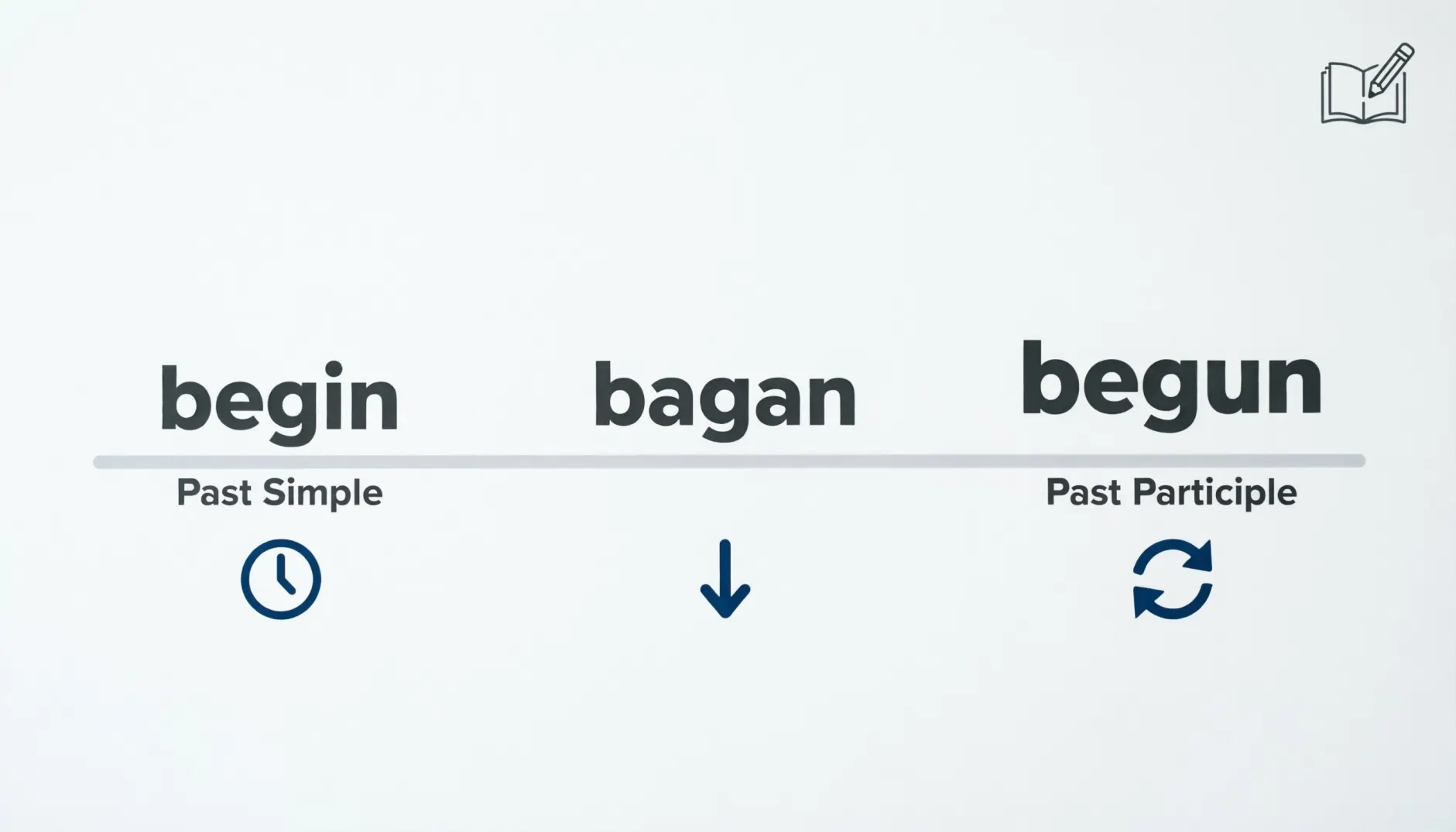
Verb Forms
| Form | Verb |
|---|---|
| Base Form | Begin |
| Past Tense | Began |
| Past Participle | Begun |
DETAILED EXPLANATION
Basic Meaning
“Begin” means to start something.
👉 Example: I begin my work at 9 AM.
Past Tense (Began)
We use “began” when something started in the past.
👉 Example: The meeting began at 10 AM.
Past Participle (Begun)
We use “begun” with helping verbs like has, have, had.
👉 Example: The movie has begun.
Important Rule
- ❌ “Begined” is WRONG
- ✅ “Began” is CORRECT
This happens because “begin” is an irregular verb.
Advanced Insight
- “Began” → used alone (simple past)
- “Begun” → used with helping verbs (perfect tenses)
FORMS / CONJUGATION TABLES
| Form | Verb | Example |
|---|---|---|
| Base Form | Begin | I begin now |
| Past Tense | Began | I began yesterday |
| Past Participle | Begun | I have begun my work |
| Present Participle | Beginning | I am beginning my work |
⏳ Full Tense Table
| Tense | Sentence |
|---|---|
| Present | I begin my work. |
| Past | I began my work. |
| Future | I will begin my work. |
| Present Perfect | I have begun my work. |
| Past Perfect | I had begun my work. |
COMPARISON SECTION
Begin vs Began – Difference
Begin = present
Began = past
Sentence 1: I begin my class at 8.
Sentence 2: I began my class at 8.
Began vs Begun – Difference
Began = simple past
Begun = used with helping verbs
Sentence 1: She began the project.
Sentence 2: She has begun the project.
Past vs Present
Present = happening now
Past = already happened
Sentence 1: They begin the game.
Sentence 2: They began the game.
Past vs Past Participle
Past = independent
Past participle = needs helper verb
Sentence 1: We began early.
Sentence 2: We have begun early.
Simple Past vs Present Perfect
Simple past = specific time
Present perfect = no exact time
Sentence 1: I began yesterday.
Sentence 2: I have begun already.
SENTENCE STRUCTURE
1. Simple Sentences Formula
Subject + began + object
Examples:
- I began my homework.
- She began a new job.
- They began the match.
- We began early.
- He began speaking.
2. Negative Sentences Formula
Subject + did not + begin
Examples:
- I did not begin the work.
- She did not begin early.
- They did not begin on time.
- We did not begin the class.
- He did not begin the task.
3. Interrogative Sentences Formula
Did + subject + begin?
Examples:
- Did you begin the work?
- Did she begin early?
- Did they begin the match?
- Did we begin late?
- Did he begin speaking?
REAL LIFE EXAMPLES
- I began my day with coffee.
- She began learning English.
- They began the meeting late.
- We began the journey early.
- He began writing a book.
- Did you begin your homework?
- She did not begin the task.
- We began watching the movie.
- The show began at 7 PM.
- I began exercising daily.
- They began building the house.
- He began cooking dinner.
- Did they begin on time?
- I did not begin yet.
- She began reading a novel.
- The class began yesterday.
- We began planning the trip.
- He began working late.
- Did she begin the project?
- They did not begin the game.
DAILY USE + DIALOGUE
Conversation 1:
A: When did you start studying?
B: I began last night.
A: Was it easy?
B: No, but I have begun to understand it now.
Conversation 2:
A: Did the meeting start?
B: Yes, it began 10 minutes ago.
A: Oh no, I’m late!
COMMON MISTAKES
❌ I begined my work
✅ I began my work
👉 Reason: “Begin” is irregular
❌ I have began
✅ I have begun
👉 Reason: Past participle needed
❌ Did you began?
✅ Did you begin?
👉 Reason: Use base form after “did”
GRAMMAR RULES
- “Begin” is an irregular verb
- Use “began” for past tense
- Use “begun” with helping verbs
- Never use “begined”
- After “did,” always use base form
- Use correct tense based on time
ADVANCED USAGE
Continuous Form
- I am beginning my work
- I was beginning to understand
Perfect Form
- I have begun the project
- She had begun before me
Future Form
- I will begin tomorrow
- They will begin soon
PRACTICE SECTION
Fill in the Blanks
- I ______ my homework yesterday.
- She has ______ the project.
- They ______ the game late.
- We have ______ already.
- He ______ the task yesterday.
MCQs
- Past tense of begin?
a) begun
b) began ✅
c) begined - Past participle?
a) began
b) begun ✅
c) begin - Correct sentence?
a) I begined
b) I began ✅ - Choose correct:
a) has began
b) has begun ✅ - After “did”:
a) began
b) begin ✅
Error Correction
- I begined → I began
- She has began → She has begun
- Did you began → Did you begin
- They has begun → They have begun
- We begined early → We began early
Answers
Fill blanks:
- began
- begun
- began
- begun
- began
FAQs
1. What is the past tense of begin?
The past tense is began.
2. What is the past participle?
It is begun.
3. Can I say “begined”?
No, it is incorrect.
4. When do we use “begun”?
With helping verbs like has, have, had.
5. Is “begin” regular or irregular?
It is an irregular verb.
6. Example of past tense?
She began her work.
7. Example of past participle?
She has begun her work.
CONCLUSION
Understanding the past tense of begin is a small but powerful step toward mastering English grammar.
While it may seem confusing at first because it’s an irregular verb, once you remember the forms begin, began, begun everything becomes much easier.
The key is practice. Try using these forms in your daily conversations, writing exercises, or even while thinking in English.
The more you use them, the more natural they will feel.
Don’t just read apply what you’ve learned. Create your own sentences, test yourself, and keep improving.
You can also use grammar tools or checkers to refine your usage.

Hi, I’m Noah Bester, a tenses expert passionate about simplifying English grammar. I create practical, easy-to-understand guides to help learners master tenses with confidence. My goal is to make grammar clear, useful, and applicable in everyday communication. tenseshub.com