Have you ever finished a workout, played a sport, or worked outside on a hot day? You might say, “I sweat a lot when I exercise.” But what should you say when the activity happened yesterday? Is it “I sweat a lot yesterday” or “I sweated a lot yesterday”?
The correct answer is that both “sweated” and “sweat” can be used as the past tense of sweat. However, “sweated” is the regular past-tense form and is especially common when describing the act of producing perspiration. “Sweat” is also an accepted past form, particularly in some varieties of English and certain expressions.
The verb sweat describes the process of producing moisture through your skin, usually because of heat, exercise, fear, or physical effort. Learning its past forms will help you describe completed activities, tell stories, write clearly, and avoid common grammar mistakes.
In this guide, you will learn the past tense of sweat, its verb forms, sentence patterns, everyday examples, and the difference between sweat and sweated. You will also find practice exercises to help you use these forms confidently.
Quick Answer: What Is the Past Tense of Sweat?
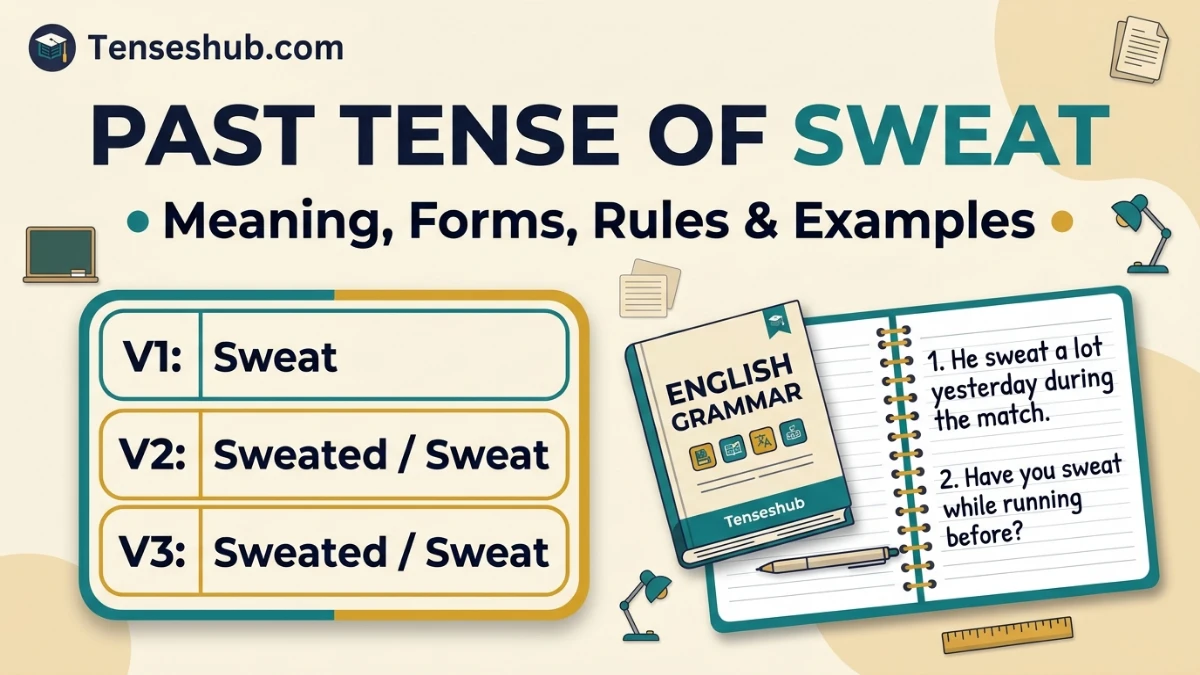
The past tense of sweat is sweated or sweat. The regular past form is sweated, while sweat is also accepted as an alternative past form. The past participle is usually sweated, though sweat is also used.
| Verb Form | Word |
|---|---|
| V1 (Base form) | sweat |
| V2 (Past tense) | sweated / sweat |
| V3 (Past participle) | sweated / sweat |
| V-ing (Present participle) | sweating |
| Third-person singular | sweats |
Examples:
- Present: I sweat during exercise.
- Past: I sweated during exercise.
- Past alternative: I sweat a lot during yesterday’s workout.
- Present perfect: I have sweated a lot today.
What Is the Past Tense of Sweat?
The past tense of sweat describes perspiration or the effort associated with it at a time before the present. It can refer to physical activity, hot weather, nervousness, or hard work.
For example:
- She sweated during the long run.
- I sweat through my shirt yesterday.
- The players sweated under the afternoon sun.
- He sweated over the difficult exam.
The word sweat is commonly used as both a noun and a verb.
As a noun, it refers to the moisture produced by your body.
Example: There was sweat on his forehead.
As a verb, it describes the action of producing that moisture.
Example: He sweated during the race.
When you talk about an action that happened in the past, you can use sweated or, where appropriate, sweat.
Is Sweat a Regular or Irregular Verb?
The verb sweat can be treated as a regular verb when forming its past tense with -ed:
- V1: Sweat
- V2: Sweated
- V3: Sweated
However, it also has an established alternative form in which the past tense and past participle remain sweat.
- V1: Sweat
- V2: Sweat
- V3: Sweat
For everyday writing, sweated is a reliable choice, especially when describing perspiration. Remember that the form sweat is not automatically wrong when used in the past.
Structure of Sentences Using the Past Tense of Sweat
The verb sweat follows the usual sentence patterns for the simple past tense. The main verb appears in the past form in affirmative statements. In negative statements and questions, use the helping verb did with the base form sweat.
1. Affirmative Sentences
Formula: Subject + past form of sweat + other words.
Examples:
- I sweated during the workout.
- She sweated in the summer heat.
- They sweat during the match.
- He sweated heavily while running.
Both sweated and sweat can appear in affirmative past-tense sentences, depending on usage and context.
2. Negative Sentences
Formula: Subject + did not + sweat + other words.
Examples:
- I did not sweat during the short walk.
- She didn’t sweat much yesterday.
- They did not sweat during the first half.
- He didn’t sweat while sitting in the shade.
Use the base form sweat after did not or didn’t. Do not write “didn’t sweated.”
3. Interrogative Sentences
Formula: Did + subject + sweat + other words?
Examples:
- Did you sweat during the race?
- Did she sweat a lot yesterday?
- Did they sweat in the heat?
- Did he sweat during the interview?
Use sweat, not sweated, after did in standard questions.
Formation of the Past Tense of Sweat
Understanding how the verb changes makes it easier to choose the right form in different sentences.
1. Add -ed to Form Sweated
The most straightforward way to form the past tense is to add -ed to sweat.
Sweat + ed = Sweated
Examples:
- I sweated during the training session.
- The workers sweated in the hot factory.
- She sweated through her presentation.
This is the regular past-tense formation and is a safe, widely understood option.
2. Use Sweat as an Alternative Past Form
English also allows sweat to function as a past-tense form.
Examples:
- He sweat through his shirt during the game.
- The team sweat under the afternoon sun.
This usage is accepted, although preferences can vary by region, context, and writing style.
3. Form the Past Participle
The past participle is used with helping verbs such as have, has, and had.
The two forms are:
- Have/has + sweated
- Have/has + sweat
Examples:
- I have sweated a lot today.
- She has sweated through several training sessions.
- He had sweat through his shirt before the match ended.
The form sweated is a clear choice for learners, especially in formal writing.
4. Form the -ing Word
To describe an action in progress, use sweating.
Examples:
- I am sweating after my workout.
- She was sweating in the crowded room.
- They were sweating while carrying the boxes.
Notice that sweating drops no letters from the base word. Simply add -ing.
How to Use the Past Tense of Sweat
The past forms of sweat are useful in many everyday situations. Your choice depends on the sentence, the time being described, and the verb pattern.
1. Describe Physical Exercise
Use sweated to explain that someone produced perspiration during a completed exercise session.
Examples:
- I sweated a lot at the gym yesterday.
- Maria sweated during her morning run.
- The players sweated throughout the football match.
The alternative sweat is also possible in past-tense statements.
Example: The players sweat through the final minutes of the game.
2. Talk About Hot Weather
You can use the past form when describing a previous experience in hot or humid conditions.
Examples:
- We sweated while waiting for the bus.
- He sweated in the summer sun.
- The children sweated during the outdoor activity.
These sentences describe completed events, so the past-tense context is clear.
3. Describe Nervousness
People may sweat when they feel anxious, embarrassed, or afraid.
Examples:
- I sweated before my job interview.
- She sweated while waiting for the exam results.
- He sweated nervously before speaking on stage.
In these examples, sweated describes a physical reaction that occurred in the past.
4. Describe Hard Work or Effort
The word sweat can also be used figuratively to describe hard work and effort.
Examples:
- They sweated for months to finish the project.
- She sweated over every detail of the report.
- The team sweated to meet the deadline.
The expression sweat over something means to work hard on it or worry about it.
5. Use Sweat in Common Expressions
Some expressions use sweat in a figurative way.
Break a sweat: To begin sweating, often because of physical effort.
Example: I barely broke a sweat during the easy walk.
Work up a sweat: To become sweaty through activity.
Example: We worked up a sweat playing basketball.
Don’t sweat it: An informal expression meaning not to worry.
Example: Don’t sweat it; we still have time.
When changing these expressions into the past, the main verb usually changes according to the sentence.
Example: I worked up a sweat during the game.
Past Tense of Sweat: Verb Pattern Table
This table summarizes the most useful forms for beginners.
| Sentence Type | Formula | Example |
|---|---|---|
| Affirmative past | Subject + sweated/sweat | She sweated during practice. |
| Negative past | Subject + didn’t + sweat | She didn’t sweat much. |
| Past question | Did + subject + sweat? | Did she sweat? |
| Past continuous | Subject + was/were + sweating | She was sweating. |
| Past perfect | Subject + had + sweated/sweat | She had sweated before resting. |
| Present perfect | Subject + has/have + sweated/sweat | She has sweated a lot. |
Real-Life Examples of Sweat in the Past Tense
Here are varied examples showing how to use the verb in everyday conversations and writing.
Affirmative Examples
- I sweated heavily during yesterday’s workout.
- My brother sweated while carrying the furniture upstairs.
- The players sweat under the stadium lights.
- She sweated through her shirt on the long hike.
- The workers sweated all afternoon in the hot weather.
- He sweated over the final details of his assignment.
Negative Examples
- I didn’t sweat much during the evening walk.
- She didn’t sweat because the room was cool.
- They didn’t sweat during the short practice session.
- He did not sweat while waiting in the air-conditioned office.
Question Examples
- Did you sweat during the fitness test?
- Did she sweat a lot in the summer heat?
- Did the players sweat through the entire match?
- Why did he sweat so much during the interview?
- When did you first notice that you were sweating?
Formal and Informal Examples
- Formal: The participants sweated during the endurance test.
- Formal: Several workers sweated in the poorly ventilated room.
- Informal: I totally sweated through my shirt at the concert.
- Informal: Don’t sweat it; you can finish the work tomorrow.
- Informal: We worked up a sweat playing basketball yesterday.
Short Conversation
Ali: Did you sweat a lot at the gym yesterday?
Hamza: Yes, I sweated quite a bit during the workout.
Ali: Did you feel tired afterward?
Hamza: A little, but I felt better after resting.
This conversation shows how the past-tense verb fits naturally into everyday English.
Common Mistakes When Using the Past Tense of Sweat
Learners sometimes use the wrong verb form because they forget how did, have, and was/were work. Here are the mistakes to avoid.
Mistake 1: Using Sweated After Did
Incorrect: Did you sweated during the race?
Correct: Did you sweat during the race?
Explanation: The helping verb did already marks the past tense. Use the base form sweat after it.
Mistake 2: Using Sweated After Didn’t
Incorrect: I didn’t sweated yesterday.
Correct: I didn’t sweat yesterday.
Explanation: After didn’t, always use the base form of the main verb.
Mistake 3: Thinking Sweat Is Always Wrong in the Past
Incorrect assumption: “Sweat can never be used as a past-tense verb.”
Correct understanding: Both sweated and sweat are accepted past forms.
Example: He sweat through his shirt during the race.
Explanation: Sweated is the regular form, but sweat is also used as a past form.
Mistake 4: Using Sweat Instead of Sweating After Was
Incorrect: She was sweat during the match.
Correct: She was sweating during the match.
Explanation: The past continuous tense uses was/were + verb-ing.
Mistake 5: Confusing the Verb With the Noun
Incorrect: There was many sweat on his face.
Better: There was a lot of sweat on his face.
Explanation: Sweat is usually an uncountable noun when referring to perspiration. Use a lot of sweat, not many sweat.
Mistake 6: Using the Wrong Form After Have
Incorrect: I have sweat a lot yesterday.
Better: I sweated a lot yesterday.
Also correct: I have sweated a lot today.
Explanation: Use the simple past with a finished time such as yesterday. Use the present perfect for a period connected to the present, such as today, when the context supports that meaning.
Key Grammar Rules for Sweat
Remember these practical rules to use the verb correctly.
Rule 1: Sweated Is the Regular Past Form
Add -ed to form sweated.
Example: The runner sweated during the race.
Rule 2: Sweat Can Also Be a Past Form
The base form can function as the simple past in accepted English usage.
Example: He sweat through his shirt.
Rule 3: Use Sweat After Did and Didn’t
The helping verb did carries the past-tense meaning.
Example: Did she sweat? She didn’t sweat.
Rule 4: Use Sweating With Was or Were
The past continuous describes an action in progress at a particular time.
Example: They were sweating when the coach arrived.
Rule 5: Use a Past Participle With Have, Has, or Had
The past participle is commonly sweated, although sweat is also accepted.
Examples:
- I have sweated a lot today.
- She had sweated before she took a break.
Rule 6: Match the Tense to the Time
Use the simple past for a completed event at a finished time.
Example: We sweated during yesterday’s match.
Use the present tense for habits or general facts.
Example: We sweat during intense exercise.
Sweat vs. Sweated vs. Sweating
These words come from the same verb, but they have different grammatical uses.
| Word | Main Use | Example |
|---|---|---|
| sweat | Base form or present tense | I sweat during exercise. |
| sweats | Present tense with he, she, or it | He sweats a lot. |
| sweated | Regular past form | He sweated yesterday. |
| sweat | Alternative past form | He sweat during the match. |
| sweating | -ing form | He was sweating. |
The correct form depends on the sentence rather than the word alone.
Sweat vs. Sweated
Both can describe an action in the past.
- She sweated during the race.
- She sweat during the race.
The first uses the regular past form. The second uses the alternative past form. When you are unsure which one to choose, sweated is a dependable option.
Sweated vs. Sweating
Sweated is commonly used for a completed past action.
Example: I sweated during the workout.
Sweating is used with a helping verb to show an action in progress.
Example: I was sweating during the workout.
Sweat vs. Sweat as a Noun
As a verb: The runner sweated during practice.
As a noun: The runner wiped sweat from his forehead.
The surrounding sentence tells you which meaning is intended.
Sweat in Different Tenses
Learning how the verb behaves in different tenses will help you write more accurate sentences.
| Tense | Example |
|---|---|
| Simple present | I sweat during exercise. |
| Simple past | I sweated yesterday. |
| Simple past (alternative) | I sweat during the match. |
| Present continuous | I am sweating now. |
| Past continuous | I was sweating earlier. |
| Present perfect | I have sweated a lot today. |
| Past perfect | I had sweated before I rested. |
| Simple future | I will sweat during the workout. |
Notice that will and did take the base form sweat. The forms am sweating and was sweating use the -ing form.
Exercises: Practice the Past Tense of Sweat
Test your understanding with these beginner-friendly questions. Try to answer each one before checking the answer key.
Exercise 1: Fill in the Blanks
Complete each sentence with the correct form of the verb in parentheses.
- I ______ a lot during yesterday’s workout. (sweat)
- Did she ______ during the race? (sweat)
- They were ______ while running in the sun. (sweat)
- He didn’t ______ much during the walk. (sweat)
- She has ______ through several training sessions. (sweat)
- We ______ during the football match last weekend. (sweat)
Exercise 2: Correct the Mistakes
Rewrite each sentence correctly.
- I didn’t sweated during the game.
- Did he sweated yesterday?
- She was sweat after the workout.
- They has sweated during practice.
- I have sweat yesterday afternoon.
Exercise 3: Rewrite the Sentences
Follow the instruction given for each sentence.
- Change to the simple past: I sweat during exercise.
- Make it negative: She sweated during practice.
- Make it a question: They sweated during the match.
- Change to the past continuous: He sweats while running.
- Change to the present perfect: We sweat during training.
Exercise 4: Multiple-Choice Questions
1. Which is the regular past tense of sweat?
A. Sweating
B. Sweated
C. Sweats
D. Sweatting
2. Choose the correct sentence.
A. Did you sweated yesterday?
B. Did you sweat yesterday?
C. Did you sweating yesterday?
D. Did you sweats yesterday?
3. Which sentence uses the past continuous correctly?
A. She was sweat.
B. She were sweating.
C. She was sweating.
D. She did sweating.
4. Which sentence is correct?
A. He didn’t sweated much.
B. He didn’t sweat much.
C. He doesn’t sweated much.
D. He not sweat much.
5. Which word completes the sentence? “I have ______ a lot today.”
A. sweating
B. sweats
C. sweated
D. sweatting
Answer Key
Exercise 1
- Sweated (sweat is also possible as a past form)
- Sweat
- Sweating
- Sweat
- Sweated (sweat is also possible)
- Sweated (sweat is also possible)
Exercise 2
- I didn’t sweat during the game.
- Did he sweat yesterday?
- She was sweating after the workout.
- They have sweated during practice.
- I sweated yesterday afternoon.
Exercise 3
- I sweated during exercise.
- She didn’t sweat during practice.
- Did they sweat during the match?
- He was sweating while running.
- We have sweated during training.
Exercise 4
- B. Sweated
- B. Did you sweat yesterday?
- C. She was sweating.
- B. He didn’t sweat much.
- C. Sweated
Frequently Asked Questions (FAQs)
1. What is the past tense of sweat?
The past tense of sweat is sweated or sweat. Sweated is the regular past form and a reliable choice for learners.
2. Is sweat or sweated correct?
Both are correct as past-tense forms. Sweated is the regular form, while sweat is an established alternative.
3. Is sweat a regular or irregular verb?
It has a regular past form, sweated, and an alternative form, sweat. Both forms are used in English.
4. What is past the participle of sweat?
The past participle is usually sweated, but sweat is also accepted. For example, “I have sweated a lot today.”
5. What is the difference between sweat and sweated?
Sweat is the base form and can also be used as a past form. Sweated is the regular past tense and past participle.
6. Is “I sweat yesterday” grammatically correct?
Yes, sweat is accepted as an alternative past form. However, “I sweated yesterday” is a straightforward choice for general writing.
7. What is the past tense of sweat in a sentence?
Example: “I sweated during the football match yesterday.” You can also say, “I sweat during the football match yesterday.”
8. What is the -ing form of sweat?
The -ing form is sweating.
Example: “The players were sweating during the match.”
9. What is the third-person singular form of sweat?
The third-person singular present form is sweats.
Example: “My brother sweats a lot during exercise.”
10. How do you use sweat in a negative past-tense sentence?
Use did not or didn’t followed by the base form sweat.
Example: “She didn’t sweat during the short walk.”
Conclusion
Learning the past tense of sweat is simple once you understand its two accepted forms. Sweated is the regular past-tense form, while sweat is also used as an alternative past form in English. Both can describe perspiration caused by exercise, hot weather, nervousness, or hard work.
Remember to use sweat after did and didn’t, as in “Did you sweat?” and “I didn’t sweat.” Use sweating with forms of be when describing an action in progress, as in “She was sweating.”
The best way to improve is to practise with everyday situations. Write a few sentences about a workout, a hot day, or a stressful moment. With regular practice, you will become more confident using sweat, sweated, and sweating correctly in conversation and writing.

Hi, I’m Noah Bester, a tenses expert passionate about simplifying English grammar. I create practical, easy-to-understand guides to help learners master tenses with confidence. My goal is to make grammar clear, useful, and applicable in everyday communication. tenseshub.com