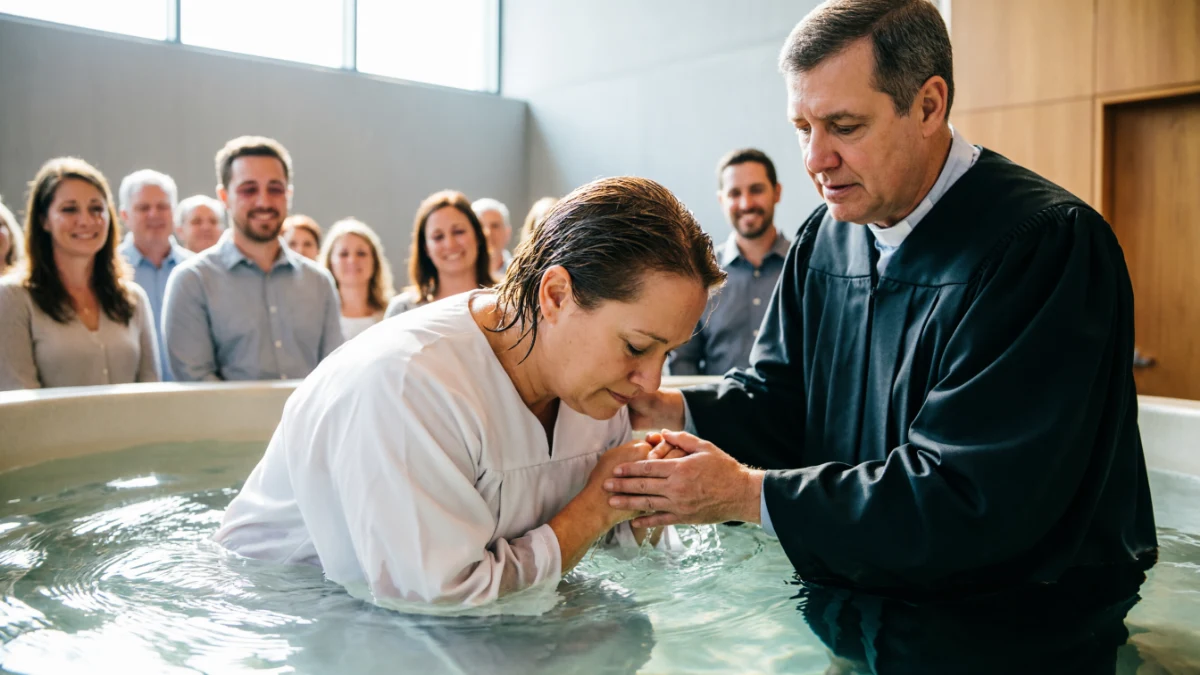
Imagine standing beside a baptismal pool with someone who has decided to publicly express their faith. Everyone is ready, the moment feels meaningful, and then you realize: What exactly should I say when baptizing someone?
If you are a pastor, minister, church leader, family member, or Christian asked to participate in a baptism, choosing the right words can feel more difficult than expected. You want the words to be respectful, clear, and appropriate for the person’s faith tradition without making the moment unnecessarily complicated.
The good news is that a baptism does not require a long speech. A short statement can acknowledge the person’s faith, explain the purpose of the baptism, and lead naturally into the act itself.
This guide explains what to say when baptizing someone, including simple baptism scripts, words for baptizing someone in water, short testimony introductions, examples for church settings, and considerations for different Christian traditions. Because baptism practices and wording vary among denominations, the safest approach is to follow the person’s church or ministerial tradition when one has already been established.
Quick Answer:
What should you say when baptizing someone?
A simple baptism statement is: “[Name], upon your profession of faith in Jesus Christ, I baptize you in the name of the Father, and of the Son, and of the Holy Spirit.” You can then immerse the person in water according to your church’s practice. The exact wording may vary among Christian traditions.
The wording above follows the baptismal command in Matthew 28:19.
A simple baptism script works best when you want clear, respectful words
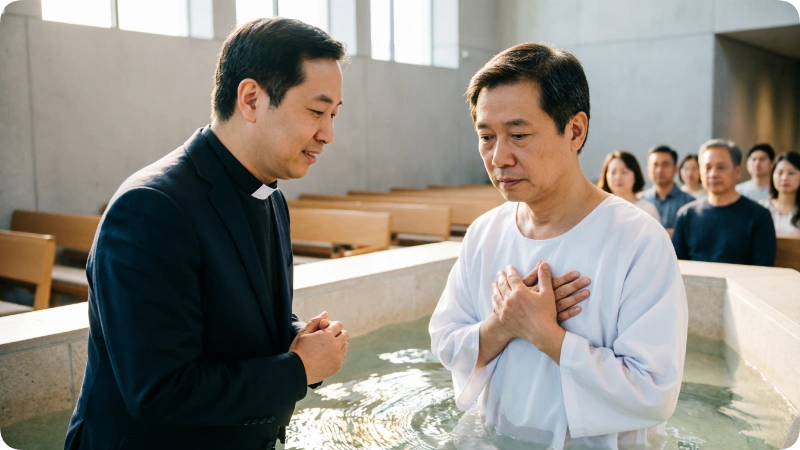
A simple script should identify the person, acknowledge their faith, and state that you are baptizing them.
Simple script:
“[Name], do you believe in Jesus Christ and desire to follow Him?”
After the person responds:
“Upon your profession of faith, I baptize you in the name of the Father, and of the Son, and of the Holy Spirit.”
You can then perform the baptism according to the practice of your church.
This approach is effective because it keeps the focus on the person being baptized rather than on the person performing the ceremony.
The exact wording is not identical across every Christian tradition. Matthew 28:19 gives the Father, Son, and Holy Spirit formula, while Acts contains references to baptism “in the name of Jesus Christ.” Different churches therefore may have established wording they expect ministers to use.
In practice: If your church already has an official baptism script, use that script rather than creating your own formula. The goal is to make the moment meaningful without introducing uncertainty at the last second.
If you are baptizing someone in water, keep your words brief and easy to hear
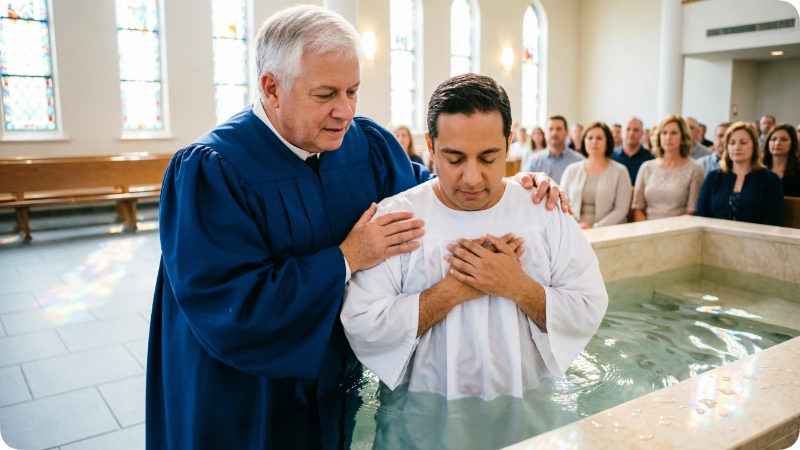
When someone is standing in a baptismal pool, river, or other body of water, long sentences can become difficult to hear and remember.
A practical water baptism script is:
“[Name], because of your faith in Jesus Christ and your desire to follow Him, I now baptize you in the name of the Father, and of the Son, and of the Holy Spirit.”
Then proceed according to your church’s baptismal practice.
The communication principle here is clarity under pressure. Water, movement, emotion, and an audience can make a ceremony feel intense, so simple language helps everyone understand what is happening.
New Testament accounts describe baptism taking place in water, including the baptism of the Ethiopian eunuch in Acts 8. Some Christian traditions understand these passages as supporting immersion, while others recognize additional forms of administering baptism.
Quick Take: Say enough to explain the meaning of the moment, but do not turn the actual baptism into a long speech.
If you want to follow Matthew 28:19, use the traditional Trinitarian wording
If your church follows the wording of Matthew 28:19, the central phrase is:
“I baptize you in the name of the Father, and of the Son, and of the Holy Spirit.”
Matthew 28:19 records Jesus’ instruction to baptize disciples in the name of the Father, Son, and Holy Spirit. Many Christian churches therefore use this wording, sometimes with an additional statement before or after it.
You could make the complete statement:
“[Name], upon your profession of faith in Jesus Christ, I baptize you in the name of the Father, and of the Son, and of the Holy Spirit.”
This works because it combines personal recognition with the traditional baptismal formula.
If you are unsure about the wording your church expects, ask the pastor or church leader beforehand.
If your church baptizes in Jesus’ name, follow your church’s established formula
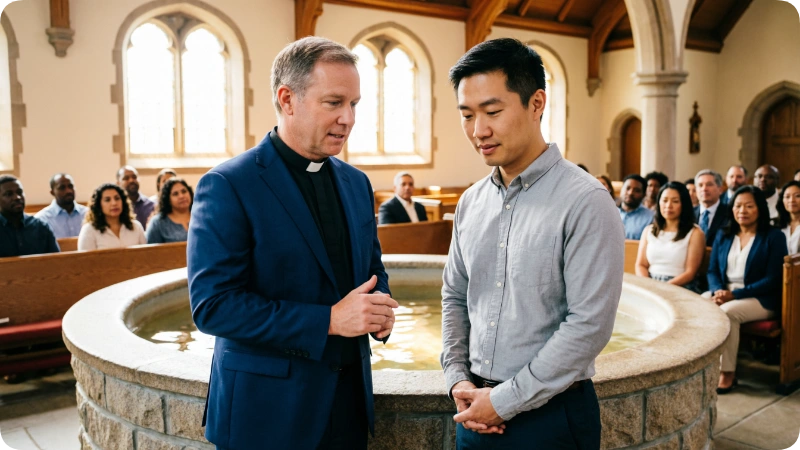
Some Christian traditions use wording centered specifically on the name of Jesus Christ.
A person may therefore hear a statement such as:
“[Name], upon your profession of faith in Jesus Christ, I baptize you in the name of Jesus Christ.”
The New Testament includes passages describing baptism “in the name of Jesus Christ,” including Acts 2:38 and Acts 10:48. Christian traditions interpret and apply these passages differently.
This is an important area where denominational context matters.
Do not assume that one formula is universally used by every Christian church. If you are baptizing someone on behalf of a church, use that church’s established practice.
In practice:
A person may search for “how to baptize someone in Jesus’ name” because they have been asked to perform a baptism. Before the ceremony, the most respectful step is to confirm the exact wording with the person’s pastor, minister, or church leadership.
If you are baptizing someone in a Church of Christ setting, use the congregation’s practice
If the baptism is taking place in a Church of Christ, do not rely on a generic internet script alone. Churches can have their own established wording and procedures.
A baptism statement may include the person’s confession of faith followed by words about baptism for the forgiveness of sins. One Church of Christ resource, for example, gives a baptismal exchange involving a confession of belief followed by a statement that the person is being baptized in the name of the Father, Son, and Holy Spirit.
A general example is:
“[Name], do you believe that Jesus Christ is the Son of God?”
After the person answers:
“Upon your confession of faith, I baptize you in the name of the Father, the Son, and the Holy Spirit.”
Treat this as a sample, not a universal Church of Christ script.
Why this works: A question and response format gives the person an opportunity to publicly express their faith before the baptism.
If you are introducing someone’s baptism testimony, let the person tell their own story
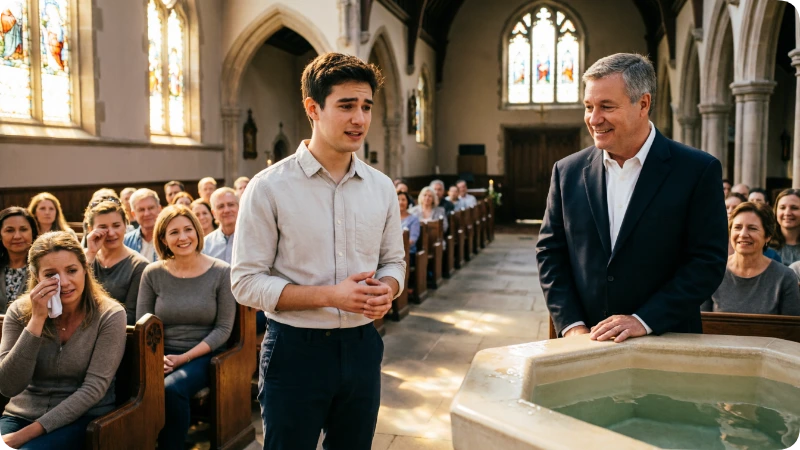
A baptism testimony should sound personal rather than rehearsed.
You might introduce it by saying:
“Before we begin the baptism, [Name] would like to share briefly why they have chosen to follow Jesus and be baptized today.”
Then allow the person to speak.
A short testimony might sound like:
“I chose to be baptized because I have placed my faith in Jesus and want to publicly commit my life to following Him. I know this is the beginning of a continuing journey of faith, and I am grateful to share this moment with my church family.”
The communication principle is authenticity. A person’s own words usually communicate their reasons for baptism more naturally than a speech written entirely by someone else.
Pastoral training resources also emphasize preparing people for what they will say and helping them communicate their reasons clearly before baptism.
If you are baptizing a friend or family member, add a personal sentence before the formal words
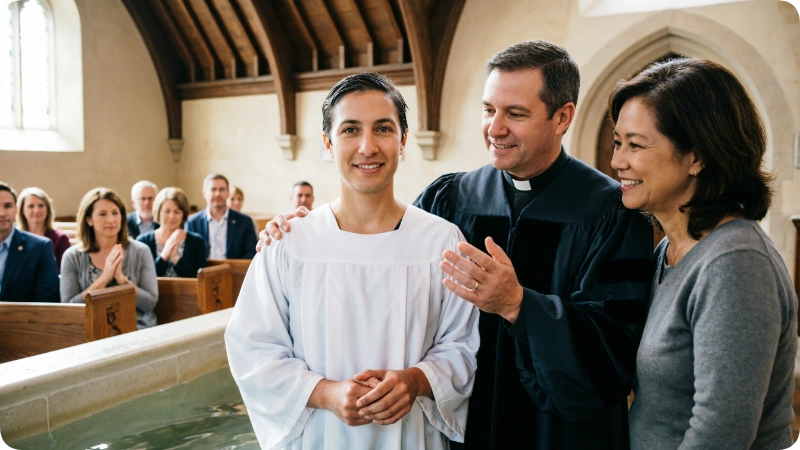
When you have a close relationship with the person, one short personal sentence can make the moment warmer.
You could say:
“It is a privilege to share this important moment with you. I am proud of the step you are taking and excited to see how your faith continues to grow.”
Then transition into the baptism:
“[Name], upon your profession of faith, I baptize you in the name of the Father, and of the Son, and of the Holy Spirit.”
This works because it separates personal encouragement from the formal baptismal statement.
In practice
Imagine your younger brother is being baptized and you have been asked to participate. Instead of giving a five minute speech, you might say:
“I have watched your faith grow, and it means a lot to be here with you today. [Name], upon your profession of faith, I baptize you…”
That feels personal without taking attention away from him.
If you are nervous, use a very short baptism script
You do not need impressive words.
Shortest useful version:
“[Name], I baptize you in the name of the Father, and of the Son, and of the Holy Spirit.”
If your tradition requires a profession of faith first, add:
“Do you believe that Jesus Christ is the Son of God?”
After the response:
“Upon your profession of faith, I baptize you in the name of the Father, and of the Son, and of the Holy Spirit.”
Short wording is especially useful when the person performing the baptism is nervous.
Why it works: A ceremony becomes easier to manage when the speaker has only a few essential lines to remember.
If you are baptizing someone at home, confirm the church’s requirements first
A home baptism can raise questions about who should perform it, what wording should be used, if witnesses are needed, and how the church recognizes the baptism.
The safest approach is to contact the person’s church or pastor before the ceremony.
If the church permits the setting and the person is appropriately prepared, the spoken portion can remain simple:
“[Name], today you are publicly expressing your faith in Jesus Christ. Upon your profession of faith, I baptize you in the name of the Father, and of the Son, and of the Holy Spirit.”
Do not assume that every denomination treats home baptism in the same way. Christian teaching and practice differ on who may administer baptism, the appropriate setting, the mode of baptism, and the meaning of the sacrament or ordinance.
In practice:
If a family asks you to baptize someone in a bathtub or private pool, the important question is not simply “What words should I say?” It is also “Does the person’s church recognize this as an appropriate baptism?” Resolve that question before the ceremony.
If you are congratulating someone after their baptism, focus on encouragement
Sometimes “what to say when baptizing someone” actually means “What should I say to someone who has just been baptized?”
In that situation, you are not performing the baptism. You are congratulating or encouraging the person.
Try:
- “Congratulations on your baptism. May God guide you as you continue your journey of faith.”
- “What a meaningful day. I am so happy to celebrate this step with you.”
- “Congratulations! May your faith continue to grow stronger as you follow Christ.”
- “I am grateful I could share this special day with you. God bless you as you continue growing in faith.”
- “Your baptism is a beautiful expression of your faith. Wishing you many years of growth and joy in Christ.”
These responses work because they recognize the person’s commitment without making the conversation about your own beliefs or experiences.
Resources on baptism messages commonly recommend words of joy, welcome, prayer, and encouragement, particularly for adults and older children who have chosen baptism themselves.
If you are writing a baptism card, keep the message warm and personal
A baptism card does not need to sound like a sermon.
For an adult:
“Congratulations on your baptism. May this special day mark the beginning of a beautiful and faithful journey with Christ. May God guide, strengthen, and bless you in every step ahead.”
For a teenager:
“Congratulations on your baptism! May you always remember this special day and continue growing in faith, wisdom, and love.”
For a child:
“Wishing you a beautiful baptism day filled with love and joy. May God bless you and guide you as you grow in faith.”
For a close friend:
“I am so happy to celebrate your baptism with you. May this new chapter of your faith be filled with God’s love, peace, strength, and guidance.”
A useful distinction is who the message is really for. With a baby or young child, the parents and family may be the natural audience. With an older child or adult, speaking directly to the person often feels more appropriate.
If you are giving a baptism speech, keep the focus on faith and the person
A baptism speech can be longer than the baptism formula itself.
A simple structure is:
- Welcome everyone.
- Acknowledge the importance of the day.
- Say something personal about the person.
- Allow them to share their testimony if appropriate.
- Explain briefly what the baptism represents within your tradition.
- Transition to the baptism.
- Say the baptismal words clearly.
Sample speech:
“Today we are gathered to celebrate an important step in [Name]’s faith journey. Baptism is a public expression of faith and a meaningful commitment to follow Christ.
[Name], we are grateful to share this moment with you. Your decision is personal, but it is also something your church family is honored to witness and celebrate.
As you continue your journey, remember that faith is lived not only in important moments like today but also in the choices you make each day.
Now, upon your profession of faith, I baptize you in the name of the Father, and of the Son, and of the Holy Spirit.”
The principle is proportion: the speech should support the baptism rather than overshadow it.
What NOT to Say When Baptizing Someone
The best baptism language is respectful, clear, and appropriate to the person’s faith tradition. Avoid statements that make the moment confusing or unnecessarily self centered.
1. Avoid making the ceremony about yourself
Instead of:
“I am the reason you came this far.”
Say:
“I am honored to share this important moment with you.”
The second statement supports the person without claiming ownership of their faith journey.
2. Avoid joking about a sacred or emotional moment
Instead of:
“Well, let’s see if you can hold your breath!”
Say:
“Take a moment, breathe, and be ready. We are honored to share this moment with you.”
Humor may be appropriate in some family celebrations, but the actual baptism should generally remain respectful.
3. Avoid claiming that every church uses exactly the same words
Instead of:
“This is the only correct baptism script for all Christians.”
Say:
“Different Christian traditions use different wording and practices, so follow your church’s established form.”
This is especially important because Christian traditions differ on baptismal wording, mode, and theology.
4. Avoid adding complicated theology when a simple statement will do
Instead of giving a long theological explanation immediately before immersion, use a concise statement that the person and congregation can understand.
5. Avoid pressuring someone into baptism
Baptism is a significant religious act. Do not use emotional pressure, embarrassment, or public guilt to persuade someone who is uncertain.
A better approach is:
“Take the time you need to understand what baptism means in your faith tradition and speak with your pastor or spiritual leader.”
Quick Reference Table
| Situation | What to Say | Tone / Use |
|---|---|---|
| Simple baptism | “I baptize you in the name of the Father, Son, and Holy Spirit.” | Formal and clear |
| Profession of faith | “Upon your profession of faith, I baptize you…” | Church ceremony |
| Water baptism | “I now baptize you…” | Brief and simple |
| Jesus’ name tradition | Follow your church’s approved wording. | Denomination-specific |
| Friend’s baptism | “I’m honored to share this moment with you.” | Warm and personal |
| Baptism testimony | “Tell us why you chose baptism.” | Before the ceremony |
| Baptism speech | “Today we celebrate an important step of faith.” | Formal gathering |
| Home baptism | Confirm your church’s requirements first. | Respectful and careful |
| After baptism | “Congratulations on your baptism!” | Encouraging |
| Baptism card | “May God guide you as your faith continues to grow.” |
FAQs
What do you say to someone for a baptism?
You can say, “Congratulations on your baptism. May God bless you and guide you as you continue growing in faith.” For a close friend or family member, add a personal sentence about how happy or honored you are to share the occasion.
What do you say in a baptism speech?
A baptism speech can welcome everyone, recognize the person’s faith journey, explain the significance of the occasion within your tradition, and encourage the person as they continue in faith. Keep the speech personal and reasonably brief.
What does a pastor say when he baptizes someone?
Many pastors use a statement based on Matthew 28:19, such as “I baptize you in the name of the Father, and of the Son, and of the Holy Spirit.” Some churches add a profession of faith question or other wording based on their tradition.
How do you respond to someone being baptized?
You can respond with congratulations, encouragement, or prayer. For example: “Congratulations on this important step of faith. I’m praying that God continues to guide you as you follow Christ.”
What do you say when you baptize someone in water?
A common statement is: “Upon your profession of faith in Jesus Christ, I baptize you in the name of the Father, and of the Son, and of the Holy Spirit.” The precise wording should follow the person’s church tradition.
How do you baptize someone according to the Bible?
The Bible describes baptism in several passages, but Christian traditions interpret the details differently. Matthew 28:19 gives Jesus’ command to baptize disciples in the name of the Father, Son, and Holy Spirit, while Acts describes baptisms in connection with faith and Jesus Christ.
How do you baptize someone in Jesus’ name?
Some Christian traditions use wording such as “I baptize you in the name of Jesus Christ.” Because churches differ in how they understand and apply passages about baptism “in the name of Jesus Christ,” follow the established practice of the person’s church.
What is a simple baptism script?
A simple script is: “[Name], do you believe in Jesus Christ and desire to follow Him?” After the response, say: “Upon your profession of faith, I baptize you in the name of the Father, and of the Son, and of the Holy Spirit.”
What should I say when baptizing someone at home?
First, confirm with the person’s church or pastor that a home baptism is appropriate and determine who should administer it. If it is approved, keep the spoken portion simple and use the wording required by that church.
What words should you say when baptizing someone?
There is not one universally used sentence across all Christian traditions. A widely used form based on Matthew 28:19 is “I baptize you in the name of the Father, and of the Son, and of the Holy Spirit.”
Conclusion
Knowing what to say when baptizing someone is less about finding a complicated speech and more about choosing words that are clear, respectful, and appropriate to the person’s Christian tradition.
For many churches, a short statement such as “Upon your profession of faith, I baptize you in the name of the Father, and of the Son, and of the Holy Spirit” provides a simple foundation. Other traditions may use different wording, so the person’s church practice should always take priority.
The most meaningful baptism words are usually the ones that keep the focus where it belongs: on the person’s faith, commitment, and relationship with God. If you are preparing for a baptism, confirm the wording and procedure beforehand, practice the short script, and speak calmly. A few sincere words can be more powerful than a long speech.
Hi, I’m Robert Lowth, a passionate expert in English tenses and grammar. I specialize in simplifying complex tense rules to help learners understand and use English with confidence. My goal is to make grammar clear, practical, and easy for everyday communication. tenseshub.com