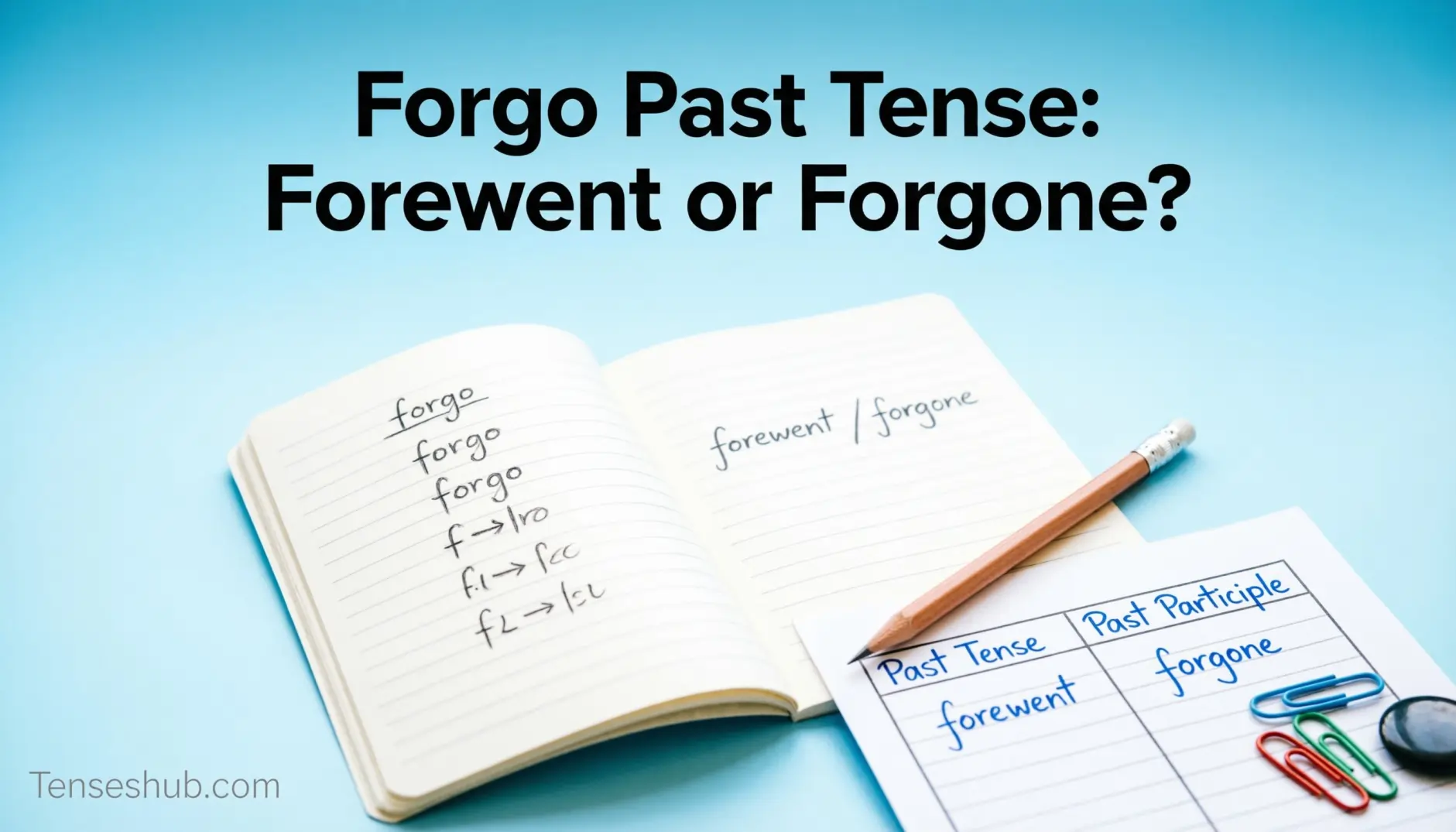
Have you ever seen the word forgo and wondered what its past tense is? Many English learners get confused because forgo is not a common everyday verb, and its spelling looks similar to other irregular verbs.
For example, should you say “I forgoed the opportunity” or “I forewent the opportunity”? This question causes confusion for students, writers, bloggers, and even native speakers.
Understanding the forgo past tense is important because the verb often appears in formal writing, business communication, academic texts, and professional conversations. If you use the wrong form, your sentence may sound unnatural or grammatically incorrect.
In this guide, you will learn the correct past tense of forgo, how to use it in sentences, common mistakes to avoid, grammar rules, examples, exercises, and answers to frequently asked questions.
Quick Answer (Featured Snippet)
| Base Form (V1) | Past Tense (V2) | Past Participle (V3) |
|---|---|---|
| forgo | forewent | forgone |
Example:
- Present: I forgo unnecessary expenses.
- Past: I forewent unnecessary expenses.
- Present Perfect: I have forgone unnecessary expenses.
What Is Forgo Past Tense?
The verb forgo means to choose not to have, do, or use something. It often refers to voluntarily giving up a benefit, opportunity, pleasure, or possession.
Meaning of Forgo
- To do without something
- To give up voluntarily
- To refrain from taking or using something
Examples in Present Tense
- I forgo dessert after dinner.
- They forgo luxury items to save money.
- She chooses to forgo unnecessary spending.
Past Tense Form
When talking about something that was given up in the past, use forewent.
Examples:
- I forewent the promotion.
- She forewent her vacation this year.
- They forewent several opportunities to save money.
The verb forgo is irregular, so it does not simply take ed.
Structure of Sentences of Forgo Past Tense
When using the past tense forewent, sentence structure remains simple.
Affirmative Structure
Subject + forewent + object
Examples:
- I forewent the offer.
- She forewent her holiday.
- They forewent the discount.
Negative Structure
Subject + did not + forgo + object
Examples:
- I did not forgo the opportunity.
- She did not forgo her education.
- They did not forgo the benefits.
Interrogative Structure
Did + subject + forgo + object?
Examples:
- Did you forgo the invitation?
- Did she forgo the scholarship?
- Did they forgo the deal?
Formation of Forgo Past Tense
The verb forgo is an irregular verb.
Verb Forms: Forgo
| Verb Form | Word |
|---|---|
| Base Form (V1) | forgo |
| Past Tense (V2) | forewent |
| Past Participle (V3) | forgone |
| Present Participle | forgoing |
Examples
- Present: I forgo unhealthy snacks.
- Past: I forewent unhealthy snacks.
- Perfect: I have forgone unhealthy snacks.
- Continuous: I am forgoing unhealthy snacks.
Why It Changes
Unlike regular verbs that add ed, irregular verbs change form completely.
Examples:
- Go → Went
- Begin → Began
- Forgo → Forewent
Because of this irregular change, forgoed is generally considered incorrect in formal English.
How to Use Forgo Past Tense
The past tense forewent is used when talking about something someone voluntarily gave up in the past.
1. Giving Up an Opportunity
- She forewent a better job offer.
- They forewent the chance to invest early.
2. Choosing Not to Have Something
- I forewent dessert at the restaurant.
- He forewent a new phone to save money.
3. Sacrifices for a Greater Goal
- The athlete forewent social activities during training.
- She forewent comfort to achieve success.
4. Formal and Professional Writing
The verb often appears in formal contexts.
- The company forewent short term profits.
- The organization forewent unnecessary expenses.
Pronunciation
Forgo = /fɔːrˈɡoʊ/
Forewent = /fɔːrˈwɛnt/
Practice:
- Forgo
- Forewent
- Forgone
Structure / Verb Pattern Table: Forgo
| Usage | Structure | Example |
|---|---|---|
| Present | Subject + forgo + object | I forgo sugar. |
| Past | Subject + forewent + object | I forewent sugar. |
| Present Perfect | Subject + have/has + forgone + object | I have forgone sugar. |
| Past Perfect | Subject + had + forgone + object | I had forgone sugar. |
| Future | Subject + will forgo + object | I will forgo sugar. |
| Continuous | Subject + be + forgoing + object | I am forgoing sugar. |
Real Life Examples
Everyday Life
- I forewent coffee this morning.
- She forewent a taxi and walked home.
- We forewent expensive decorations.
School and Education
- He forewent a year abroad.
- The student forewent extra activities to focus on exams.
Business
- The company forewent immediate profits.
- Management forewent bonuses during difficult times.
Informal Conversation
- I forewent dessert because I was full.
- We forewent the movie and stayed home.
Questions
- Did you forgo the discount?
- Did she forgo the opportunity?
Negative Sentences
- I did not forgo the offer.
- They did not forgo the benefits.
Common Mistakes
Mistake 1: Using “Forgoed”
❌ I forgoed the opportunity.
✅ I forewent the opportunity.
Explanation: The correct past tense is forewent.
Mistake 2: Using “Foregone” as Past Tense
❌ I foregone the opportunity.
✅ I forewent the opportunity.
Explanation: Forgone is the past participle, not the simple past tense.
Mistake 3: Using Past Form After “Did”
❌ Did you forewent the opportunity?
✅ Did you forgo the opportunity?
Explanation: After did, use the base verb.
Mistake 4: Wrong Perfect Tense
❌ I have forewent the opportunity.
✅ I have forgone the opportunity.
Explanation: Perfect tenses require the past participle forgone.
Key Grammar Rules
1. Forgo Is an Irregular Verb
- Forgo → Forewent → Forgone
2. Use Forewent for Simple Past
- She forewent the opportunity.
3. Use Forgone for Perfect Tenses
- She has forgone the opportunity.
4. Use the Base Form After Did
- Did you forgo the opportunity?
5. Use Forgoing for Continuous Tenses
- She is forgoing dessert.
6. Forgo Usually Means a Voluntary Choice
- He forewent luxury items.
- She forewent unnecessary expenses.
Comparisons with Similar Grammar Forms
Forgo vs Forego
These spellings are often treated as variants.
- Forgo = More common modern spelling
- Forego = Older variant in some contexts
Examples:
- I chose to forgo dessert.
- I chose to forego dessert.
Both may appear, but forgo is generally preferred when meaning “to do without.”
Forgo vs Give Up
Forgo is more formal.
Forgo
- She forewent the scholarship.
Give Up
- She gave up the scholarship.
Forgo vs Sacrifice
Forgo means choosing not to take something.
Sacrifice often suggests giving something up for a greater purpose.
Examples:
- He forewent the opportunity.
- He sacrificed his free time for success.
Forgo vs Abstain
Abstain usually means deliberately avoiding an action.
- She abstained from voting.
- She forewent the benefit.
Exercises
Exercise 1: Fill in the Blanks
Choose the correct form.
- Yesterday, I ______ the discount.
- She has ______ several opportunities.
- We ______ dessert last night.
- They are ______ luxury purchases.
- Did you ______ the invitation?
Exercise 2: Correct the Mistakes
- I forgoed the offer.
- She has forewent the opportunity.
- Did he forewent the discount?
- They have forewent several benefits.
- We forgoed dessert.
Exercise 3: Rewrite in the Past Tense
- I forgo unnecessary expenses.
- She forgoes luxury items.
- They forgo vacations.
- We forgo extra spending.
- He forgoes the opportunity.
Exercise 4: Multiple Choice
1. What is the past tense of forgo?
A. Forgoed
B. Forewent
C. Forgone
D. Forgoes
2. Which sentence is correct?
A. I forgoed the opportunity.
B. I foregone the opportunity.
C. I forewent the opportunity.
D. I forgo the opportunity yesterday.
3. Which is the past participle?
A. Forgone
B. Forewent
C. Forgo
D. Forgoing
Answer Key
Exercise 1
- forewent
- forgone
- forewent
- forgoing
- forgo
Exercise 2
- I forewent the offer.
- She has forgone the opportunity.
- Did he forgo the discount?
- They have forgone several benefits.
- We forewent dessert.
Exercise 3
- I forewent unnecessary expenses.
- She forewent luxury items.
- They forewent vacations.
- We forewent extra spending.
- He forewent the opportunity.
Exercise 4
- B
- C
- A
FAQs
What is the past tense of forgo?
The past tense of forgo is forewent.
What is the past participle of forgo?
The past participle is forgone.
Is “forgoed” correct?
No. In standard English, forewent is the accepted past tense form.
How do I use forgone in a sentence?
- She has forgone several opportunities.
- They had forgone many benefits.
Is forgo a regular or irregular verb?
It is an irregular verb because its forms change to forewent and forgone.
What does forgo mean?
It means to voluntarily give up, do without, or choose not to have something.
Conclusion
The forgo past tense often confuses English learners because it does not follow the regular ed pattern. The correct forms are forgo (V1), forewent (V2), and forgone (V3).
Remember that forewent is used for the simple past, while forgone is used in perfect tenses such as has forgone or had forgone.
A useful way to remember this verb is to practice it in real life situations. Think about things people choose to give up, such as opportunities, luxury items, desserts, or expenses. The more you use forewent and forgone in sentences, the more natural they will become.
With regular practice, you will be able to use this irregular verb confidently in both speaking and writing.
Hi, I’m Robert Lowth, a passionate expert in English tenses and grammar. I specialize in simplifying complex tense rules to help learners understand and use English with confidence. My goal is to make grammar clear, practical, and easy for everyday communication. tenseshub.com