Talking about the future in English can be confusing. Should you say “I will call you,” “I am going to call you,” or “I am calling you”? All three can talk about the future, but they are not used in exactly the same way.
English does not usually show the future by changing the main verb ending. Instead, we use helping verbs and verb structures such as will + base verb, be going to + base verb, and present continuous ( ing). Each form has a different purpose.
In this guide, you’ll learn the most common future tense forms, how to form them, when to use each one, common mistakes to avoid, and simple exercises to test your understanding.
Quick Answer
English does not have one special future tense ending. Instead, English usually uses helping verbs and verb structures to express future time.
The most common future forms are:
- will + V1 — decisions, promises, offers, and predictions
- be going to + V1 — plans, intentions, and predictions based on present evidence
- present continuous — confirmed future arrangements
- future continuous — actions that will be in progress at a future time
- future perfect — actions completed before a future time
- future perfect continuous — actions continuing for a period of time up to a future poin
| Future Form | Pattern & Main Use |
|---|---|
| Will | Pattern: will + V1 Use: Decisions, offers, promises, predictions |
| Going to | Pattern: am/is/are + going to + V1 Use: Plans, intentions, evidence-based predictions |
| Present Continuous | Pattern: am/is/are + V-ing Use: Confirmed future arrangements |
| Future Continuous | Pattern: will be + V-ing Use: Actions in progress at a future time |
| Future Perfect | Pattern: will have + V3 Use: Actions completed before a future time |
| Future Perfect Continuous | Pattern: will have been + V-ing Use: Duration continuing up to a future time |
The important point is that English usually does not change the main verb into a special future form. Instead, it uses auxiliary verbs and different verb structures to show future meaning.
Future Tense Forms at a Glance
English uses several structures to express future time. The best choice depends on if you are making a decision now, describing a plan, talking about an arrangement, or describing an action that will be completed later.
- Will + V1: I will call you tonight.
- Be going to + V1: I am going to study tonight.
- Present continuous: I am meeting Sarah tonight.
- Future continuous: I will be studying at 8 p.m.
- Future perfect: I will have finished by Friday.
- Future perfect continuous: I will have been studying for three hours by 8 p.m.
This gives readers a complete overview before you explain each form.
What Are Future Tense Endings?
Future tense endings are the specific verb structures English speakers attach to sentences when talking about things that will happen later tonight, tomorrow, next year, or someday.
The word “ending” here refers to how the verb changes or what gets added to it. In many languages, you simply change the verb’s ending to signal the future. English works a bit differently. Instead of changing the verb itself, you usually add a helper word (called an auxiliary verb) in front of it, and sometimes change the verb form that follows.
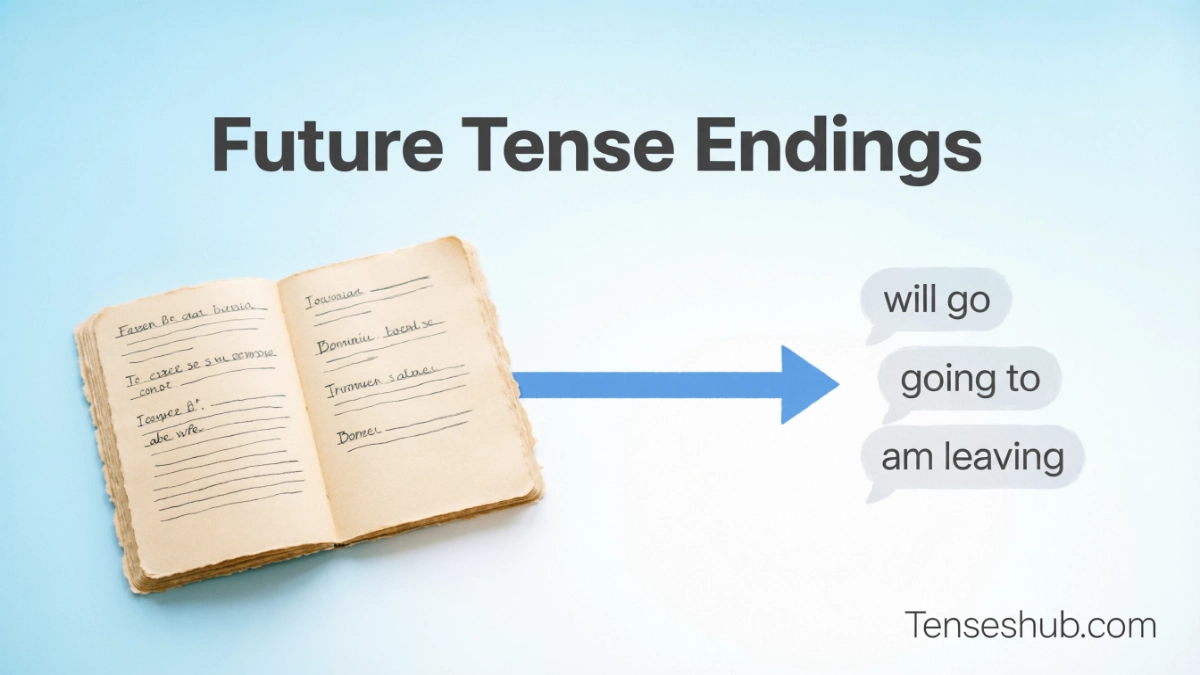
The three most common future tense structures in everyday English are:
- will + base verb (I will go)
- be going to + base verb (I am going to go)
- be + verb ing (I am going tomorrow present continuous for future)
Each of these serves a different purpose. They’re not just stylistic choices they actually carry different meanings. Mixing them up is one of the most common mistakes English learners make.The phrase “future tense endings” can be slightly misleading in English. Unlike some languages, English usually does not change the main verb itself to create the future. Instead, it commonly uses auxiliary verbs such as will and be, along with forms such as going to and the ing form.
This is an important improvement because your current article correctly discusses English structures, but the phrase “future tense endings” could make beginners think English verbs receive a special future suffix.
Structure of Future Tense Sentences
Getting the word order right is half the battle. Here’s how affirmative, negative, and question forms work for each structure.
Will + base verb
- Affirmative: Subject + will + V1 → She will help you.
- Negative: Subject + will not (won’t) + V1 → She won’t help you.
- Question: Will + subject + V1? → Will she help you?
Going to + base verb
- Affirmative: Subject + am/is/are + going to + V1 → They are going to travel.
- Negative: Subject + am/is/are + not + going to + V1 → They aren’t going to travel.
- Question: Am/Is/Are + subject + going to + V1? → Are they going to travel?
Present continuous for future
- Affirmative: Subject + am/is/are + V ing → We are leaving at noon.
- Negative: Subject + am/is/are + not + V ing → We aren’t leaving at noon.
- Question: Am/Is/Are + subject + V ing? → Are we leaving at noon?
Notice that in all three forms, the sentence structure is clean and predictable. The subject always comes first. The helper verb (will / am / is / are) always comes right after. The main verb follows in its correct form.
Formation of Future Tense Endings
Let’s look at how each form is built what verb form follows each helper, and how contractions work.
1. Will + base verb (V1)
“Will” is a modal auxiliary. It never changes no “wills,” no “willed” in future use. The verb that follows must always stay in its base form (V1), no matter who the subject is.
- I will go / She will go / They will go ✓
- She will goes ✗ no ” s” ending after will
Common contractions: I’ll, you’ll, he’ll, she’ll, we’ll, they’ll, won’t (will not)
2. Be going to + base verb (V1)
Here “be” changes depending on the subject: am (I), is (he/she/it), are (you/we/they). The main verb stays in base form.
- I am going to study.
- She is going to study.
- We are going to study.
Contractions: I’m going to, she’s going to, we’re going to, isn’t going to, aren’t going to
3. Be + V ing (present continuous)
For this form, the ” ing” ending is added to the main verb. The rules:
- Most verbs: add ing → go → going, play → playing
- Verbs ending in silent e: drop the e, add ing → come → coming, write → writing
- Short verbs ending in consonant vowel consonant: double the final consonant → sit → sitting, run → running
The auxiliary “be” changes just like in “going to”: am / is / are + verb ing.
Formation of Future table
| Future Form | Formula & Example |
|---|---|
| Will | Formula: Subject + will + V1 Example: She will work. |
| Going to | Formula: Subject + be + going to + V1 Example: She is going to work. |
| Present Continuous | Formula: Subject + be + V-ing Example: She is working tomorrow. |
| Future Continuous | Formula: Subject + will be + V-ing Example: She will be working at 8. |
| Future Perfect | Formula: Subject + will have + V3 Example: She will have finished by 8 |
How to Use Future Tense Endings
This is where most learners struggle not the form, but the function. Why does this matter? Because saying “I will meet him at 3” and “I’m meeting him at 3” aren’t wrong in the same situations they’re just used for different contexts.
Use “will” for:
- Decisions made at the moment of speaking: “The phone’s ringing.” “I’ll get it.”
- Predictions based on opinion: “I think it will rain tomorrow.”
- Promises and offers: “I’ll help you move next weekend.”
- Facts about the future: “The sun will rise at 6 a.m.”
Use “going to” for:
- Plans decided before the moment of speaking: “I’m going to call the dentist this afternoon.” (You already planned this.)
- Predictions based on visible evidence: “Look at those clouds it’s going to rain.”
Use present continuous ( ing) for:
- Fixed arrangements with other people or organizations: “We’re having dinner with Mia on Friday.” (Booked. Confirmed. Not just a plan in your head.)
One more pattern worth knowing: “will be + V ing” (future continuous). This describes something that will be in progress at a specific future time.
- At 8 p.m. tonight, I’ll be watching the game.
- Don’t call her at noon she’ll be sleeping.
Use will for spontaneous decisions
Rule: Use will when you decide to do something at the moment of speaking.
Example:
The phone is ringing. I’ll answer it.
Use going to for previous plans
Rule: Use going to when you already decided to do something before speaking.
Example:
I’m going to visit my uncle this weekend.
Use present continuous for arrangements
Rule: Use the present continuous when a future event has been arranged or confirmed.
Example:
We’re meeting the teacher tomorrow.
This format is much easier for beginners to scan.
Structure and Verb Pattern Table
| Tense Form | Formula & Example |
|---|---|
| Simple Future | Formula: will + V1 Example: I will call her. |
| Future (Going to) | Formula: am/is/are + going to + V1 Example: He is going to leave. |
| Future Continuous | Formula: will be + V-ing Example: She will be working at 9. |
| Present Continuous (Future) | Formula: am/is/are + V-ing Example: They are flying tomorrow. |
| Future Perfect | Formula: will have + V3 Example: I will have finished by then. |
Real Life Examples
Affirmative sentences:
- I’ll text you when I get there. (will decision in the moment)
- She’s going to apply for the job next week. (going to plan already made)
- They’re arriving on Tuesday morning. (present continuous confirmed arrangement)
- By midnight, he’ll have driven 400 miles. (future perfect)
Negative sentences:
- We won’t be late, I promise.
- I’m not going to eat junk food anymore.
- She isn’t coming to the party.
Questions:
- Will you be at the office tomorrow?
- Are they going to fix the road this year?
- Is he flying in tonight?
Formal vs. informal:
Formal: The committee will announce its decision on Friday. Informal: We’re gonna grab coffee later, want to come? (“gonna” = informal spoken “going to”)
Common Mistakes
Mistake 1:Adding “ s” After Will
❌ She will goes to school.
✅ She will go to school.
After will, always use the base verb.
Mistake 2:Using Will for Every Future Situation
❌ Look at those dark clouds. It will rain.
✅ Look at those dark clouds. It’s going to rain.
When a prediction is based on clear present evidence, going to is usually the better choice.
Mistake 3:Using the Wrong Form of “Be”
❌ He are going to travel next month.
✅ He is going to travel next month.
Remember:
- I am
- he/she/it is
- you/we/they are
Mistake 4:Forgetting “Be” Before Going To
❌ I going to call you later.
✅ I’m going to call you later.
The correct structure is:
am/is/are + going to + V1
Mistake 5:Using the Wrong Form After “Will”
❌ They will be drink coffee at noon.
✅ They will be drinking coffee at noon.
For the future continuous, use:
will + be + V ing
Mistake 6:Using Will After a Future Time Clause
❌ When I will arrive, I will call you.
✅ When I arrive, I will call you.
After words such as when, before, after, until, and as soon as, English commonly uses the present simple to refer to a future event.
Mistake 7:Spelling ing Forms Incorrectly
❌ She is comming tomorrow.
✅ She is coming tomorrow.
When adding ing, remember common spelling rules such as dropping a silent e:
come → coming
and doubling the final consonant in some short stressed verbs:
run → running
Key Grammar Rules
- Will is followed by the base verb.
Say she will go, not she will goes. - Going to needs a form of “be.”
Use am/is/are + going to + V1.
Example: She is going to study. - The present continuous can express a future arrangement.
Example: We are meeting the teacher tomorrow. - Will has more than one use.
It can express spontaneous decisions, offers, promises, willingness, intentions, and predictions. - Going to is commonly used for previous plans and evidence based predictions.
Example: Look at those clouds. It’s going to rain. - Use the present simple after future time words such as when, before, after, until, and as soon as.
Say: When I arrive, I’ll call you.
Not: When I will arrive, I’ll call you. - Future perfect uses will have + V3.
Example: By Friday, I’ll have finished the report. - Future perfect continuous uses will have been + V ing.
Example: By 8 p.m., I’ll have been studying for three hours.
Comparisons with Similar Grammar Forms
Will vs. Going to
These two are the most commonly confused. “Will” is spontaneous you decide right now. “Going to” is intentional you decided before. Try this test: if you could have made the plan yesterday, use “going to.” If the thought just crossed your mind, use “will.”
You’re visiting a friend and see their dishes piling up.
- Spontaneous offer: “I’ll wash the dishes.” ✓
- Pre planned: “I was going to wash the dishes before you came home.” ✓
Going to vs. Present Continuous
Both describe pre planned future events. The difference is how firm the plan is. Present continuous suggests a confirmed arrangement (often involving other people, bookings, or schedules). “Going to” can be a personal intention.
- I’m going to buy a new laptop. (intention no booking made)
- I’m buying a new laptop tomorrow. (arranged you’re going to the store, maybe ordered online)
Will vs. Future Continuous (will be + ing)
“Will call” = a single action at some point in the future. “Will be calling” = an action that will be in progress over a period of time.
- I’ll call you at 8. (one call, at 8)
- I’ll be calling clients all morning. (the action stretches across the morning)
Learners who want to go further might also explore future perfect (will have + V3) and future perfect continuous (will have been + V ing) for describing more complex timelines.
Future Tense Forms in Everyday English
Different future forms can describe different kinds of future situations.
Will:
I’ll call you tonight.
This can express a decision, offer, promise, intention, or prediction depending on the context.
Going to:
I’m going to study tonight.
This commonly expresses a plan or intention decided before speaking.
Present continuous:
I’m meeting Sarah tonight.
This usually describes a planned or confirmed arrangement.
Future continuous:
I’ll be studying at 8 p.m.
This describes an action that will be in progress at a particular future time.
Future perfect:
I’ll have finished the work by 8 p.m.
This describes an action that will be completed before a future point.
Future perfect continuous:
I’ll have been studying for three hours by 8 p.m.
This focuses on how long an action will have continued up to a future point.
Exercises
Exercise 1 Fill in the Blanks
Use will, going to, or the present continuous form of the verb in brackets.
- It’s very hot. I __________ (drink) some water. (spontaneous decision)
- We __________ (visit) Paris next summer. (confirmed booking)
- She __________ (not / eat) sugar anymore. (strong intention)
- Look! The cat __________ (jump) off the table! (evidence based prediction)
- __________ you __________ (come) to the meeting tomorrow?
Exercise 2 Spot the Error
Find and correct the mistake in each sentence.
- She will goes to the market.
- I are going to study harder this year.
- They will be drink coffee at noon tomorrow.
- He is going call his parents tonight.
- I comming to your party on Saturday.
Exercise 3 Rewrite the Sentence
Change each sentence to its negative form.
- I will finish the report by Monday.
- She is going to join the gym.
- They are flying to London next week.
Exercise 4 Choose the Correct Option (MCQ)
- “The phone is ringing!” “Don’t worry, _____ get it.”
- a) I’m going to b) I’ll c) I’m
- Those storm clouds are huge. It _____ rain heavily.
- a) will b) is going to c) is
- We _____ dinner at 7 tonight. I already booked the table.
- a) will have b) are having c) going to have
Answer Key
Exercise 1:
- I’ll drink / I’m going to drink
- We’re visiting
- She’s not going to eat / She won’t eat
- is going to jump
- Are you coming
Exercise 2:
- She will go to the market.
- I am going to study harder this year.
- They will be drinking coffee at noon tomorrow.
- He is going to call his parents tonight.
- I am coming to your party on Saturday.
Exercise 3:
- I won’t finish the report by Monday.
- She isn’t going to join the gym.
- They aren’t flying to London next week.
Exercise 4:
- b) I’ll
- b) is going to
- b) are having
Which Future Form Should I Use?
| Meaning / Situation | Future Form & Example |
|---|---|
| Decision made at the moment | Will — I’ll answer the phone. |
| Offer or promise | Will — I’ll help you. |
| Opinion-based prediction | Will — I think it will rain. |
| Plan or intention decided earlier | Going to — I’m going to study tonight. |
| Prediction based on present evidence | Going to — Look! It’s going to rain. |
| Confirmed arrangement | Present Continuous — I’m meeting Sarah tomorrow. |
| Action in progress at a future time | Future Continuous — I’ll be working at 8 p.m. |
| Action completed before a future time | Future Perfect — I’ll have finished by Friday. |
| Action continuing up to a future time | Future Perfect Continuous — I’ll have been working for three hours by 8 p.m |
Quick Memory Tip
Will → decision, offer, promise, or opinion
Going to → previous plan or present evidence
Present continuous → confirmed arrangement
Future continuous → action in progress later
Future perfect → completed before a future point
Future perfect continuous → duration up to a future point
Frequently Asked Questions
What are future tense endings in English?
English does not have one special ending for the future. Instead, it commonly uses structures such as will + V1, be going to + V1, and the present continuous to express future meaning.
What is the difference between will and going to?
Will commonly expresses decisions, offers, promises, and predictions based on opinion. Going to commonly expresses plans, intentions, and predictions based on present evidence.
Is “going to” a future tense?
Be going to is a common English structure used to express future plans, intentions, and predictions based on present evidence.
Can the present continuous talk about the future?
Yes. The present continuous can describe a future arrangement, especially when the event has been planned or confirmed.
For example:
We’re meeting the teacher tomorrow.
Does the verb change after will?
No. The verb after will stays in the base form.
✅ She will go.
❌ She will goes.
What is the difference between will and shall?
Will is much more common in everyday English. Shall is mainly used with I and we for suggestions and offers, such as “Shall we start?” It also appears in some formal and legal language.
Is “gonna” correct English?
Gonna is an informal spoken form of going to. It is common in casual conversation and informal writing, but going to is better for formal writing, academic work, and professional communication.
How do I choose the correct future form?
Think about the situation. Use will for decisions, offers, promises, and many predictions; going to for previous plans and evidence based predictions; and the present continuous for confirmed arrangements.
Conclusion
Future tense endings don’t have to feel confusing. Once you understand that “will” is for spontaneous moments, “going to” is for things you’ve already planned, and ” ing” is for locked in arrangements, the whole system starts to click into place.
The key is practice. Don’t just memorize the rules try using each form in sentences about your own life. Write about what you’ll do this weekend, what you’re going to work on next month, and what arrangements you already have on your calendar. Real life practice sticks far better than any grammar table.
You’ve already taken the most important step by reading this guide. Keep building on it. Grammar doesn’t become automatic overnight, but every sentence you write and every correction you make brings you one step closer to confident, natural English. You’ve got this.
Hi, I’m Robert Lowth, a passionate expert in English tenses and grammar. I specialize in simplifying complex tense rules to help learners understand and use English with confidence. My goal is to make grammar clear, practical, and easy for everyday communication. tenseshub.com