Learning Spanish can be confusing when one verb changes into several different forms. The verb jugar is a good example.
It means “to play” and is commonly used when talking about sports, games, and recreational activities. However, its present tense forms do not follow the usual pattern of regular Spanish verbs.
For example, you say yo juego (I play), not yo jugo. The verb changes from u to ue in most present tense forms, but not in every form. This small change can be difficult for beginners to remember.
In this guide, you’ll learn how to conjugate jugar in the present tense, understand when to use each form, make affirmative and negative sentences, ask questions, and avoid common mistakes.
You’ll also see everyday Spanish examples, compare jugar with similar verbs such as hacer and practicar, and test your knowledge with exercises.
By the end, you’ll be able to use jugar more confidently when talking about your favorite sports, games, and activities.
Quick Answer: What Is the Present Tense of Jugar?
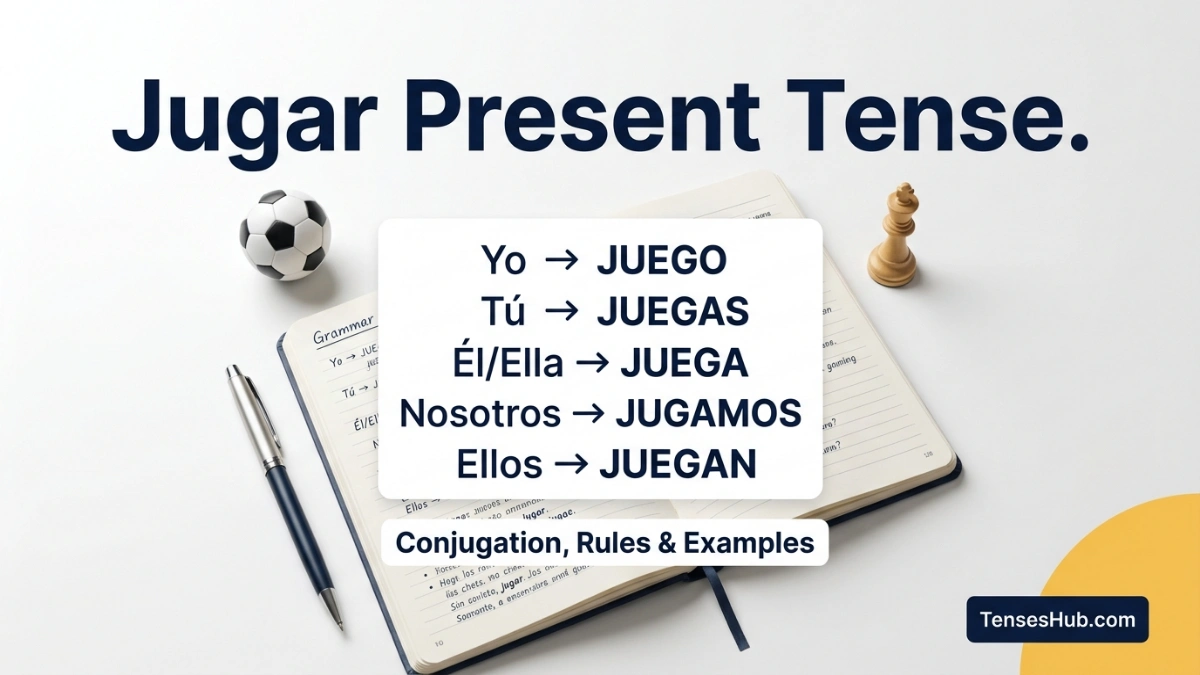
The present tense of jugar means “play,” “plays,” or “am playing,” depending on the subject and context. It is a stem changing verb: u changes to ue in four forms, while nosotros and vosotros keep the original u.
| Subject | Conjugation | English |
|---|---|---|
| Yo | juego | I play |
| Tú | juegas | You play |
| Él / Ella / Usted | juega | He / She / You play |
| Nosotros/as | jugamos | We play |
| Vosotros/as | jugáis | You play |
| Ellos / Ellas / Ustedes | juegan | They / You play |
Examples:
- Yo juego al fútbol. I play soccer.
- Ella juega al tenis. She plays tennis.
- Nosotros jugamos videojuegos. We play video games.
What Is Jugar in the Present Tense?
Jugar is a Spanish verb meaning “to play.” Its present tense, called the presente de indicativo, describes actions that happen regularly, activities happening around the present, and general habits.
Unlike a regular verb such as hablar (to speak), jugar changes its stem in most present tense forms. This is why it is called a stem changing verb.
Examples:
- Juego al fútbol todos los sábados. I play soccer every Saturday.
- ¿Juegas al tenis? Do you play tennis?
- Mi hermano juega en el parque. My brother plays in the park.
- Jugamos después de clase. We play after class.
Notice that English often uses “do” or “does” in questions, but Spanish usually forms these questions without an extra helping verb.
Structure of Sentences Using Jugar in the Present Tense
The conjugated form of jugar changes according to the subject. You can use it to make statements, negative sentences, and questions.
1. Affirmative Sentences
Use the subject followed by the conjugated form of jugar and any additional information.
Pattern: Subject + jugar (present form) + complement
Examples:
- Yo juego al fútbol. I play soccer.
- Tú juegas al ajedrez. You play chess.
- Ella juega al tenis. She plays tennis.
2. Negative Sentences
Place no immediately before the conjugated verb.
Pattern: Subject + no + jugar (present form) + complement
Examples:
- No juego al baloncesto. I don’t play basketball.
- Él no juega al tenis. He doesn’t play tennis.
- No jugamos hoy. We don’t play today.
3. Interrogative Sentences
Spanish questions can use the same basic word order as statements, with question marks around the sentence. You can also place the verb before the subject.
Pattern: ¿Jugar (present form) + subject + complement?
Examples:
- ¿Juegas al fútbol? Do you play soccer?
- ¿Juega María al tenis? Does María play tennis?
- ¿Juegan ustedes aquí? Do you play here?
You can also ask ¿Tú juegas al fútbol? The subject pronoun is optional when the meaning is clear.
Formation of the Present Tense of Jugar
To conjugate jugar, start with its infinitive form and learn the six present tense forms. The important feature is the stem change from jug to jueg in most forms.
Jugar Conjugation Chart
| Subject Pronoun | Verb Form | Stem Pattern |
|---|---|---|
| Yo | juego | u → ue |
| Tú | juegas | u → ue |
| Él / Ella / Usted | juega | u → ue |
| Nosotros / Nosotras | jugamos | No stem change |
| Vosotros / Vosotras | jugáis | No stem change |
| Ellos / Ellas / Ustedes | juegan | u → ue |
Why Does Jugar Change From U to UE?
The infinitive is jugar, but the stressed stem vowel changes in most present tense forms:
- jug → jueg : juego, juegas, juega, juegan
- jug remains unchanged: jugamos, jugáis
This is a common Spanish verb pattern known as a stem change or cambio vocálico. The change occurs in the forms where the stem vowel receives the relevant stress.
Does Jugar Use Helping Verbs?
In the simple present tense, jugar does not need a helping verb.
- Correct: Yo juego al fútbol.
- Incorrect: Yo do juego al fútbol.
Spanish uses the conjugated verb itself to express the present action. For emphasis or other meanings, additional words may appear, but they are not required to form the present tense.
How to Use Jugar in the Present Tense
The present tense of jugar is useful in everyday conversations about sports, games, hobbies, and free time.
1. Talking About Sports
Use jugar with sports that are played as games.
Examples:
- Juego al fútbol con mis amigos. I play soccer with my friends.
- Mi hermana juega al baloncesto. My sister plays basketball.
- ¿Juegas al tenis los domingos? Do you play tennis on Sundays?
- Ellos juegan al voleibol en la playa. They play volleyball at the beach.
In Spanish, sports are often introduced with a + the definite article:
- jugar al fútbol
- jugar al tenis
- jugar al baloncesto
Here, al is the contraction of a + el.
2. Talking About Games
You can use jugar to talk about board games, card games, and video games.
Examples:
- Juego al ajedrez con mi abuelo. I play chess with my grandfather.
- Ella juega a las cartas. She plays cards.
- Jugamos a videojuegos después de cenar. We play video games after dinner.
- ¿Juegas a Minecraft? Do you play Minecraft?
Usage can vary by region. You may also hear jugar videojuegos, especially in Latin American Spanish. The construction with a is a useful general pattern to learn.
3. Talking About Children and Toys
Use jugar con when describing playing with a person, toy, or object.
Examples:
- El niño juega con sus juguetes. The boy plays with his toys.
- Mi hija juega con su hermana. My daughter plays with her sister.
- Los niños juegan con una pelota. The children play with a ball.
Compare these two patterns:
- Jugar al fútbol to play soccer
- Jugar con una pelota to play with a ball
The preposition depends on what you mean.
4. Describing Habits and Routines
The present tense can describe activities that happen regularly.
Examples:
- Juego al tenis dos veces por semana. I play tennis twice a week.
- Mi primo juega videojuegos cada noche. My cousin plays video games every night.
- Jugamos en el parque después de la escuela. We play in the park after school.
Words such as siempre (always), a menudo (often), a veces (sometimes), and todos los días (every day) help show how frequently an activity happens.
5. Talking About Plans and Current Situations
Spanish speakers also use the present tense for actions happening around the current time or for scheduled activities, depending on context.
Examples:
- Ahora juego con mi hermano. I’m playing with my brother now.
- Hoy jugamos contra el equipo local. Today we play against the local team.
- Esta tarde juegan en casa. This afternoon they play at home.
For an action in progress, Spanish may also use estar + jugando:
Estoy jugando al fútbol. I am playing soccer.
That is the present progressive, not the simple present tense.
Jugar Present Tense: Verb Pattern Table
Use this compact table to review the conjugations and the most common sentence patterns.
| Form | Pattern | Example |
|---|---|---|
| Affirmative | Subject + jugar form | Yo juego al tenis. |
| Negative | Subject + no + jugar form | No juego al tenis. |
| Question | ¿Jugar form + subject…? | ¿Juegas al tenis? |
| With a | jugar + a + game/sport | Juego al fútbol. |
| With con | jugar + con + person/object | Juego con Ana. |
| Present progressive | estar + jugando | Estoy jugando. |
Real Life Examples of Jugar in the Present Tense
Here are examples from everyday situations to help you understand how jugar works in context.
Everyday Statements
- Juego al fútbol después del trabajo. I play soccer after work.
- Mi padre juega al ajedrez los fines de semana. My father plays chess on weekends.
- Mis amigos juegan en el parque. My friends play in the park.
- Jugamos videojuegos los viernes. We play video games on Fridays.
- Mi equipo juega muy bien. My team plays very well.
Negative Sentences
- No juego al tenis. I don’t play tennis.
- Mi hermana no juega videojuegos. My sister doesn’t play video games.
- Nosotros no jugamos los lunes. We don’t play on Mondays.
- Ellos no juegan en casa hoy. They don’t play at home today.
Questions and Answers
10. ¿Juegas al fútbol? Do you play soccer?
Sí, juego todos los sábados. Yes, I play every Saturday.
11. ¿Juega tu hermano al baloncesto? Does your brother play basketball?
No, juega al voleibol. No, he plays volleyball.
12. ¿Dónde juegan los niños? Where do the children play?
Juegan en el jardín. They play in the garden.
Formal and Informal Situations
13. ¿Usted juega al tenis, señor? Do you play tennis, sir?
14. ¿Tú juegas con nosotros? Are you playing with us? / Do you play with us?
15. ¿Juegan ustedes este fin de semana? Are you playing this weekend?
The verb form juega is used with formal singular usted, while juegas is used with informal singular tú. For plural ustedes, use juegan.
Common Mistakes When Using Jugar
Beginners often understand the meaning of jugar but struggle with its irregular forms and prepositions.
Mistake 1: Using “jugo” Instead of “juego”
Incorrect: Yo jugo al fútbol.
Correct: Yo juego al fútbol.
The present tense form for yo is juego because the stem changes from u to ue.
Mistake 2: Forgetting the Stem Change
Incorrect: Ella juga al tenis.
Correct: Ella juega al tenis.
Use juega with él, ella, and usted. The stem changing pattern applies to these forms.
Mistake 3: Changing the Nosotros Form
Incorrect: Nosotros juegamos al fútbol.
Correct: Nosotros jugamos al fútbol.
The nosotros form does not change u to ue. The same is true of vosotros: jugáis, not juegáis.
Mistake 4: Using the Wrong Preposition
Incorrect: Juego el fútbol.
Correct: Juego al fútbol.
Sports and games commonly use jugar a. With the masculine singular article el, the words combine to form al.
Mistake 5: Confusing Jugar With Practicar
Incorrect for the usual meaning: Juego piano.
Correct: Toco el piano. I play the piano.
In Spanish, jugar is generally used for games and sports. For musical instruments, use tocar. For participating in or training in a sport, practicar can also be appropriate.
Mistake 6: Adding “Do” to a Spanish Question
Incorrect: ¿Do you juegas al tenis?
Correct: ¿Juegas al tenis?
Spanish does not use the English auxiliary do to form an ordinary present tense question.
Key Grammar Rules for Jugar
Remember these six practical rules.
1. Learn the six conjugations. The main forms are juego, juegas, juega, jugamos, jugáis, and juegan.
2. Remember the stem change. The vowel changes from u to ue in four forms: juego, juegas, juega, and juegan.
3. Keep the original stem in nosotros and vosotros. Say jugamos and jugáis, not juegamos or juegáis.
4. Use no before the verb for negatives. For example, No juego al tenis.
5. Learn the common prepositions. Use jugar al fútbol, jugar a las cartas, and jugar con amigos.
6. Remember that subject pronouns are optional. Both Yo juego and Juego mean “I play.” Spanish often leaves out the pronoun when the subject is clear.
Jugar vs. Similar Spanish Verbs
Several Spanish verbs describe activities, but their meanings and uses differ.
| Verb | Meaning | Example |
|---|---|---|
| Jugar | To play a game or sport | Juego al fútbol. |
| Practicar | To practice or participate in an activity | Practico natación. |
| Tocar | To play a musical instrument; to touch | Toco la guitarra. |
| Hacer | To do or make | Hago ejercicio. |
| Divertirse | To have fun | Me divierto con mis amigos. |
Jugar vs. Practicar
Jugar emphasizes playing a game or sport.
Juego al baloncesto. I play basketball.
Practicar emphasizes practicing or engaging in an activity.
Practico baloncesto tres veces por semana. I practice/play basketball three times a week.
Both can be appropriate when discussing sports, depending on the intended meaning.
Jugar vs. Hacer
Use jugar for games and sports, and hacer for many activities or exercises.
- Juego al fútbol. I play soccer.
- Hago ejercicio. I exercise.
You can explore [LINK: Hacer Present Tense] for the conjugation of hacer.
Jugar vs. Estar Jugando
These forms are related but not identical.
- Juego al fútbol todos los días. I play soccer every day.
- Estoy jugando al fútbol ahora. I am playing soccer right now.
The simple present often describes routines or general activities. The present progressive, estar + gerundio, emphasizes an action in progress.
Exercises: Practice Jugar in the Present Tense
Test your knowledge with these beginner friendly exercises.
Exercise 1: Fill in the Blanks
Complete each sentence with the correct present tense form of jugar.
- Yo ______ al fútbol.
- Tú ______ al ajedrez.
- Mi hermana ______ al tenis.
- Nosotros ______ en el parque.
- Vosotros ______ videojuegos.
- Ellos ______ al baloncesto.
Exercise 2: Correct the Mistakes
Rewrite each sentence correctly.
- Yo jugo al fútbol.
- Ella juga al tenis.
- Nosotros juegamos juntos.
- ¿Tú juegas el fútbol?
- Ellos no juegan al videojuegos.
Exercise 3: Choose the Correct Answer
1. Which is the correct form for “I play”?
- A. Juga
- B. Juego
- C. Jugamos
2. Which sentence means “We play soccer”?
- A. Nosotros juegan al fútbol.
- B. Nosotros juegamos al fútbol.
- C. Nosotros jugamos al fútbol.
3. Which form goes with ella?
- A. Juega
- B. Juego
- C. Juegan
4. Complete the sentence: “No ______ al tenis.” (I don’t play tennis.)
- A. juegas
- B. juego
- C. juega
Exercise 4: Translate Into Spanish
- I play chess.
- She plays soccer.
- We don’t play today.
- Do you play tennis? (informal singular)
- They play with their friends.
Answer Key
Exercise 1
- juego
- juegas
- juega
- jugamos
- jugáis
- juegan
Exercise 2
- Yo juego al fútbol.
- Ella juega al tenis.
- Nosotros jugamos juntos.
- ¿Tú juegas al fútbol?
- Ellos no juegan a los videojuegos. (In many Latin American contexts, no juegan videojuegos is also natural.)
Exercise 3
- B Juego
- C Nosotros jugamos al fútbol.
- A Juega
- B Juego
Exercise 4
- Juego al ajedrez.
- Ella juega al fútbol.
- No jugamos hoy.
- ¿Juegas al tenis?
- Juegan con sus amigos.
FAQs
What is the present tense of jugar?
The six forms are juego, juegas, juega, jugamos, jugáis, and juegan. The correct form depends on the subject.
Is jugar a regular or irregular verb?
Jugar is a stem changing verb in the present indicative. It changes from u to ue in four forms but retains u in jugamos and jugáis.
Why is it juego and not jugo?
The yo form is juego because jugar undergoes a stem change in the present tense. Jugo is a different Spanish word meaning “juice” in many Spanish speaking regions.
What does juego mean in Spanish?
Juego can mean “I play,” as a form of the verb jugar. As a noun, el juego means “the game.” The meaning depends on the sentence.
What is the difference between juega and juegan?
Juega is used with él, ella, and usted. Juegan is used with ellos, ellas, and ustedes.
- Ella juega al tenis.
- Ellos juegan al tenis.
How do you say “I am playing” in Spanish?
You can say estoy jugando. For example, Estoy jugando al fútbol means “I am playing soccer.” This uses the present progressive rather than the simple present juego.
Do you say jugar fútbol or jugar al fútbol?
Jugar al fútbol is a widely taught standard construction, particularly in Spain. In Latin America, usage varies, and you may hear jugar fútbol as well. Learning jugar al fútbol is a useful starting point.
What is the present tense of jugar in English?
The English equivalents are “I play,” “you play,” “they plays,” “we play,” and “they play.” English usually changes the verb only for the third person singular, while Spanish has distinct forms for several subjects.
Conclusion
The present tense of jugar is useful whenever you want to talk about sports, games, hobbies, and everyday activities in Spanish.
Its six forms are juego, juegas, juega, jugamos, jugáis, and juegan. The most important rule is that u changes to ue in most forms, but not in nosotros or vosotros.
Remember to use jugar a with many games and sports, and jugar con when talking about playing with people or objects.
Also, distinguish jugar from tocar, which is commonly used for musical instruments, and practicar, which can describe practicing a sport or skill.
The best way to learn these forms is to use them in short, everyday sentences. Start with activities you enjoy, such as playing soccer, chess, or video games. With regular practice, you’ll find it easier to choose the right form and speak Spanish with confidence.

Hi, I’m Noah Bester, a tenses expert passionate about simplifying English grammar. I create practical, easy-to-understand guides to help learners master tenses with confidence. My goal is to make grammar clear, useful, and applicable in everyday communication. tenseshub.com