Have you ever known the meaning of a verb but felt unsure about how to change it when talking about the past? For example, should you say walked, went, did go, or had gone?
This confusion is common for English learners because English verbs do not all form the past tense in the same way.
Past tense conjugation means changing a verb or using the correct helping verb so that a sentence clearly shows a past time action, event, state, or experience. Regular verbs usually take ed, while irregular verbs can change completely. For example, walk → walked, but go → went.
Learning past tense conjugation helps you talk about yesterday, last week, completed actions, past experiences, and events that happened before another past event. It is also important for writing stories, emails, school assignments, reports, and everyday conversations.
This guide explains how to conjugate English verbs in the past tense, including regular and irregular forms, sentence patterns, common mistakes, examples, and practice exercises.
Quick Answer
Past tense conjugation is the process of changing a verb or using the correct auxiliary verb to express a past action or situation.
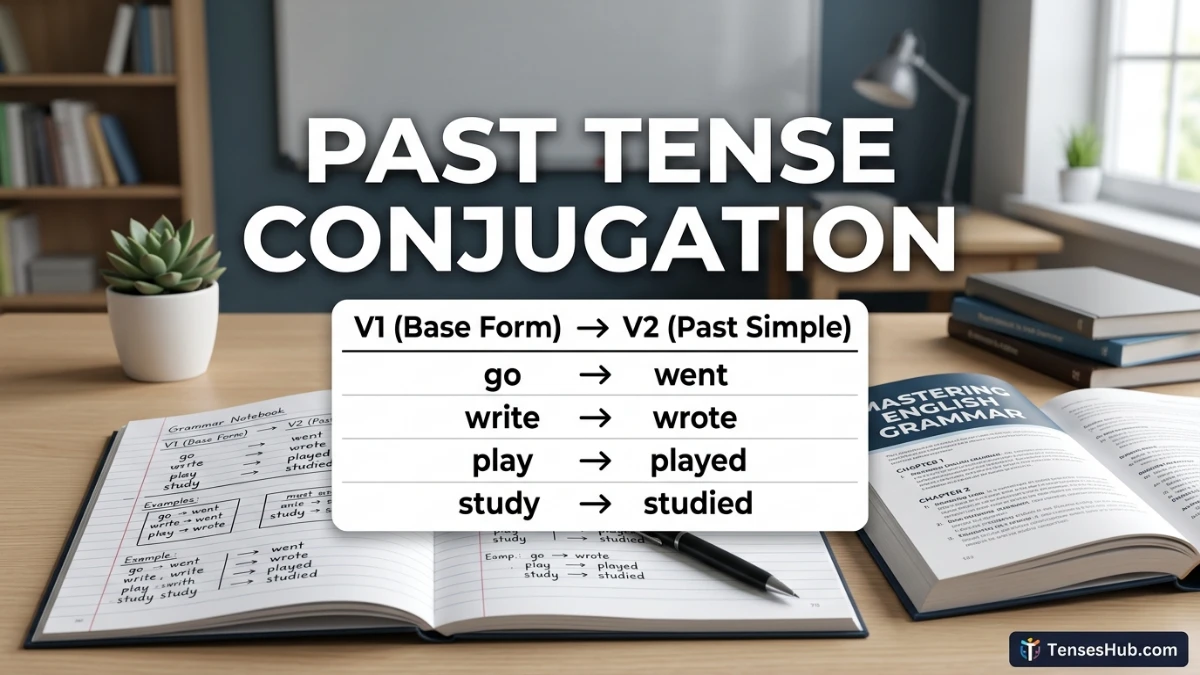
| Present | Past |
|---|---|
| walk | walked |
| play | played |
| go | went |
| write | wrote |
| eat | ate |
For simple past sentences, regular verbs usually use V2 ( ed form), while irregular verbs have their own past forms.
What Is Past Tense Conjugation?
Past tense conjugation is the way English verbs change to show that something happened or existed in the past.
For example:
- I walk to school. → I walked to school.
- She plays tennis. → She played tennis.
- They go home. → They went home.
- He writes emails. → He wrote emails.
The most common past tense in everyday English is the simple past tense. It is used for actions that started and finished in the past.
Regular and Irregular Verbs
English verbs can be divided into two main groups when forming the simple past.
Regular verbs normally add ed:
- work → worked
- clean → cleaned
- open → opened
- watch → watched
Irregular verbs do not follow one single pattern:
- go → went
- see → saw
- take → took
- buy → bought
- write → wrote
There is no universal rule for every irregular verb, so learners often need to memorize their common forms.
Does English Change the Verb for Every Subject?
Unlike many languages, English usually does not change the simple past verb according to the subject.
For example:
- I worked.
- You worked.
- He worked.
- We worked.
- They worked.
The main exception is the verb be:
- I was tired.
- He was tired.
- They were tired.
Structure of Sentences of Past Tense Conjugation
The sentence structure depends on if the sentence is affirmative, negative, or interrogative.
Affirmative Sentences
For a simple past affirmative sentence:
Subject + past verb (V2) + object/complement
Examples:
- I visited my friend.
- She bought a new phone.
- They watched a movie.
With be:
Subject + was/were + complement
- I was tired.
- They were happy.
Negative Sentences
For most verbs:
Subject + did not + V1 + object
Examples:
- I did not visit my friend.
- She did not buy a phone.
- They did not watch the movie.
The common contraction is didn’t:
- I didn’t visit him.
- She didn’t buy anything.
Notice that after did/didn’t, we use the base form (V1), not the past form.
Incorrect: She didn’t went.
Correct: She didn’t go.
Interrogative Sentences
For most verbs:
Did + subject + V1 + object?
Examples:
- Did you visit him?
- Did she buy a phone?
- Did they watch the movie?
Was/With be:
Were + subject + complement?
- Was he tired?
- Were they ready?
Formation of Past Tense Conjugation
Past tense formation depends on the type of verb and the tense being used.
Regular Verbs
Regular verbs normally form the simple past by adding ed.
- work → worked
- clean → cleaned
- call → called
- open → opened
Some spelling changes are necessary.
Verbs Ending in e
Add only d:
- live → lived
- love → loved
- dance → danced
- close → closed
Verbs Ending in Consonant + y
Change y to i and add ed:
- study → studied
- carry → carried
- try → tried
But if a verb ends in a vowel + y, simply add ed:
- play → played
- enjoy → enjoyed
Some Short Verbs Double the Final Consonant
Some one syllable verbs ending in consonant vowel consonant double the final consonant:
- stop → stopped
- plan → planned
- drop → dropped
Irregular Verbs
Irregular verbs do not use one fixed ending.
Examples:
- go → went
- come → came
- eat → ate
- drink → drank
- speak → spoke
- write → wrote
- take → took
- see → saw
These forms generally need to be learned individually.
The Verb “Be”
The past forms of be are:
- was I, he, she, it
- were you, we, they
Examples:
- I was busy.
- She was at home.
- We were late.
- They were excited.
Helping Verb “Did”
In simple past negative and question forms, did carries the past meaning.
Therefore, the main verb returns to its base form:
- She went home.
- She didn’t go home.
- Did she go home?
Not:
- She didn’t went home.
- Did she went home?
How to Use Past Tense Conjugation
Past tense conjugation is mainly used when you need to show that an action or situation belongs to the past.
1. Completed Past Actions
Use the simple past for an action that started and finished in the past.
- I finished my homework.
- She called me yesterday.
- We visited Lahore last month.
2. A Series of Past Actions
The simple past can describe several completed actions in sequence.
- I woke up, ate breakfast, and left for work.
- She opened the door, walked inside, and sat down.
3. Past Habits
The simple past can describe repeated actions or habits in the past when the context makes the past meaning clear.
- We played outside every evening.
- My grandfather walked to work every day.
For stronger emphasis on repeated past habits, used to can also be useful:
- We used to play outside every evening.
4. Past States
The simple past can describe a past condition or state.
- I was tired.
- She knew the answer.
- They liked the restaurant.
5. Past Events With a Finished Time
Past time expressions often appear with the simple past.
Common expressions include:
- yesterday
- last night
- last week
- two days ago
- in 2020
- when I was young
Examples:
- I met him yesterday.
- She graduated in 2020.
- We moved here three years ago.
Past Tense Does Not Always Mean “Yesterday”
A sentence can refer to the past without giving an exact time.
- I saw that movie.
- She visited Spain.
- He worked there.
The important point is that the speaker understands the event as belonging to the past.
Structure or Verb Pattern Table
| Sentence Type | Pattern | Example |
|---|---|---|
| Affirmative | Subject + V2 | She visited me. |
| Negative | Subject + did not + V1 | She did not visit me. |
| Question | Did + subject + V1? | Did she visit me? |
| With be | Subject + was/were | They were happy. |
| Negative with be | Subject + was/were not | They were not happy. |
| Question with be | Was/Were + subject? | Were they happy? |
Real Life Examples
Here are natural examples showing how past tense conjugation works in everyday English.
Affirmative Examples
- I finished my work early.
- She called her mother.
- We watched a documentary last night.
- He bought some groceries.
- They went to the market.
- My brother wrote an email to his teacher.
Negative Examples
- I didn’t finish the report.
- She didn’t call me yesterday.
- We didn’t watch the game.
- He didn’t buy anything.
- They didn’t go to school.
Questions
- Did you finish your homework?
- Did she call you?
- Did they visit the museum?
- Did he write the email?
- Did you see my keys?
Examples With “Be”
- I was nervous before the interview.
- She was at home.
- He wasn’t ready.
- We were very busy.
- They weren’t late.
- Were you tired?
Formal and Informal Examples
Formal:
- The company announced the decision yesterday.
- The researcher completed the study in June.
Informal:
- I called you earlier.
- We watched a movie last night.
The basic past tense rules remain the same in both formal and informal English.
Common Mistakes
Mistake 1: Using V2 After “Did”
Incorrect:
- Did you went there?
Correct:
- Did you go there?
After did, always use the base form of the main verb.
Mistake 2: Using V2 After “Didn’t”
Incorrect:
- She didn’t bought a car.
Correct:
- She didn’t buy a car.
The word didn’t already shows the past.
Mistake 3: Adding ed to an Irregular Verb
Incorrect:
- I goed home.
Correct:
- I went home.
Go is an irregular verb.
Mistake 4: Confusing Was and Were
Incorrect:
- They was happy.
Correct:
- They were happy.
Use was with I/he/she/it and were with you/we/they.
Mistake 5: Using “Did” With “Was/Were”
Incorrect:
- Did you were tired?
Correct:
- Were you tired?
The verb be forms past questions without did.
Mistake 6: Using the Present Form for a Finished Past Action
Incorrect:
- Yesterday, I go to school.
Correct:
- Yesterday, I went to school.
The finished action requires the appropriate past form.
Key Grammar Rules
- Regular verbs usually take ed in the simple past.
- walk → walked
- clean → cleaned
- Irregular verbs use their own past forms.
- take → took
- see → saw
- write → wrote
- Use V1 after did and didn’t.
- Did she come?
- She didn’t come.
- Use was/were for the past of be.
- I was tired.
- They were tired.
- Do not use did with was/were.
- Were you busy?
- Not: Did you were busy?
- The simple past normally has the same verb form for different subjects.
- I worked.
- She worked.
- They worked.
- Use a past form when the context clearly places the action in the past.
- I visited him last week.
- She called me yesterday.
Comparisons with Similar Grammar Forms
Simple Past vs. Present Perfect
The simple past usually refers to a completed past event, often with a finished time.
- I visited London in 2023.
The present perfect connects a past action to the present or refers to an experience without focusing on a finished past time.
- I have visited London.
Compare:
- I saw that movie last night.
- I have seen that movie before.
The phrase last night points to a finished past time, so simple past is natural.
Simple Past vs. Past Continuous
The simple past usually presents a completed action.
- I watched TV.
The past continuous focuses on an action that was in progress at a particular past time.
- I was watching TV when she called.
These forms can work together:
- I was sleeping when the phone rang.
Simple Past vs. Past Perfect
The simple past describes a past event.
- She left the office.
The past perfect shows that one past action happened before another past action.
- She had left the office before I arrived.
If you want to learn more about this relationship, study past perfect tense and pluperfect tense.
Simple Past vs. Used To
The simple past can describe a completed past action or past habit:
- We played football every Sunday.
Used to emphasizes a past habit or situation that is no longer true:
- We used to play football every Sunday.
Exercises
Exercise 1: Fill in the Blanks
Use the correct past form of the verb in brackets.
- I ________ my homework last night. (finish)
- She ________ to the store. (go)
- They ________ dinner at 8 p.m. (eat)
- He ________ a new book. (buy)
- We ________ very tired. (be)
Exercise 2: Choose the Correct Answer
- Did you ___ the movie?
- a) saw
- b) see
- c) seen
- She ___ home yesterday.
- a) go
- b) went
- c) gone
- They ___ happy after the match.
- a) was
- b) were
- c) be
- He didn’t ___ the email.
- a) wrote
- b) write
- c) written
Exercise 3: Correct the Sentences
- Did she went to school?
- I didn’t watched TV.
- They was late.
- He goed home early.
- Were you went there yesterday?
Exercise 4: Rewrite the Sentences in the Negative
- She visited her grandmother.
- They bought a new computer.
- He finished the project.
Answer Key
Exercise 1
- finished
- went
- ate
- bought
- were
Exercise 2
- b) see
- b) went
- b) were
- b) write
Exercise 3
- Did she go to school?
- I didn’t watch TV.
- They were late.
- He went home early.
- Did you go there yesterday?
Exercise 4
- She didn’t visit her grandmother.
- They didn’t buy a new computer.
- He didn’t finish the project.
FAQs
What is past tense conjugation?
Past tense conjugation is the process of using or changing a verb to show that an action, event, or state happened in the past.
How do you conjugate a verb in the past tense?
For regular verbs, usually add ed. For irregular verbs, use the verb’s special past form.
- work → worked
- go → went
What is the past tense formula?
For an affirmative simple past sentence, the basic pattern is:
Subject + V2 + object
Example: She visited her friend.
For negatives and questions, use did + V1.
Do all past tense verbs end in ed?
No. Only regular verbs normally use ed. Irregular verbs have different forms.
- play → played
- go → went
- write → wrote
What is V1 and V2 in English grammar?
V1 is the base form of a verb, while V2 is its simple past form.
- V1: go
- V2: went
Do we use V1 after did?
Yes. Always use the base form after did or didn’t.
- Did you go?
- I didn’t go.
How do you conjugate “be” in the past tense?
The past forms of be are was and were.
- I/he/she/it → was
- you/we/they → were
What is the difference between regular and irregular past tense verbs?
Regular verbs normally form the past with ed, while irregular verbs change in different ways.
- talk → talked
- make → made
Can the simple past describe a habit?
Yes. The simple past can describe repeated past actions when the context makes the past meaning clear.
- We played cricket every evening.
You can also use used to when emphasizing an old habit or situation.
Conclusion
Understanding past tense conjugation makes it much easier to talk and write about completed actions, past events, experiences, and situations.
The most important idea is to learn the difference between regular and irregular verbs.
Regular verbs usually add ed, while irregular verbs such as go → went, write → wrote, and eat → ate follow their own patterns.
Remember one especially important rule: after did or didn’t, use the base verb. Say “Did you go?” and “I didn’t go,” not “Did you went?” or “I didn’t went.” Also, remember was/were when using the past form of be.
The best way to master past tense conjugation is regular practice. Read simple stories, notice past tense verbs, write about what you did yesterday, and practice common irregular verbs until their forms become natural.