Have you ever written, “I lose my phone yesterday,” and wondered if the sentence is correct? You are not alone. Many English learners confuse lose, lost, and loss because they look and sound related but have different grammatical jobs.
The past tense of lose is “lost.” If something happened before now, we use lost, not lose. For example, “I lost my keys yesterday” is correct.
Learning the past tense of lose is useful because this irregular verb appears often in everyday English. We use it when talking about misplacing something, failing to win a game, missing an opportunity, or no longer having something.
In this guide, you will learn the lose past tense, its past participle, pronunciation, sentence patterns, common mistakes, and practical examples. You will also get exercises to help you use lose, lost, and loss correctly.
Quick Answer (Featured Snippet)
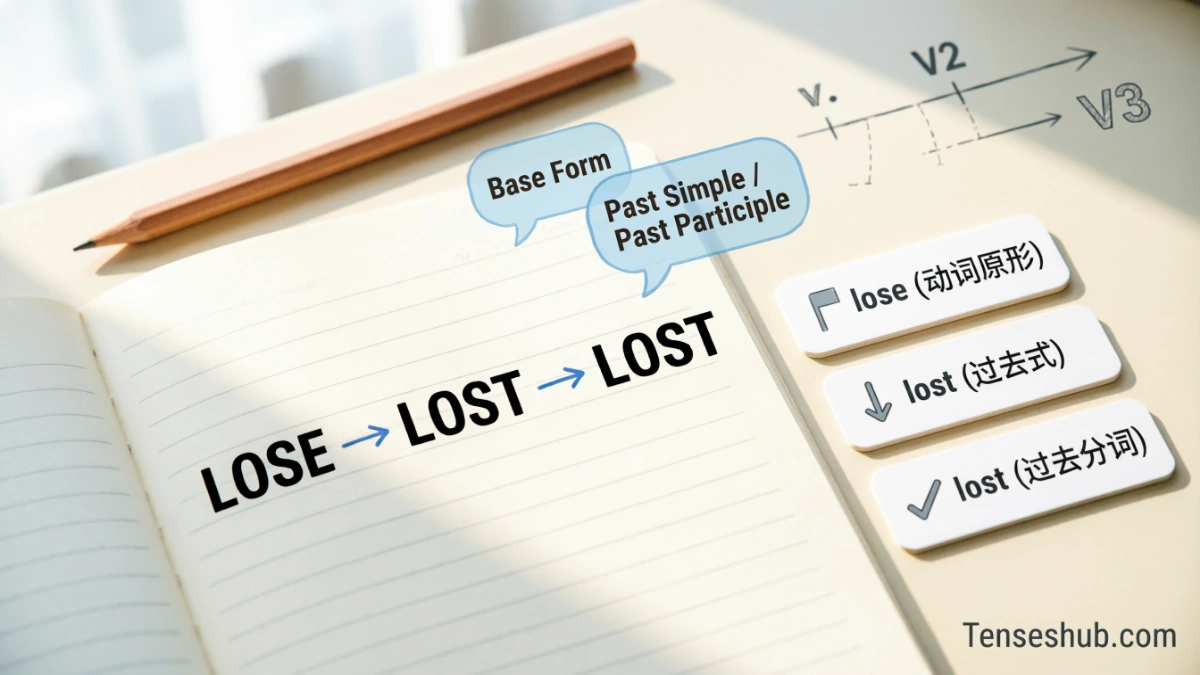
The past tense of lose is “lost.” The past participle is also “lost.” Lose is an irregular verb, so we do not add -ed to make its past form.
| Verb Form | Word |
|---|---|
| V1 – Base Form | lose |
| V2 – Past Tense | lost |
| V3 – Past Participle | lost |
| -ing Form | losing |
Example: I lost my wallet yesterday.
Quick Answer: What Is the Past Tense of Lose?
The past tense of lose is “lost.” The past participle is also “lost.” Lose is an irregular verb, so its past forms do not follow the regular -ed pattern.
| Verb Form | Word |
|---|---|
| V1 – Base Form | lose |
| V2 – Past Tense | lost |
| V3 – Past Participle | lost |
| V-ing Form | losing |
Example: I lost my wallet yesterday.
Remember:
lose → lost → lost
What Is the Lose Past Tense?
The lose past tense is lost.
Lose is an irregular verb. It means to no longer have something, fail to win something, or miss something.
When the action happened in the past, use lost.
Examples
- I lost my phone yesterday.
- She lost the game last night.
- We lost our way in the city.
- He lost his job last month.
- They lost the opportunity.
Notice that lost does not follow the regular -ed pattern.
We say:
lose → lost
Not:
lose → losed ❌
What Does “Lost” Mean?
Lost can have different meanings depending on the sentence.
1. Misplaced something
I lost my keys.
This means you had your keys but cannot find them now.
2. Failed to win
Our team lost the match.
This means the other team won.
3. Became unable to find the right direction
We lost our way.
This means we did not know where to go.
4. No longer had something
She lost her job.
This means she no longer had that job.
Structure of Sentences of Lose Past Tense
When using lost in the simple past, the sentence structure changes depending on whether it is affirmative, negative, or interrogative.
Affirmative
Subject + lost + object
Examples:
- I lost my bag.
- She lost her phone.
- They lost the match.
Negative
Subject + did not + lose + object
Examples:
- I did not lose my bag.
- She didn’t lose her phone.
- They did not lose the match.
Notice an important point: after did not, use the base form lose, not lost.
Incorrect:
I did not lost my keys. ❌
Correct:
I did not lose my keys. ✅
Interrogative
Did + subject + lose + object?
Examples:
- Did you lose your wallet?
- Did she lose the game?
- Did they lose their tickets?
Again, use lose after did.
Formation of Lose Past Tense
Lose is an irregular verb, so its past form is not made by simply adding -ed.
Verb Forms of Lose
| Form | Verb |
|---|---|
| V1 – Base Form | lose |
| V2 – Past Tense | lost |
| V3 – Past Participle | lost |
| V-ing – Present Participle | losing |
V1: Lose
Lose is the base form.
Examples:
- I don’t want to lose my phone.
- Try not to lose hope.
- They may lose the game.
V2: Lost
Lost is the simple past form.
Examples:
- I lost my wallet yesterday.
- She lost the race.
- He lost his passport.
V3: Lost
Lost is also the past participle.
It is used with helping verbs such as has, have, and had.
Examples:
- I have lost my keys.
- She has lost her phone.
- They had lost the match before we arrived.
-ing Form: Losing
The present participle or gerund form is losing.
Examples:
- He is losing patience.
- We are losing time.
- She was losing confidence.
Lost as a Past Participle
Lost is both the simple past form and the past participle of lose. The spelling stays the same, but its grammatical job can change depending on the sentence.
Lost as the Simple Past
Use lost by itself to describe an action that happened in the past.
- I lost my keys yesterday.
- She lost the match last week.
- He lost his wallet on the bus.
Lost as the Past Participle
Use lost with a helping verb such as has, have, or had.
- I have lost my keys.
- She has lost her phone.
- They had lost the game before we arrived.
Lost in Perfect Tenses
The word lost does not change. The helping verb shows the tense.
| Tense | Pattern | Example |
|---|---|---|
| Present Perfect | has/have + lost | I have lost my keys. |
| Past Perfect | had + lost | She had lost her phone. |
| Future Perfect | will have + lost | He will have lost his chance |
The key difference is simple:
I lost my wallet yesterday. → simple past
I have lost my wallet. → past participle with a present result
So, lost can be V2 or V3, depending on how it is used in the sentence.
How to Use Lose Past Tense
Use lost when the action happened and finished in the past.
1. Losing a Physical Object
Use lost when you cannot find something you previously had.
I lost my keys this morning.
She lost her glasses at school.
He lost his wallet on the bus.
2. Losing a Game or Competition
We also use lost when someone did not win a game, match, race, or competition.
Our team lost the final.
She lost the race.
They lost the game 3–1.
3. Losing an Opportunity
Lost can describe an opportunity that is no longer available.
I lost the opportunity to study abroad.
He lost his chance to apply.
4. Losing Time
We can use lost when time has been wasted or unavailable.
We lost two hours because of traffic.
5. Losing Direction
The expression lose your way means becoming unable to find the correct direction.
We lost our way in the forest.
6. Losing a Job
Lost can also mean that someone no longer has a job.
He lost his job last year.
Pronunciation of Lose and Lost
Lose is pronounced approximately like “looz” /luːz/.
Lost is pronounced approximately like “lost” /lɔːst/ in many varieties of English.
The pronunciation changes noticeably:
- lose → /luːz/
- lost → /lɔːst/
Do not confuse lose with loose. Loose means “not tight.”
I don’t want to lose my ring. ✅
My shirt is loose. ✅
Lose in Different Tenses
The verb lose can be used in several English tenses. Learning these forms can help you understand the difference between lose, lost, losing, and have lost.
| Tense | Example |
|---|---|
| Simple Present | I sometimes lose my keys. |
| Simple Past | I lost my keys yesterday. |
| Simple Future | I will lose my chance if I wait. |
| Present Continuous | I am losing my patience. |
| Past Continuous | I was losing focus. |
| Present Perfect | I have lost my wallet. |
| Past Perfect | I had lost my ticket. |
| Future Perfect | I will have lost the opportunity by then |
Lose in the Future Tense
For the simple future, use:
will + lose
Examples:
- I will lose my chance if I wait too long.
- She will lose the game if she gives up.
- They will lose money if they cancel the project.
After will, always use the base form lose, not lost.
❌ I will lost my chance.
✅ I will lose my chance.
Remember These Important Rules
- The simple past of lose is lost.
- I lost my phone yesterday.
- The past participle of lose is also lost.
- I have lost my phone.
- Use the base form lose after did or didn’t.
- Did you lose your keys?
- I didn’t lose them.
- Never use losed as the standard past form.
- I lost the game. ✅
- Lose is a verb, while loss is a noun.
- We lost money.
- We suffered a loss.
- Do not confuse lose with loose.
- I don’t want to lose my bag.
- The handle is loose.
Structure or Verb Pattern Table
| Use | Pattern | Example |
|---|---|---|
| Simple Past | Subject + lost + object | I lost my keys. |
| Past Negative | Subject + did not + lose | I didn’t lose my keys. |
| Past Question | Did + subject + lose? | Did you lose your keys? |
| Present Perfect | has/have + lost | She has lost her phone. |
| Past Perfect | had + lost | He had lost his wallet. |
| Past Continuous | was/were + losing | They were losing time. |
Key point: After did/didn’t, always use lose, not lost.
Real-Life Examples
Here are practical examples showing how lose and lost work in everyday English.
Affirmative Sentences
- I lost my phone yesterday.
- Sarah lost her notebook at school.
- We lost the match last weekend.
- He lost his keys somewhere downtown.
- They lost their chance to participate.
Negative Sentences
- I didn’t lose my passport.
- She did not lose the competition.
- We didn’t lose any money.
- He didn’t lose his ticket.
Questions
- Did you lose your wallet?
- Did she lose the game?
- Did they lose their way?
- Did he lose his job?
Formal Examples
- The company lost several important clients last year.
- The organization lost valuable time during the investigation.
- The team lost the final match despite strong preparation.
Informal Examples
- I lost my phone again!
- Did you lose your keys?
- We lost the game, but we had fun.
- I think I lost my pen.
Common Mistakes
Mistake 1
Using “losed”
Wrong: I losed my phone yesterday. ❌
Correct: I lost my phone yesterday. ✅
Why? Lose is irregular. Its past form is lost, not losed.
Mistake 2
Using “lost” after “did”
Wrong: Did you lost your bag? ❌
Correct: Did you lose your bag? ✅
After did, use the base verb.
Mistake 3
Using “lost” after “didn’t”
Wrong: I didn’t lost my wallet. ❌
Correct: I didn’t lose my wallet. ✅
Mistake 4
Confusing Lose and Loss
Wrong: I loss my phone yesterday. ❌
Correct: I lost my phone yesterday. ✅
Lose is a verb, while loss is a noun.
The company suffered a major loss.
Mistake 5
Confusing Lose and Loose
Lose = to no longer have something or fail to win.
Loose = not tight.
Don’t lose your keys.
These shoes are loose.
Mistake 6
Confusing Lost and Loss
Lost is commonly a verb or adjective.
I lost my wallet.
Loss is a noun.
The financial loss was significant.
Key Grammar Rules
Remember these six simple rules:
- The simple past of lose is lost.
- I lost my phone.
- The past participle of lose is also lost.
- I have lost my phone.
- Use lose after did or didn’t.
- Did you lose your keys?
- I didn’t lose them.
- Never use “losed” as the standard past form.
- I lost the game. ✅
- Lose is a verb, while loss is a noun.
- We lost money.
- We suffered a loss.
- Don’t confuse lose with loose.
- I don’t want to lose my bag.
- The handle is loose.
Comparisons with Similar Grammar Forms
Lose vs. Lost
| Word | Use | Example |
|---|---|---|
| lose | Present / Base Form | I don’t want to lose. |
| lost | Simple Past | I lost yesterday |
Use lose for the base form and lost when talking about a completed past action.
Lost vs. Loss
Lost is a verb form.
She lost her phone.
Loss is a noun.
The loss of her phone was frustrating.
A simple way to remember it:
lose → verb
lost → past verb
loss → noun
Lose vs. Loose
These two words are often confused because their spelling is similar.
Lose means to misplace something, fail to win, or no longer have something.
Don’t lose your passport.
Loose means not tight or firmly attached.
The wheel is loose.
Lost vs. Losing
Lost is the past form.
I lost my keys yesterday.
Losing is the -ing form.
I am losing patience.
Lost vs. Have Lost
Lost can describe a completed past event:
I lost my wallet yesterday.
Have lost connects a past action to the present:
I have lost my wallet.
The second sentence emphasizes the current result: the wallet is still missing.
Exercises
Exercise 1: Fill in the Blanks
Choose lose, lost, or losing.
- I ______ my keys yesterday.
- Don’t ______ your passport.
- She is ______ patience.
- Did you ______ your phone?
- They ______ the match last Sunday.
- We don’t want to ______ this opportunity.
- He has ______ his wallet.
- I am afraid of ______ my job.
Exercise 2: Correct the Sentences
Find and correct the mistake.
- I losed my pen yesterday.
- Did she lost the game?
- He didn’t lost his wallet.
- I loss my keys every week.
- She has lose her phone.
Exercise 3: Rewrite the Sentences
Change each sentence as instructed.
- I lose my keys. → Change to simple past.
- She lost her phone. → Make it negative.
- They lost the game. → Make it a question.
- He lost his wallet. → Change to present perfect.
- We lost our way. → Make it negative.
Exercise 4: Multiple Choice
1. What is the past tense of “lose”?
A. losed
B. lost
C. loss
D. losing
2. Which sentence is correct?
A. I losed my bag.
B. I loss my bag.
C. I lost my bag.
D. I losing my bag.
3. Which sentence is correct?
A. Did you lost your keys?
B. Did you lose your keys?
C. Did you loss your keys?
D. Did you losing your keys?
4. Which word is a noun?
A. lose
B. lost
C. losing
D. loss
5. Which sentence uses “loose” correctly?
A. I don’t want to loose my phone.
B. I loose the game yesterday.
C. My jacket is loose.
D. She loose her keys.
Answer Key
Exercise 1
- lost
- lose
- losing
- lose
- lost
- lose
- lost
- losing
Exercise 2
- I lost my pen yesterday.
- Did she lose the game?
- He didn’t lose his wallet.
- I lose my keys every week.
- She has lost her phone.
Exercise 3
- I lost my keys.
- She didn’t lose her phone.
- Did they lose the game?
- He has lost his wallet.
- We didn’t lose our way.
Exercise 4
- B — lost
- C — I lost my bag.
- B — Did you lose your keys?
- D — loss
- C — My jacket is loose.
FAQs
What is the past tense of lose?
The past tense of lose is lost.
I lost my phone yesterday.
What is the past participle of lose?
The past participle is also lost.
She has lost her keys.
Is “losed” the past tense of lose?
No. Losed is incorrect in standard English. The correct past form is lost.
What are the three forms of lose?
The three main forms are:
lose – lost – lost
- V1: lose
- V2: lost
- V3: lost
Is it “loss” or “lost” a game?
Use lost when describing the action.
We lost the game.
Loss is a noun:
The loss was disappointing.
Is “lose” present tense?
Yes. Lose is the base form and is used in the present tense with appropriate subjects and structures.
I don’t want to lose.
What is the past tense of lose in a sentence?
She lost her wallet on Monday.
Here, lost shows that the action happened in the past.
What is the difference between lose and lost?
Lose is the base form, while lost is the simple past and past participle form.
I might lose the game.
I lost the game yesterday.
What is the difference between lose and loss?
Lose is a verb.
Don’t lose hope.
Loss is a noun.
The loss was difficult.
What is the pronunciation of lose?
Lose is pronounced approximately like “looz.” It rhymes with words such as choose and shoes.
What is the third form of lose?
The third form (V3) of lose is lost.
The three main forms are:
lose – lost – lost
- V1 = lose
- V2 = lost
- V3 = lost
Example:
I have lost my keys.
Here, lost is the past participle because it comes after have.
Is it “loss” or “lost” a game?
The correct expression is “lost the game.”
Lost is the past tense of the verb lose.
✅ We lost the game yesterday.
❌ We loss the game yesterday.
Use loss when it works as a noun:
✅ The team’s loss was disappointing.
Remember:
- lose = verb
- lost = past form of lose
- loss = noun
Frequently Asked Questions (FAQs)
What is the past tense of lose?
The past tense of lose is lost.
Example: I lost my phone yesterday.
What is the past participle of lose?
The past participle of lose is also lost.
Example: She has lost her keys.
Is “losed” the past tense of lose?
No. Losed is not the standard past form of lose. The correct form is lost.
Lose → lost → lost
What are the three forms of lose?
The three main forms are:
- V1: lose
- V2: lost
- V3: lost
Is it “loss” or “lost” a game?
Use lost when talking about the action of not winning a game.
- We lost the game. ✅
- We loss the game. ❌
Use loss as a noun:
- The team’s loss was disappointing.
Is lose a present-tense verb?
Yes. Lose is the base form of the verb and can be used in the present tense.
Example: I don’t want to lose my keys.
What is the difference between lose and lost?
Lose is the base form, while lost is the simple past and past participle form.
- I might lose the game.
- I lost the game yesterday.
- I have lost the game.
What is the difference between lose and loss?
Lose is a verb.
- Don’t lose hope.
Loss is a noun.
- The loss was difficult.
What is the third form of lose?
The third form, or V3, of lose is lost.
Lose → lost → lost
Example:
- I have lost my keys.
How do you pronounce lose?
Lose is pronounced /luːz/, approximately like “looz.”
It sounds different from lost, which is pronounced /lɔːst/ in many varieties of English.
Is lost both V2 and V3?
Yes. Lost is both the simple past (V2) and past participle (V3) of lose.
- V2: I lost my wallet yesterday.
- V3: I have lost my wallet.
What is the difference between lose and loose?
Lose means to misplace something, fail to win, or no longer have something.
- Don’t lose your passport.
Loose means not tight or firmly attached.
- My shirt is loose.
Conclusion
The past tense of lose is lost, and the past participle is also lost. Because lose is an irregular verb, you should never use losed in standard English.
The most important pattern to remember is lose → lost → lost. Use lost for completed past actions, such as “I lost my keys yesterday.” But after did or didn’t, return to the base form: “Did you lose your keys?” and “I didn’t lose them.”
Also remember the difference between lose, lost, loss, and loose. These words may look similar, but they have different meanings and grammatical roles.
With a little practice, you can use them confidently in everyday speaking and writing. Try creating your own sentences with each form to make the rules easier to remember.

Hi, I’m Robert Lowth, a passionate expert in English tenses and grammar. I specialize in simplifying complex tense rules to help learners understand and use English with confidence. My goal is to make grammar clear, practical, and easy for everyday communication. tenseshub.com