Have you ever wanted to explain that something had been happening for a period of time before another event in the past? For example, you may want to say, “I had been studying for two hours when my friend called.” This is where the past perfect continuous tense becomes useful.
The past perfect continuous tense describes an action that started in the past and continued for some time before another past event or time. It helps us show both the duration of an activity and its connection to another point in the past.
For English learners, this tense can feel confusing because it combines several helping verbs with the ing form of a verb. However, once you understand its basic structure, it becomes much easier to use.
In this guide, you will learn the past perfect continuous tense meaning, structure, formation, rules, uses, examples, common mistakes, comparisons, and exercises. You will also see how to use it naturally in everyday English.
Quick Answer
The past perfect continuous tense is used for an action that had been continuing for a period of time before another past event or time.
Basic formula:
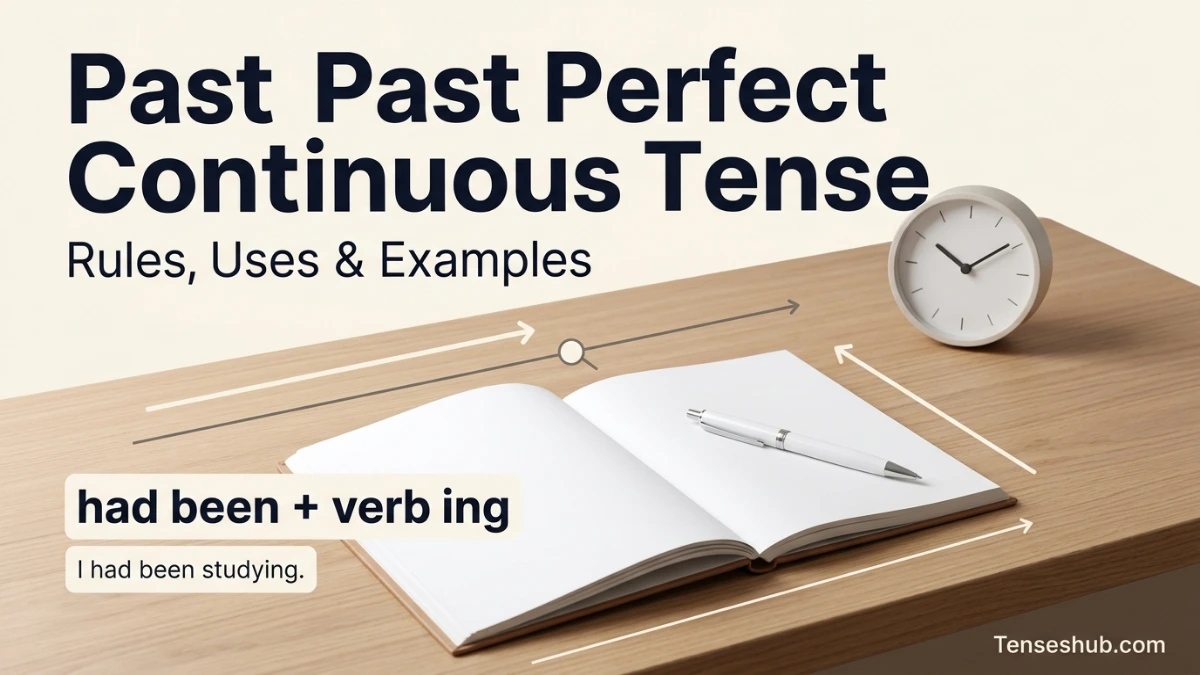
Subject + had been + verb ing + …
| Example | Meaning |
|---|---|
| I had been studying for two hours. | The studying continued before a past point. |
| She had been working there since 2020. | Her work continued up to a past time. |
What Is the Past Perfect Continuous Tense?
The past perfect continuous tense shows that an action or activity had been happening continuously for some time before another event or point in the past.
It is also called the past perfect progressive tense.
For example:
I had been waiting for an hour when the bus finally arrived.
The sentence tells us two things:
- The waiting started before the bus arrived.
- The waiting continued for one hour before that event.
The tense is especially useful when we want to emphasize duration.
Compare these sentences:
- I studied for two hours.
- I had been studying for two hours when he called.
The first sentence simply tells us about a past activity. The second connects the activity to another past event and emphasizes how long it had continued.
Basic Examples
- She had been sleeping for three hours when I arrived.
- They had been playing football before it started raining.
- We had been traveling all day when we reached the hotel.
- He had been learning English for six months before he moved abroad.
The important idea is:
Earlier continuing action → later past event
Structure of Sentences of the Past Perfect Continuous Tense
The sentence structure changes depending on if the sentence is affirmative, negative, or interrogative.
Affirmative Sentences
Subject + had been + verb ing + object/complement
Examples:
- I had been reading for an hour.
- She had been studying English.
- They had been waiting outside.
- We had been working all morning.
Negative Sentences
Subject + had not been + verb ing + object/complement
Examples:
- I had not been sleeping well.
- She had not been working that day.
- They had not been waiting for long.
- We had not been using the computer.
Interrogative Sentences
Had + subject + been + verb ing + object/complement?
Examples:
- Had you been studying?
- Had she been waiting outside?
- Had they been working all day?
- Had he been driving for several hours?
Wh Questions
Wh word + had + subject + been + verb ing…?
Examples:
- How long had you been waiting?
- Why had she been crying?
- Where had they been working?
- What had he been doing?
Formation of the Past Perfect Continuous Tense
The past perfect continuous tense is formed with:
had + been + present participle (verb ing)
The word had is used with every subject.
| Subject | Helping Verbs | Main Verb |
|---|---|---|
| I | had been | working |
| You | had been | working |
| He | had been | working |
| She | had been | working |
| It | had been | working |
| We | had been | working |
| They | had been | working |
Unlike the simple past tense, the main verb does not change into its V2 form.
For example:
- work → working
- study → studying
- play → playing
- write → writing
- run → running
Regular and Irregular Verbs
The verb itself is normally used in its ing form, so if a verb is regular or irregular does not change the basic tense structure.
Examples:
- go → going
- take → taking
- write → writing
- eat → eating
- make → making
- swim → swimming
Notice that we do not say:
- ❌ had been went
- ❌ had been written
- ❌ had been ate
Instead:
- ✅ had been going
- ✅ had been writing
- ✅ had been eating
Contractions
In everyday English, had is often shortened to ‘d.
- I had been working. → I’d been working.
- She had been waiting. → She’d been waiting.
- They had been studying. → They’d been studying.
The contraction ‘d can also represent would, so the meaning must be understood from context.
How to Use the Past Perfect Continuous Tense
The main purpose of the past perfect continuous tense is to show that an activity continued for some time before another past event or point.
1. An Action Continued Before Another Past Action
Use it when one continuing activity happened before another event in the past.
Example:
I had been cooking when the guests arrived.
The cooking started first. The guests arrived later.
Another example:
She had been studying when her mother called her.
The studying was already in progress before the call.
2. To Emphasize Duration
This is one of the most common uses.
Words such as for and since are often used.
For shows a period of time:
- for two hours
- for five minutes
- for three years
- for a long time
Example:
They had been waiting for two hours when the train arrived.
Since identifies the starting point:
- since Monday
- since 2020
- since morning
- since 8 o’clock
Example:
She had been working there since 2020 when she decided to leave.
3. To Explain the Cause of a Past Result
The tense can also explain why something happened or why someone appeared in a particular condition.
He was tired because he had been working all night.
His tiredness had a clear connection with the earlier continuous activity.
Another example:
The ground was wet because it had been raining.
The earlier rain explains the wet ground.
4. Before a Specific Time in the Past
The tense can describe an activity that continued up to a particular past time.
By noon, I had been studying for four hours.
The activity started earlier and continued until noon.
5. In Storytelling
The past perfect continuous tense is useful when describing background actions in a past story.
Maria was exhausted. She had been traveling for twelve hours before she finally reached home.
It helps readers understand what had been happening before an important event.
When Should You Use “For” and “Since”?
A simple rule is:
For = duration
I had been waiting for three hours.
Since = starting point
I had been waiting since 7 a.m.
Both can be used with the past perfect continuous tense when the meaning requires them.
Structure or Verb Pattern Table
| Sentence Type | Formula | Example |
|---|---|---|
| Affirmative | Subject + had been + V ing | She had been working. |
| Negative | Subject + had not been + V ing | She had not been working. |
| Question | Had + subject + been + V ing? | Had she been working? |
| Wh question | Wh word + had + subject + been + V ing? | How long had she been working? |
Real Life Examples
Here are practical examples of the past perfect continuous tense in everyday English.
Affirmative Examples
- I had been studying for three hours before dinner.
- She had been working at the company for five years before she resigned.
- They had been waiting outside when the store opened.
- We had been driving for hours before we stopped for lunch.
- He had been practicing English every day before his interview.
Negative Examples
- I had not been sleeping well before the exam.
- She had not been feeling well before she visited the doctor.
- They had not been living there for very long.
- We had not been waiting for more than ten minutes.
- He had not been paying attention when the teacher asked the question.
Questions
- Had you been waiting long?
- Had she been studying before the test?
- Had they been working all morning?
- How long had he been driving?
- Why had you been crying?
Formal Examples
- The researchers had been studying the problem for several months before publishing their findings.
- The company had been investigating the issue before announcing its decision.
- The team had been working on the project for weeks before the deadline changed.
Informal Examples
- I had been waiting forever before you called!
- We had been talking for hours.
- She had been looking for her keys before she found them in her bag.
Common Mistakes
Mistake 1: Using “had” with the past form
❌ She had been worked all day.
✅ She had been working all day.
After had been, use the ing form when forming the past perfect continuous tense.
Mistake 2: Forgetting “been”
❌ I had studying for two hours.
✅ I had been studying for two hours.
The complete structure is:
had + been + verb ing
Mistake 3: Using “has been” for the past perfect continuous
❌ They has been waiting for an hour before the bus arrived.
✅ They had been waiting for an hour before the bus arrived.
The past perfect continuous tense uses had been, regardless of the subject.
Mistake 4: Confusing “for” and “since”
❌ I had been working since three hours.
✅ I had been working for three hours.
Use for with a duration and since with a starting point.
Mistake 5: Using the tense with every past action
Not every past action needs the past perfect continuous tense.
❌ I had been went to school yesterday.
✅ I went to school yesterday.
Use the past perfect continuous tense when you need to emphasize an activity that continued before another past point or event.
Mistake 6: Using stative verbs incorrectly
Some verbs usually describe states rather than ongoing activities. These often do not naturally appear in continuous forms.
For example:
❌ I had been knowing him for ten years.
More natural:
✅ I had known him for ten years.
Common stative verbs include know, believe, understand, own, belong, and need.
Key Grammar Rules
Rule 1: Always use “had been”
The basic helping verb pattern is:
had + been + verb ing
She had been studying.
Rule 2: Use the ing form of the main verb
They had been playing football.
Not:
❌ They had been played football.
Rule 3: Use “for” for a duration
He had been working for five hours.
Rule 4: Use “since” for a starting point
He had been working since 8 a.m.
Rule 5: Use it to connect an earlier continuing action with a past point
We had been waiting for an hour when the bus arrived.
Rule 6: Use “had” with every subject
I had been working.
She had been working.
They had been working.
The helping verb does not change to has or have.
Comparisons with Similar Grammar Forms
Understanding the difference between similar tenses can make the past perfect continuous tense much easier.
Past Perfect vs. Past Perfect Continuous
Past perfect focuses more on the completion or result of an action.
I had finished my homework before dinner.
Past perfect continuous emphasizes the activity or duration.
I had been doing my homework for two hours before dinner.
Think:
Past perfect = completed action/result
Past perfect continuous = continuing activity/duration
Past Continuous vs. Past Perfect Continuous
The past continuous tense describes an action in progress at a particular time in the past.
I was studying at 8 p.m.
The past perfect continuous tense shows that the activity had already been continuing before another past point.
I had been studying for two hours when my friend called.
Present Perfect Continuous vs. Past Perfect Continuous
The present perfect continuous tense connects a past activity to the present.
I have been studying for two hours.
The past perfect continuous tense connects an earlier activity to another past point.
I had been studying for two hours when my friend called.
Simple Past vs. Past Perfect Continuous
The simple past tells us that something happened.
She worked there for five years.
The past perfect continuous emphasizes an activity that was continuing before another past event.
She had been working there for five years before she moved away.
A Simple Way to Remember
Ask yourself:
“Am I talking about an activity that was continuing before another point in the past?”
If yes, the past perfect continuous may be the appropriate tense.
Exercises
Exercise 1: Fill in the Blanks
Complete each sentence using the past perfect continuous form of the verb in brackets.
- I ________ (study) for two hours before my friend arrived.
- She ________ (work) all morning before she took a break.
- They ________ (wait) for thirty minutes when the bus came.
- We ________ (travel) for several hours before reaching the hotel.
- He ________ (practice) the piano before the concert began.
Exercise 2: Make the Sentences Negative
Rewrite each sentence in the negative form.
- She had been sleeping.
- They had been working all day.
- I had been waiting for an hour.
Exercise 3: Make Questions
Turn these statements into questions.
- You had been studying.
- She had been working there for five years.
- They had been waiting outside.
Exercise 4: Correct the Mistakes
- I had been studied for two hours.
- She had studying before the exam.
- They had been wait for the bus.
- He had been working since three hours.
- We had been went home before the rain started.
Exercise 5: Choose the Correct Answer
1. She ________ for three hours before she stopped.
A. had been studying
B. has been studied
C. had studieding
D. was been studying
2. They had been waiting ________ 8 a.m.
A. for
B. since
C. during
D. by
3. I had been working ________ five hours.
A. since
B. for
C. from
D. at
4. ________ you been sleeping before I called?
A. Had
B. Have
C. Did
D. Were
5. He was tired because he ________ all night.
A. had been working
B. had working
C. has been work
D. was worked
Answer Key
Exercise 1
- had been studying
- had been working
- had been waiting
- had been traveling
- had been practicing
Exercise 2
- She had not been sleeping.
- They had not been working all day.
- I had not been waiting for an hour.
Exercise 3
- Had you been studying?
- Had she been working there for five years?
- Had they been waiting outside?
Exercise 4
- I had been studying for two hours.
- She had been studying before the exam.
- They had been waiting for the bus.
- He had been working for three hours.
- We had gone home before the rain started.
Exercise 5
- A had been studying
- B since
- B for
- A Had
- A had been working
FAQs
What is the past perfect continuous tense?
The past perfect continuous tense describes an action that had been continuing for some time before another past event or point.
I had been studying for two hours when he called.
What is the formula for the past perfect continuous tense?
The basic formula is:
Subject + had been + verb ing
Example:
She had been working.
When do we use the past perfect continuous tense?
Use it when you want to show that an activity continued before another past event or to emphasize how long it had continued.
What is the difference between past perfect and past perfect continuous?
Past perfect often emphasizes a completed action or result, while past perfect continuous emphasizes an ongoing activity or its duration.
Can I use “for” with the past perfect continuous tense?
Yes. Use for to show a period of time.
They had been waiting for two hours.
Can I use “since” with the past perfect continuous tense?
Yes. Use since to show the starting point of an activity.
She had been working since morning.
Is “had been” used with all subjects?
Yes. Use had been with I, you, he, she, it, we, and they.
What is another name for the past perfect continuous tense?
It is also called the past perfect progressive tense.
Is the past perfect continuous tense always used with “for” or “since”?
No. For and since are common, especially when emphasizing duration, but they are not required.
It had been raining when we left.
Conclusion
The past perfect continuous tense is used to show that an activity had been continuing for a period of time before another event or point in the past. Its basic structure is simple: subject + had been + verb ing.
Use this tense when you want to emphasize an earlier ongoing activity, its duration, or its connection to another past event. Remember that for is normally used for a duration, while since introduces a starting point.
For example, “I had been studying for three hours when my friend called” clearly shows both the ongoing activity and the later past event.
The best way to master this tense is to practice making affirmative, negative, and question forms. Once you become comfortable with had been + verb ing, you will find the past perfect continuous tense much easier to use in both speaking and writing.