Picture this: you’re writing a story about a fisherman, and you type “he casted his line into the river.” Something feels off but you’re not sure why. Or maybe you’re describing a movie you watched and you want to say the director “chose” who played each role. Do you write “cast” or “casted”?
This kind of confusion trips up English learners, bloggers, and even native speakers every single day. The verb cast is one of those tricky irregular verbs that doesn’t follow the usual rules. It doesn’t add -ed in the past tense like most verbs. Instead, it stays exactly the same and that surprises a lot of people.
If you’re writing about fishing, theater, movies, or magic spells, understanding how to use this verb correctly will make your English cleaner and more natural. Let’s break it all down in plain, simple language so there’s zero confusion left.
Quick Answer
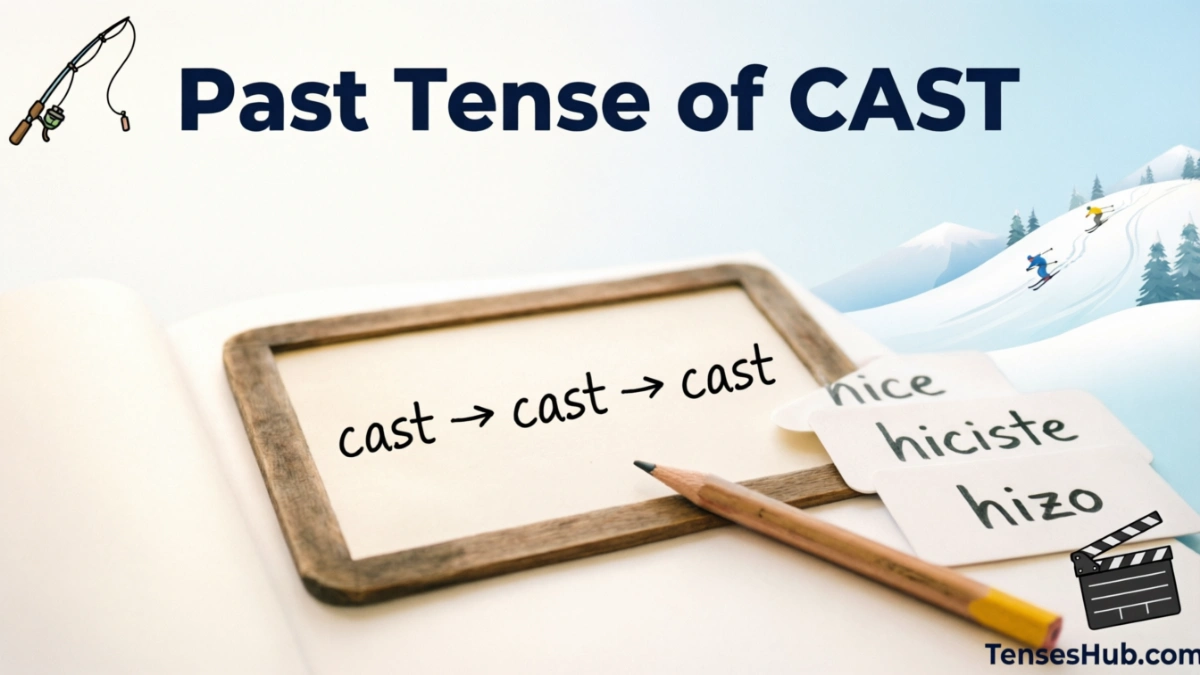
The past tense of cast is cast not “casted.” It’s an irregular verb that doesn’t change form in the simple past or past participle.
| Form | Word |
| Base (Present) | cast |
| Simple Past | cast |
| Past Participle | cast |
What Is the Past Tense of Cast?
The verb cast means different things depending on the context throwing something (like a fishing line), assigning roles in a film or play, or even spreading light or shadow. But no matter how you use it, the past tense form is always the same: cast.
This is what makes it an irregular verb. Most English verbs form their past tense by adding -ed (walk → walked, talk → talked). But cast belongs to a special group of verbs like cut, put, and hurt where the base form, simple past, and past participle are all identical.
So when someone asks, “What is the past tense of cast?” the answer is simply: cast.
You’ll hear people say “casted” sometimes, but that form is widely considered incorrect in standard English. More on that in a moment.
Sentence Structure Using “Cast” in the Past Tense
Forming sentences with the past tense of cast follows the same basic patterns as any simple past sentence. The verb form itself doesn’t change what changes is how you build around it.
Affirmative (Positive) sentences
Follow the pattern: Subject + cast + object/rest of sentence.
- She cast the fishing line into the lake.
- The director cast a young actor in the lead role.
Negative sentences
Use did not (or didn’t) + the base form cast:
- He didn’t cast the net properly.
- They did not cast anyone from the original play.
Interrogative (Question) sentences
Start with did + subject + cast:
- Did she cast her vote before noon?
- Did the director cast someone new for that role?
One thing to notice: in negative and question forms, you always use the base form cast after did/didn’t never a different form.
How “Cast” Is Formed in the Past Tense
The formation of the past tense of cast is refreshingly simple: nothing changes. No -ed, no vowel shift, no spelling trick. The base form and simple past are identical.
This happens because cast belongs to a category linguists sometimes call zero-change irregular verbs verbs whose past tense and past participle look exactly like the present tense.
Here’s how it compares to other verbs in the same category:
| Base Form | Simple Past | Past Participle |
| cast | cast | cast |
| cut | cut | cut |
| put | put | put |
| hit | hit | hit |
| hurt | hurt | hurt |
When you see this pattern, it’s a clear sign you’re dealing with an irregular verb. The trick is memorizing which verbs belong to this group and cast is one of the most commonly used ones.
How to Use “Cast” in the Past Tense
Knowing the form is one thing. Using it naturally in real sentences is another. Why does this matter? Because cast has several distinct meanings, and each one shows up in different real-life situations.
1. Throwing or projecting something
This is the most physical meaning. You’ll find it often in fishing, sports, or any situation where something is sent through the air or across a distance.
- The fisherman cast his line before sunrise.
- She cast the rope across to the other boat.
2. Assigning roles in a performance
Directors, producers, and drama teachers use this sense all the time.
- The producer cast three unknown actors in the film.
- Our drama teacher cast me as the villain in the school play.
3. Spreading or projecting light, shadow, or doubt
This is a slightly more literary or formal use.
- The tall building cast a long shadow across the street.
- His behavior cast doubt on the whole investigation.
4. Casting a vote
Common in political and formal contexts.
- Millions of people cast their ballots on election day.
- She cast her vote early to avoid the long lines.
5. Shaping metal or materials
Used in manufacturing and crafts.
- The workers cast the molten iron into molds.
Each of these uses follows the same rule: the past tense is cast, not “casted.” The meaning changes, but the form never does.
Verb Pattern Table
| Sentence Type | Pattern | Example |
| Affirmative | Subject + cast + object | He cast the net into the sea. |
| Negative | Subject + didn’t + cast + object | She didn’t cast anyone new. |
| Question | Did + subject + cast + object? | Did they cast the vote in time? |
| Passive | Subject + was/were + cast | The actor was cast last week. |
| Perfect | Subject + had + cast | She had cast her line already. |
Real-Life Examples
Here’s a range of natural sentences showing how cast works in past tense across different contexts and sentence types:
Affirmative:
- The director cast her in the leading role without an audition.
- He cast a shadow over the entire room when he walked in.
- They cast their votes and waited nervously for the results.
- The fisherman cast his net three times before catching anything.
Negative:
- The producer didn’t cast anyone from the original cast of the play.
- She didn’t cast her ballot because she missed the deadline.
- The sun didn’t cast much light through the heavy clouds.
Interrogative:
- Did they cast the movie with local actors?
- Who cast the deciding vote in the meeting?
- Why did the director cast someone so inexperienced?
Passive:
- The bronze statue was cast in a small workshop in Italy.
- All the roles were cast within two weeks of auditions.
- Doubt was cast on the accuracy of the report.
Formal / Written:
- The committee cast a unanimous vote in favor of the new policy.
- The sculpture was cast from a mold created by the original artist.
Common Mistakes
Mistake 1: Using “casted” as the past tense
❌ She casted her fishing line into the river. ✅ She cast her fishing line into the river.
“Casted” isn’t the standard past tense of cast. The correct form is simply “cast.”
Mistake 2: Using “cast” when you mean “casted” in a non-standard dialect and then generalizing
Some dialects do use “casted,” and you might hear it in casual speech. But in academic writing, professional content, and formal English, always use “cast.”
Mistake 3: Confusing past tense and present tense
❌ Yesterday, he cast the net. Today he casted again. ✅ Yesterday, he cast the net. Today he cast again.
Both uses are past both should be “cast.”
Mistake 4: Forgetting “cast” in the passive voice
❌ The actor was casted by the director. ✅ The actor was cast by the director.
The past participle is also “cast,” not “casted” so the passive form follows the same rule.
Mistake 5: Mixing up noun and verb forms
The word “cast” is also a noun (the cast of a play, a cast on a broken arm). Don’t let this confuse the verb form. Context will always tell you which one you’re dealing with.
Key Grammar Rules
Rule 1: Cast is always cast past tense never adds -ed.
No exceptions in standard English. The base form, simple past, and past participle are all “cast.”
Rule 2: Use “did + cast” for negatives and questions, not “did + casted.”
The helping verb did already signals past tense. The main verb returns to its base form.
Rule 3: In passive voice, use “was/were cast.”
Never “was/were casted.” The past participle is “cast,” full stop.
Rule 4: In perfect tenses, use “had cast” or “have cast.”
- She had cast her vote before the polls closed. ✅
- They have cast the film with local talent. ✅
Rule 5: “Casted” only appears in some informal or dialectal speech.
If you’re writing formal essays, articles, or professional emails, always use “cast.”
Rule 6: Context determines meaning, not form.
The verb form stays the same if you’re talking about fishing, films, or foundries. Pay attention to the surrounding sentence to understand which meaning is intended.
Comparisons with Similar Grammar Forms
Cast vs. Casted
This is the big one. “Casted” does pop up in casual speech and even in some dictionaries as an informal variant, but standard grammar guides consistently list “cast” as the only correct past tense. When in doubt, use “cast” you’ll never be wrong.
Cast vs. Threw
Cast and threw can sometimes feel interchangeable in physical contexts, but they’re not identical. “Threw” (past of throw) suggests a more general, forceful motion. “Cast” often implies a specific, controlled throw like casting a fishing line or casting a net. A fisherman casts; a baseball player throws.
Simple Past vs. Past Perfect with Cast
- Simple past: She cast her vote. (action completed in the past)
- Past perfect: She had cast her vote before the station closed. (action completed before another past event)
Both use “cast” but the context tells you which tense is in play.
Cast (verb) vs. Cast (noun)
Don’t confuse these. The cast of a movie is a noun (the group of actors). To cast someone in a role is a verb (the action of choosing them). In the past tense, the verb becomes “cast” and so does the noun in phrases like “the cast was announced.”
If you want to keep building your grammar skills, studying other irregular verbs like put, cut, hit, and set will help you recognize this pattern more quickly in future reading and writing.
Exercises
Exercise 1: Fill in the Blank
Use the correct past tense form of cast.
- The director ________ her in the supporting role.
- He ________ his fishing line near the old bridge.
- They ________ their votes and left the polling station.
- The evening sun ________ long shadows across the field.
- She ________ doubt on the whole idea without saying a word.
Exercise 2: Correct the Mistake
Find and fix the error in each sentence.
- The sculptor casted the statue in bronze.
- He casted the net early in the morning.
- The actors were casted by a famous Hollywood director.
- Did she casted her vote before noon?
Exercise 3: Rewrite in the Past Tense
Change each sentence from present to past tense.
- The teacher casts students for the school play.
- He casts a shadow over the meeting.
- They cast their votes online.
Exercise 4: Multiple Choice
Choose the correct option.
- The director ________ three new actors last week. a) casted b) cast c) casting d) casts
- She ________ her ballot before leaving the country. a) casted b) has casted c) cast d) is casting
- The statue was ________ in solid gold. a) casted b) cast c) casting d) been casted
Answer Key
Exercise 1: 1) cast 2) cast 3) cast 4) cast 5) cast
Exercise 2:
- The sculptor cast the statue in bronze.
- He cast the net early in the morning.
- The actors were cast by a famous Hollywood director.
- Did she cast her vote before noon?
Exercise 3:
- The teacher cast students for the school play.
- He cast a shadow over the meeting.
- They cast their votes online.
Exercise 4: 1) b 2) c 3) b
Frequently Asked Questions
Is “casted” ever correct?
In standard written English, no. “Cast” is the accepted past tense. “Casted” appears occasionally in informal speech and some regional dialects, but it’s not standard and should be avoided in formal writing.
How do I know which meaning of “cast” is being used?
Context is your best guide. If someone’s near water, it’s probably fishing. If it’s about a movie, it’s about roles. If there’s light or shadow involved, it’s the visual sense. The verb form stays the same only the situation changes.
What’s the past participle of cast?
Also “cast.” So you’d say “She has cast” or “It was cast” never “casted” in either case.
Why doesn’t cast follow regular verb rules?
English has hundreds of irregular verbs inherited from Old English and other Germanic languages. These verbs evolved differently and simply don’t follow the standard -ed pattern. Cast is one of them and memorizing the small group of zero-change verbs like cut, put, and hit will save you a lot of confusion.
Can cast be used in the present perfect?
Yes. “She has cast the lead role” or “They have cast their votes” are both correct present perfect forms.
What does it mean when an actor is “cast” in a role?
It means a director or casting team chose that actor to play the role. You’ll often see it in passive: “He was cast as the villain.”
Conclusion
Here’s the simple truth: the past tense of cast is cast and it never changes, no matter how you use the word. If you’re writing about a fisherman at dawn, a film director choosing actors, or a shadow falling across a room, the rule stays the same.
The biggest mistake learners make is adding -ed to create “casted.” It sounds logical after all, that’s how most verbs work but cast is irregular. It belongs to a small, memorable group of verbs that don’t change between their present and past forms.
You’ve now seen it in real sentences, fixed common mistakes, and practiced with exercises. That’s the kind of hands-on work that actually makes grammar stick. Don’t just read about these rules try writing your own sentences using cast in different contexts. The more you practice, the more natural it’ll feel. Keep going, and your English writing will keep getting sharper.
Hi, I’m Robert Lowth, a passionate expert in English tenses and grammar. I specialize in simplifying complex tense rules to help learners understand and use English with confidence. My goal is to make grammar clear, practical, and easy for everyday communication. tenseshub.com