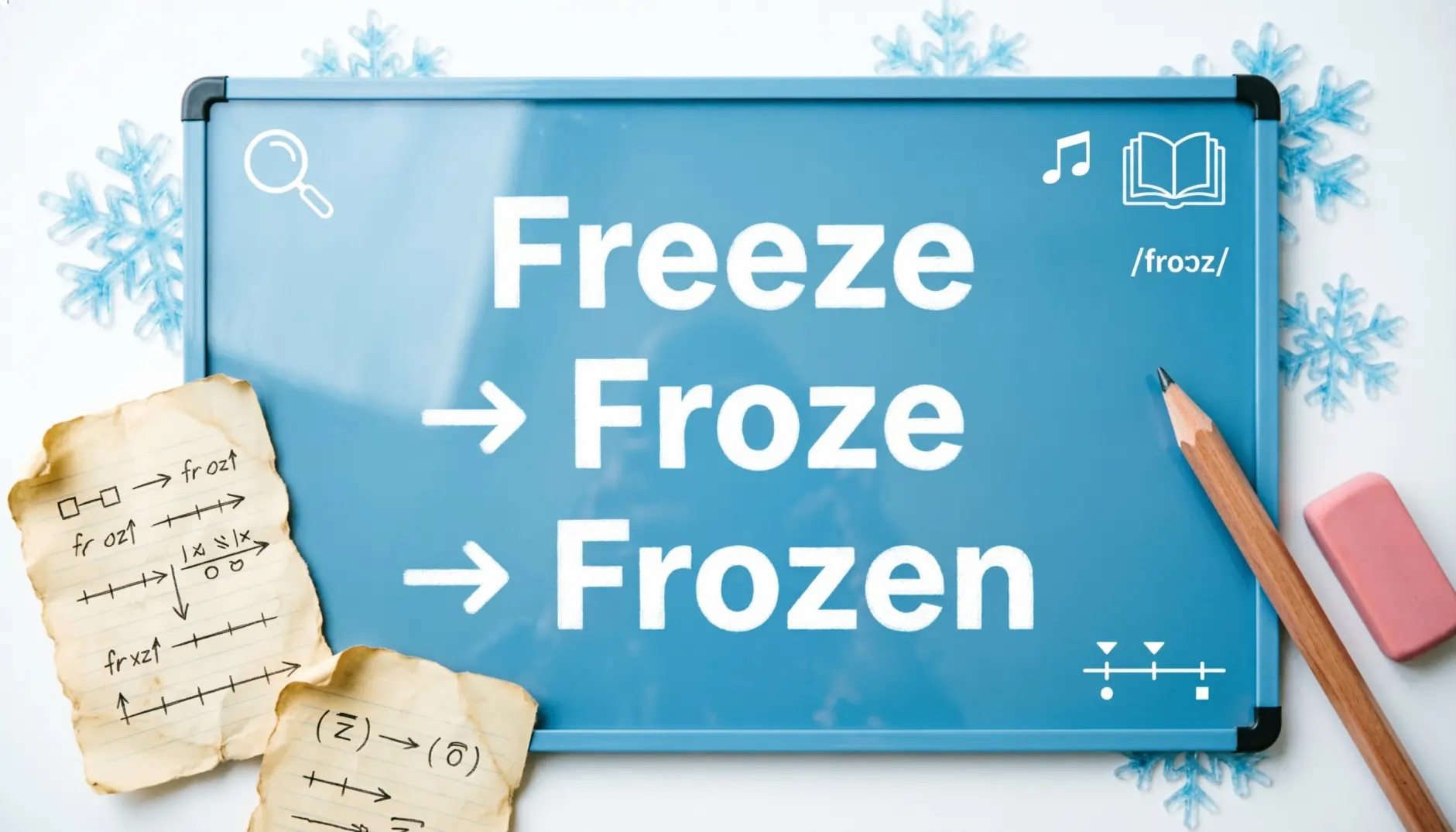
Have you ever written a sentence like “The lake freezed during winter” and wondered if it was correct? Many English learners get confused about the freeze past tense because it is an irregular verb.
Unlike regular verbs that simply add ed, the verb freeze changes its form completely.Understanding the correct past tense of freeze is important for speaking and writing accurate English.
If you are describing cold weather, frozen food, a computer that stopped working, or a person who suddenly became scared, this verb appears in many everyday situations.
The good news is that once you learn the different forms of freeze, using them becomes much easier.
In this guide, you will learn the past tense, past participle, sentence structures, grammar rules, common mistakes, and plenty of real life examples to help you use freeze confidently.
Quick Answer (Featured Snippet)
The past tense of freeze is froze.
The past participle of freeze is frozen.
| Verb Form | Word |
|---|---|
| Base Form (V1) | Freeze |
| Past Tense (V2) | Froze |
| Past Participle (V3) | Frozen |
| Present Participle | Freezing |
Example:
- Present: I freeze water every day.
- Past: I froze the water yesterday.
- Past Participle: The water has frozen.
What Is Freeze Past Tense?
The freeze past tense refers to the form froze, which is used to talk about an action that happened in the past.
The verb freeze means:
- To become ice or very cold
- To make something become ice
- To stop moving because of fear or shock
- To stop working temporarily (such as a computer)
Examples:
- The river froze last winter.
- She froze when she heard the loud noise.
- My laptop froze during the meeting.
In English grammar, froze is the simple past form of the irregular verb freeze.
Structure of Sentences of Freeze Past Tense
Affirmative Sentences
Subject + froze + object/complement
Examples:
- The lake froze overnight.
- He froze the vegetables.
- I froze when I saw the dog.
Negative Sentences
Subject + did not (didn’t) + freeze + object
Examples:
- The water did not freeze.
- She didn’t freeze in fear.
- We didn’t freeze the fruit.
Interrogative Sentences
Did + subject + freeze + object?
Examples:
- Did the pond freeze last night?
- Did you freeze the meat?
- Did she freeze when she saw the snake?
Formation of Freeze Past Tense
The verb freeze is an irregular verb. It does not follow the regular pattern of adding ed.
Verb Forms of Freeze
| Form | Verb |
|---|---|
| V1 (Base Form) | Freeze |
| V2 (Past Tense) | Froze |
| V3 (Past Participle) | Frozen |
| V-ing (Present Participle) | Freezing |
Examples:
- Present: They freeze water.
- Past: They froze water.
- Present Perfect: They have frozen water.
- Continuous: They are freezing water.
Important Note
Because freeze is irregular, forms such as freezed are incorrect.
❌ I freezed the food.
✅ I froze the food.
How to Use Freeze Past Tense
The past tense froze is used when talking about actions or situations that happened and finished in the past.
1. To Talk About Something Becoming Ice
- The river froze during the night.
- The pipes froze in winter.
2. To Talk About Freezing Something
- Mom froze the leftovers.
- We froze the berries for later use.
3. To Describe Fear or Shock
- I froze when I heard footsteps behind me.
- She froze with fear.
4. To Describe Technology Stopping
- My computer froze during the presentation.
- The screen froze suddenly.
Pronunciation Tip
- Freeze = /friːz/
- Froze = /froʊz/
- Frozen = /ˈfroʊzən/
Practice saying them aloud:
Freeze → Froze → Frozen
Structure or Verb Pattern Table
| Usage | Structure |
|---|---|
| Simple Present | Subject + freeze/freezes |
| Simple Past | Subject + froze |
| Present Perfect | Subject + has/have + frozen |
| Past Perfect | Subject + had + frozen |
| Future Tense | Subject + will + freeze |
| Negative Past | Subject + did not + freeze |
| Past Question | Did + subject + freeze? |
Real Life Examples
Affirmative Examples
- The lake froze completely.
- I froze the chicken for dinner.
- She froze when she saw the accident.
- Our computer froze during class.
- The flowers froze in the cold weather.
Negative Examples
- The river did not freeze this year.
- He didn’t freeze when the emergency happened.
- We didn’t freeze the vegetables.
Interrogative Examples
- Did the water freeze overnight?
- Did you freeze the fish?
- Did she freeze in fear?
Informal Examples
- My phone froze again.
- I totally froze during the interview.
Formal Examples
- The equipment froze due to extreme temperatures.
- Several pipelines froze during the storm.
Common Mistakes
Mistake 1: Using “Freezed”
❌ The pond freezed last night.
✅ The pond froze last night.
Explanation: Freeze is irregular. The correct past tense is froze.
Mistake 2: Using Froze After Did
❌ Did the lake froze?
✅ Did the lake freeze?
Explanation: After did, use the base verb.
Mistake 3: Confusing Froze and Frozen
❌ The water has froze.
✅ The water has frozen.
Explanation: Present perfect requires the past participle frozen.
Mistake 4: Using Frozen as Simple Past
❌ I frozen the vegetables yesterday.
✅ I froze the vegetables yesterday.
Explanation: Use froze for simple past actions.
Key Grammar Rules
1. Freeze Is an Irregular Verb
- Freeze → Froze → Frozen
2. Use “Froze” for Simple Past
- The river froze last night.
3. Use “Frozen” After Have, Has, or Had
- The river has frozen.
4. Use the Base Form After Did
- Did the river freeze?
5. Never Use “Freezed”
- ❌ Freezed
- ✅ Froze
6. Frozen Can Also Be an Adjective
- Frozen food
- Frozen lake
- Frozen vegetables
Comparisons with Similar Grammar Forms
Freeze vs Froze
| Word | Usage |
|---|---|
| Freeze | Base form (V1) |
| Froze | Past tense (V2) |
Examples:
- I freeze vegetables every week.
- I froze vegetables yesterday.
Froze vs Frozen
| Word | Usage |
|---|---|
| Froze | Simple Past (V2) |
| Frozen | Past Participle (V3) |
Examples:
- The lake froze last night.
- The lake has frozen.
Freeze vs Ice
Freeze is a verb.
- Water can freeze.
Ice is usually a noun.
- The pond is covered with ice.
Exercises
Exercise 1: Fill in the Blanks
Choose the correct form of the verb.
- The river ______ last winter.
- I have ______ the vegetables.
- My computer ______ during the meeting.
- Did the water ______ overnight?
- She ______ when she heard the noise.
Exercise 2: Correct the Mistakes
- The lake freezed yesterday.
- Has the pond froze?
- Did he froze in fear?
- I frozen the meat last week.
- The computer has froze again.
Exercise 3: Rewrite the Sentences
Change these sentences into the past tense.
- The water freezes.
- I freeze fruit for smoothies.
- She freezes when she gets nervous.
- The screen freezes suddenly.
- We freeze leftovers.
Exercise 4: Multiple Choice Questions
1. What is the past tense of freeze?
A. Freezed
B. Frozen
C. Froze
D. Freeze
2. Which sentence is correct?
A. The river freezed.
B. The river frozen.
C. The river froze.
D. The river freeze.
3. Which is the past participle form?
A. Freeze
B. Froze
C. Freezing
D. Frozen
4. Complete the sentence:
The food has ______.
A. froze
B. frozen
C. freeze
D. freezing
Answer Key
Exercise 1
- froze
- frozen
- froze
- freeze
- froze
Exercise 2
- froze
- Has the pond frozen?
- Did he freeze in fear?
- I froze the meat last week.
- The computer has frozen again.
Exercise 3
- The water froze.
- I froze fruit for smoothies.
- She froze when she got nervous.
- The screen froze suddenly.
- We froze leftovers.
Exercise 4
- C
- C
- D
- B
FAQs
What is the past tense of freeze?
The past tense of freeze is froze.
What is the past participle of freeze?
The past participle is frozen.
Is “freezed” correct?
No. Freezed is incorrect. The correct past tense is froze.
What is the difference between froze and frozen?
Froze is the simple past form, while frozen is the past participle.
Can frozen be an adjective?
Yes.
Examples:
- Frozen food
- Frozen lake
- Frozen vegetables
Is freeze a regular or irregular verb?
It is an irregular verb because its forms change to froze and frozen instead of adding ed.
Conclusion
Learning the freeze past tense is easier once you remember its irregular forms: freeze, froze, frozen. The most common mistake learners make is using freezed, but the correct simple past form is always froze. Use froze when talking about completed actions in the past, and use frozen as the past participle after has, have, or had.
Whether you are describing cold weather, frozen food, a computer problem, or a moment of fear, this verb appears frequently in everyday English.
Practice using freeze, froze, and frozen in your own sentences, and soon these forms will feel natural. The more you read, write, and speak English, the more confidently you will use this important irregular verb.