Have you ever stopped doing something and wondered how to describe it in English? For example, if you stopped smoking last year or left a job two months ago, should you say quit or quitted? This is a common question for English learners.
The past tense of quit is quit. It is an irregular verb that usually keeps the same spelling in its base form, simple past form, and past participle. For example, “I quit my job last year” is correct.
You do not need to change quit to quitted in standard everyday English.The verb quit means to stop doing something, leave a job or place, or give up an activity. It is commonly used when talking about habits, work, games, and personal decisions.
In this guide, you will learn the past tense of quit, its verb forms, sentence patterns, spelling rules, real life examples, and common mistakes. You will also find simple exercises to help you use quit correctly in everyday English.
Quick Answer: What Is the Past Tense of Quit?
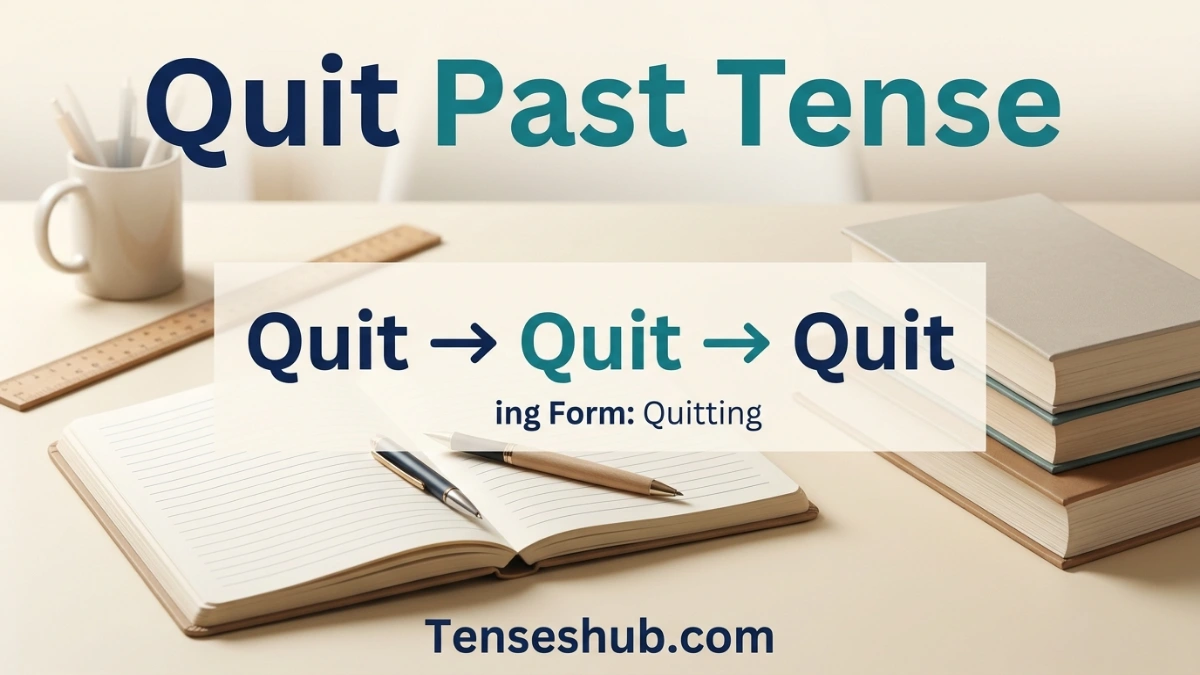
The past tense of quit is quit, and its past participle is also quit. It is an irregular verb that does not change its spelling in these three forms.
| Verb Form | Word |
|---|---|
| Base form (V1) | quit |
| Simple past (V2) | quit |
| Past participle (V3) | quit |
| ing form | quitting |
| Third person singular | quits |
Examples:
- Present: I quit when the work becomes too difficult.
- Past: I quit my job last month.
- Present perfect: I have quit smoking.
What Is the Quit Past Tense?
The quit past tense is the simple past form of the verb quit. It describes an action that stopped or ended in the past.
The word quit has several common meanings.
1. To stop doing something
We use quit when someone stops an activity or habit.
Examples:
- She quit smoking last year.
- He quit playing football after his injury.
- I quit eating junk food every day.
2. To leave a job
The verb quit is often used when someone leaves a job voluntarily.
Examples:
- Maria quit her job last week.
- My brother quit his position at the company.
- He quit because he wanted to study full time.
3. To stop trying or give up
We can also use quit when someone stops trying to complete something.
Examples:
- She never quit trying to learn English.
- They quit the competition before the final round.
- I almost quit, but I decided to continue.
Is Quit a Regular or Irregular Verb?
Quit is an irregular verb. Unlike regular verbs such as walk → walked or work → worked, its simple past and past participle usually remain unchanged.
- Present: I quit the activity.
- Past: I quit the activity yesterday.
- Present perfect: I have quit the activity.
Although quitted appears in some historical or less common uses, quit is the standard and most natural choice in modern everyday English.
Structure of Sentences of the Quit Past Tense
The simple past tense of quit follows the usual sentence patterns for affirmative, negative, and interrogative sentences.
1. Affirmative sentences
Formula: Subject + quit + object.
Examples:
- I quit my job yesterday.
- She quit smoking last year.
- They quit the game early.
2. Negative sentences
Formula: Subject + did not + quit + object.
Examples:
- I did not quit my job.
- She didn’t quit the course.
- They did not quit the competition.
The word did shows the past tense, so use the base form quit after it.
3. Interrogative sentences
Formula: Did + subject + quit + object?
Examples:
- Did you quit your job?
- Did she quit smoking?
- Did they quit the game?
In everyday conversation, you can also use contractions such as didn’t in negative sentences.
Formation of the Quit Past Tense
The verb quit is irregular because its simple past form does not take the usual ed ending.
1. Base form to simple past
The base form and simple past form have the same spelling.
Quit → Quit
Examples:
- Present: I quit the habit when it becomes difficult.
- Past: I quit the habit last year.
2. Past participle
The past participle is also quit. Use it with helping verbs such as has, have, and had.
Examples:
- I have quit smoking.
- She has quit her job.
- They had quit the game before it ended.
3. The ing form
When adding ing, double the final t.
Quit → Quitting
Examples:
- He is quitting his job.
- She was quitting the team when the coach called her.
4. The third person singular form
In the simple present tense, add s to form quits.
Examples:
- He quits when the task becomes difficult.
- She quits her job only after careful thought.
5. Use quit after did
In questions and negative sentences, use quit after did or didn’t.
- Correct: Did he quit his job?
- Incorrect: Did he quitted his job?
- Correct: She didn’t quit the course.
- Incorrect: She didn’t quitted the course.
How to Use Quit in Sentences
The verb quit is useful in many everyday situations. The meaning depends on what a person stops or leaves.
1. Talking about jobs
Use quit when someone voluntarily leaves a job.
Examples:
- I quit my job because I found a better opportunity.
- She quit her position last Friday.
- He quit his job to start his own business.
2. Talking about habits
Use quit when someone stops a habit or repeated activity.
Examples:
- He quit smoking two years ago.
- She quit drinking sugary drinks.
- I quit staying up late every night.
3. Talking about games and activities
Examples:
- The player quit the game halfway through.
- They quit the competition because they were injured.
- She almost quit learning English, but her teacher encouraged her.
4. Using the present perfect
Use have quit or has quit when a past decision is relevant to the present.
Examples:
- I have quit smoking.
- She has quit her job.
- They have quit the project.
5. Using the past perfect
Use had quit when the action happened before another past event.
Examples:
- He had quit his job before moving abroad.
- She had quit the team before the tournament began.
6. Using quit with an object or without one
The verb can appear with an object or on its own when the context is clear.
With an object:
- She quit her job.
- He quit smoking.
Without an object:
- I wanted to continue, but I quit.
- Several players quit before the final round.
Quit Past Tense: Verb Pattern Table
| Sentence Type | Pattern | Example |
|---|---|---|
| Simple past | Subject + quit | She quit her job. |
| Negative past | Subject + didn’t + quit | She didn’t quit her job. |
| Past question | Did + subject + quit? | Did she quit her job? |
| Present perfect | Subject + has/have + quit | She has quit her job. |
| Past perfect | Subject + had + quit | She had quit before I arrived. |
| Past continuous | Subject + was/were + quitting | She was quitting the team. |
| Simple present | Subject + quits | She quits early. |
Real Life Examples of Quit Past Tense
Here are practical examples showing how quit is used in different situations.
Affirmative sentences
- I quit my job last month.
- She quit smoking two years ago.
- He quit the football team after the injury.
- They quit the competition before the final round.
- My friend quit his bad habit last year.
Negative sentences
- I didn’t quit my studies.
- She did not quit her job.
- He didn’t quit playing football.
- They did not quit the project.
- We didn’t quit trying to solve the problem.
Interrogative sentences
- Did you quit your job?
- Did she quit smoking?
- Why did he quit the team?
- When did they quit the competition?
- Did your friend quit the course?
Formal examples
- The employee quit his position after accepting another offer.
- She quit the project because its goals had changed.
- The participant quit the competition due to an injury.
Informal examples
- I quit that game because it was too difficult.
- He quit his job and started travelling.
- She almost quit, but she kept going.
Common Mistakes When Using Quit
1. Using quitted instead of quit
Incorrect: I quitted my job last year.
Correct: I quit my job last year.
Why? Quit is the standard past tense form in modern everyday English.
2. Using quitted after did
Incorrect: Did you quitted the game?
Correct: Did you quit the game?
Why? Use the base form after did.
3. Using quitted in a negative sentence
Incorrect: She didn’t quitted smoking.
Correct: She didn’t quit smoking.
Why? The helping verb didn’t already marks the past tense.
4. Forgetting the past tense in a completed action
Incorrect: He quit his job yesterday and start a new one.
Correct: He quit his job yesterday and started a new one.
Why? Keep the verb tenses consistent when describing completed past events.
5. Confusing quit with quiet
Incorrect: I quiet my job last week.
Correct: I quit my job last week.
Why? Quit means to stop or leave something. Quiet means making little or no noise, or it can describe something calm.
6. Confusing quit with quite
Incorrect: I quite smoking last year.
Correct: I quit smoking last year.
Why? Quite usually means fairly or completely, depending on context. It does not mean to stop a habit.
Key Grammar Rules for Quit
- The simple past is quit. Example: She quit her job yesterday.
- The past participle is quit. Example: She has quit her job.
- Use quit after did or didn’t. Example: Did he quit the team?
- Double the final t before adding ing. Example: quit → quitting.
- Add s in the third person singular present. Example: He quits when he feels tired.
- Use had quit for an earlier past action. Example: He had quit before the manager arrived.
- Use quit rather than quitted in standard everyday English. Example: They quit the competition.
Quit vs. Quitted vs. Quitting
These forms are related, but they are not used in the same way.
| Word | Usage | Example |
|---|---|---|
| Quit | Base form | I want to quit smoking. |
| Quit | Simple past | I quit smoking last year. |
| Quit | Past participle | I have quit smoking. |
| Quitting | ing form | I am quitting smoking. |
| Quits | Present form with he/she/it | He quits when he gets tired. |
| Quitted | Rare or nonstandard in everyday use | Prefer “quit” in ordinary modern English. |
Quit vs. leave
Quit often emphasizes stopping an activity or voluntarily giving something up. Leave is broader and can mean departing from a place or person.
- I quit my job. (I resigned or stopped working there.)
- I left the office at five. (I departed from the office.)
Quit vs. give up
These expressions can have similar meanings, but their usage differs slightly.
- She quit smoking. (She stopped the habit.)
- She gave up trying. (She stopped making an effort.)
Both expressions are common in everyday English.
Exercises: Practice the Past Tense of Quit
Test your understanding with these exercises.
Exercise 1: Fill in the blanks
Complete each sentence with the correct form of quit.
- I ______ my job last month.
- Did she ______ smoking?
- He has ______ the team.
- They were ______ the competition.
- She didn’t ______ the course.
Exercise 2: Correct the sentences
- I quitted my job yesterday.
- Did he quitted the game?
- She didn’t quitted smoking.
- He is quit his job.
- My brother quit his job and start a business.
Exercise 3: Rewrite the sentences
- She quit her job. (Make it negative.)
- He quit smoking. (Make it a question.)
- I quit the team. (Use the present perfect.)
- She quits the game early. (Change to the simple past.)
- He quit his job before I arrived. (Use the past perfect.)
Exercise 4: Multiple choice questions
1. What is the simple past tense of quit?
A. Quitted
B. Quit
C. Quitting
2. Choose the correct sentence.
A. Did she quitted her job?
B. Did she quit her job?
C. Did she quits her job?
3. What is the ing form of quit?
A. Quiting
B. Quitted
C. Quitting
4. Which sentence uses the present perfect correctly?
A. He has quit smoking.
B. He have quit smoking.
C. He has quitting smoking.
5. Which sentence is correct?
A. She didn’t quitted the course.
B. She didn’t quit the course.
C. She didn’t quits the course.
Answer Key
Exercise 1
- quit
- quit
- quit
- quitting
- quit
Exercise 2
- I quit my job yesterday.
- Did he quit the game?
- She didn’t quit smoking.
- He is quitting his job.
- My brother quit his job and started a business.
Exercise 3
- She did not quit her job.
- Did he quit smoking?
- I have quit the team.
- She quit the game early.
- He had quit his job before I arrived.
Exercise 4
- B. Quit
- B. Did she quit her job?
- C. Quitting
- A. He has quit smoking.
- B. She didn’t quit the course.
FAQs
1. What is the past tense of quit?
The past tense of quit is quit. Example: I quit my job last year.
2. Is quit a regular or irregular verb?
Quit is an irregular verb because its past tense does not use the regular ed ending.
3. Is it quit or quitted?
Quit is the standard form in modern everyday English. Use it for the simple past and past participle.
4. What is the past participle of quit?
The past participle is quit. Example: She has quit smoking.
5. What is the ing form of quit?
The ing form is quitting. The final t is doubled before adding ing.
6. What is the third person singular form of quit?
The simple present form is quits. Example: He quits when the work becomes too difficult.
7. How do you use quit in a negative sentence?
Use did not quit or didn’t quit. Example: I didn’t quit my studies.
8. Is “I have quit” correct?
Yes. Have quit is the present perfect form. Example: I have quit smoking.
9. What is the difference between quit and give up?
Both can mean to stop doing something. Quit is common for jobs and habits, while give up often emphasizes stopping an attempt or losing hope.
10. Can quit be used for leaving a job?
Yes. “She quit her job last week” means she voluntarily left her job.
Conclusion
The past tense of quit is quit, and its past participle is also quit. This irregular verb keeps the same spelling in its base, simple past, and past participle forms.
However, its ing form is quitting, with a doubled final t, and its third person singular present form is quits.
Use quit when describing someone who stopped a habit, left a job, or gave up an activity. Remember to use the base form after did and didn’t, as in “Did you quit?” and “I didn’t quit.”
With these rules and examples, you can use the verb confidently in everyday conversations, school assignments, and professional writing. Practice the exercises and create your own sentences to remember the correct forms.