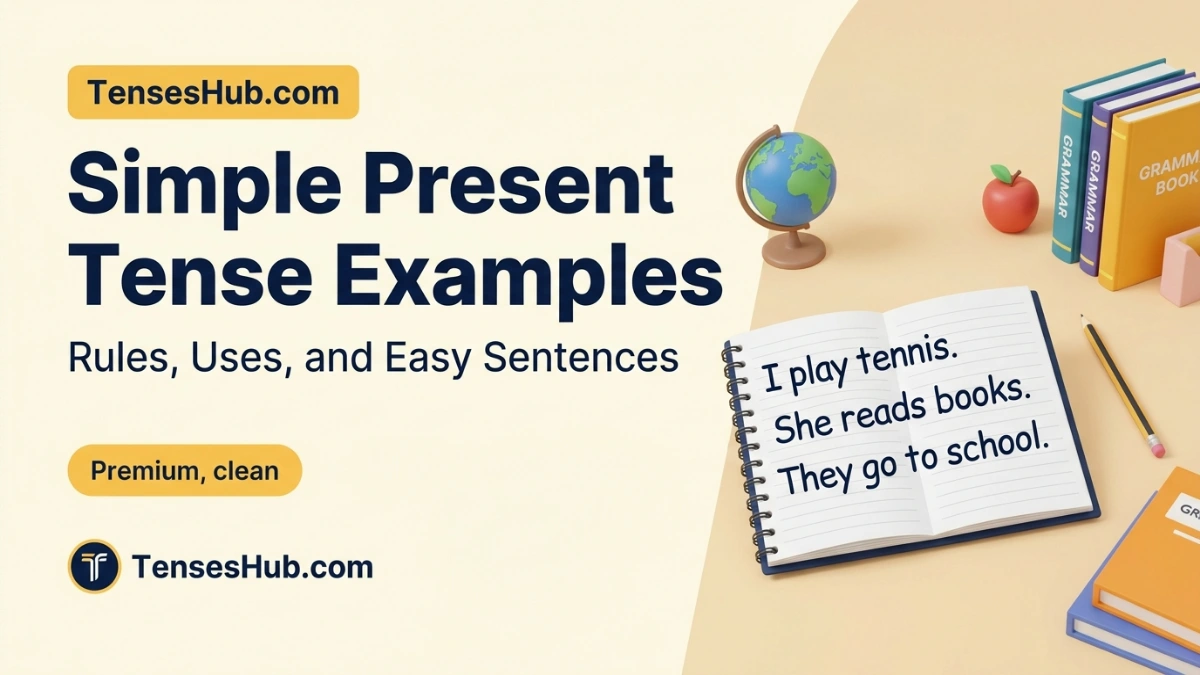
Do you sometimes get confused about if to write “She plays cricket” or “She play cricket”? Many English learners make this mistake when speaking or writing. The good news is that the simple present tense is easy to learn when you understand its basic rules and practice with examples.
We use this tense to talk about daily routines, habits, general facts, feelings, and repeated actions. For example, “I wake up early,” “He works in an office,” and “The sun rises in the east” are all examples of the simple present tense.
Learning simple present tense examples helps you understand how English sentences work in everyday conversations. It also improves your writing, speaking, and grammar skills.
In this guide, you will learn what the simple present tense means, how to form affirmative, negative, and interrogative sentences, and when to use it correctly. You will also find practical examples, common mistakes, comparisons with other tenses, and exercises with answers to test your knowledge.
Quick Answer: What Is the Simple Present Tense?
The simple present tense describes habits, routines, general truths, repeated actions, and situations that are generally true.
Examples:
- I drink water every day.
- She reads books.
- They play football on Sundays.
- The Earth revolves around the Sun.
Basic rule: Use the base verb with I, you, we, and they. With he, she, and it, usually add s or es to the verb in affirmative sentences.
What Is the Simple Present Tense?
The simple present tense is a verb tense used to describe actions that happen regularly, facts that are generally true, and situations that exist in the present.
It does not always describe something happening at this exact moment. Instead, it often explains what someone usually does, what happens repeatedly, or what is generally true.
For example:
- I study English every day.
- She works in a hospital.
- My brother likes football.
- We live in Pakistan.
- Water freezes at 0°C under standard atmospheric pressure.
In these sentences, the verbs describe habits, situations, preferences, and general facts.
The simple present tense is also called the present simple tense. Both terms mean the same thing.
Main Uses of the Simple Present Tense
We use this tense to talk about:
- Daily routines and habits
- General facts and scientific truths
- Repeated actions
- Feelings, opinions, and preferences
- Stable situations
- Fixed schedules and timetables
Understanding these uses will help you decide when to use the simple present tense in your own sentences.
Structure of Simple Present Tense Sentences
The simple present tense has three main sentence structures: affirmative, negative, and interrogative.
1. Affirmative Sentences
An affirmative sentence tells us that something happens or is true.
Structure: Subject + main verb + rest of the sentence.
Examples:
- I play cricket.
- You speak English.
- We study together.
- They work hard.
- He plays cricket.
- She speaks English.
Notice that the verb changes with he, she, and it in affirmative sentences.
2. Negative Sentences
A negative sentence tells us that something does not happen or is not true.
Structure: Subject + do/does + not + base verb + rest of the sentence.
Examples:
- I do not drink coffee.
- They do not watch television.
- He does not play football.
- She does not eat meat.
In everyday English, we often use contractions:
- Do not → Don’t
- Does not → Doesn’t
Examples:
- I don’t drink coffee.
- She doesn’t eat meat.
3. Interrogative Sentences
An interrogative sentence asks a question.
Structure: Do/Does + subject + base verb + rest of the sentence?
Examples:
- Do you speak English?
- Do they live here?
- Does he work at a bank?
- Does she like music?
Use do with I, you, we, and they. Use does with he, she, and it.
Remember that the main verb stays in its base form after does.
4. WH Questions
WH questions begin with words such as what, where, when, why, and how.
Structure: WH word + do/does + subject + base verb?
Examples:
- Where do you live?
- What does she want?
- When do they arrive?
- Why does he study English?
- How do you make tea?
These questions help you ask for specific information.
Formation of the Simple Present Tense
The simple present tense uses the base form of a verb, with a few changes depending on the subject and sentence type.
1. Use the Base Form of the Verb
With I, you, we, and they, use the base verb in affirmative sentences.
| Subject | Verb | Example |
|---|---|---|
| I | work | I work every day. |
| You | read | You read quickly. |
| We | play | We play football. |
| They | study | They study English. |
The base form is the ordinary form of a verb, such as eat, write, go, or speak.
2. Add s or es with He, She, and It
In affirmative sentences, verbs usually take s or es with third person singular subjects.
| Base Verb | Simple Present | Example |
|---|---|---|
| Play | Plays | He plays chess. |
| Read | Reads | She reads daily. |
| Work | Works | My brother works here. |
| Go | Goes | He goes to school. |
| Watch | Watches | She watches movies. |
| Fix | Fixes | It fixes the problem. |
| Wash | Washes | He washes his hands. |
3. Verbs Ending in y
When a verb ends in a consonant followed by y, change the y to i and add es.
- Study → Studies
- Carry → Carries
- Try → Tries
- Fly → Flies
Examples:
- She studies English.
- He carries a bag.
- The bird flies high.
However, if a verb ends in a vowel followed by y, simply add s.
- Play → Plays
- Enjoy → Enjoys
- Buy → Buys
Examples:
- He plays cricket.
- She enjoys music.
- My father buys groceries.
4. Use Do and Does in Negatives and Questions
Use do or does with the base form of the main verb.
Examples:
- I do not understand.
- They do not eat fish.
- He does not understand.
- She does not eat fish.
- Do you understand?
- Does she eat fish?
Do not add s to the main verb after does.
Correct: She does not like coffee.
Incorrect: She does not likes coffee.
5. Contractions in the Simple Present Tense
Contractions are shorter forms commonly used in everyday English.
| Full Form | Contraction |
|---|---|
| Do not | Don’t |
| Does not | Doesn’t |
Examples:
- I don’t smoke.
- We don’t live here.
- He doesn’t drive.
- She doesn’t work on Sundays.
Both full forms and contractions are correct. Full forms may be preferred in formal writing, while contractions are common in conversations and informal writing.
How to Use the Simple Present Tense
The simple present tense has several important uses. Here are the main rules with practical examples.
1. Daily Routines and Habits
Use the simple present tense to describe things you do regularly.
Examples:
- I wake up at 6 a.m.
- She brushes her teeth twice a day.
- We go to school by bus.
- My mother cooks dinner every evening.
- He exercises every morning.
Time expressions such as every day, every week, usually, and often frequently appear with habitual actions.
2. General Facts and Universal Truths
Use this tense for facts and truths that are generally accepted.
Examples:
- The Earth revolves around the Sun.
- Plants need water to grow.
- Ice melts when it gets warm enough.
- Water freezes at 0°C under standard atmospheric pressure.
- Bees produce honey.
These sentences describe general facts rather than actions happening only at the moment of speaking.
3. Feelings, Opinions, and Preferences
Many verbs describing thoughts, feelings, possession, and preferences are commonly used in the simple present tense.
Examples:
- I love my family.
- She likes classical music.
- He knows the answer.
- We believe you.
- They own a small house.
Some of these are called stative verbs. They describe a state rather than an action and are not usually used in continuous forms with the same meaning.
4. Repeated Actions
Use the simple present tense for actions that happen repeatedly.
Examples:
- The bus arrives at 8 a.m.
- He visits his grandparents every month.
- We play badminton on Fridays.
- She calls her friend every evening.
These sentences describe repeated events, not necessarily actions happening at the moment of speaking.
5. Timetables and Schedules
Use the simple present tense to talk about fixed schedules, including transport times, school timetables, and official programs.
Examples:
- The train leaves at 9 p.m.
- Our class starts at 8:30 a.m.
- The shop opens at 10 a.m.
- The movie begins at 7 p.m.
Even though these events may happen in the future, the simple present tense is commonly used because they are scheduled.
6. Instructions and Directions
The base form of a verb is used to give instructions and directions.
Examples:
- Turn left at the next street.
- Add two cups of water.
- Open the book to page ten.
- Mix the ingredients well.
These are imperative sentences. They use the base verb, but they are not ordinary third person simple present statements.
Simple Present Tense Structure Table
Use this table as a quick reference when making sentences.
| Sentence Type | Structure | Example |
|---|---|---|
| Affirmative | Subject + V1/V1 s | She writes daily. |
| Negative | Subject + do/does not + V1 | He does not write daily. |
| Yes/No Question | Do/Does + subject + V1? | Does he write daily? |
| WH Question | WH word + do/does + subject + V1? | Where does he work? |
Important: The verb be is different from ordinary verbs. Its simple present forms are am, is, and are. Do not use do or does to form ordinary negatives and questions with be.
Correct: Is he happy?
Incorrect: Does he be happy?
Simple Present Tense Examples in Real Life
Here are 30 examples grouped by everyday situations.
A. Daily Routine Examples
- I wake up early every morning.
- She takes a shower before breakfast.
- He walks to school.
- We eat dinner together.
- They go to bed at 10 p.m.
B. School and Education Examples
- The teacher explains the lesson.
- Students complete their homework.
- Ali studies English every evening.
- My sister reads storybooks.
- Our school opens at 8 a.m.
C. Work and Business Examples
- My father works in an office.
- She manages a small business.
- He answers customer emails.
- We attend meetings every Monday.
- The company sells computer equipment.
D. Family and Home Examples
- My mother prepares breakfast.
- My brother cleans his room.
- We help our parents.
- The baby sleeps in the afternoon.
- Our dog barks at strangers.
E. Negative Sentence Examples
- I do not waste my time.
- She does not drink coffee.
- They do not live in this city.
- He does not play video games on weekdays.
- We don’t watch television during dinner.
F. Question Examples
- Do you speak English?
- Does she work here?
- Where do your parents live?
- What does he eat for breakfast?
- Do they visit you every weekend?
Notice how the verb changes with he, she, and it in affirmative statements, but returns to its base form after does in questions and negative sentences.
Common Mistakes in the Simple Present Tense
English learners often make a few predictable mistakes when using this tense. Learning to spot them will help you write more accurate sentences.
Mistake 1: Forgetting s or es
Incorrect: She play tennis.
Correct: She plays tennis.
Why? In affirmative sentences, third person singular subjects usually require s or es on the main verb.
Mistake 2: Adding s After Does
Incorrect: He does not likes milk.
Correct: He does not like milk.
Why? The helping verb does already carries the third person singular marking. The main verb stays in its base form.
Mistake 3: Using Do Instead of Does
Incorrect: Does he plays football?
Correct: Does he play football?
Incorrect: He do not work here.
Correct: He does not work here.
Why? Use does with he, she, and it in standard present simple questions and negatives.
Mistake 4: Using the Wrong Verb with Plural Subjects
Incorrect: They goes to school.
Correct: They go to school.
Why? Use the base verb with plural subjects such as they and we.
Mistake 5: Confusing the Simple Present with the Present Continuous
Incorrect: I am go to school every day.
Correct: I go to school every day.
Why? Use the simple present for regular habits. The present continuous uses am/is/are + verb ing and often describes an action in progress.
Mistake 6: Using Do or Does with the Verb Be
Incorrect: Does she be happy?
Correct: Is she happy?
Incorrect: He doesn’t be tired.
Correct: He isn’t tired.
Why? The verb be forms its own negatives and questions using am, is, and are.
Key Grammar Rules of the Simple Present Tense
Remember these seven rules to use the tense correctly.
1. Use the base verb with I, you, we, and they. Example: They play cricket.
2. Add s or es with he, she, and it in affirmative sentences. Example: He watches television.
3. Use do not or don’t with I, you, we, and they for negative sentences. Example: We don’t eat meat.
4. Use does not or doesn’t with he, she, and it. Example: She doesn’t drive.
5. Use the base form of the main verb after do or does. Example: Does he work here?
6. Use am, is, and are for present tense forms of be. Example: I am ready. They are happy.
7. Use the simple present for habits, general truths, repeated actions, and fixed schedules. Example: The train leaves at 6 p.m.
These rules cover most beginner level simple present tense sentences.
Simple Present Tense vs. Present Continuous Tense
The simple present and present continuous both describe the present, but they have different uses.
| Simple Present | Present Continuous |
|---|---|
| Describes habits or routines | Describes actions in progress |
| I read every night. | I am reading now. |
| She works in a bank. | She is working from home today. |
| They play football on Sundays. | They are playing football right now. |
When Should You Use Each Tense?
Use the simple present when describing something that happens regularly or is generally true.
- He drinks tea every morning.
- I work at a school.
Use the present continuous for something happening now or around the current period.
- He is drinking tea right now.
- I am working on a new project this week.
Some verbs, such as know, like, and believe, are generally used in simple forms when they describe states.
For example:
- Correct: I know the answer.
- Usually incorrect in this meaning: I am knowing the answer.
Simple Present Tense Exercises
Practice the following questions to check your understanding. Try to answer them before looking at the answer key.
Exercise 1: Fill in the Blanks
Complete each sentence using the correct form of the verb in brackets.
- She _____ to school every day. (go)
- They _____ football on Sundays. (play)
- He _____ English very well. (speak)
- My mother _____ dinner every evening. (cook)
- We _____ coffee in the morning. (drink)
- The baby _____ a lot. (cry)
- Ali _____ his homework after school. (do)
- The shop _____ at 9 a.m. (open)
Exercise 2: Correct the Mistakes
Rewrite each sentence correctly.
- She walk to work every day.
- He doesn’t likes apples.
- Does your brother plays cricket?
- They goes to school by bus.
- I am study English every night.
Exercise 3: Change the Sentences
Follow the instruction for each sentence.
- She reads books. (Make it negative.)
- They work here. (Make it a question.)
- He plays tennis. (Make it negative.)
- You speak English. (Make it a question.)
- Maria lives in Lahore. (Make it a question.)
Exercise 4: Choose the Correct Answer
1. My brother _____ television every evening. a) watch b) watches c) watching
2. _____ she like chocolate? a) Do b) Does c) Is
3. They _____ live near the school. a) doesn’t b) don’t c) isn’t
4. The Earth _____ around the Sun. a) revolve b) revolves c) revolving
5. I _____ happy today. a) am b) does c) do
Answer Key
Exercise 1
- goes
- play
- speaks
- cooks
- drink
- cries
- does
- opens
Exercise 2
- She walks to work every day.
- He doesn’t like apples.
- Does your brother play cricket?
- They go to school by bus.
- I study English every night.
Exercise 3
- She does not read books.
- Do they work here?
- He does not play tennis.
- Do you speak English?
- Does Maria live in Lahore?
Exercise 4
- b) watches
- b) Does
- b) don’t
- b) revolves
- a) am
If you answered most questions correctly, you understand the main rules. Review any mistakes and try writing five original sentences about your daily routine.
FAQs
1. What are five examples of the simple present tense?
- I drink water every day.
- She reads a book.
- He works in an office.
- They play football.
- The Sun rises in the east.
2. What is the formula for the simple present tense?
For affirmative sentences, use subject + main verb. With he, she, and it, usually add s or es. For negatives, use subject + do/does not + base verb. For questions, use do/does + subject + base verb.
3. What are ten simple present tense sentences?
- I wake up early.
- She cooks breakfast.
- He drives carefully.
- We study English.
- They live nearby.
- My father reads newspapers.
- The baby cries loudly.
- Birds fly in the sky.
- The bus arrives on time.
- She teaches mathematics.
4. When do we use the simple present tense?
Use it for habits, daily routines, general facts, repeated actions, feelings, opinions, and fixed schedules.
5. Do we add s to every verb in the simple present tense?
No. In affirmative sentences, s or es is generally added when the subject is he, she, or it. With I, you, we, and they, use the base form. After does or doesn’t, use the base form for every subject.
6. What are the helping verbs in the simple present tense?
The main helping verbs used to form questions and negatives are do and does. The verb be has its own present forms: am, is, and are.
7. What is the difference between simple present and present continuous?
The simple present usually describes habits and general facts, while the present continuous often describes actions happening now or around the current period.
- Simple present: She writes every day.
- Present continuous: She is writing now.
8. Can we use the simple present tense for future events?
Yes. We commonly use it for fixed schedules and timetables.
Example: “The train leaves at 7 p.m. tomorrow.”
For personal plans and intentions, the present continuous or going to is often more natural.
9. Is “I am agree” correct?
No. The correct sentence is “I agree.” The verb agree is a main verb, so it does not need am in this sentence.
10. Is the simple present tense the same as the present simple tense?
Yes. These are two names for the same grammatical tense. Both terms are used in English learning materials.
Conclusion
The simple present tense is an essential part of English grammar because it helps you describe daily routines, habits, general facts, repeated actions, feelings, and scheduled events. Once you understand its basic rules, creating correct sentences becomes much easier.
Remember to use the base verb with I, you, we, and they, and usually add s or es with he, she, and it in affirmative sentences. For negative sentences and questions, use do or does followed by the base verb. Also, remember that am, is, and are work differently from ordinary verbs.