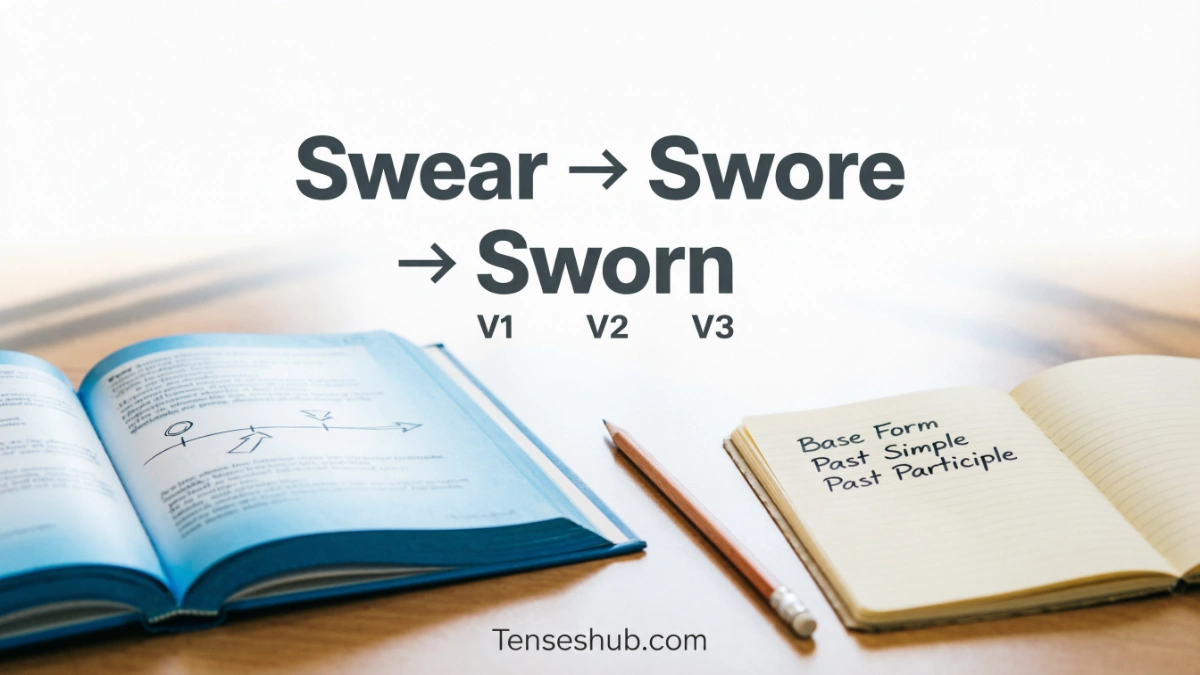
Have you ever wanted to say that someone swore something yesterday, but wondered if the correct word was swear, swore, or sworn? This is a common problem for English learners because swear is an irregular verb, so its past forms do not follow the usual ed pattern.
The swear past tense is swore. Its past participle is sworn, and its ing form is swearing. For example, we say, “He swore to tell the truth,” but “He has sworn to tell the truth.”
The verb swear can have several meanings. It can mean making a serious promise, making an oath, or using offensive language. Understanding the correct form is important for everyday conversations, storytelling, writing, and formal English.
In this guide, you will learn the past tense of swear, its forms, sentence patterns, common mistakes, practical examples, and easy exercises.
Quick Answer
The past tense of swear is “swore.” The past participle is “sworn,” while the ing form is “swearing.”
| Verb Form | Word |
|---|---|
| V1 – Base Form | swear |
| V2 – Past Tense | swore |
| V3 – Past Participle | sworn |
| V-ing Form | swearing |
Example: She swore that she was telling the truth.
What Is Swear Past Tense?
The swear past tense refers to the form of the irregular verb swear used for an action that happened in the past.
The simple past form of swear is swore.
For example:
- I swore to keep your secret.
- He swore that he was innocent.
- They swore an oath together.
- She swore at the driver.
The verb swear has more than one meaning.
1. Swear means to make a serious promise
When someone promises very seriously that something is true or that they will do something, we can use swear.
Present:
- I swear I am telling the truth.
Past:
- I swore I was telling the truth.
2. Swear means to make an oath
It can also mean making a formal or serious oath.
- The witness swore to tell the truth.
- The soldiers swore an oath of loyalty.
3. Swear means to use offensive language
In informal English, swear can mean using rude, offensive, or bad language.
- He swore when he hurt his finger.
- She swore at the other driver.
The meaning depends on the context.
Structure of Sentences of Swear Past Tense
When using swore in the simple past, the sentence structure is straightforward.
Affirmative Sentence
Subject + swore + rest of sentence
Examples:
- She swore to tell the truth.
- He swore that he had not taken the money.
- They swore an oath.
Negative Sentence
For negative sentences, use did not (didn’t) + swear, not did not swore.
Subject + did not + swear + rest of sentence
Examples:
- She did not swear at him.
- He didn’t swear that he knew the answer.
- They did not swear an oath.
Interrogative Sentence
For questions, place did before the subject and use the base form swear.
Did + subject + swear + rest of sentence?
Examples:
- Did she swear to tell the truth?
- Did he swear at you?
- Did they swear an oath?
Remember: after did or didn’t, use swear, not swore.
Formation of Swear Past Tense
Swear is an irregular verb. It does not form its simple past by adding ed.
Its main forms are:
- V1: swear
- V2: swore
- V3: sworn
- ing form: swearing
Simple Past: Swore
Use swore for a completed action in the past.
- I swore to keep the secret.
- She swore she had seen him before.
Past Participle: Sworn
Sworn is the past participle. It is normally used with a helping verb such as has, have, or had.
- He has sworn to protect the family.
- They have sworn an oath.
- She had sworn that she was innocent.
ing Form: Swearing
The ing form is swearing.
- He is swearing at the television.
- They were swearing during the argument.
Notice the spelling: swear → swearing. The verb does not become swearring.
Is “Swore” Regular or Irregular?
Swear is an irregular verb.
A regular verb such as walk becomes walked in the simple past. However, swear changes to swore.
- walk → walked
- play → played
- swear → swore
How to Use Swear Past Tense
Use swore when talking about something that happened and finished in the past.
1. To describe a serious promise
- I swore that I would never tell anyone.
- She swore to keep the information private.
- He swore he would return the money.
Here, swore means “made a very serious promise.”
2. To report that someone strongly claimed something
- He swore that he had locked the door.
- She swore she had never met him.
- Tom swore that the story was true.
This use often shows that the speaker strongly insisted that something was true.
3. To describe an oath
- The witness swore to tell the truth.
- The new members swore an oath.
- He swore loyalty to the organization.
4. To describe using bad language
- He swore when he dropped the glass.
- She swore at the driver.
- The player swore after missing the shot.
In this meaning, swore is often followed by at when identifying the person receiving the offensive language.
5. With time expressions
The simple past commonly appears with past time expressions such as:
- yesterday
- last night
- last week
- a few minutes ago
- when I was younger
- two years ago
Examples:
- He swore at me yesterday.
- She swore to help me last week.
- I swore I saw him two days ago.
Structure or Verb Pattern Table
| Use | Pattern | Example |
|---|---|---|
| Simple Past | Subject + swore | He swore. |
| Past Negative | Subject + did not + swear | He did not swear. |
| Past Question | Did + subject + swear? | Did he swear? |
| Present Perfect | has/have + sworn | She has sworn. |
| Past Perfect | had + sworn | She had sworn. |
| Past Continuous | was/were + swearing | He was swearing |
The most important point is this: swore is the simple past form, while sworn is the past participle.
Real Life Examples
Here are practical examples showing how swore works in different situations.
Affirmative Examples
- I swore to keep your secret.
- She swore that she was telling the truth.
- He swore an oath before the court.
- They swore to support their friend.
- The boy swore that he had not broken the window.
Negative Examples
- I didn’t swear at anyone.
- She did not swear that the information was correct.
- He didn’t swear to keep the secret.
- They did not swear an oath.
Question Examples
- Did you swear to tell the truth?
- Did she swear at you?
- Did he swear that he was innocent?
- Did they swear an oath?
Formal Examples
- The witness swore to tell the truth.
- The members swore an oath of loyalty.
- He swore that his statement was accurate.
Informal Examples
- He swore when his phone fell.
- She swore at the driver.
- I swore I left my keys on the table.
The exact meaning of swore depends on the sentence. It can mean made a serious promise, made an oath, strongly claimed something, or used offensive language.
Common Mistakes
Mistake 1: Using “swore” after “did”
❌ Did he swore to help you?
✅ Did he swear to help you?
After did, use the base verb.
Mistake 2: Using “swore” after “didn’t”
❌ She didn’t swore at him.
✅ She didn’t swear at him.
The helping verb didn’t already shows the past tense.
Mistake 3: Using “sworn” as the simple past
❌ Yesterday, he sworn to help me.
✅ Yesterday, he swore to help me.
Use swore for the simple past.
Mistake 4: Using “swore” after “has”
❌ She has swore to tell the truth.
✅ She has sworn to tell the truth.
After has, use the past participle sworn.
Mistake 5: Writing “swearred”
❌ He swearred at the driver.
✅ He swore at the driver.
Swear is irregular, so you cannot simply add ed.
Mistake 6: Confusing “swore” and “sworn”
Remember:
- swore = simple past
- sworn = past participle
Compare:
- He swore yesterday.
- He has sworn to tell the truth.
Key Grammar Rules
Here are the most important rules to remember.
Rule 1: The simple past of “swear” is “swore.”
Use swore for a completed past action.
- She swore to help me.
Rule 2: “Swear” is an irregular verb.
Do not use swear ed or swearred.
- Correct: swore
- Incorrect: sweared / swearred
Rule 3: Use “swear” after “did” and “didn’t.”
- Did he swear?
- He didn’t swear.
Not:
- ❌ Did he swore?
- ❌ He didn’t swore.
Rule 4: “Sworn” is the past participle.
Use it with helping verbs such as has, have, and had.
- She has sworn to help.
- He had sworn an oath.
Rule 5: “Swearing” is the ing form.
Use swearing with forms of be when describing an ongoing action.
- He was swearing at the driver.
- They were swearing during the argument.
Rule 6: “Swear” has several meanings.
It can mean making a serious promise, making an oath, strongly claiming something, or using offensive language.
The surrounding words usually make the meaning clear.
Comparisons with Similar Grammar Forms
Swear vs. Swore
Swear is the base form, while swore is the simple past.
- I swear I am telling the truth.
- I swore I was telling the truth.
Use swear for the present or after helping verbs such as did. Use swore for a completed past action.
Swore vs. Sworn
These two forms are often confused.
Swore is the simple past:
- He swore to keep the secret.
Sworn is the past participle:
- He has sworn to keep the secret.
A simple way to remember this is:
Yesterday → swore
Has/have/had → sworn
Swore vs. Swearing
Swore describes a completed past action.
- He swore at the driver.
Swearing is the ing form and can describe an action in progress.
- He was swearing at the driver.
Swear vs. Promise
Swear and promise can be similar when they mean making a serious commitment.
- I promise to help you.
- I swear to help you.
However, swear can sound stronger or more serious in some contexts.
Swear vs. Curse
When swear means using offensive language, it is close in meaning to curse.
- He swore at the man.
- He cursed at the man.
Learners may also want to study related topics such as past tense verbs, irregular verbs, simple past tense, past participles, and present perfect tense.
Exercises
Practice these questions to check your understanding of swear, swore, sworn, and swearing.
A. Fill in the Blanks
Complete each sentence with the correct form of swear.
- She ______ to keep my secret yesterday.
- He has ______ that he is innocent.
- Did you ______ to tell the truth?
- They were ______ during the argument.
- I didn’t ______ at anyone.
- He ______ an oath before the judge.
B. Choose the Correct Answer
- Which is the simple past of swear?
A. sweared
B. swore
C. sworn
D. swearing
- Which sentence is correct?
A. She did not swore at him.
B. She did not sworn at him.
C. She did not swear at him.
D. She did not swearing at him.
- Which sentence correctly uses the past participle?
A. He has swore to help.
B. He has sworn to help.
C. He has swear to help.
D. He has swearing to help.
- Which sentence describes an action in progress?
A. He swore at me.
B. He has sworn at me.
C. He was swearing at me.
D. He did swear at me.
C. Correct the Mistakes
- Did she swore that she was telling the truth?
- He has swore to protect his family.
- They swear an oath yesterday.
- She didn’t swore at the driver.
D. Rewrite the Sentences
- Change to the simple past:
I swear to keep your secret. - Change to a question:
He swore to tell the truth. - Change to a negative sentence:
She swore at him.
Answer Key
A. Fill in the blanks
- swore
- sworn
- swear
- swearing
- swear
- swore
B. Multiple choice
- B. swore
- C. She did not swear at him.
- B. He has sworn to help.
- C. He was swearing at me.
C. Corrections
- Did she swear that she was telling the truth?
- He has sworn to protect his family.
- They swore an oath yesterday.
- She didn’t swear at the driver.
D. Rewrites
- I swore to keep your secret.
- Did he swear to tell the truth?
- She did not swear at him.
FAQs
What is the past tense of swear?
The simple past tense of swear is swore.
Example: He swore to tell the truth.
Is “swore” the past tense of swear?
Yes. Swore is the simple past form of the irregular verb swear.
What is the past participle of swear?
The past participle is sworn.
Example: She has sworn to keep the secret.
Is “swear” a regular or irregular verb?
Swear is an irregular verb. Its forms are swear – swore – sworn.
What is the difference between swore and sworn?
Swore is the simple past, while sworn is the past participle.
- He swore yesterday.
- He has sworn to help.
Is “sweared” correct?
No. The standard past form is swore, not sweared.
What is the ing form of swear?
The ing form is swearing.
Example: He was swearing at the driver.
Is “swore” used with did?
No. After did, use the base form swear.
Correct: Did he swear?
Incorrect: Did he swore?
What does “swore” mean?
Depending on context, swore can mean made a serious promise, made an oath, strongly claimed something was true, or used offensive language.
What are the three forms of swear?
The three main forms are:
V1: swear → V2: swore → V3: sworn
Conclusion
Learning the swear past tense is easy once you remember its three main forms: swear, swore, sworn. The simple past is swore, while sworn is the past participle used with helping verbs such as has, have, and had. The ing form is swearing.
The most important rule is to avoid forms such as sweared and swearred. Also remember that after did or didn’t, you must use swear, not swore. For example, “Did he swear?” is correct.
Because swear has several meanings, pay attention to context. It can describe a serious promise, an oath, a strong claim, or the use of offensive language.
Practice these forms in short sentences, conversations, and writing. With regular practice, swear, swore, and sworn will become much easier to use naturally and correctly.
Hi, I’m Robert Lowth, a passionate expert in English tenses and grammar. I specialize in simplifying complex tense rules to help learners understand and use English with confidence. My goal is to make grammar clear, practical, and easy for everyday communication. tenseshub.com