Learning Spanish can feel confusing when verbs change based on tense and subject. One verb that often causes trouble for beginners is ser, especially in the imperfect tense.
Many learners wonder: How do you conjugate ser in the imperfect tense? When should you use it instead of the preterite tense?
The good news is that ser imperfect tense conjugation is one of the easiest irregular Spanish verb forms to learn because its endings stay consistent and are used frequently in everyday conversation.
You will use the imperfect tense of ser when describing past situations, characteristics, ages, occupations, weather, times, and ongoing background information.
If you are a student, traveler, writer, or Spanish learner, mastering this verb will help you communicate more naturally.
In this guide, you’ll learn the complete conjugation chart, sentence structures, usage rules, examples, common mistakes, comparisons, exercises, and FAQs in a simple and beginner friendly way.
Quick Answer (Featured Snippet)
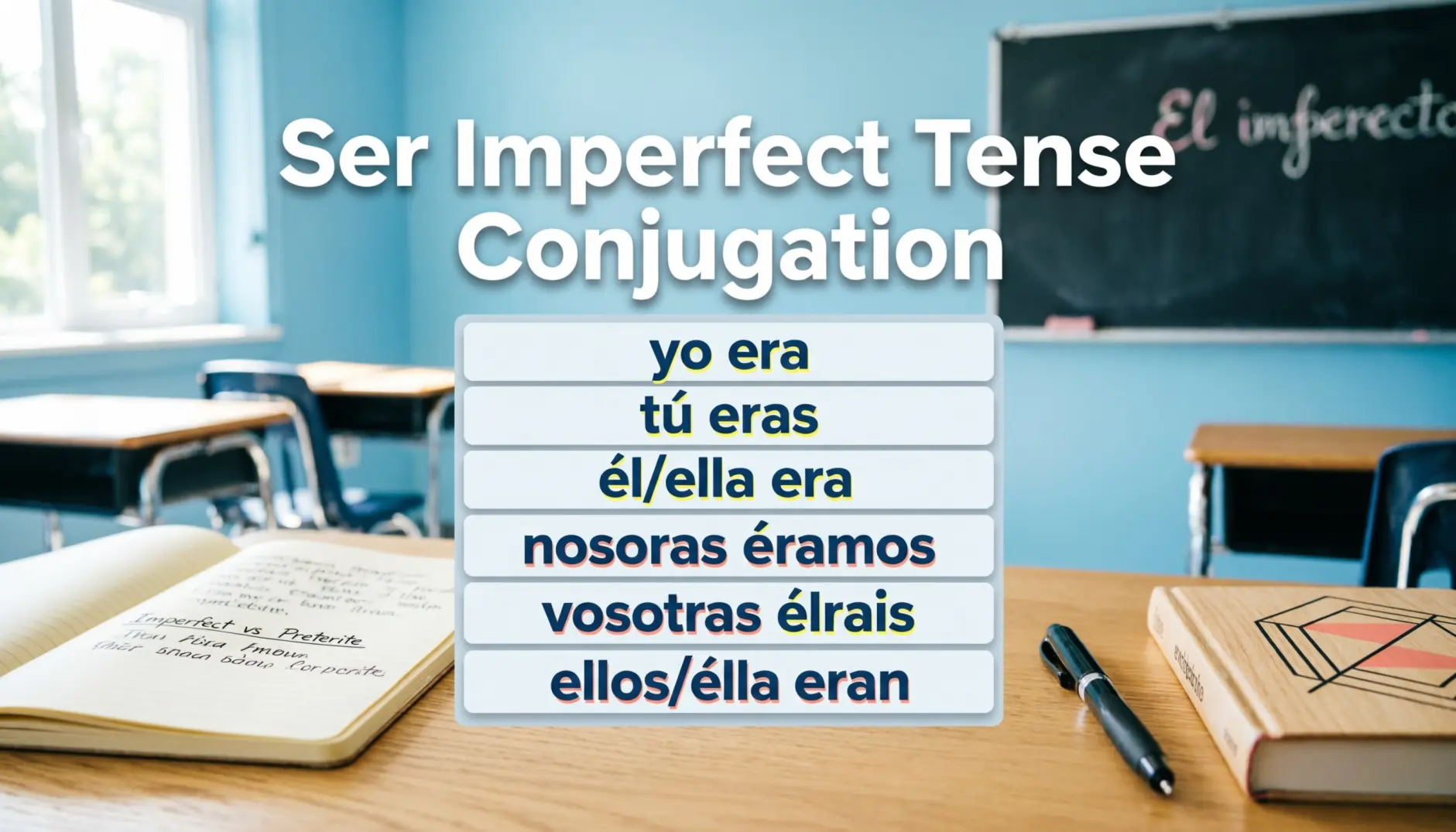
The ser imperfect tense is used to describe what someone or something was like in the past. The imperfect forms of ser are irregular and must be memorized.
| Subject Pronoun | Imperfect Form |
|---|---|
| Yo | era |
| Tú | eras |
| Él / Ella / Usted | era |
| Nosotros / Nosotras | éramos |
| Vosotros / Vosotras | erais |
| Ellos / Ellas / Ustedes | eran |
Example: Cuando era niño, era muy tímido. (When I was a child, I was very shy.)
What Is Ser Imperfect Tense Conjugation?
The imperfect tense of ser is used to describe states, characteristics, conditions, and situations that existed in the past.
The Spanish verb ser means:
- To be
- To exist as
- To describe identity or characteristics
When used in the imperfect tense, it often translates into English as:
- was
- were
- used to be
Examples
- Yo era estudiante.
- I was a student.
- Ella era amable.
- She was kind.
- Nosotros éramos vecinos.
- We were neighbors.
The imperfect tense focuses on descriptions and ongoing situations rather than completed actions.
Structure of Sentences of Ser Imperfect Tense Conjugation
Affirmative Structure
Subject + Ser (Imperfect Form) + Complement
Examples:
- Yo era feliz.
- Ella era profesora.
- Nosotros éramos amigos.
Negative Structure
Subject + No + Ser (Imperfect Form) + Complement
Examples:
- Yo no era rico.
- Él no era médico.
- Ellos no eran vecinos.
Interrogative Structure
¿Ser (Imperfect Form) + Subject + Complement?
Examples:
- ¿Eras estudiante?
- ¿Era tu hermano?
- ¿Eran ustedes compañeros?
These patterns help learners create basic statements, questions, and negative sentences correctly.
Formation of Ser Imperfect Tense Conjugation
Unlike most Spanish verbs, ser has an irregular imperfect form.
Complete Conjugation Chart (Ser – Imperfect)
| Subject | Conjugation |
|---|---|
| Yo | era |
| Tú | eras |
| Él | era |
| Ella | era |
| Usted | era |
| Nosotros / Nosotras | éramos |
| Vosotros / Vosotras | erais |
| Ellos / Ellas | eran |
| Ustedes | eran |
Important Note
The imperfect forms of ser do not follow the regular endings of many Spanish verbs. Therefore, learners should memorize the entire chart.
Example Sentences
- Yo era feliz.
- Tú eras inteligente.
- Ella era paciente.
- Nosotros éramos compañeros.
- Ellos eran simpáticos.
How to Use Ser Imperfect Tense Conjugation
The imperfect tense of ser has several common uses.
1. Describing People in the Past
Use it when talking about physical appearance or personality.
Examples:
- Mi abuelo era alto.
- Ella era muy amable.
- Eran personas honestas.
2. Talking About Age
Examples:
- Cuando tenía cinco años, era muy pequeño.
- Mi hermana era adolescente.
3. Describing Occupations
Examples:
- Mi padre era profesor.
- Ella era médica.
4. Giving Background Information
Examples:
- La casa era grande.
- El pueblo era tranquilo.
5. Talking About Time and Dates
Examples:
- Eran las ocho de la noche.
- Era lunes.
6. Describing Ongoing Situations
Examples:
- La vida era difícil.
- Todo era diferente entonces.
These uses help create vivid descriptions of the past.
Structure / Verb Pattern Table
| Usage | Pattern | Example |
|---|---|---|
| Description | Subject + era/eras + adjective | Ella era amable. |
| Identity / Occupation | Subject + era/eras + noun | Yo era estudiante. |
| Profession | Subject + era/eras + profession | Mi padre era médico. |
| Time | Era/Eran + time expression | Eran las diez. |
| Negative | Subject + no + era/eras | Él no era alto. |
| Question | ¿Era/Eras + subject? | ¿Eras feliz? |
Real Life Examples
Here are practical examples you may hear in daily Spanish.
Affirmative Examples
- Yo era muy tímido cuando era niño.
- Mi madre era profesora.
- La ciudad era hermosa.
- Nosotros éramos vecinos.
- Ellos eran buenos amigos.
Negative Examples
- Yo no era deportista.
- Ella no era famosa.
- Nosotros no éramos ricos.
- Ellos no eran estudiantes.
Interrogative Examples
- ¿Eras feliz en tu infancia?
- ¿Era tu profesora?
- ¿Eran tus amigos?
Informal Examples
- Era genial.
- Eras muy divertido.
- Eran buenos tiempos.
Formal Examples
- Usted era director de la empresa.
- El señor era muy respetado.
Common Mistakes
Many learners confuse the imperfect and preterite forms.
Mistake 1
❌ Yo fui tímido cuando era niño.
✅ Yo era tímido cuando era niño.
Why?
Personality descriptions usually require the imperfect tense.
Mistake 2
❌ Eramos vecinos.
✅ Éramos vecinos.
Why?
The nosotros form needs an accent mark.
Mistake 3
❌ Yo era un médico ayer.
✅ Yo fui médico ayer.
Why?
A specific completed event often requires the preterite.
Mistake 4
❌ Ellos fue amables.
✅ Ellos eran amables.
Why?
Use the correct imperfect form for plural subjects.
Key Grammar Rules
Rule 1
Use ser imperfect for descriptions in the past.
Example:
- Ella era amable.
Rule 2
Use it for age.
Example:
- Yo era joven.
Rule 3
Use it for occupations and identities.
Example:
- Mi padre era ingeniero.
Rule 4
Use it for time and dates.
Example:
- Era martes.
- Eran las cinco.
Rule 5
Use it for ongoing conditions or background information.
Example:
- La casa era antigua.
Rule 6
Remember that ser is irregular in the imperfect tense.
Example:
- Yo era.
- Nosotros éramos.
Comparisons with Similar Grammar Forms
Ser: Imperfect vs Preterite
| Imperfect (era/eran) | Preterite (fue/fueron) |
|---|---|
| Description | Completed event |
| Ongoing state | Specific change |
| Background information | Finished action |
Examples:
Imperfect
- Mi abuelo era amable.
Preterite
- Mi abuelo fue elegido alcalde.
The first describes a characteristic. The second describes a completed event.
Ser vs Estar in the Imperfect
Ser
Used for identity and characteristics.
- Era inteligente.
Estar
Used for temporary conditions.
- Estaba cansado.
Ser Imperfect vs Estar Imperfect
- Ella era tranquila. (personality)
- Ella estaba tranquila. (temporary mood)
This distinction is one of the most important concepts in Spanish grammar.
Exercises
Exercise 1: Fill in the Blanks
Choose the correct imperfect form of ser.
- Yo _____ estudiante.
- Tú _____ amable.
- Nosotros _____ vecinos.
- Ellos _____ altos.
- Ella _____ profesora.
Exercise 2: Correct the Mistakes
- Yo fue feliz.
- Nosotros eramos amigos.
- Ellos era estudiantes.
- Tú era médico.
- Ella fueron amable.
Exercise 3: Rewrite the Sentences
Rewrite using the imperfect tense of ser.
- Yo soy estudiante.
- Ella es amable.
- Nosotros somos vecinos.
- Ellos son altos.
- Tú eres divertido.
Exercise 4: Multiple Choice
- Which form is correct for “we were”?
A) era
B) eras
C) éramos
D) eran
- Which form is correct for “they were”?
A) era
B) eran
C) eras
D) éramos
- Which sentence is correct?
A) Yo eran estudiante.
B) Yo era estudiante.
C) Yo eras estudiante.
D) Yo éramos estudiante.
Answer Key
Exercise 1
- era
- eras
- éramos
- eran
- era
Exercise 2
- Yo era feliz.
- Nosotros éramos amigos.
- Ellos eran estudiantes.
- Tú eras médico.
- Ella era amable.
Exercise 3
- Yo era estudiante.
- Ella era amable.
- Nosotros éramos vecinos.
- Ellos eran altos.
- Tú eras divertido.
Exercise 4
- C
- B
- B
FAQs
What is the imperfect tense of ser?
The imperfect forms are: era, eras, era, éramos, erais, eran.
Is ser imperfect irregular?
Yes. The imperfect conjugation of ser is irregular and must be memorized.
What does era mean?
Era means was and is used with yo, él, ella, and usted.
What does eran mean?
Eran means were and is used with ellos, ellas, and ustedes.
When should I use ser imperfect instead of preterite?
Use the imperfect for descriptions, characteristics, and background information. Use the preterite for completed events.
How do I remember the ser imperfect forms?
Practice the pattern:
- era
- eras
- era
- éramos
- erais
- eran
Regular repetition helps learners remember them quickly.
Conclusion
The ser imperfect tense conjugation is an essential part of Spanish grammar and one of the most common verb forms you’ll encounter in conversations, stories, and descriptions.
The forms era, eras, era, éramos, erais, and eran are used to describe people, ages, occupations, times, places, and ongoing situations in the past.
A helpful way to remember its purpose is that the imperfect tense paints a picture of what things were like rather than focusing on what happened. This makes it different from the preterite tense, which describes completed events.
Keep practicing with real life sentences, conversations, and short writing exercises. The more you use ser in the imperfect tense, the more natural it will become. With regular practice, you’ll be able to describe past situations confidently and accurately in Spanish.