Learning Spanish past tense can be confusing, especially when you need to use the verb tener. The verb tener means “to have” and is used to talk about possessions, age, feelings, and experiences.
Its past tense forms are different from regular Spanish verbs, so beginners often make mistakes when conjugating it.The two most common past tenses of tener are the preterite and the imperfect.
The preterite is used for completed past events, while the imperfect describes past habits, situations, and ongoing conditions.For example, tuve means “I had” in a completed past situation, while tenía means “I had” in a descriptive or ongoing situation.
Understanding this difference will help you speak and write Spanish more naturally. In this guide, you will learn the conjugations, grammar rules, examples, common mistakes, and exercises for using tener in the past tense.
Quick Answer: What Is the Past Tense of Tener?
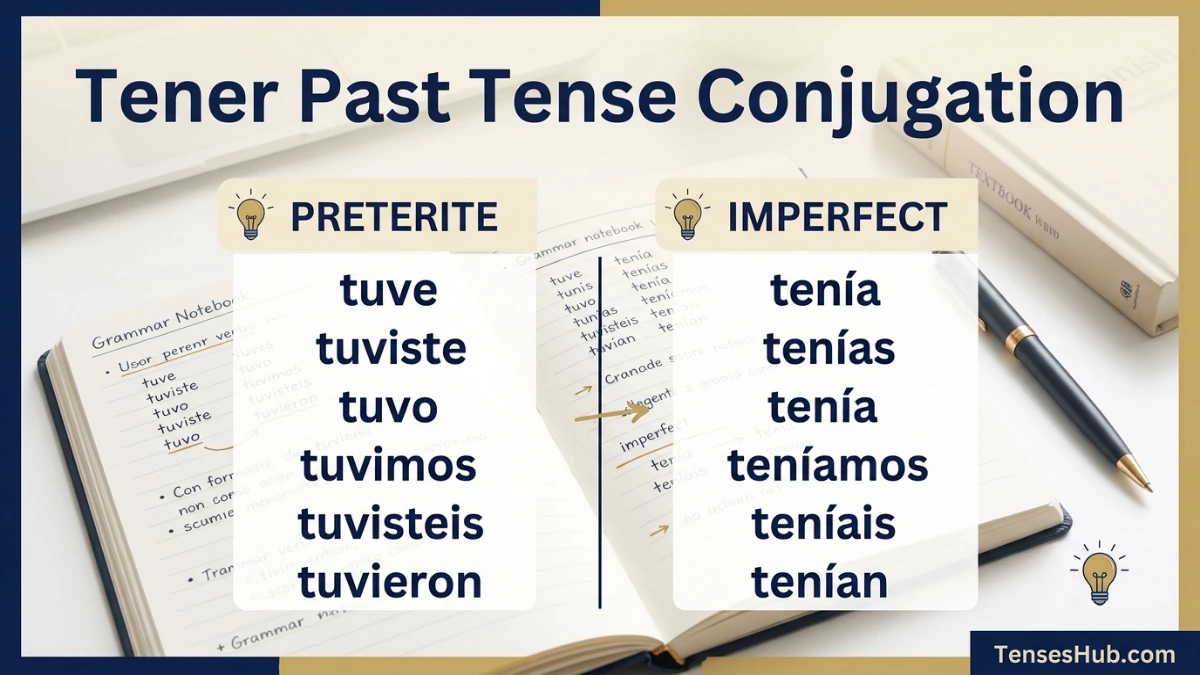
The Spanish verb tener means “to have.” Its main past tense forms are tuve in the preterite and tenía in the imperfect.
| Subject | Preterite | Imperfect |
|---|---|---|
| Yo | tuve | tenía |
| Tú | tuviste | tenías |
| Él/Ella/Usted | tuvo | tenía |
| Nosotros/as | tuvimos | teníamos |
| Vosotros/as | tuvisteis | teníais |
| Ellos/Ellas/Ustedes | tuvieron | tenían |
What Is Tener Past Tense Conjugation?
Tener past tense conjugation means changing the verb tener to match the subject and the past tense meaning.
Spanish has two commonly used past tenses for tener: the preterite and the imperfect.
The preterite describes completed past events.
Examples:
- Yo tuve un problema. I had a problem.
- Ella tuvo una reunión. She had a meeting.
- Nosotros tuvimos suerte. We were lucky.
The imperfect describes past habits, conditions, and situations.
Examples:
- Yo tenía un perro. I had a dog.
- Ella tenía hambre. She was hungry.
- Nosotros teníamos una casa grande. We had a big house.
Structure of Sentences of Tener Past Tense
Affirmative Sentences
Use this pattern:
Subject + conjugated form of tener + complement
Examples:
- Yo tuve tiempo. I had time.
- Ella tenía dinero. She had money.
- Ellos tuvieron una reunión. They had a meeting.
Negative Sentences
Use this pattern:
Subject + no + conjugated form of tener + complement
Examples:
- Yo no tuve tiempo. I did not have time.
- Ella no tenía dinero. She did not have money.
- Nosotros no tuvimos problemas. We did not have problems.
Interrogative Sentences
Use a question mark at the beginning and end of a Spanish question.
Examples:
- ¿Tuviste tiempo? Did you have time?
- ¿Tenías un coche? Did you have a car?
- ¿Tuvieron una reunión? Did they have a meeting?
Formation of Tener Past Tense
The verb tener is irregular in the preterite but follows a regular pattern in the imperfect.
1. Preterite Conjugation
The preterite uses the stem tuv with the following endings.
| Subject | Tener |
|---|---|
| Yo | tuve |
| Tú | tuviste |
| Él/Ella/Usted | tuvo |
| Nosotros/as | tuvimos |
| Vosotros/as | tuvisteis |
| Ellos/Ellas/Ustedes | tuvieron |
Examples:
- Ayer tuve una entrevista. Yesterday, I had an interview.
- Ella tuvo una idea. She had an idea.
- Ellos tuvieron suerte. They were lucky.
2. Imperfect Conjugation
The imperfect uses the stem ten and the regular imperfect endings for er verbs.
| Subject | Tener |
|---|---|
| Yo | tenía |
| Tú | tenías |
| Él/Ella/Usted | tenía |
| Nosotros/as | teníamos |
| Vosotros/as | teníais |
| Ellos/Ellas/Ustedes | tenían |
Examples:
- Cuando era niño, tenía un perro. When I was a child, I had a dog.
- Ella tenía diez años. She was ten years old.
- Nosotros teníamos mucho trabajo. We had a lot of work.
3. Past Participle of Tener
The past participle of tener is tenido.
It is used with the helping verb haber to form compound tenses.
Examples:
- He tenido mucho trabajo. I have had a lot of work.
- Había tenido una oportunidad. I had had an opportunity.
Do not confuse tuvo with tenido. Tuvo is a preterite form, while tenido is a past participle.
How to Use Tener Past Tense
1. Use the Preterite for Completed Events
Use the preterite when you describe a completed event or a past experience.
Examples:
- Ayer tuve una reunión. Yesterday, I had a meeting.
- Tuvimos una fiesta el sábado. We had a party on Saturday.
- Ella tuvo un problema. She had a problem.
2. Use the Imperfect for Past Habits
Use the imperfect to describe things that happened regularly in the past.
Examples:
- Cuando era niño, tenía muchos juguetes. When I was a child, I had many toys.
- Antes, teníamos una casa pequeña. We used to have a small house.
- Ellos tenían clases todos los días. They had classes every day.
3. Use the Imperfect for Age
Spanish uses tener to express age.
Examples:
- Yo tenía diez años. I was ten years old.
- Mi hermana tenía cinco años. My sister was five years old.
- Nosotros teníamos veinte años. We were twenty years old.
4. Use Tener for Feelings and Conditions
Spanish uses tener in expressions that English often translates with “to be.”
| Spanish Expression | English Meaning |
|---|---|
| Tener hambre | To be hungry |
| Tener sed | To be thirsty |
| Tener sueño | To be sleepy |
| Tener miedo | To be afraid |
| Tener frío | To be cold |
| Tener razón | To be right |
Examples:
- Tuve hambre después del partido. I was hungry after the game.
- Tenía sueño durante la clase. I was sleepy during class.
- Tuvimos miedo. We were afraid.
Tener Past Tense Structure Table
| Grammar Point | Pattern | Example |
|---|---|---|
| Preterite | Subject + tuve/tuvo, etc. | Tuve suerte. |
| Imperfect | Subject + tenía/tenían, etc. | Tenía suerte. |
| Negative | Subject + no + verb | No tuve tiempo. |
| Question | Question + conjugated verb | ¿Tuviste tiempo? |
| Past participle | Haber + tenido | He tenido suerte. |
| Age | Subject + tenía + age | Tenía doce años. |
Real Life Examples of Tener Past Tense
Affirmative Sentences
- Ayer tuve mucho trabajo. I had a lot of work yesterday.
- Mi hermano tenía un teléfono nuevo. My brother had a new phone.
- Tuvimos una cena familiar. We had a family dinner.
- Ella tenía una casa grande. She had a big house.
- Ellos tuvieron una buena oportunidad. They had a good opportunity.
Negative Sentences
- No tuve suficiente dinero. I did not have enough money.
- Ella no tenía ganas de salir. She did not feel like going out.
- No tuvimos problemas. We did not have problems.
Questions
- ¿Tuviste un buen día? Did you have a good day?
- ¿Tenías un coche? Did you have a car?
- ¿Tuvieron tiempo para estudiar? Did they have time to study?
Everyday Conversation
Ana: ¿Tuviste tiempo para estudiar ayer? Did you have time to study yesterday?
Luis: No, tuve mucho trabajo. No, I had a lot of work.
Ana: ¿Antes tenías más tiempo libre? Did you have more free time before?
Luis: Sí, tenía más tiempo durante las vacaciones. Yes, I had more time during the holidays.
Common Mistakes with Tener Past Tense
| Incorrect | Correct |
|---|---|
| Yo tení un perro. | Yo tuve un perro. |
| Ella tenió hambre. | Ella tuvo hambre. |
| Nosotros tuveron suerte. | Nosotros tuvimos suerte. |
| Ellos tuveron problemas. | Ellos tuvieron problemas. |
| Yo tenia diez años. | Yo tenía diez años. |
| Yo fui hambre. | Yo tuve hambre. |
| He tuvido un problema. | He tenido un problema. |
Remember that tener uses the irregular stem tuv in the preterite. The imperfect forms require written accent marks, and the past participle is tenido.
Key Grammar Rules
- Use tuve, tuviste, tuvo, tuvimos, tuvisteis, and tuvieron for the preterite.
- Use tenía, tenías, tenía, teníamos, teníais, and tenían for the imperfect.
- Use the preterite for completed past events.
- Use the imperfect for past habits, descriptions, and ongoing conditions.
- Use tener to express age, hunger, thirst, and other common conditions.
- Use tenido with haber to form compound tenses.
Comparisons with Similar Grammar Forms
Tener Preterite vs. Tener Imperfect
The preterite and imperfect both describe the past, but they present situations differently.
| Preterite | Imperfect |
|---|---|
| Tuve un perro. | Tenía un perro. |
| I had a dog, viewed as a completed past situation. | I had a dog, described as a past situation. |
| Tuvimos una reunión ayer. | Teníamos reuniones cada semana. |
| We had a meeting yesterday. | We used to have meetings every week. |
Tener vs. Haber
Tener expresses possession, age, and conditions. Haber is used as a helping verb in compound tenses.
Examples:
- Tuve un libro. I had a book.
- He tenido un libro interesante. I have had an interesting book.
- Había tenido un libro similar. I had had a similar book.
Exercises
Exercise 1: Fill in the Blanks
Complete each sentence with the correct form of tener.
- Ayer yo ______ una reunión.
- Cuando era niño, tú ______ muchos juguetes.
- Nosotros ______ hambre después del partido.
- Mi abuela ______ una casa en el campo.
- Ellos ______ un problema durante el viaje.
Exercise 2: Correct the Sentences
- Yo tení una bicicleta.
- Ella tenió miedo.
- Nosotros tuveron una reunión.
- Cuando era niño, tuve ocho años.
- He tuvido una buena experiencia.
Exercise 3: Choose the Correct Answer
1. Ayer María ___ una entrevista.
- A. tenía
- B. tuvo
- C. tenió
2. Cuando era niño, yo ___ un perro.
- A. tenía
- B. tuveo
- C. tení
3. Nosotros ___ una reunión la semana pasada.
- A. teníamos
- B. tuvieron
- C. tuvimos
Answer Key
Exercise 1
- tuve
- tenías
- tuvimos
- tenía
- tuvieron
Exercise 2
- Yo tuve una bicicleta.
- Ella tuvo miedo.
- Nosotros tuvimos una reunión.
- Cuando era niño, tenía ocho años.
- He tenido una buena experiencia.
Exercise 3
- B tuvo
- A tenía
- C tuvimos
FAQs
1. What is the past tense of tener?
The two main past tense forms are tuve (preterite) and tenía (imperfect).
2. Is tener irregular in the past tense?
Yes. Tener uses the irregular stem tuv in the preterite, but its imperfect forms follow a regular pattern.
3. What is the difference between tuve and tenía?
Tuve describes a completed past event or situation. Tenía describes a past habit, condition, or ongoing situation.
4. What is the imperfect conjugation of tener?
The imperfect forms are tenía, tenías, tenía, teníamos, teníais, and tenían.
5. What is the past participle of tener?
The past participle is tenido. It is used with haber, as in he tenido.
6. How do you say “I was hungry” in Spanish?
You can say Tenía hambre or Tuve hambre. The best choice depends on if you describe an ongoing condition or a particular past experience.
7. How do you say “I was ten years old” in Spanish?
Say Tenía diez años. Spanish uses tener to express age.
8. What is the difference between tuvieron and tenían?
Tuvieron is the preterite form for “they had,” while tenían is the imperfect form for “they had” or “they used to have.”
Conclusion
Learning tener past tense conjugation becomes easier when you understand the difference between the preterite and the imperfect.
The preterite forms, such as tuve, tuviste, and tuvieron, describe completed past events. The imperfect forms, such as tenía, tenías, and tenían, describe past habits, ages, and ongoing conditions.
Remember that tener is irregular in the preterite, so you should practice its forms until they become familiar. Also, pay attention to accent marks in words such as tenía and teníamos.
Practice common expressions like tener hambre, tener miedo, and tener razón to improve your everyday Spanish.
Start by writing a few sentences about what you had as a child, what you had yesterday, and how old you were at different times. With regular practice, you will become more confident using tener in Spanish conversations and writing.