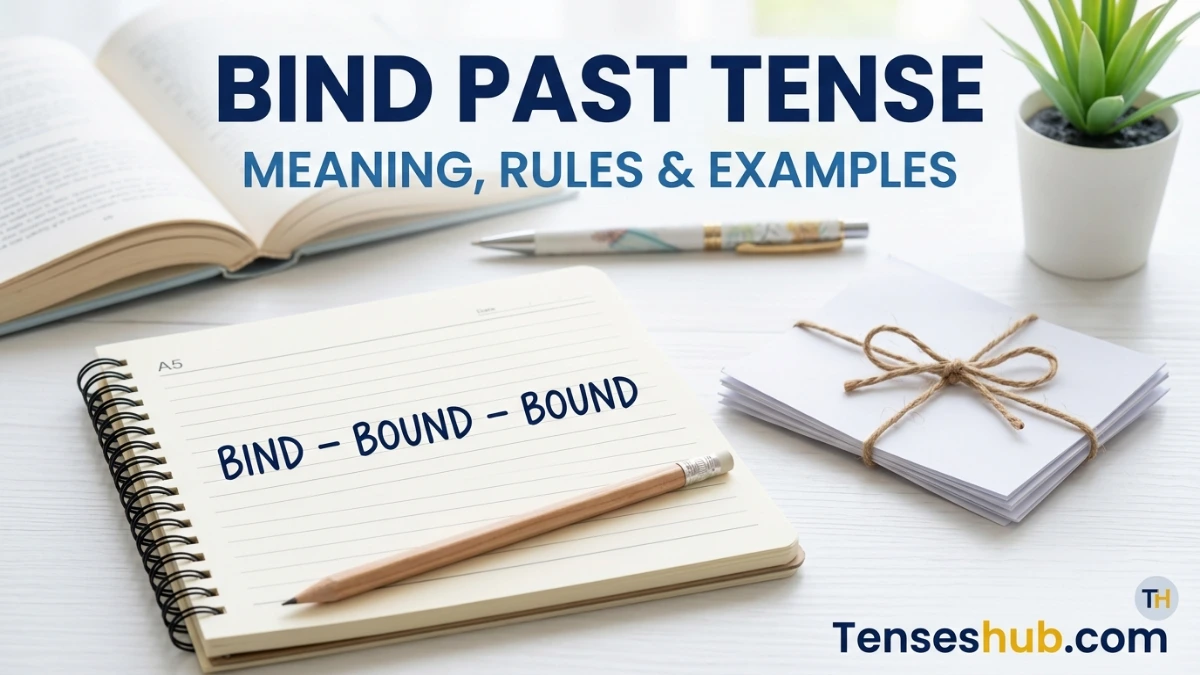
Have you ever wanted to explain that you tied a package, connected two things, or made an agreement in the past? You may wonder if the past tense of bind is binded or bound. The correct answer is bound.
The verb bind is an irregular verb, which means it does not form its past tense by simply adding ed. Instead, its forms change from bind to bound. Learning these forms will help you write clear sentences and avoid common grammar mistakes.
The word bind has several meanings. You can bind a book, bind a package with string, or bind someone to an agreement. Its past form, bound, works with all these meanings when describing a completed action in the past.
In this guide, you will learn the past tense of bind, its verb forms, sentence patterns, practical examples, common mistakes, and exercises to help you use the word correctly.
Quick Answer: What Is the Past Tense of Bind?
The past tense of bind is bound. The past participle is also bound, so the three main forms are bind – bound – bound.
| Verb Form | Word |
|---|---|
| Base form (V1) | bind |
| Simple past (V2) | bound |
| Past participle (V3) | bound |
| ing form | binding |
| Third person singular | binds |
Examples:
- I bound the package with a ribbon yesterday.
- She has bound the documents together.
- The agreement bound both parties to its terms.
What Is the Bind Past Tense?
The past tense of bind is bound. We use it to describe an action that happened or was completed in the past.
The verb bind generally means to tie, fasten, connect, secure, or place someone under an obligation. Its exact meaning depends on the sentence.
Examples:
- The worker bound the boxes with rope.
- My grandmother bound the pages into a small book.
- The contract bound the company to its promises.
- The nurse bound the injured arm with a bandage.
In each example, bound describes an action that took place in the past.
Remember that binded is not the standard simple past tense of bind. Although it may appear in learner mistakes, use bound in standard English.
Structure of Sentences of the Bind Past Tense
The simple past form bound is used in affirmative sentences. In negative and interrogative sentences, use the base form bind after the helping verb did.
1. Affirmative Sentences
Formula: Subject + bound + object/complement
Examples:
- I bound the papers together.
- She bound the book in leather.
- They bound the package securely.
- The contract bound both companies.
2. Negative Sentences
Formula: Subject + did not + bind + object/complement
Examples:
- I did not bind the papers.
- She did not bind the book.
- They did not bind the package properly.
You can also use the contraction didn’t:
- He didn’t bind the documents.
- We didn’t bind ourselves to the agreement.
3. Interrogative Sentences
Formula: Did + subject + bind + object/complement?
Examples:
- Did you bind the papers?
- Did she bind the book?
- Did they bind the package securely?
Short answers:
- Yes, I did.
- No, I didn’t.
Formation of the Past Tense of Bind
The verb bind is irregular. Unlike regular verbs such as walk and clean, it does not form the simple past by adding ed.
Bind – Bound – Bound
| Verb Form | Example |
|---|---|
| V1: bind | I bind the pages together. |
| V2: bound | I bound the pages yesterday. |
| V3: bound | I have bound the pages together. |
| V ing: binding | I am binding the pages now. |
| Third person singular: binds | She binds the pages carefully. |
Why Is It Bound Instead of Binded?
Some verbs form their past tense by adding ed. For example:
- walk → walked
- open → opened
- clean → cleaned
However, bind belongs to a group of irregular verbs that change their spelling.
- bind → bound
- find → found
- wind → wound (when pronounced like “wound” meaning an injury, the spelling is the same but the pronunciation differs; as the verb meaning to turn or coil, the past is also wound)
- grind → ground
For bind, remember the change from i to ou: bind becomes bound.
How to Use Bound in the Past Tense
The simple past form bound can be used in several situations. The meaning of the verb may change slightly according to the context.
1. To Describe Tying or Fastening Something
Use bound when someone tied or secured an object.
Examples:
- I bound the parcel with string.
- She bound the flowers with a ribbon.
- The farmer bound the hay into bundles.
- He bound the loose papers together.
2. To Describe Putting Pages or a Book Together
Bind can mean joining pages to make a book or attaching a cover to them.
Examples:
- The printer bound my thesis last week.
- They bound the old documents into a volume.
- The library bound the magazines together.
3. To Describe an Agreement or Obligation
The verb can also mean making someone legally or formally responsible for something.
Examples:
- The signed contract bound both parties to the agreement.
- The promise bound him to his word.
- The new rules bound every member of the group.
4. To Describe Restriction or Limitation
Sometimes, bound means that a person or group was restricted by a rule, duty, or situation.
Examples:
- The team was bound by the competition rules.
- She felt bound by her promise.
- They were bound by the terms of the agreement.
In these examples, bound may function as a past participle or adjective rather than the simple past of an active verb. The surrounding sentence helps determine its grammatical role.
Bind Past Tense: Structure and Verb Pattern Table
This table shows how bind changes in common English tense patterns.
| Tense or Pattern | Structure | Example |
|---|---|---|
| Simple present | Subject + bind/binds | She binds the papers. |
| Simple past | Subject + bound | She bound the papers. |
| Simple past negative | Subject + did not + bind | She did not bind the papers. |
| Simple past question | Did + subject + bind? | Did she bind the papers? |
| Present perfect | Subject + has/have + bound | She has bound the papers. |
| Past perfect | Subject + had + bound | She had bound the papers. |
| Future simple | Subject + will + bind | She will bind the papers. |
| Present continuous | Subject + am/is/are + binding | She is binding the papers. |
Real Life Examples of Bound in Sentences
Here are examples from everyday situations, school, work, and formal writing.
Everyday Examples
- I bound the gift with a blue ribbon.
- She bound the broken pages with tape.
- We bound the documents together before the meeting.
- He bound the package tightly.
- The children bound the sticks with string.
School and Work Examples
- The printer bound my project yesterday.
- The office assistant bound the reports into one file.
- The students bound their notes together for revision.
- The publisher bound the book before sending it to the shop.
- The librarian bound several old issues of the magazine.
Formal Examples
- The agreement bound both parties to the stated conditions.
- The contract bound the company to deliver the goods.
- The court order bound the organization to follow the ruling.
- The policy bound employees to specific procedures.
- The written promise bound him to complete the task.
Negative Examples
- I did not bind the package correctly.
- She didn’t bind the documents before submitting them.
- They did not bind the company to the proposed terms.
Questions
- Did you bind the book yourself?
- Did the agreement bind both parties?
- Why did she bind the papers with string?
- When did the publisher bind the book?
Common Mistakes When Using Bind
Learners sometimes confuse the simple past, past participle, and base form of bind. These examples show how to avoid those errors.
Mistake 1: Using Binded Instead of Bound
Incorrect: I binded the package yesterday.
Correct: I bound the package yesterday.
Explanation: Bind is irregular. Its simple past form is bound, not binded.
Mistake 2: Using Bound After Did
Incorrect: Did you bound the papers?
Correct: Did you bind the papers?
Explanation: After did, use the base form of the main verb.
Mistake 3: Using Bound After Did Not
Incorrect: She did not bound the book.
Correct: She did not bind the book.
Explanation: The helping verb did already marks the past tense, so the main verb remains bind.
Mistake 4: Using Bind Instead of Bound in a Simple Past Statement
Incorrect: He bind the papers yesterday.
Correct: He bound the papers yesterday.
Explanation: In an affirmative simple past sentence, use bound.
Mistake 5: Confusing the Simple Past and Past Participle
Incorrect: I have bind the documents.
Correct: I have bound the documents.
Explanation: The present perfect uses has/have + past participle. The past participle of bind is bound.
Mistake 6: Using Bound in Every Tense
Incorrect: I am bound the pages now.
Correct: I am binding the pages now.
Explanation: The present continuous uses am/is/are + verb ing. The ing form of bind is binding.
Key Grammar Rules for Bind
Remember these important rules when using bind and bound.
- Use bound for the simple past.
Example: The worker bound the package yesterday. - Use bound as the past participle.
Example: She has bound the documents. - Use the base form after did and didn’t.
Example: Did he bind the book? He didn’t bind it. - Use binding after am, is, or are for the present continuous.
Example: They are binding the reports. - Do not add ed to form the standard past tense.
Write bound, not binded. - Use context to understand the meaning.
Bound may describe fastening something, creating an obligation, or being restricted by a rule.
Bind vs. Bound: What’s the Difference?
The main difference is grammatical: bind is the base form, while bound is both the simple past and past participle.
| Word | Use | Example |
|---|---|---|
| Bind | Base form | I bind the papers together. |
| Binds | Present tense with he/she/it | She binds the papers. |
| Bound | Simple past | She bound the papers yesterday. |
| Bound | Past participle | She has bound the papers. |
| Binding | ing form | She is binding the papers. |
Bind vs. Binded
Binded is not the standard past tense of bind. In standard English, use bound.
- Incorrect: They binded the book.
- Correct: They bound the book.
Bound vs. Bounded
Bounded is a real word used in other contexts, especially when something has limits or boundaries. However, it is not the normal simple past form when bind means to tie, fasten, or obligate.
- The contract bound the parties to the agreement.
- The garden was bounded by a stone wall.
The second sentence uses bounded to mean “enclosed by boundaries,” not as the ordinary past form of bind.
Bound vs. Binding
Bound can be a past tense verb or a past participle. Binding is the ing form and can also be a noun or adjective.
- Past: He bound the package.
- Ongoing action: He is binding the package.
- Noun: The book has a leather binding.
Exercises: Practice the Past Tense of Bind
Test your understanding with these short exercises. Try answering before checking the answer key.
Exercise 1: Fill in the Blanks
Complete each sentence using the correct form of bind.
- Yesterday, I ______ the package with string.
- She has ______ the pages into a book.
- Did they ______ the documents together?
- He didn’t ______ the parcel securely.
- The printer is ______ the book now.
Exercise 2: Correct the Sentences
Rewrite each sentence correctly.
- I binded the papers yesterday.
- Did she bound the book?
- They did not bound the package.
- He has bind the documents.
- We are bound the pages right now.
Exercise 3: Choose the Correct Answer
- The worker ______ the package yesterday.
a) bind
b) bound
c) binded - Did you ______ the papers?
a) bound
b) binding
c) bind - She has ______ the documents together.
a) bound
b) bind
c) binds - They are ______ the book now.
a) bound
b) binding
c) binded - He didn’t ______ the files.
a) bound
b) binds
c) bind
Exercise 4: Rewrite in the Simple Past
Rewrite each sentence in the simple past tense.
- I bind the flowers with ribbon.
- She binds the reports together.
- They bind the book by hand.
- The contract binds both parties.
Answer Key
Exercise 1
- bound
- bound
- bind
- bind
- binding
Exercise 2
- I bound the papers yesterday.
- Did she bind the book?
- They did not bind the package.
- He has bound the documents.
- We are binding the pages right now.
Exercise 3
- b) bound
- c) bind
- a) bound
- b) binding
- c) bind
Exercise 4
- I bound the flowers with ribbon.
- She bound the reports together.
- They bound the book by hand.
- The contract bound both parties.
FAQs
What is the past tense of bind?
The past tense of bind is bound. Example: “She bound the papers together yesterday.”
Is it binded or bound?
Bound is the standard simple past and past participle of bind. “Binded” is not the standard form.
What is the past participle of bind?
The past participle is bound. It is used with helping verbs such as has, have, and had. Example: “They have bound the documents.”
What are the three forms of bind?
The three main forms are bind – bound – bound: base form, simple past, and past participle.
What is the ing form of bind?
The ing form is binding. Example: “She is binding the book.”
How do I use bind in a negative past tense sentence?
Use did not or didn’t followed by the base form bind. Example: “I didn’t bind the package.”
Is bound always a past tense verb?
No. Bound can be a simple past verb, a past participle, or an adjective, depending on the sentence. For example, “The contract bound them” uses the simple past, while “They were bound by the rules” uses a past participle or adjective like form.
Conclusion
The past tense of bind is bound, and its past participle is also bound. The three main forms are bind – bound – bound. Because bind is an irregular verb, you should not add ed to make its past tense.
Use bound in affirmative simple past sentences, as in “I bound the package yesterday.” In negative sentences and questions with did, use the base form bind: “I didn’t bind the package” and “Did you bind the package?” When using the present perfect, write “has bound” or “have bound.”
Practice these forms in everyday sentences to make them easier to remember. Once you understand the difference between bind, bound, and binding, you can use this verb more confidently in speaking and writing.
Hi, I’m Robert Lowth, a passionate expert in English tenses and grammar. I specialize in simplifying complex tense rules to help learners understand and use English with confidence. My goal is to make grammar clear, practical, and easy for everyday communication. tenseshub.com