Have you ever talked about spreading butter on bread, sharing news with friends, or covering a table with a cloth? When describing these actions in the past, you may wonder if to use spread or spreaded. Many English learners make this mistake because they think every verb forms its past tense by adding ed.
However, the past tense of spread is spread. The word does not change its spelling in the simple past tense. Its past participle is also spread, which makes this verb easy to remember once you learn the basic rule.
The verb spread has several common uses in English. It can describe covering a surface, moving across an area, sharing information, or making an idea known to more people. You can use it in everyday conversations, school assignments, emails, and formal writing.
In this guide, you will learn the meaning and forms of spread, how to use it in different tenses, common grammar mistakes, and practical examples. You will also find exercises with answers to test your understanding.
Quick Answer: What Is the Past Tense of Spread?
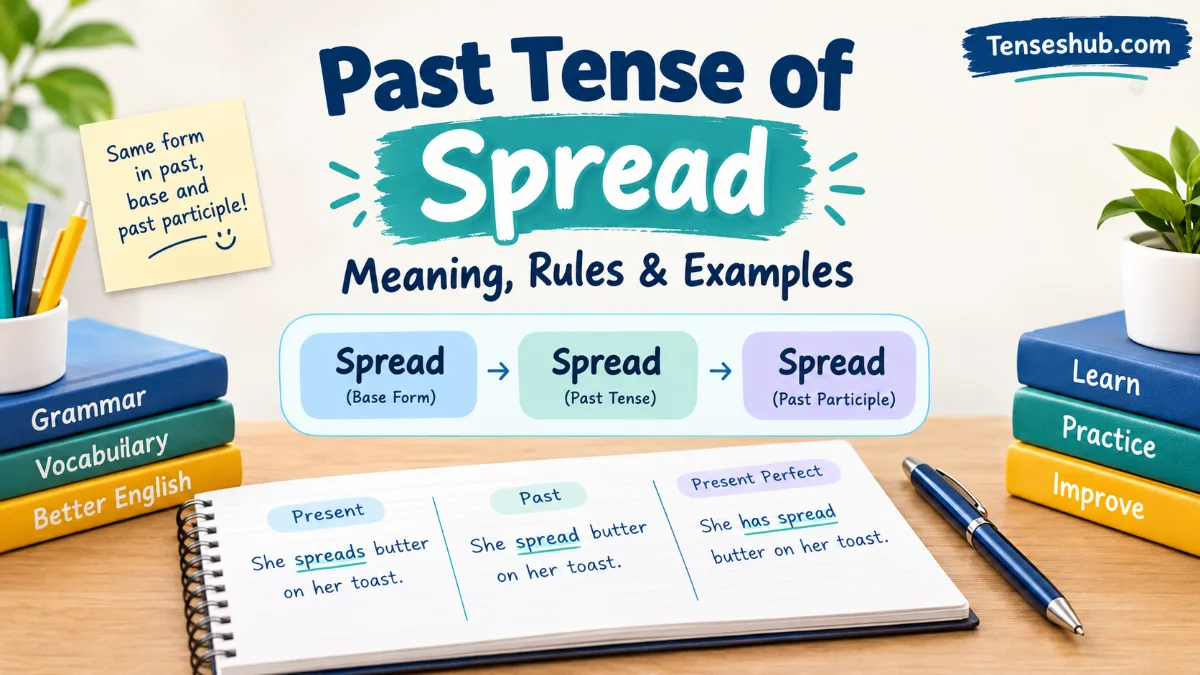
The past tense of spread is spread, not spreaded. It is an irregular verb whose base form, simple past, and past participle are all the same.
| Verb Form | Word |
|---|---|
| V1 (Base Form) | Spread |
| V2 (Simple Past) | Spread |
| V3 (Past Participle) | Spread |
| V ing Form | Spreading |
| Third Person Singular | Spreads |
Examples:
- Present: She spreads butter on her toast.
- Past: She spread butter on her toast.
- Past perfect: She had spread butter on her toast.
What Is the Past Tense of Spread?
The past tense of spread describes an action that happened in the past. Although many English verbs add ed to form the simple past, spread is an irregular verb and keeps the same spelling.
For example:
- Present: I spread a blanket on the grass every weekend.
- Past: I spread a blanket on the grass yesterday.
- Present: The teacher spreads information among the students.
- Past: The teacher spread information among the students last week.
In these sentences, the verb remains unchanged. Words such as yesterday and last week help show that the action happened in the past.
What Does Spread Mean?
The word spread has several meanings depending on how it is used.
1. To cover a surface
- She spread butter on the bread.
- He spread a cloth over the table.
2. To move across an area
- The fire spread through the forest.
- Water spread across the floor.
3. To share news or information
- The news spread quickly through the town.
- Someone spread a rumor about the competition.
4. To make an idea or message known
- The organization spread awareness about road safety.
- The teacher spread knowledge among the students.
In all these examples, spread is the correct form when describing a completed past action.
Structure of Sentences Using the Past Tense of Spread
The simple past tense can be used in affirmative, negative, and interrogative sentences.
1. Affirmative Sentences
Use an affirmative sentence to say that an action happened.
Formula: Subject + spread + object
Examples:
- I spread the news yesterday.
- She spread the blanket on the bed.
- They spread seeds across the field.
2. Negative Sentences
Use did not or didn’t to say that an action did not happen.
Formula: Subject + did not + spread + object
Examples:
- I did not spread the rumor.
- She didn’t spread the butter evenly.
- They did not spread the message.
3. Interrogative Sentences
Use did at the beginning of a simple past question.
Formula: Did + subject + spread + object?
Examples:
- Did you spread the butter?
- Did she spread the news?
- Did they spread the seeds?
Remember that the main verb remains spread after did and didn’t.
Formation of the Past Tense of Spread
English verbs can be regular or irregular. Regular verbs usually form their simple past by adding ed or d. Irregular verbs follow different patterns.
Spread is an irregular verb because its simple past and past participle do not change from the base form.
Forms of Spread
V1 — Spread: The base form of the verb.
Example: I spread butter on my toast every morning.
V2 — Spread: The simple past form.
Example: I spread butter on my toast yesterday.
V3 — Spread: The past participle, used with helping verbs.
Examples:
- She has spread the message.
- They had spread the seeds before the rain started.
V ing — Spreading: Used in continuous tenses.
Examples:
- She is spreading butter on the bread.
- They were spreading seeds across the field.
Spreads: Used with third person singular subjects in the simple present tense.
Example: The rumor spreads quickly.
Why Is Spread an Irregular Verb?
Spread is irregular because it does not form its simple past by adding ed. Its first three forms are identical.
| Base Form | Simple Past | Past Participle |
|---|---|---|
| Spread | Spread | Spread |
| Cut | Cut | Cut |
| Put | Put | Put |
| Hit | Hit | Hit |
| Set | Set | Set |
Learning these verbs together can make English grammar easier to remember.
How to Use the Past Tense of Spread
The verb spread is used in several everyday situations. The following rules will help you choose the correct form.
1. To Describe a Completed Past Action
Use spread when an action happened and finished in the past.
Examples:
- We spread the picnic blanket on the ground yesterday.
- She spread cream on the cake.
- The farmer spread fertilizer across the field last week.
Time expressions such as yesterday, last night, and two days ago often indicate the simple past tense.
2. To Describe Something Moving Across an Area
Use spread when something moves over a surface or reaches a wider area.
Examples:
- Smoke spread throughout the room.
- The floodwater spread into nearby streets.
- The smell of fresh bread spread through the house.
3. To Talk About News and Information
Use spread when information, rumors, or stories reach other people.
Examples:
- The news spread quickly after the announcement.
- The story spread throughout the school.
- The organization spread awareness about online safety.
This meaning is common in conversations, reports, and news articles.
4. To Form the Past Perfect Tense
Use had + spread when one past action happened before another past action.
Examples:
- The news had spread before the principal arrived.
- She had spread the seeds before the rain began.
- The fire had spread to nearby fields before help arrived.
5. To Form the Present Perfect Tense
Use has/have + spread when a past action is connected to the present.
Examples:
- The news has spread quickly.
- They have spread the message to thousands of people.
- The rumor has spread throughout the town.
The correct form is has spread or have spread, never has spreaded in standard English.
6. To Form the Past Continuous Tense
Use was/were + spreading to describe an action that was in progress at a particular time in the past.
Examples:
- She was spreading butter when the phone rang.
- They were spreading seeds across the field.
- The fire was spreading when the firefighters arrived.
Notice that the continuous form uses spreading, not spread.
7. To Form Passive Sentences
Use a suitable form of be with the past participle spread when the focus is on the thing affected by the action.
Examples:
- The message was spread throughout the department.
- The information had been spread before the meeting.
- The news was spread through social media.
Structure or Verb Pattern Table
| Grammar Form | Structure | Example |
|---|---|---|
| Simple past | Subject + spread | She spread the news. |
| Past negative | Subject + didn’t + spread | She didn’t spread the news. |
| Past question | Did + subject + spread? | Did she spread the news? |
| Past continuous | Was/were + spreading | They were spreading seeds. |
| Past perfect | Had + spread | He had spread the message. |
| Present perfect | Has/have + spread | The news has spread. |
| Past passive | Was/were + spread | The message was spread. |
Real Life Examples of Spread in the Past Tense
Here are examples from everyday life, school, work, and communication.
Everyday Life
- I spread butter on my toast this morning.
- She spread a blanket on the grass.
- He spread the papers across his desk.
- We spread the seeds around the garden.
- They spread the map on the table.
School and Work
- The teacher spread the worksheets across the desks.
- The manager spread the tasks among the team members.
- The students spread their projects out for display.
- The company spread information about its new policy.
- The librarian spread the books across several tables.
News and Communication
- The news spread quickly after the announcement.
- The rumor spread throughout the school.
- The organization spread awareness about road safety.
- The message spread across social media.
- Word of the celebration spread through the neighborhood.
Negative Sentences
- I didn’t spread the rumor.
- She did not spread the cream evenly.
- They didn’t spread the information without permission.
Questions
- Did you spread the blanket on the floor?
- Did the news spread before the meeting?
- Why did he spread the documents across the table?
Formal and Informal Examples
- Formal: The department spread the updated guidelines among its employees.
- Formal: The report stated that the fire spread rapidly.
- Informal: We spread our snacks on the picnic table.
- Informal: The story spread like wildfire among our friends.
Common Mistakes When Using Spread
English learners sometimes make mistakes because they assume every verb needs an ed ending in the past tense.
Mistake 1: Using Spreaded
Incorrect: She spreaded butter on her toast.
Correct: She spread butter on her toast.
Explanation: Spread is irregular. Its simple past form is spread, not spreaded.
Mistake 2: Using Spreaded After Did
Incorrect: Did they spreaded the news?
Correct: Did they spread the news?
Explanation: After did, use the base form of the main verb.
Mistake 3: Using Spreaded After Didn’t
Incorrect: He didn’t spreaded the seeds.
Correct: He didn’t spread the seeds.
Explanation: The helping verb didn’t already indicates the past tense.
Mistake 4: Using the Wrong Past Participle
Incorrect: The news has spreaded everywhere.
Correct: The news has spread everywhere.
Explanation: The past participle is also spread.
Mistake 5: Confusing Spread and Spreading
Incorrect: They were spread the blanket.
Correct: They were spreading the blanket.
Explanation: The past continuous uses was/were + verb ing.
Mistake 6: Forgetting the Helping Verb
Incorrect: She not spread the message yesterday.
Correct: She did not spread the message yesterday.
Explanation: A standard simple past negative sentence uses did not before the base verb.
Mistake 7: Using Spreads for a Past Action
Incorrect: Yesterday, the news spreads quickly.
Correct: Yesterday, the news spread quickly.
Explanation: Use spread for a completed action in the past.
Key Grammar Rules for Spread
Remember these six rules when using this verb.
Rule 1: The simple past is spread.
Example: We spread the blanket yesterday.
Rule 2: The past participle is spread.
Examples: She has spread the news. They had spread the seeds.
Rule 3: Do not add ed to spread.
Use spread, not spreaded, in standard English.
Rule 4: Use the base form after did and didn’t.
Examples: Did you spread the butter? I didn’t spread the rumor.
Rule 5: Use spreading for continuous actions.
Example: They were spreading the message.
Rule 6: Choose the correct helping verb for each tense.
- Simple past: The news spread.
- Past perfect: The news had spread.
- Past continuous: The news was spreading.
- Present perfect: The news has spread.
Comparisons with Similar Grammar Forms
Spread vs. Spreaded
| Form | Status | Example |
|---|---|---|
| Spread | Correct standard form | The news spread quickly. |
| Spreaded | Incorrect for the ordinary verb in standard modern English | The news spreaded quickly. |
Always use spread for the simple past and past participle.
Spread vs. Spreading
Spread is the simple past form, while spreading is the ing form.
Examples:
- Past: The fire spread through the forest.
- Past continuous: The fire was spreading through the forest.
The first sentence describes the event. The second emphasizes an action in progress.
Spread vs. Spreads
Spreads is used with third person singular subjects in the simple present tense. Spread is used for the simple past.
Examples:
- Present: The rumor spreads quickly.
- Past: The rumor spread quickly.
Spread vs. Had Spread
Both refer to past events, but the past perfect emphasizes that an action happened before another past event.
- Simple past: The news spread yesterday.
- Past perfect: The news had spread before the meeting began.
Spread vs. Spoke
These verbs have different meanings and forms.
| Base Form | Simple Past | Past Participle |
|---|---|---|
| Spread | Spread | Spread |
| Speak | Spoke | Spoken |
Examples:
- She spread the information.
- She spoke to the teacher.
Spread often means to share something widely, while speak means to talk.
Exercises: Practice the Past Tense of Spread
Try these exercises before checking the answers.
Exercise 1: Fill in the Blanks
Complete each sentence with the correct form of spread.
- She _____ butter on the bread yesterday.
- The news _____ quickly last night.
- They had _____ the seeds before the rain started.
- He didn’t _____ the rumor.
- Were they _____ the blanket on the grass?
- The message has _____ throughout the school.
Exercise 2: Correct the Sentences
Rewrite each sentence correctly.
- She spreaded the jam on her toast.
- Did they spreaded the news?
- He didn’t spreaded the seeds.
- The information has spreaded quickly.
- They were spread the blanket on the floor.
Exercise 3: Choose the Correct Answer
1. What is the simple past tense of spread?
A. Spreaded
B. Spreads
C. Spread
D. Spreading
2. Which sentence is correct?
A. She spreaded the butter yesterday.
B. She spread the butter yesterday.
C. She spreads the butter yesterday.
D. She spreading the butter yesterday.
3. Choose the correct negative sentence.
A. He didn’t spread the rumor.
B. He didn’t spreaded the rumor.
C. He not spread the rumor.
D. He doesn’t spreaded the rumor.
4. Complete the sentence: The news has _____ everywhere.
A. Spreaded
B. Spreads
C. Spreading
D. Spread
5. Which sentence uses the past continuous correctly?
A. They were spread the seeds.
B. They were spreading the seeds.
C. They was spreading the seeds.
D. They did spreading the seeds.
Exercise 4: Rewrite the Sentences
- She spreads the news. (Change to simple past.)
- They spread the blanket. (Make it negative.)
- He spread the butter. (Change into a question.)
- The fire spread through the forest. (Use the past perfect.)
- They spread the message. (Use the past continuous.)
Answer Key
Exercise 1
- spread
- spread
- spread
- spread
- spreading
- spread
Exercise 2
- She spread the jam on her toast.
- Did they spread the news?
- He didn’t spread the seeds.
- The information has spread quickly.
- They were spreading the blanket on the floor.
Exercise 3
- C — Spread
- B — She spread the butter yesterday.
- A — He didn’t spread the rumor.
- D — Spread
- B — They were spreading the seeds.
Exercise 4
- She spread the news.
- They did not spread the blanket.
- Did he spread the butter?
- The fire had spread through the forest.
- They were spreading the message.
FAQs
1. What is the past tense of spread?
The past tense of spread is spread. For example, “She spread butter on her toast yesterday.”
2. Is spreaded correct English?
Spreaded is not the standard past tense of the ordinary verb spread. Use spread instead.
3. Is spread a regular or irregular verb?
Spread is an irregular verb because its simple past does not end in ed.
4. What is the past participle of spread?
The past participle is spread. For example, “The news has spread.”
5. What are the five forms of spread?
The five commonly taught forms are spread, spread, spread, spreading, and spreads.
6. What is the difference between spread and spreading?
Spread is used for the simple past and other verb forms. Spreading is the ing form. For example, “The fire spread” and “The fire was spreading.”
7. How do you use spread in a negative sentence?
Use did not or didn’t followed by spread. For example, “They didn’t spread the rumor.”
8. What is the past tense of spread out?
The expression is spread out. For example, “We spread out the papers on the table.”
9. Is it has spread or has spreaded?
The correct form is has spread. For example, “The news has spread throughout the town.”
Conclusion
The past tense of spread is easy to remember once you understand that it is an irregular verb. Its base form, simple past, and past participle are all spelled spread. You do not need to add ed, so spreaded is not correct in standard English for the ordinary verb.
Use spread for completed past actions, such as “She spread the butter yesterday.” For negative sentences, use didn’t spread, and for questions, use Did … spread? When describing an action in progress, use was spreading or were spreading. For perfect tenses, use has spread, have spread, or had spread.