Have you ever wanted to say “I was,” “she was,” or “they were” in Spanish and wondered whether to use ser or estar? This is one of the most common problems for Spanish learners.
The verb estar means “to be,” and its preterite tense is used when talking about a state, condition, location, or situation that happened in the past and is viewed as completed.
For example, you can use the estar preterite tense to say:
- Estuve en casa. — I was at home.
- Ella estuvo enferma. — She was sick.
- Estuvimos muy ocupados. — We were very busy.
- Ellos estuvieron en Madrid. — They were in Madrid.
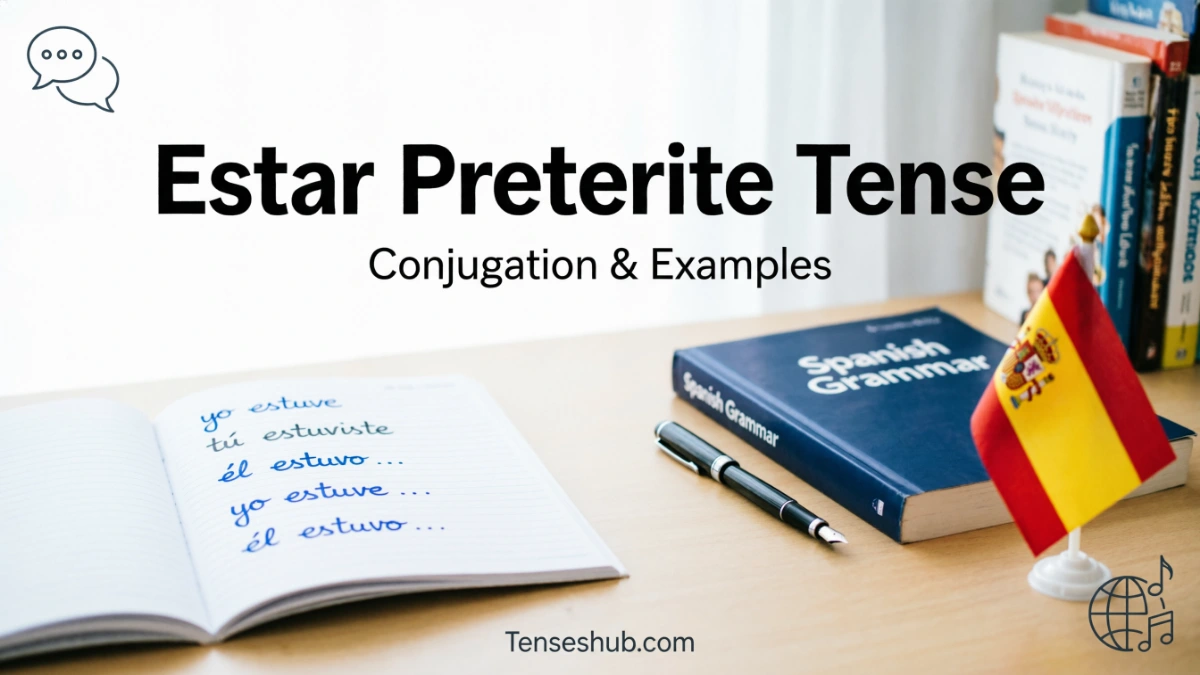
The important thing to remember is that estar does not follow the normal -ar verb pattern in the preterite. Its forms are irregular: estuve, estuviste, estuvo, estuvimos, estuvisteis, estuvieron.
In this guide, you will learn the complete estar preterite conjugation, when to use it, how to form sentences, how it differs from the imperfect, and how to avoid common mistakes.
Quick Answer: What Is the Preterite of Estar?
The preterite of estar is:
estuve, estuviste, estuvo, estuvimos, estuvisteis, estuvieron
The verb estar is irregular in the preterite and uses the stem estuv-.
| Subject | Estar – Preterite | English Meaning |
|---|---|---|
| Yo | estuve | I was |
| Tú | estuviste | You were |
| Él / Ella / Usted | estuvo | He / She was; You were |
| Nosotros / Nosotras | estuvimos | We were |
| Vosotros / Vosotras | estuvisteis | You all were |
| Ellos / Ellas / Ustedes | estuvieron | They were; You all were |
Example:
Estuve en casa ayer. — I was at home yesterday.
The preterite is commonly used when the past state, condition, feeling, or location is viewed as completed, bounded, or connected to a specific past situation.
What Is Estar Preterite Tense?
The estar preterite tense is the preterite form of the Spanish verb estar, which means “to be.”
The Spanish preterite, also called the pretérito or pretérito perfecto simple, is commonly used for actions, events, states, or situations that took place in the past and are viewed as completed.
Because estar describes states and conditions, its preterite forms are often used to talk about:
- Where someone was
- How someone felt at a particular time
- A temporary condition in the past
- A physical or emotional state
- A situation that lasted for a known or completed period
- A past state connected to a specific event or time
Consider these examples:
Estuve en casa ayer.
I was at home yesterday.
María estuvo cansada después del viaje.
María was tired after the trip.
Estuvimos en el hotel durante dos días.
We were at the hotel for two days.
The verb estar is different from ser, even though both can sometimes translate as “to be.”
For example:
Estuve enfermo.
I was sick.
Here, estar is used because being sick is a condition or state.
A useful beginner rule is:
Estar + preterite = a past state, condition, feeling, or location viewed as completed or bounded.
However, context matters. Spanish does not simply use the preterite every time English uses “was” or “were.”
Structure of Sentences of Estar Preterite Tense
The sentence structure is fairly simple. The subject can be followed by the appropriate preterite form of estar and then the information that explains the past state, condition, or location.
Affirmative Sentences
The basic pattern is:
Subject + estar in preterite + complement
Examples:
- Yo estuve en casa. — I was at home.
- Ella estuvo cansada. — She was tired.
- Nosotros estuvimos en México. — We were in Mexico.
- Ellos estuvieron felices. — They were happy.
In Spanish, the subject pronoun is often omitted because the verb form already shows who performed the action or experienced the state.
So instead of:
Yo estuve en casa.
You can simply say:
Estuve en casa.
Both are correct.
Negative Sentences
The basic pattern is:
Subject + no + estar in preterite + complement
Examples:
- No estuve en casa. — I was not at home.
- Ella no estuvo enferma. — She was not sick.
- No estuvimos allí. — We were not there.
- Ellos no estuvieron preparados. — They were not prepared.
The word no normally comes directly before the conjugated verb.
Interrogative Sentences
The basic pattern is:
Estar in preterite + subject + complement?
Examples:
- Estuviste en casa? — Were you at home?
- Estuvo María enferma? — Was María sick?
- Estuvieron ustedes en Madrid? — Were you in Madrid?
- Estuvimos allí ayer? — Were we there yesterday?
Spanish can also use question words:
Dónde estuviste ayer?
Where were you yesterday?
Cómo estuvo el viaje?
How was the trip?
Formation of Estar Preterite Tense
The verb estar is irregular in the preterite.
Unlike a regular -ar verb such as hablar, you cannot simply remove -ar and add the normal preterite endings.
Instead, estar uses the irregular stem:
estuv-
The preterite endings are then added to this stem.
| Subject | Stem + Ending | Preterite Form |
|---|---|---|
| Yo | estuv + e | estuve |
| Tú | estuv + iste | estuviste |
| Él / Ella / Usted | estuv + o | estuvo |
| Nosotros / Nosotras | estuv + imos | estuvimos |
| Vosotros / Vosotras | estuv + isteis | estuvisteis |
| Ellos / Ellas / Ustedes | estuv + ieron | estuvieron |
The Stem Is Estuv-
The most important formation rule is:
estar → estuv-
Then add the preterite endings.
For example:
estuv + e = estuve
estuv + iste = estuviste
estuv + o = estuvo
estuv + imos = estuvimos
estuv + isteis = estuvisteis
estuv + ieron = estuvieron
Notice that the v remains throughout the conjugation.
There Are No Written Accent Marks
The standard preterite forms of estar do not require written accent marks:
- estuve
- estuviste
- estuvo
- estuvimos
- estuvisteis
- estuvieron
This is useful to remember because learners sometimes try to add accents based on pronunciation.
Remember the Irregular Stem
A simple memory trick is to learn the forms as one family:
estuve → estuviste → estuvo → estuvimos → estuvisteis → estuvieron
The repeated estuv- part makes the pattern easier to recognize.
How to Use Estar Preterite Tense
The preterite of estar has several important uses. The main idea is that the speaker views the past state, condition, or location as completed, bounded, or connected to a specific past period or event.
1. Talking About a Past Location
One of the most common uses is describing where someone or something was.
Examples:
Estuve en casa toda la mañana.
I was at home all morning.
Ella estuvo en la oficina ayer.
She was at the office yesterday.
Estuvimos en España el año pasado.
We were in Spain last year.
Ellos estuvieron en el restaurante durante dos horas.
They were at the restaurant for two hours.
A specific or completed time period often makes the preterite natural.
2. Describing a Past Condition
You can use estar in the preterite for a condition that occurred during a completed past period.
Examples:
Estuve enfermo la semana pasada.
I was sick last week.
Ella estuvo cansada después del examen.
She was tired after the exam.
Estuvimos ocupados todo el día.
We were busy all day.
The condition does not necessarily need to be extremely short. What matters is how the speaker presents the situation.
3. Talking About Feelings
The preterite of estar can describe a feeling or emotional state during a particular completed situation.
Examples:
Estuve muy feliz ayer.
I was very happy yesterday.
Ella estuvo triste después de la noticia.
She was sad after the news.
Estuvimos preocupados durante el viaje.
We were worried during the trip.
4. Describing a Temporary State
The preterite can be used when a temporary state is connected to a completed period.
Estuvo enfermo durante tres días.
He was sick for three days.
Estuvimos ocupados durante la reunión.
We were busy during the meeting.
Estuve muy nervioso antes del examen.
I was very nervous before the exam.
5. Describing How Something Was at a Particular Time
Estar can also be used when asking or saying how something was at a particular time.
Cómo estuvo la película?
How was the movie?
La película estuvo excelente.
The movie was excellent.
Cómo estuvo la fiesta?
How was the party?
La fiesta estuvo muy divertida.
The party was very fun.
This use is especially common in everyday Spanish.
Estar Preterite Tense Verb Pattern Table
| Use | Pattern | Example |
|---|---|---|
| Past Affirmative | Subject + estar preterite | Ella estuvo allí. |
| Past Negative | Subject + no + estar preterite | Ella no estuvo allí. |
| Past Question | ¿Estar preterite + subject…? | ¿Estuvo ella allí? |
| Past Location | Subject + estar preterite + place | Estuvimos en Madrid. |
| Past Condition | Subject + estar preterite + adjective | Estuve cansado. |
Real-Life Examples
Here are practical examples that show how estar in the preterite works in everyday Spanish.
Affirmative Examples
Estuve en casa ayer.
I was at home yesterday.
Estuviste muy ocupado esta mañana.
You were very busy this morning.
Mi hermano estuvo enfermo la semana pasada.
My brother was sick last week.
Estuvimos en el parque toda la tarde.
We were at the park all afternoon.
Mis amigos estuvieron en la universidad.
My friends were at the university.
Los estudiantes estuvieron preparados para el examen.
The students were prepared for the exam.
Negative Examples
No estuve en casa anoche.
I was not at home last night.
No estuviste en la reunión.
You were not at the meeting.
Ella no estuvo disponible ayer.
She was not available yesterday.
No estuvimos allí mucho tiempo.
We were not there for long.
Ellos no estuvieron listos.
They were not ready.
Questions
Dónde estuviste ayer?
Where were you yesterday?
Estuviste en casa anoche?
Were you at home last night?
Cómo estuvo tu viaje?
How was your trip?
Estuvo Juan en la escuela?
Was Juan at school?
Estuvieron ustedes en el hotel?
Were you at the hotel?
Everyday Conversation
A: Dónde estuviste ayer?
B: Estuve en casa.
A: Where were you yesterday?
B: I was at home.
Another example:
A: Cómo estuvo la comida?
B: Estuvo deliciosa.
A: How was the food?
B: It was delicious.
These short exchanges show why the preterite of estar is useful in everyday Spanish.
Common Mistakes
Mistake 1: Using “esté” for the Preterite
Incorrect:
Ayer esté en casa.
Correct:
Ayer estuve en casa.
Esté is not the normal first-person singular preterite form of estar. The correct form is estuve.
Mistake 2: Using the Regular -ar Pattern
Some learners treat estar like a regular -ar verb.
Incorrect:
Yo estó en casa.
Correct:
Yo estuve en casa.
The verb estar is irregular in the preterite, so you must use the estuv- stem.
Mistake 3: Forgetting the V
Incorrect:
Estuieron allí.
Correct:
Estuvieron allí.
The irregular stem contains v:
estuv-
So the correct form is:
estuvieron
Mistake 4: Using “Estaba” Automatically
English speakers often translate every “was” as estaba.
But Spanish uses different past forms depending on meaning and context.
Compare:
Estuve en Madrid el lunes.
I was in Madrid on Monday.
Estaba en Madrid cuando me llamaste.
I was in Madrid when you called me.
The first presents the stay as a completed past event. The second presents the state as ongoing or as background to another event.
Mistake 5: Confusing Estar With Ser
Both ser and estar can translate as “to be,” but they are not interchangeable.
Incorrect:
Fue enfermo ayer.
More natural:
Estuvo enfermo ayer.
Illness is normally expressed with estar.
Key Grammar Rules
Here are the most important rules to remember.
Rule 1: Estar Is Irregular in the Preterite
Do not use the normal regular -ar endings directly on estar.
Use:
estuv- + preterite ending
Example:
Estuve en casa.
Rule 2: Use Estuve for Yo
The first-person singular form is:
yo estuve
Example:
Estuve en la biblioteca.
I was in the library.
Rule 3: Use Estuvo for Él, Ella, and Usted
The third-person singular form is:
estuvo
Examples:
Él estuvo aquí.
He was here.
Ella estuvo enferma.
She was sick.
Usted estuvo muy amable.
You were very kind.
Rule 4: Use Estuvieron for Ellos, Ellas, and Ustedes
Examples:
Ellos estuvieron en casa.
They were at home.
Ustedes estuvieron muy ocupados.
You were very busy.
Rule 5: Put “No” Before the Verb
For negative sentences:
no + estar in preterite
Example:
No estuve allí.
I was not there.
Rule 6: Do Not Add a Written Accent to the Standard Forms
Write:
estuve
not:
estuvé
Write:
estuvieron
not:
estuvierón
The standard preterite forms are written without accent marks.
Comparisons With Similar Grammar Forms
Understanding estar preterite becomes much easier when you compare it with related Spanish forms.
Estar Preterite vs. Estar Imperfect
This is probably the most important comparison.
The preterite generally presents the past state as completed, bounded, or associated with a specific event or period.
The imperfect generally presents a past state as ongoing, habitual, or background information.
Compare:
Estuve en casa ayer.
I was at home yesterday.
Estaba en casa cuando llamaste.
I was at home when you called.
In the first sentence, the speaker is simply reporting a completed past location.
In the second sentence, being at home provides background for another event: you called.
Another comparison:
Estuve enfermo tres días.
I was sick for three days.
Estaba enfermo cuando llegó.
I was sick when he arrived.
The preterite focuses on the completed period. The imperfect describes the condition as ongoing when another event occurred.
Estar Preterite vs. Ser Preterite
The verbs estar and ser both mean “to be,” but they have different uses.
Compare:
Estuve en casa.
I was at home.
Fui estudiante.
I was a student.
The first describes location, so estar is appropriate.
The second describes identity or classification, so ser is used.
Another useful pair:
La comida estuvo deliciosa.
The food was delicious.
La comida fue preparada por Ana.
The food was prepared by Ana.
The meaning and context determine whether estar or ser is appropriate.
Estar Preterite vs. Estar Present
The tense changes the time.
Estoy en casa.
I am at home.
Estuve en casa.
I was at home.
Estoy cansado.
I am tired.
Estuve cansado.
I was tired.
The present describes a current state, while the preterite places the state in the completed past.
Estar Preterite vs. English “Was/Were”
English often uses the simple past was/were for situations that Spanish divides between the preterite and imperfect.
For example:
Estuve allí.
I was there.
Estaba allí cuando llegaste.
I was there when you arrived.
Both can contain “I was” in English, but Spanish chooses the tense based on how the speaker views the situation.
This is why translating word-for-word can lead to mistakes.
Exercises
Practice the preterite forms of estar before checking the answers.
Exercise 1: Fill in the Blanks
Complete each sentence with the correct preterite form of estar.
- Yo ______ en casa ayer.
- Tú ______ muy cansado después del trabajo.
- Ella ______ en la oficina.
- Nosotros ______ en México el año pasado.
- Ellos ______ enfermos durante tres días.
- ¿Dónde ______ tú ayer?
- Ustedes ______ muy ocupados esta mañana.
- Mi hermano ______ en el hospital.
Exercise 2: Correct the Sentences
Find and correct the mistake.
- Yo estó en casa ayer.
- Ella estuieron enferma.
- Nosotros estaba en Madrid.
- No estuveé allí.
- ¿Estabas en casa ayer? — Assume the speaker is asking about a completed visit that happened yesterday.
Exercise 3: Translate Into Spanish
- I was at home yesterday.
- She was sick last week.
- We were in Spain last year.
- They were very busy.
- Were you at the restaurant?
- I was not at school.
- Where were you yesterday?
- How was the movie?
Exercise 4: Multiple Choice
1. Which is the correct preterite form for “yo”?
A. estaba
B. estuve
C. estó
D. estaré
2. Which sentence means “They were in Madrid”?
A. Ellos estaban Madrid.
B. Ellos estuvieron en Madrid.
C. Ellos estuve en Madrid.
D. Ellos estarán en Madrid.
3. Which form belongs with “nosotros”?
A. estuvo
B. estuvieron
C. estuvimos
D. estuviste
4. What is the irregular stem of estar in the preterite?
A. est-
B. estuv-
C. estu-
D. estar-
5. Which sentence is correct?
A. No estuve allí.
B. No estuvo allí yo.
C. No estó allí.
D. No estuveé allí.
Answer Key
Exercise 1
- estuve
- estuviste
- estuvo
- estuvimos
- estuvieron
- estuviste
- estuvieron
- estuvo
Exercise 2
- Yo estuve en casa ayer.
- Ella estuvo enferma.
- Nosotros estuvimos en Madrid.
- No estuve allí.
- ¿Estuviste en casa ayer?
Exercise 3
- Estuve en casa ayer.
- Ella estuvo enferma la semana pasada.
- Estuvimos en España el año pasado.
- Estuvieron muy ocupados.
- ¿Estuviste en el restaurante?
- No estuve en la escuela.
- ¿Dónde estuviste ayer?
- ¿Cómo estuvo la película?
Exercise 4
- B — estuve
- B — Ellos estuvieron en Madrid.
- C — estuvimos
- B — estuv-
- A — No estuve allí.
FAQs
What is the preterite tense of estar?
The preterite forms of estar are estuve, estuviste, estuvo, estuvimos, estuvisteis, and estuvieron.
What does estuve mean?
Estuve means “I was” when using the preterite of estar.
Example:
Estuve en casa.
I was at home.
What does estuvo mean?
Estuvo can mean “he was,” “she was,” or “you were” in the formal usted form.
Example:
Ella estuvo enferma.
She was sick.
What is the difference between estuve and estaba?
Estuve is the preterite and commonly presents a past state as completed or bounded. Estaba is the imperfect and commonly presents a state as ongoing, habitual, or background information.
Example:
Estuve en casa ayer.
I was at home yesterday.
Estaba en casa cuando llamaste.
I was at home when you called.
Is estar regular or irregular in the preterite?
Estar is irregular in the preterite. It uses the stem estuv-.
What is the nosotros form of estar in the preterite?
The nosotros form is estuvimos.
Example:
Estuvimos en España.
We were in Spain.
What is the ustedes form of estar in the preterite?
The ustedes form is estuvieron.
Example:
Ustedes estuvieron aquí.
You were here.
Does estar preterite have accent marks?
No. The standard preterite forms of estar are written without accent marks:
estuve, estuviste, estuvo, estuvimos, estuvisteis, estuvieron.
Is “estuve” the same as “estaba”?
No. Both can translate as “I was,” but they express different views of the past.
Estuve is preterite, while estaba is imperfect.
Why is estar irregular in the preterite?
Estar is an irregular verb in the preterite because it uses the stem estuv- rather than the regular stem used by ordinary -ar verbs.
For example:
estuv- + e = estuve
estuv- + ieron = estuvieron
The best approach is to memorize the six preterite forms as a group.
What are the six forms of estar in the preterite?
The six forms are:
estuve, estuviste, estuvo, estuvimos, estuvisteis, estuvieron.
They correspond to yo, tú, él/ella/usted, nosotros/as, vosotros/as, and ellos/ellas/ustedes.
Can estar in the preterite describe a long period?
Yes. The preterite does not mean that the state must have been short. A situation can last for days, months, or longer if the speaker presents that period as completed or bounded.
For example:
Estuvimos en España durante un mes.
We were in Spain for a month.
Conclusion
The estar preterite tense is an essential Spanish grammar form for talking about past locations, conditions, feelings, and temporary states that are viewed as completed or connected to a specific past period.
The most important thing to remember is that estar is irregular in the preterite. Its stem changes to estuv-, giving you the forms estuve, estuviste, estuvo, estuvimos, estuvisteis, and estuvieron.
Pay special attention to the difference between estuve and estaba. The preterite often presents a past state as completed or bounded, while the imperfect presents it as ongoing, habitual, or background information.
Also remember that estar and ser are not interchangeable simply because both can mean “to be” in English. With regular practice and real-life examples, these differences become much easier to recognize.
Start by memorizing the six preterite forms of estar, then practice using them in short sentences. This will help you build confidence and use Spanish more naturally.

Hi, I’m Noah Bester, a tenses expert passionate about simplifying English grammar. I create practical, easy-to-understand guides to help learners master tenses with confidence. My goal is to make grammar clear, useful, and applicable in everyday communication. tenseshub.com