Picture this: you’re telling your friend about a trip you took last weekend, and you want to say “I made a reservation” or “We did everything on the list.” You reach for the verb hacer and then freeze. How exactly do you conjugate it in the past tense?
You’re not alone. Hacer is one of the most-used Spanish verbs, but its preterite forms trip up beginners every single time. It doesn’t follow the normal rules, and the yo form especially looks nothing like what you’d expect.
Here’s the thing though once you see the pattern clearly laid out, it actually becomes one of the easier irregular verbs to remember.
This guide walks you through every conjugation, explains when and how to use hacer in the preterite tense, and gives you real examples plus exercises to make it stick. You’ll be using it confidently by the end.
Quick Answer
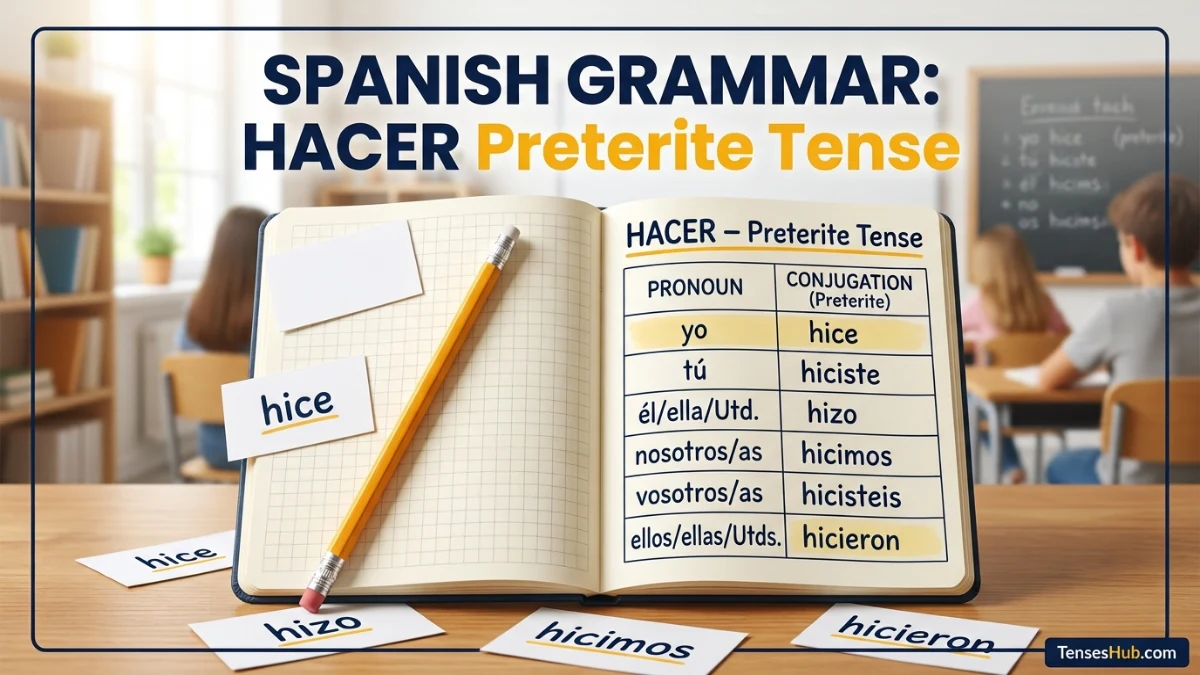
Hacer in the preterite tense means “to do” or “to make” in the past. It’s irregular, so the stem changes to hic- for most forms, and the yo form becomes hice. The él/ella form becomes hizo (with a spelling change to keep the pronunciation consistent).
| Pronoun | Hacer (Preterite) | Meaning |
| yo | hice | I did / I made |
| tú | hiciste | you did / you made |
| él/ella/usted | hizo | he/she did / you (formal) did |
| nosotros | hicimos | we did / we made |
| vosotros | hicisteis | you all did (Spain) |
| ellos/ellas/ustedes | hicieron | they did / you all did |
What Is the Hacer Preterite Tense?
Hacer is a Spanish verb that means “to do” or “to make.” In the preterite tense (pretérito indefinido), it refers to completed actions in the past things that happened and are done.
So when you say Hice mi tarea (“I did my homework”), you’re describing a specific, finished event. It’s not ongoing. It happened, it ended, it’s past.
What makes hacer tricky is that it’s completely irregular in the preterite. The stem shifts from hac- to hic-, and the endings it takes aren’t the regular -er verb endings you might already know. Instead, it uses a special set of endings shared by a family of other irregular preterite verbs like tener, estar, and poder.
Why does this matter? Because hacer shows up everywhere in everyday Spanish. “What did you do?” ¿Qué hiciste? “She made dinner.” Ella hizo la cena. “We did it!” ¡Lo hicimos! You can’t really get through a conversation about the past without it.
Conjugation of Hacer in the Preterite
Let’s look at exactly how the forms are built.
The stem used in the preterite is hic-. Add these endings to that stem:
| Pronoun | Stem | Ending | Full Form |
| yo | hic- | -e | hice |
| tú | hic- | -iste | hiciste |
| él/ella/usted | hic- | -o → hizo | hizo |
| nosotros | hic- | -imos | hicimos |
| vosotros | hic- | -isteis | hicisteis |
| ellos/ustedes | hic- | -ieron | hicieron |
Notice the él/ella form: instead of hicó, it becomes hizo. The c changes to z to preserve the soft /s/ sound before the letter o. Without that spelling change, hicó would sound like hikó and that’s just not how Spanish pronunciation works.
The yo form hice is also worth noting. It ends in -e, not the typical -é you see in regular -ar verbs. This is part of the irregular preterite pattern and it means hice carries no written accent mark.
Sentence Structure with Hacer in the Preterite
Forming sentences is straightforward once you have the conjugation down. Spanish word order is flexible, but the most common structure looks like this:
Subject + hice/hiciste/hizo… + object/complement
Here are the three basic sentence types:
Affirmative (positive statements):
Subject + preterite form of hacer + object
- Yo hice una lista. I made a list.
- Ella hizo café esta mañana. She made coffee this morning.
Negative (negative statements):
Subject + no + preterite form of hacer + object
- No hice nada el sábado. I didn’t do anything on Saturday.
- Ellos no hicieron la tarea. They didn’t do the homework.
Interrogative (questions):
¿ + (Subject) + preterite form of hacer + object + ?
- ¿Qué hiciste ayer? What did you do yesterday?
- ¿Quién hizo esto? Who did this?
Spanish doesn’t require a subject pronoun in most sentences since the verb ending tells you who the subject is. You’ll often see sentences like Hicimos una barbacoa (“We had a barbecue”) with no nosotros at all and that’s perfectly natural.
How to Use Hacer in the Preterite
The preterite tense in Spanish describes completed past actions events that happened at a specific time, had a clear beginning and end, or occurred a set number of times. Hacer in the preterite fits all of these situations.
Specific completed actions:
Use it when talking about something you did that’s fully finished.
- Hice ejercicio esta mañana. I worked out this morning.
- Hizo una llamada importante. He made an important call.
Reactions or responses to something:
Hacer often appears in questions asking what someone did in response to a situation.
- ¿Qué hiciste cuando supiste la noticia? What did you do when you heard the news?
Weather expressions (with hacer):
Here’s something that surprises a lot of learners hacer is also used to talk about weather in Spanish. In the preterite, it describes past weather conditions.
- Hizo mucho calor ayer. It was very hot yesterday.
- Hizo frío toda la semana. It was cold all week.
Time expressions that go with the preterite:
Watch for these trigger words they usually signal that you need the preterite:
- ayer (yesterday), anoche (last night), la semana pasada (last week), el año pasado (last year), hace dos días (two days ago)
Hiciste mucho la semana pasada. You did a lot last week.
Don’t confuse the preterite with the imperfect (hacía). If you want to say someone used to do something or was doing something habitually in the past, that’s the imperfect not the preterite. More on that in the comparisons section.
Real-Life Examples
Seeing the verb in authentic, varied sentences is one of the best ways to make conjugations feel natural.
Everyday situations:
- Hice las compras por la tarde. I did the grocery shopping in the afternoon.
- ¿Hiciste la reservación? Did you make the reservation?
- No hicimos nada especial el fin de semana. We didn’t do anything special over the weekend.
- Ellos hicieron un buen trabajo. They did a good job.
Weather:
- Hizo viento toda la tarde. It was windy all afternoon.
- ¿Hizo frío en la ciudad? Was it cold in the city?
Formal and workplace contexts:
- El equipo hizo una presentación excelente. The team gave an excellent presentation.
- Usted no hizo los cambios que pedí. You didn’t make the changes I requested.
Conversational, informal use:
- ¡Lo hiciste muy bien! You did really well!
- ¿Qué hicieron en la fiesta? What did you all do at the party?
- No hice nada, te lo juro. I didn’t do anything, I swear.
Common Mistakes
1. Using the regular -er preterite endings
❌ Yo haí la cena. ✅ Yo hice la cena.
The verb hacer doesn’t use regular preterite endings. The stem changes to hic- and the endings are part of the irregular preterite family.
2. Forgetting the z in hizo
❌ Él hicó el trabajo. ✅ Él hizo el trabajo.
The third-person singular form is hizo, not hicó. The spelling change from c to z is required to maintain the correct pronunciation.
3. Adding an accent to hice
❌ Yo hicé. ✅ Yo hice.
Unlike regular preterite yo forms (hablé, comí), irregular preterite yo forms carry no written accent. Hice is correct without any accent mark.
4. Mixing up preterite and imperfect
❌ Ayer hacía mi tarea. (if you mean you completed it) ✅ Ayer hice mi tarea.
Hacía describes an ongoing or habitual past action. If the action was completed on a specific occasion, use the preterite form.
5. Using hizo for weather without hacer
❌ Fue mucho calor ayer. ✅ Hizo mucho calor ayer.
Weather in Spanish requires hacer, not ser or estar. This is one of those fixed patterns you just need to memorize.
Key Grammar Rules
1. Hacer is fully irregular in the preterite.
The stem changes from hac- to hic-, and the endings are not the same as regular -er verbs.
2. The yo form has no accent.
Hice (not hicé) irregular preterite yo forms never take a written accent mark.
3. The c → z change in hizo is purely about spelling and sound.
It keeps the pronunciation consistent. The c before o would produce a hard /k/ sound, so it changes to z.
4. Hacer uses the preterite for completed, specific past actions.
If you did something once, finished it, or are referring to a definite past moment preterite is your tense.
5. Weather expressions use hacer in all tenses.
Hace calor (present), hacía calor (imperfect), hizo calor (preterite) hacer is the go-to verb for weather in Spanish.
6. No subject pronoun is required.
The conjugated verb form already tells you the subject. Hicimos la tarea is perfectly natural without nosotros.
7. Time markers help signal the preterite.
Words like ayer, anoche, la semana pasada, and hace + time almost always pair with the preterite tense.
Comparing Hacer Preterite vs. Hacer Imperfect
This is the comparison that confuses learners most and it’s worth spending time on.
| Preterite (hice, hiciste…) | Imperfect (hacía, hacías…) | |
| Use | Completed, one-time past actions | Ongoing, habitual, or repeated past actions |
| Time feel | A specific moment or event | A stretch of time or routine |
| Example | Hice ejercicio ayer. (I worked out yesterday.) | Hacía ejercicio todos los días. (I used to work out every day.) |
The short version: if you can replace the past action with “used to do” in English and it still makes sense, you probably need the imperfect. If not, go with the preterite.
Hacer also belongs to a group of irregular preterite verbs that share the same ending pattern, including tener (tuve), estar (estuve), poder (pude), and querer (quise). Learning hacer well actually gives you a head start on all of these.
Exercises
1. Fill in the Blank
Conjugate hacer in the preterite tense.
- Yo ________ la cama esta mañana.
- ¿Tú ________ la reservación?
- Él ________ un pastel para la fiesta.
- Nosotros ________ mucho trabajo ayer.
- Ellas ________ todo lo posible.
2. Spot and Correct the Mistake
- Ayer yo haí mis ejercicios.
- Ella hicó una pregunta importante.
- ¿Qué hicistéis vosotros?
- Fue mucho frío la semana pasada.
- Nosotros hacíamos la tarea ayer por la noche. (if you mean it was completed)
3. Translate into Spanish
- What did you (tú) do last night?
- We made a big decision.
- She didn’t do anything wrong.
- It was very hot yesterday.
- They did everything on time.
4. Multiple Choice
Choose the correct form:
- Yo ________ la compra esta tarde. a) hice b) hizo c) hacía
- ¿Quién ________ este dibujo? a) hiciste b) hizo c) hicieron
- Ellos no ________ nada. a) hicieron b) hicimos c) hiciste
- ________ mucho viento ayer. a) Hice b) Hizo c) Hicimos
Answer Key
1: 1. hice | 2. hiciste | 3. hizo | 4. hicimos | 5. hicieron
2:
- ❌ haí → ✅ hice hacer is irregular; don’t use regular -er endings
- ❌ hicó → ✅ hizo the c changes to z before o
- ✅ Correct hicisteis is the proper vosotros form
- ❌ Fue → ✅ Hizo weather uses hacer, not ser
- ❌ hacíamos → ✅ hicimos if the homework was finished last night, use the preterite
3:
- ¿Qué hiciste anoche?
- Hicimos una decisión grande. / Tomamos una gran decisión. (both natural)
- Ella no hizo nada malo.
- Hizo mucho calor ayer.
- Ellos hicieron todo a tiempo.
4: 1. a | 2. b | 3. a | 4. b
Frequently Asked Questions
Why does hizo have a z instead of c?
It’s a spelling rule. The letter c before o makes a hard /k/ sound in Spanish (co = /ko/). To keep the soft /s/ sound of the stem hic-, Spanish swaps the c for a z. So hizo sounds like EE-so, not EE-ko.
Is hice the same as I made and I did?
Yes hacer covers both meanings. Context tells you which one applies. Hice una torta = I made a cake. Hice mi tarea = I did my homework.
Does hacer have an accent in the preterite yo form?
No. Regular preterite yo forms like hablé and comí carry accents, but irregular preterite yo forms including hice do not. This is a consistent rule across all irregular preterite verbs.
When do I use hacía instead of hice?
Use hacía (imperfect) for ongoing, habitual, or background past actions: Siempre hacía deporte por las mañanas (I always used to exercise in the mornings). Use hice (preterite) for a single, completed past event: Hice deporte ayer (I worked out yesterday).
How do I say “it was hot” in Spanish using hacer?
Hizo calor. Weather expressions in Spanish use hacer as the main verb: hizo frío, hizo viento, hizo buen tiempo it was cold, it was windy, the weather was nice.
Are there other verbs conjugated the same way as hacer?
Yes! Tener (tuve), estar (estuve), poder (pude), poner (puse), and querer (quise) all follow a similar irregular preterite pattern with a stem change and the same set of endings.
Conclusion
Hacer in the preterite tense might look intimidating at first glance, but you’ve now seen that its pattern is actually quite consistent. The stem shifts to hic-, the yo form is hice (no accent), and the only real spelling quirk is hizo which makes complete sense once you understand why the z is there.
The most important thing now is practice. Don’t just memorize the table and move on. Try using these forms in real sentences today. Tell yourself what you did this morning, what you made for lunch, what the weather was like. The more you actively use hice, hiciste, hizo, and the rest, the faster they’ll feel natural.
You’ve got the conjugation, the rules, the examples, and the exercises. Now it’s just a matter of putting it all together. Keep going every Spanish learner who’s ever become fluent sat exactly where you’re sitting right now, and they kept practicing until it clicked.
Hi, I’m Robert Lowth, a passionate expert in English tenses and grammar. I specialize in simplifying complex tense rules to help learners understand and use English with confidence. My goal is to make grammar clear, practical, and easy for everyday communication. tenseshub.com









