Picture this: you’re in a Spanish class and the teacher says, “Sigue las instrucciones.” You understand “instructions” but what exactly happened to the verb seguir? Why doesn’t it look like it should?
If that kind of confusion sounds familiar, you’re not alone. The verb seguir meaning “to follow,” “to continue,” or “to keep doing something” trips up beginners constantly.
It looks like a regular -ir verb, so learners conjugate it like one. Then they get it wrong, and they can’t figure out why.
Here’s the thing: seguir in the present tense is what Spanish teachers call a stem-changing verb with a spelling twist.
That makes it behave differently from most verbs you’ve learned so far. But once you understand the pattern, it actually becomes easy to use and incredibly useful in everyday Spanish conversation.
This guide breaks everything down for you: how it’s formed, how it’s used, real life examples, common mistakes, and exercises to help it stick.
Quick Answer
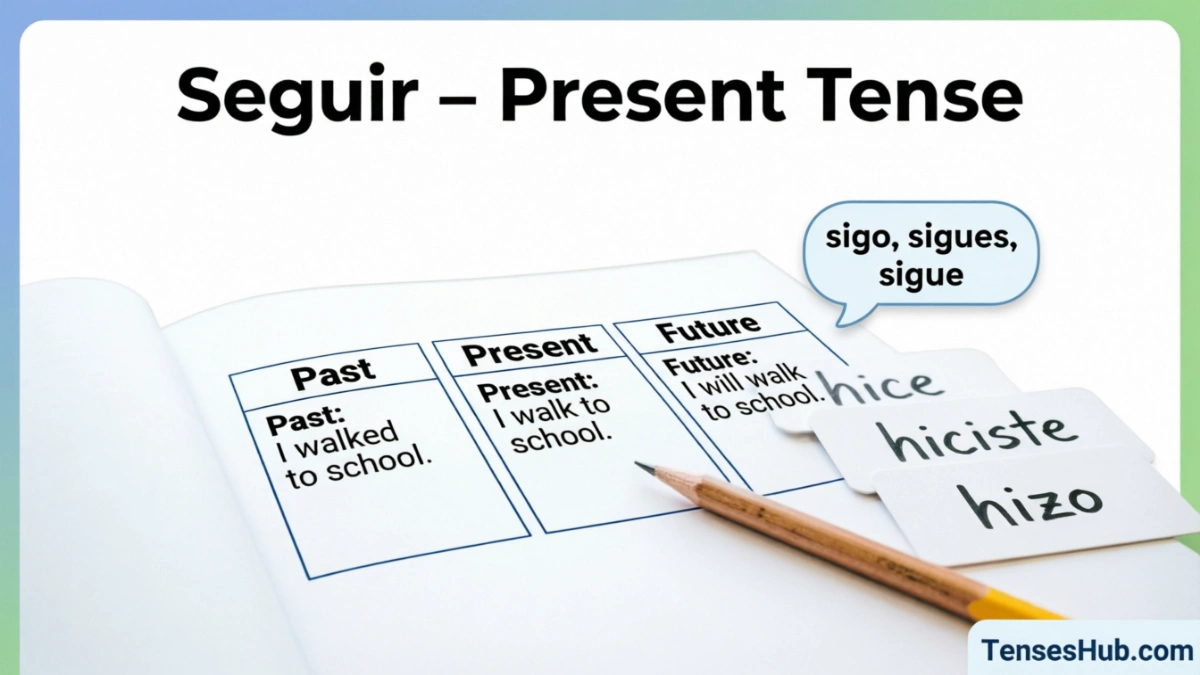
Seguir is an e→i stem-changing verb in the present tense. The stem vowel e changes to i in all forms except nosotros and vosotros. It also drops the u from its stem spelling.
| Subject | Conjugation | Meaning |
| yo | sigo | I follow / I continue |
| tú | sigues | you follow |
| él/ella/usted | sigue | he/she follows |
| nosotros | seguimos | we follow |
| vosotros | seguís | you all follow |
| ellos/ustedes | siguen | they follow |
What Is Seguir in the Present Tense?
Seguir is a Spanish -ir verb that means “to follow,” “to continue,” or “to keep doing something.” In English, you’d use it in sentences like “I follow the rules,” “She continues studying,” or “They keep talking.”
What makes seguir interesting and a little tricky is that it belongs to a special group called e→i stem-changing verbs. These are verbs where the e in the stem changes to i when the verb is conjugated. On top of that, seguir drops the u in all conjugated forms (it’s only there in the infinitive to keep the hard “g” sound).
Why does this matter? Because if you don’t know this rule, you’ll write “yo seguo” or “ella sege” both of which don’t exist in Spanish. Understanding seguir properly also prepares you for other similar verbs like pedir, repetir, and conseguir, all of which follow the same e→i pattern.
Structure of Sentences with Seguir
Sentences with seguir follow the same basic word order as any Spanish present tense sentence: subject + verb + rest of the sentence. The verb slot is where seguir gets conjugated.
Affirmative (positive) structure:
Subject + seguir (conjugated) + complement
- Ella sigue las instrucciones. She follows the instructions.
- Yo sigo estudiando. I keep studying.
Negative structure:
Subject + no + seguir (conjugated) + complement
- No sigo a nadie en redes sociales. I don’t follow anyone on social media.
- Él no sigue el plan. He doesn’t follow the plan.
Question structure:
¿ + seguir (conjugated) + subject + complement + ?
- ¿Sigues el mismo camino todos los días? Do you follow the same path every day?
- ¿Sigue ella trabajando aquí? Does she still work here?
Notice that Spanish doesn’t need a helper verb like “do” or “does” for questions the question mark and intonation do that job. The conjugated form of seguir carries it all.
Formation of Seguir in the Present Tense
Here’s where most learners need to slow down, because seguir has two things happening at once when you conjugate it.
Change 1 The e→i stem change:
The e in the infinitive stem segu- changes to i, giving you sigu-. This happens in all forms except nosotros and vosotros, which keep the original stem.
Change 2 The u is dropped:
The u in seguir is only there to keep the “g” sounding hard (like in “go”) before the e in the infinitive. Once you conjugate it, the vowel endings change, and the u is no longer needed so it disappears.
Here’s how the two changes play out together:
| Infinitive stem | After e→i change | After dropping u | + ending |
| segu- | sigu- | sig- | o → sigo |
| segu- | sigu- | sigu- | es → sigues |
| segu- | sigu- | sigu- | e → sigue |
| segu- | (no change) | segu- | imos → seguimos |
| segu- | (no change) | segu- | ís → seguís |
| segu- | sigu- | sigu- | en → siguen |
You’ll notice nosotros (seguimos) and vosotros (seguís) keep the original stem that’s the standard pattern for e→i verbs. They’re the exceptions to the change, not the rule.
How to Use Seguir
Seguir is one of those verbs that pops up in conversation all the time. You’ll use it in a few distinct ways.
1. To follow a person, route, or account
This is the most literal meaning physically following someone or something.
- Sigo a mi jefe al trabajo. I follow my boss to work.
- ¿Sigues esta cuenta en Instagram? Do you follow this account on Instagram?
2. To continue doing something (seguir + gerund)
This is one of the most practical uses. When seguir is followed by a gerund (-ando/-iendo form), it means “to keep doing” or “to continue doing” something. This structure is used constantly in everyday conversation.
- Sigo aprendiendo español. I keep learning Spanish.
- Ella sigue trabajando aunque es tarde. She keeps working even though it’s late.
- ¿Siguen hablando de lo mismo? Are they still talking about the same thing?
Why does this structure matter so much? Because it expresses ongoing, continuous action something you need constantly when describing real life.
3. To mean “still” in certain contexts
When combined with an adjective or situation, seguir can express that something hasn’t changed.
- ¿Sigues en Madrid? Are you still in Madrid?
- Sigo aquí. I’m still here.
4. To follow instructions, rules, or a plan
- Seguimos las reglas del juego. We follow the rules of the game.
- Sigue las instrucciones del médico. Follow the doctor’s instructions.
Verb Pattern Table
| Subject | Present Form | seguir + gerund example |
| yo | sigo | Sigo corriendo. (I keep running.) |
| tú | sigues | Sigues cantando. (You keep singing.) |
| él/ella/usted | sigue | Sigue leyendo. (He or she keeps reading.) |
| nosotros | seguimos | Seguimos intentando. (We keep trying.) |
| vosotros | seguís | Seguís hablando. (You all keep talking.) |
| ellos/ustedes | siguen | Siguen esperando. (They keep waiting.) |
Real-Life Examples
Everyday conversation:
- ¿Sigues viviendo con tus padres? Are you still living with your parents?
- Sigo pensando que tienes razón. I still think you’re right.
- No siguen el mismo horario. They don’t follow the same schedule.
Social media & technology:
- ¿Sigues a muchos artistas en línea? Do you follow many artists online?
- Sigo tres canales de cocina en YouTube. I follow three cooking channels on YouTube.
School and work:
- Seguimos estudiando para el examen. We keep studying for the exam.
- Mi jefa sigue explicando el proyecto. My boss keeps explaining the project.
Giving instructions:
- Sigue recto y luego gira a la derecha. Go straight and then turn right.
- Sigue las instrucciones con cuidado. Follow the instructions carefully.
Informal and formal:
- Informal: ¿Sigues con tu novio? Are you still with your boyfriend?
- Formal: ¿Sigue usted trabajando en esa empresa? Are you still working at that company?
Common Mistakes
Mistake 1: Forgetting the e→i stem change
❌ Yo seguo las reglas. ✅ Yo sigo las reglas.
The stem must change from segu- to sig- in the yo form. Seguo doesn’t exist.
Mistake 2: Keeping the u where it doesn’t belong
❌ Ella sigue-u hablando. ✅ Ella sigue hablando.
Once you conjugate, don’t overthink it the u disappears naturally in all conjugated forms.
Mistake 3: Using an infinitive instead of a gerund after seguir
❌ Sigo hablar español. ✅ Sigo hablando español.
When seguir means “to keep doing,” it must be followed by the gerund (-ando/-iendo), not the infinitive. This is one of the most common mistakes beginners make with this verb.
Mistake 4: Treating nosotros like a stem-changing form
❌ Nosotros sigimos estudiando. ✅ Nosotros seguimos estudiando.
The nosotros and vosotros forms don’t change their stem they keep the original segu-.
Mistake 5: Using a subject pronoun every single time
❌ (Ella) ella sigue estudiando. ✅ Ella sigue estudiando. or just Sigue estudiando.
Spanish verb endings often make the subject obvious. You don’t always need the pronoun especially in casual speech.
Key Grammar Rules
Rule 1: E→I stem change applies to four forms.
Yo, tú, él/ella/usted, and ellos/ustedes all change the stem vowel. Only nosotros and vosotros are exceptions.
Rule 2: The u in “seguir” is a spelling device, not a real vowel sound.
It exists to preserve the hard “g” sound before e in the infinitive. Once conjugated, the vowel endings change and the u is dropped.
Rule 3: Seguir + gerund = “to keep doing” or “to continue doing.”
This structure is extremely common. Don’t confuse it with empezar a + infinitive (to start doing) or dejar de + infinitive (to stop doing).
Rule 4: For “still” + adjective or location, use seguir without a gerund.
- ¿Sigues en clase? Are you still in class?
Rule 5: Questions in Spanish don’t need a helper verb.
You don’t say “¿Haces tú sigues?” just invert or use intonation: ¿Sigues estudiando?
Rule 6: Verb endings for -ir verbs still apply.
Even with stem changes, the endings themselves (-o, -es, -e, -imos, -ís, -en) are the standard -ir present tense endings.
Rule 7: Context determines the meaning.
Seguir can mean “follow,” “continue,” or “still be.” The surrounding sentence makes it clear which meaning is intended.
Comparisons with Similar Grammar Forms
Seguir vs. Continuar
Both mean “to continue,” but they’re not always interchangeable. Seguir + gerund sounds more natural in everyday speech, while continuar + gerund is slightly more formal.
- Sigo trabajando. ✅ Very natural in conversation.
- Continúo trabajando. ✅ Slightly more formal or written.
Seguir vs. Pedir (another e→i verb)
Pedir (to ask for/to order) follows the exact same e→i pattern: pido, pides, pide, pedimos, pedís, piden. If you’ve learned seguir, you’ve essentially learned the pattern for pedir, repetir, medir, conseguir, and elegir too.
Seguir vs. Ir a + infinitive (going to do)
Don’t confuse seguir + gerund with ir a + infinitive.
- Sigo estudiando = I keep/continue studying (ongoing action already happening).
- Voy a estudiar = I’m going to study (future intention).
Seguir vs. Estar + gerund
Estar + gerund describes what’s happening right now at this moment. Seguir + gerund emphasizes continuation that something hasn’t stopped.
- Estoy estudiando. I’m studying. (right now)
- Sigo estudiando. I’m still studying / I keep studying. (continuing)
Learners who want to explore these distinctions further might also want to look into the Spanish present progressive and ser vs. estar both connect naturally to how seguir works.
Exercises
Exercise 1: Fill in the Blank
Complete each sentence with the correct form of seguir.
- Yo ________ aprendiendo nuevas palabras cada día.
- Ella ________ las instrucciones del profesor.
- Nosotros ________ estudiando aunque es tarde.
- ¿Tú ________ viviendo en la misma ciudad?
- Ellos ________ hablando después de clase.
Exercise 2: Spot the Error
Find and correct the mistake in each sentence.
- Yo seguo corriendo todos los días.
- Ellas siguien esperando el autobús.
- Nosotros sigimos trabajando juntos.
- Él sigue hablar inglés en casa.
- ¿Tú sigues a María en Twitter? ✅ (This one is correct mark it as such!)
Exercise 3: Translate into Spanish
- She keeps reading the same book.
- Do you still follow him on social media?
- We continue following the plan.
- I keep making mistakes.
- They don’t follow the rules.
Exercise 4: Multiple Choice
Choose the correct option.
- Yo ________ las noticias cada mañana. a) segues b) sigo c) siguemos d) siguen
- ¿________ tú estudiando para el examen? a) Sigues b) Sigo c) Sigue d) Siguiendo
- Ellos ________ trabajando en el proyecto. a) siguimos b) siguen c) siga d) seguís
Answer Key
Exercise 1:
- sigo 2. sigue 3. seguimos 4. sigues 5. siguen
Exercise 2:
- Yo sigo corriendo todos los días.
- Ellas siguen esperando el autobús.
- Nosotros seguimos trabajando juntos.
- Él sigue hablando inglés en casa. (infinitive → gerund)
- ✅ Correct as written.
Exercise 3:
- Ella sigue leyendo el mismo libro.
- ¿Sigues a él en redes sociales?
- Seguimos el plan. / Seguimos siguiendo el plan.
- Sigo cometiendo errores.
- No siguen las reglas.
Exercise 4:
- b) sigo 2. a) Sigues 3. b) siguen
Frequently Asked Questions
Is seguir regular or irregular?
Seguir is irregular it’s a stem-changing (e→i) verb. It doesn’t follow the standard pattern of regular -ir verbs, which is why it needs its own study.
Why does the u disappear when seguir is conjugated?
The u in seguir is a spelling convention to keep the “g” sounding hard before the e in the infinitive. In conjugated forms, the endings create different sounds, so the u is no longer needed and is dropped.
Can I use seguir without a gerund?
Yes! Seguir can be used without a gerund to mean “to follow” (a person, route, account) or “to still be” somewhere.
- Sigo en casa. I’m still at home.
- ¿Sigues a ese cantante? Do you follow that singer?
What’s the difference between sigo and continúo?
Both can express “I continue,” but sigo + gerund is more common in spoken Spanish. Continúo tends to appear in more formal or written contexts.
What other verbs work like seguir?
Conseguir (to get/achieve), perseguir (to chase), pedir (to ask for), repetir (to repeat), medir (to measure), and elegir (to choose) all follow the same e→i pattern.
Does seguir ever mean something other than “follow” or “continue”?
In some contexts, it can translate as “to go on,” “to proceed,” or even “to still be doing.” Context makes the meaning clear.
Conclusion
The verb seguir might look complicated at first, but it follows a clear, learnable pattern. Once you understand the e→i stem change, why the u disappears, and how seguir + gerund works, you’ll find this verb showing up everywhere in directions, conversations, social media, and everyday life.
The biggest takeaway? Don’t treat nosotros and vosotros like the other forms they’re the exceptions that keep the original stem. And always use a gerund, not an infinitive, when you want to say “keep doing” something.
Practice the exercises above, use the verb in real sentences you care about, and don’t worry about making mistakes that’s part of the process. Every time you write “sigo aprendiendo,” you’re not just using a grammar rule. You’re living it.

Hi, I’m Noah Bester, a tenses expert passionate about simplifying English grammar. I create practical, easy-to-understand guides to help learners master tenses with confidence. My goal is to make grammar clear, useful, and applicable in everyday communication. tenseshub.com