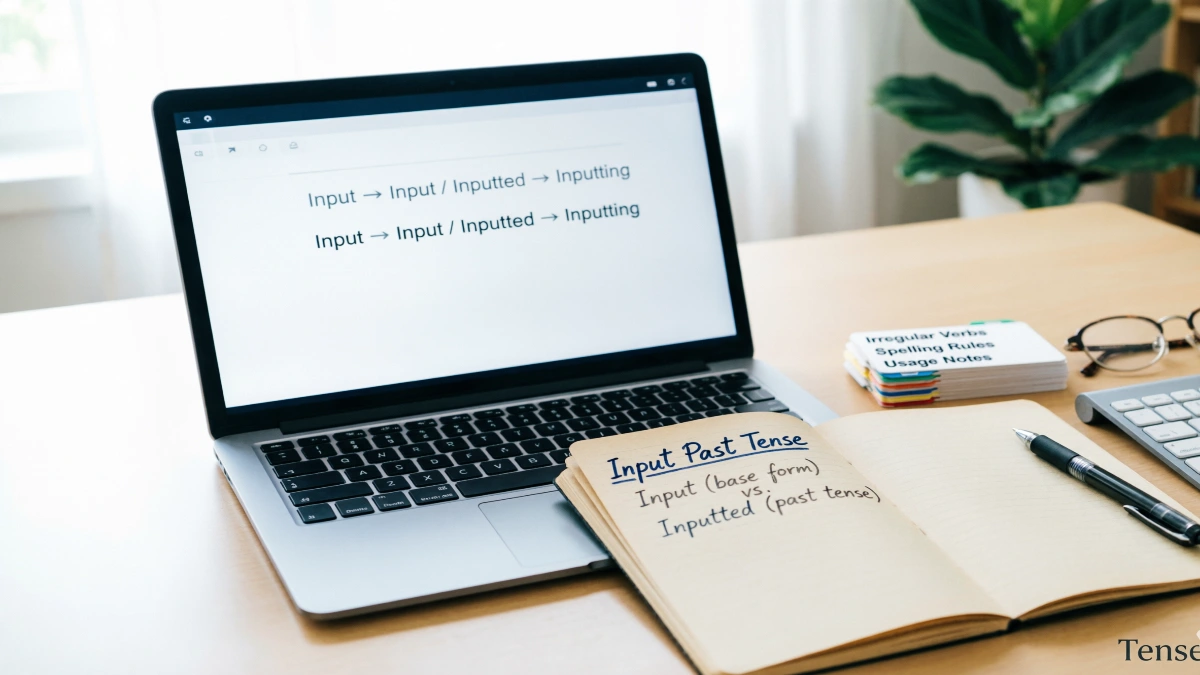
Have you ever wondered if the correct sentence is “I input the data yesterday” or “I inputted the data yesterday”? This is a common grammar question, especially for students, writers, office workers, and people who use computers regularly.
The verb input is unusual because it can have input as its past tense and past participle, while inputted is also used, especially in some technical and everyday contexts. This makes learners unsure about which form to choose.
In modern English, input is widely accepted as the past tense of input. Inputted is also a recognized form and can be useful when you want to make the past tense meaning especially clear. The best choice can depend on context and style.
In this guide, you will learn the past tense of input, the difference between input and inputted, the correct V1, V2, and V3 forms, sentence structures, practical examples, common mistakes, and exercises. By the end, you will know how to use this verb naturally and correctly.
Quick Answer
The past tense of input can be input or inputted. Input is very common, while inputted is also correct and is often used when the past action needs to be especially clear.
| Verb Form | Common Form | Alternative |
|---|---|---|
| V1 | input | — |
| V2 | input | inputted |
| V3 | input | inputted |
| V-ing | inputting | — |
Example:
“I input the data yesterday.”
“I inputted the data yesterday.”
Both forms can be correct, depending on context and style.
What Is the Past Tense of Input?
The verb input means to enter information, data, instructions, or other material into a computer, system, machine, form, or database.
The past tense can be input or inputted.
For example:
I input the customer details yesterday.
or:
I inputted the customer details yesterday.
Both forms are used in English. However, input is especially common because input can function as a verb without changing its form.
Input Verb Forms
The main forms of the verb are:
| Form | Word |
|---|---|
| V1 – Base Form | input |
| V2 – Past | input / inputted |
| V3 – Past Participle | input / inputted |
| V-ing | inputting |
Examples:
Base form:
Please input your name.
Past form:
She input the information yesterday.
or:
She inputted the information yesterday.
Past participle:
He has input the data.
or:
He has inputted the data.
ing form:
They are inputting the records.
What Does “Input” Mean?
As a verb, input usually means to enter information into a system.
For example:
Please input your password.
The employee input the customer information.
She inputted the figures into the database.
The word can also refer to information or advice that is provided to a process.
For example:
The manager gave useful input during the meeting.
Here, input is a noun rather than a verb.
This distinction is important because input can be both a noun and a verb.
Structure of Sentences of the Past Tense of Input
The sentence structure depends on if you are making an affirmative, negative, or interrogative sentence.
Affirmative Sentences
The basic pattern is:
Subject + input/inputted + object
Examples:
- I input the data yesterday.
- She inputted the information into the system.
- He input the figures last night.
- They inputted the customer details carefully.
Both input and inputted can be used in affirmative past sentences.
Negative Sentences
The pattern is:
Subject + did not + input + object
Examples:
- I did not input the data.
- She didn’t input the information.
- He did not input the figures.
- They didn’t input the customer details.
Notice that after did not or didn’t, we use the base form input.
Incorrect:
She didn’t inputted the information.
Correct:
She didn’t input the information.
Interrogative Sentences
The pattern is:
Did + subject + input + object?
Examples:
- Did you input the data?
- Did she input the information?
- Did they input the figures?
- Did he input the customer’s details?
Again, use input, not inputted, after did.
Formation of the Past Tense of Input
The verb input is different from many regular verbs because it can keep the same form in the past.
For example:
I input the information every morning.
Present:
I input the information every morning.
Past:
I input the information yesterday.
The context or time expression tells us that input is being used as a past form.
Input vs. Inputted
Both forms can be used as past forms:
input → input
input → inputted
Examples:
She input the data yesterday.
She inputted the data yesterday.
The first form is shorter and is very common. The second form clearly looks like a past tense verb and may be preferred in some contexts.
Past Participle
The same two forms can also be used as past participles:
She has input the data.
She has inputted the data.
However, usage can vary by speaker, industry, and style. When writing for a particular organization, it is useful to follow that organization’s preferred style.
The ing Form
The continuous form is inputting.
When adding ing to input, the final t is doubled:
input → inputting
Examples:
She is inputting the data.
They were inputting customer information.
I am inputting the numbers now.
This spelling is important because inputing is incorrect.
How to Use the Past Tense of Input
The past forms input and inputted are used to describe information that was entered into a system or process in the past.
1. Entering Data
This is the most common use.
She input the data yesterday.
She inputted the data yesterday.
Both sentences describe a completed action.
2. Entering Information Into a Computer
Examples:
He input the information into the computer.
The assistant inputted the customer’s details into the system.
This usage is common in offices and workplaces.
3. Entering Numbers or Figures
Use input when entering numerical information.
The accountant input the figures into the spreadsheet.
The employee inputted the sales numbers into the database.
4. Entering Information Into a Form
Examples:
I input my address into the online form.
She inputted her contact details before submitting the application.
5. Giving Information or Instructions to a System
The verb can also describe providing instructions or information to a computer or machine.
The technician input the instructions into the machine.
The programmer inputted the required commands.
6. Using “Input” in Technical Writing
In technical and professional writing, both input and inputted may appear.
For example:
The user input the required values.
or:
The user inputted the required values.
If your company, school, or publication follows a specific style guide, follow its preferred form.
7. When “Input” Is a Noun
Do not confuse the verb with the noun.
As a noun, input can mean information, advice, or an opinion contributed to something.
The manager asked for my input.
Here, input is not a past tense verb.
Compare:
I input the data yesterday.
Here, input is a verb.
Structure or Verb Pattern Table
| Grammar Use | Pattern | Example |
|---|---|---|
| Present | Subject + input | I input data daily. |
| Simple Past | Subject + input/inputted | I input the data yesterday. |
| Negative Past | Subject + did not + input | I did not input the data. |
| Past Question | Did + subject + input? | Did you input the data? |
| Present Perfect | has/have + input/inputted | She has input the data. |
| Past Perfect | had + input/inputted | They had input the figures. |
| Present Continuous | is/are + inputting | She is inputting the data. |
| Past Continuous | was/were + inputting | She was inputting the data. |
Real Life Examples
Affirmative Examples
- I input the data yesterday.
- She inputted the customer information last night.
- He input the figures into the spreadsheet.
- The assistant inputted the details into the database.
- We input the results after the meeting.
- They inputted all the records before lunch.
- The technician input the instructions into the system.
- Maria inputted the patient’s details into the computer.
Negative Examples
- I didn’t input the information.
- She did not input the customer details.
- He didn’t input the correct figures.
- They did not input the results yesterday.
- We didn’t input the data into the system.
The important pattern is:
didn’t + input
Not:
didn’t + inputted
Questions
- Did you input the data?
- Did she input the information?
- Did they input the correct figures?
- Did he input the customer’s details?
- Why did you input that number?
- When did she input the records?
Present Perfect Examples
Both forms can be found with has or have:
She has input the data.
She has inputted the data.
They have input the results.
They have inputted the results.
Past Perfect Examples
The employee had input the information before the manager arrived.
The employee had inputted the information before the manager arrived.
Continuous Examples
The ing form is inputting.
She is inputting the data now.
They were inputting customer records all morning.
He was inputting the figures when the computer stopped.
Common Mistakes
Mistake 1: Using “Inputted” After “Did”
Incorrect:
Did she inputted the information?
Correct:
Did she input the information?
After did, always use the base form.
Mistake 2: Using “Inputted” After “Didn’t”
Incorrect:
He didn’t inputted the data.
Correct:
He didn’t input the data.
The helping verb didn’t already carries the past tense.
Mistake 3: Spelling the ing Form as “Inputing”
Incorrect:
She is inputing the data.
Correct:
She is inputting the data.
The final t is doubled before ing.
Mistake 4: Thinking “Inputted” Is the Only Correct Past Form
Some learners are taught that every past tense verb must change or take ed.
With input, this is not necessary.
She input the data yesterday.
is a valid construction.
Inputted is also used:
She inputted the data yesterday.
Mistake 5: Confusing the Verb and Noun
Compare:
I input the information.
Here, input is a verb.
I gave my input during the meeting.
Here, input is a noun.
Mistake 6: Using “Inputted” After “Has” Without Understanding the Form
Both input and inputted can occur as past participles, but consistency and style matter.
She has input the information.
She has inputted the information.
If you are writing for a specific workplace or publication, follow its established style.
Mistake 7: Using “Inputing”
Incorrect:
They are inputing the numbers.
Correct:
They are inputting the numbers.
Key Grammar Rules
Rule 1: The past tense of “input” can be “input” or “inputted.”
Examples:
She input the data yesterday.
She inputted the data yesterday.
Rule 2: Use “input” after “did.”
Did he input the information?
Not:
Did he inputted the information?
Rule 3: Use “input” after “didn’t.”
She didn’t input the figures.
Rule 4: “Inputted” is an accepted past form.
Although input is very common as the past form, inputted is also used, especially when the writer wants a clearly marked past tense form.
Rule 5: The ing form is “inputting.”
He is inputting the data.
Not:
He is inputing the data.
Rule 6: “Input” can be a noun or a verb.
Verb:
I input the data.
Noun:
We need your input.
Rule 7: Context often identifies the tense when the form stays “input.”
Compare:
I input data every day.
This normally describes a present habit.
I input the data yesterday.
The word yesterday makes the past meaning clear.
Comparisons with Similar Grammar Forms
Input vs. Inputted
This is the main comparison learners want to understand.
| Form | Example | Use |
|---|---|---|
| input | I input the data yesterday. | Common past form |
| inputted | I inputted the data yesterday. | Also accepted past form |
Both can be correct.
If you are writing general educational content, it is useful to recognize both forms rather than treating inputted as automatically wrong.
Input vs. Enter
Input and enter are often similar when talking about computers.
I input the information into the system.
I entered the information into the system.
Enter is often more natural in everyday computer instructions:
Enter your password.
Input can sound more technical and is common in discussions of data and systems.
Input vs. Inputting
Input is the base or past form, depending on context.
Please input your name.
I input the data yesterday.
Inputting is the ing form.
I am inputting the data now.
Input vs. Entered
Entered is the regular past tense of enter.
She entered the information yesterday.
Input can also be used:
She input the information yesterday.
In many everyday contexts, entered may sound more natural, while input can emphasize the process of providing data to a system.
Input vs. Gave Input
These two expressions have completely different meanings.
Input as a verb:
She input the figures into the database.
This means she entered data.
Input as a noun:
She gave input during the meeting.
This means she provided an opinion, idea, or advice.
Exercises
Exercise 1: Fill in the Blanks
Complete each sentence with input, inputted, or inputting.
- She ______ the data yesterday.
- They are ______ the information now.
- He ______ the figures into the spreadsheet last night.
- Please ______ your password.
- We were ______ customer details all morning.
- She has ______ the results into the system.
- The employee ______ the information before the meeting.
- They ______ the records yesterday.
Exercise 2: Choose the Correct Answer
- What can be used as the past tense of input?
a) input
b) inputted
c) Both a and b - Which sentence is correct?
a) Did she inputted the data?
b) Did she input the data?
c) Did she inputting the data? - Which is the correct ing form?
a) inputing
b) inputting
c) inputted - Which sentence is correct?
a) He didn’t input the information.
b) He didn’t inputted the information.
c) He didn’t inputting the information. - Which sentence uses input as a noun?
a) I input the data.
b) She gave useful input.
c) They input the figures.
Exercise 3: Correct the Mistakes
- Did she inputted the data?
- He didn’t inputted the figures.
- They are inputing the information.
- She inputted the data yesterday.
- I gave my input the database.
- Did he inputted the customer details?
Exercise 4: Rewrite the Sentences
- She input the data yesterday.
Make it negative. - He inputted the information.
Make it a question. - They input the results.
Use the present perfect. - She inputs the data every morning.
Change it to a past sentence.
Exercise 5: Choose the Best Form
- Yesterday, I ______ the information into the system.
a) input
b) inputted
c) Both can be used - Did you ______ the figures?
a) input
b) inputted
c) inputting - She was ______ the records.
a) input
b) inputted
c) inputting - He has ______ the customer information.
a) input
b) inputted
c) Both can be used
Answer Key
Exercise 1
- input / inputted
- inputting
- input / inputted
- input
- inputting
- input / inputted
- input / inputted
- input / inputted
Exercise 2
- c) Both a and b
- b) Did she input the data?
- b) inputting
- a) He didn’t input the information.
- b) She gave useful input.
Exercise 3
- Did she input the data?
- He didn’t input the figures.
- They are inputting the information.
- She input the data yesterday. / She inputted the data yesterday.
- I gave my input to the database.
(If the intended meaning is entering data, say: “I input the data into the database.”) - Did he input the customer details?
Exercise 4
- She did not input the data yesterday.
- Did he input the information?
- They have input the results. / They have inputted the results.
- She input the data every morning. / She inputted the data every morning.
(The second option is clearer if you want to emphasize repeated completed past actions, but a time expression such as “yesterday” makes the past meaning clearer.)
Exercise 5
- c) Both can be used
- a) input
- c) inputting
- d) Both can be used
FAQs
What is the past tense of input?
The past tense of input can be input or inputted.
I input the data yesterday.
I inputted the data yesterday.
Is “inputted” correct?
Yes. Inputted is an accepted past tense and past participle form of input. Input is also widely used.
Is “input” the past tense of input?
Yes. Input can function as both the base form and the past form.
Context or a time expression tells you which meaning is intended.
What are the three forms of input?
A useful verb form list is:
input – input/inputted – input/inputted
The ing form is inputting.
What is the V2 of input?
The V2 form can be input or inputted.
What is the V3 of input?
The V3 form can also be input or inputted.
Which is better: input or inputted?
Both are correct. Input is concise and very common, while inputted clearly marks the past or participle form. Follow the style preferred by your workplace, school, publication, or audience.
Can I say “I input the data yesterday”?
Yes.
I input the data yesterday.
The time expression yesterday clearly shows that input is being used as a past form.
Can I say “I inputted the data yesterday”?
Yes.
I inputted the data yesterday.
This is also grammatically acceptable.
What is the past tense of input into a computer?
It can be input or inputted.
She input the information into the computer.
She inputted the information into the computer.
What is the ing form of input?
The ing form is inputting.
They are inputting the data.
Is “inputing” correct?
No. The correct spelling is inputting, with two t’s.
What is the difference between input and entered?
Both can describe putting information into a system.
I input the data.
I entered the data.
Entered is often more natural in everyday computer instructions, while input is common in technical contexts.
Is input a noun or a verb?
It can be both.
Verb:
I input the information.
Noun:
The manager asked for my input.
What is the past tense of input data?
The past can be input or inputted.
She input the data yesterday.
She inputted the data yesterday.
Conclusion
The past tense of input can be input or inputted. This makes input different from many regular verbs because the base form can remain unchanged when it is used in the past. Inputted is also an accepted form and can make the past meaning more obvious.
The most useful forms to remember are input – input/inputted – input/inputted – inputting. When using did or didn’t, always return to the base form input, as in “Did you input the data?” or “She didn’t input the information.” For continuous tenses, use inputting, not inputing.
If you are unsure if to use input or inputted, consider your context and follow the style preferred by your audience. With regular practice, both forms become easy to recognize and use correctly in workplace, academic, technical, and everyday English.
Meta Description
Feature Image Prompt

Hi, I’m Noah Bester, a tenses expert passionate about simplifying English grammar. I create practical, easy-to-understand guides to help learners master tenses with confidence. My goal is to make grammar clear, useful, and applicable in everyday communication. tenseshub.com