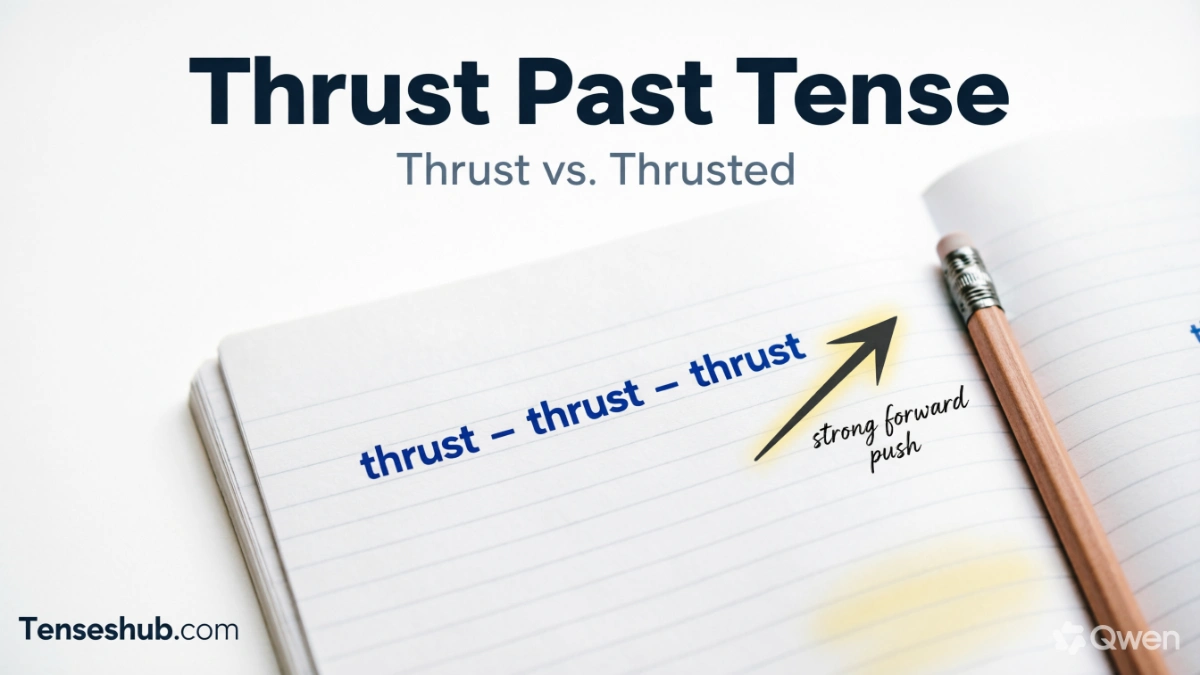
Have you ever wondered if the past tense of thrust is “thrusted” or simply “thrust”? This is a common question because many English verbs change their spelling in the past tense, while some irregular verbs keep the same form.
The correct past tense of thrust is usually thrust. The past participle is also thrust. The verb means to push something suddenly, strongly, or forcefully. For example, “He thrust the sword forward” describes a strong forward movement.
Learning the forms of thrust is useful for students, writers, bloggers, and English learners because the verb appears in stories, news reports, instructions, sports descriptions, and everyday conversations.
In this guide, you will learn the meaning, verb forms, sentence patterns, common mistakes, grammar rules, and practical examples of thrust.
Quick Answer
The past tense of thrust is thrust, not “thrusted” in standard modern English. Its past participle is also thrust.
| Verb Form | Correct Form | Example |
|---|---|---|
| Base Form | thrust | They thrust the door open. |
| Past Tense | thrust | He thrust the letter into my hand. |
| Past Participle | thrust | She has thrust the box under the bed. |
| -ing Form | thrusting | The machine is thrusting the object forward. |
The word thrusted is generally considered incorrect when used as the past tense of the verb thrust.
What Is the Thrust Past Tense?
The thrust past tense refers to using the verb thrust to describe an action that happened in the past.
The verb thrust means:
- To push something suddenly or forcefully
- To move something forward with strength
- To place or push something into a particular position
- To force someone or something into a situation
Unlike regular verbs such as walk → walked or jump → jumped, thrust is an irregular verb. It does not change its spelling in the simple past tense.
Examples
- He thrust the door open.
- The soldier thrust his spear forward.
- She thrust the documents into her bag.
- The child thrust his hands into his pockets.
- The strong wind thrust the boat toward the rocks.
In each sentence, thrust describes an action that happened in the past.
Thrust as a Verb
As a verb, thrust describes a strong pushing action.
- The man thrust the chair aside.
- She thrust the key into the lock.
- The player thrust his body forward.
Thrust as a Noun
Thrust can also be a noun. As a noun, it means a strong push, driving force, or main direction.
- The engine produces enough thrust to lift the aircraft.
- The main thrust of the speech was education reform.
- The rocket’s thrust increased rapidly.
The noun form does not change for the past tense. Only the verb needs to be considered when discussing verb forms.
Structure of Sentences of the Thrust Past Tense
The simple past tense of thrust follows the normal sentence patterns used with other past tense verbs.
Affirmative Sentences
Pattern:
Subject + thrust + object or complement
Examples:
- He thrust the door open.
- She thrust the paper into the folder.
- The horse thrust its head forward.
- They thrust the boat into the water.
Negative Sentences
Pattern:
Subject + did not + thrust + object or complement
Use the base form thrust after did not. Do not use “thrusted.”
Examples:
- He did not thrust the door open.
- She did not thrust the paper into the folder.
- They did not thrust the boat into the water.
- The player did not thrust his arm forward.
The contraction is:
did not = didn’t
Example:
- He didn’t thrust the object forward.
Interrogative Sentences
Pattern:
Did + subject + thrust + object or complement?
Examples:
- Did he thrust the door open?
- Did she thrust the letter into your hand?
- Did they thrust the boat into the water?
- Did the player thrust his arm forward?
Short answers:
- Yes, he did.
- No, he didn’t.
- Yes, they did.
- No, they didn’t.
Formation of the Thrust Past Tense
The verb thrust is an irregular verb. Its past tense and past participle remain the same as the base form.
Main Verb Forms
| Form | Verb |
|---|---|
| V1: Base Form | thrust |
| V2: Simple Past | thrust |
| V3: Past Participle | thrust |
| V4: Present Participle | thrusting |
| V5: Third Person Singular | thrusts |
Important Formation Rule
The simple past form is:
thrust → thrust
The past participle is:
thrust → thrust
The spelling does not change. However, the pronunciation may vary slightly depending on the speaker’s accent and sentence rhythm.
The ing Form
When adding ing, the final letter combination changes slightly in spelling:
thrust + ing = thrusting
Examples:
- The machine is thrusting the object forward.
- He was thrusting his hands into his pockets.
- The waves kept thrusting the boat toward the shore.
Using Helping Verbs
The past tense can appear with helping verbs in different structures:
- Did he thrust the door open?
- He did not thrust the door open.
- He had thrust the letter into the drawer.
- The object was thrust into the container.
- The soldiers were thrusting their weapons forward.
Remember that after did, the verb remains in its base form:
- Correct: She did not thrust the box.
- Incorrect: She did not thrusted the box.
How to Use the Thrust Past Tense
The simple past form thrust is used when a forceful pushing action happened and finished in the past.
1. To Describe a Sudden Push
Use thrust when someone pushes something quickly or strongly.
- He thrust the door open.
- The man thrust the chair aside.
- She thrust the book toward me.
2. To Describe Moving Something Forward
The verb can describe a forward movement.
- The athlete thrust his body forward.
- The bird thrust its wings outward.
- The swimmer thrust both arms ahead.
3. To Describe Putting Something into a Place
Thrust can also mean pushing something into a particular position.
- She thrust the papers into her bag.
- He thrust the key into the lock.
- The boy thrust his hands into his pockets.
4. To Describe Forcing Someone into a Situation
The verb can be used in a figurative way.
- The sudden problem thrust him into a leadership role.
- The accident thrust the issue into public attention.
- Her success thrust her into the spotlight.
Here, thrust does not describe a physical push. It means that someone was suddenly placed into a new situation.
5. To Describe Movement in Stories
Writers often use thrust in action scenes.
- The knight thrust his sword toward the enemy.
- The explorer thrust the torch into the darkness.
- The waves thrust the boat against the rocks.
6. To Use the Passive Voice
The past participle thrust can be used in passive sentences.
- The door was thrust open.
- The papers were thrust into a drawer.
- He was thrust into a difficult position.
Because the past participle is also thrust, the form does not change after was, were, has, have, or had.
Structure or Verb Pattern Table
| Grammar Use | Pattern | Example |
|---|---|---|
| Simple Present | Subject + thrusts/thrust | He thrusts the door open. |
| Simple Past | Subject + thrust | He thrust the door open. |
| Negative Past | Subject + did not + thrust | He did not thrust the door open. |
| Past Question | Did + subject + thrust? | Did he thrust the door open? |
| Present Perfect | Subject + has/have + thrust | She has thrust the papers into the drawer. |
| Past Perfect | Subject + had + thrust | They had thrust the boat into the water. |
| Past Continuous | Subject + was/were + thrusting | He was thrusting the object forward. |
| Passive Voice | Subject + was/were + thrust | The door was thrust open. |
Real Life Examples
Affirmative Examples
- He thrust the door open with his shoulder.
- She thrust the letter into my hand.
- The player thrust his arms into the air.
- The waves thrust the boat toward the shore.
- The sudden event thrust her into the public eye.
- The soldier thrust his weapon forward.
- The child thrust his hands into his pockets.
- The strong wind thrust the window open.
Negative Examples
- He did not thrust the door open.
- She didn’t thrust the documents into the drawer.
- The boat did not thrust forward.
- They didn’t thrust the object into the machine.
- The accident did not thrust him into danger.
Interrogative Examples
- Did he thrust the door open?
- Did she thrust the letter into your hand?
- Did the waves thrust the boat toward the rocks?
- Did they thrust the box under the table?
- Did the event thrust her into the spotlight?
Formal Examples
- The sudden crisis thrust the organization into an unfamiliar situation.
- The new discovery thrust the scientist into international attention.
- The force of the impact thrust the vehicle against the barrier.
Informal Examples
- He thrust the phone at me and told me to look.
- She thrust her hands into her jacket pockets.
- The dog thrust its nose through the gate.
Passive Examples
- The door was thrust open by the wind.
- The papers were thrust into a folder.
- The young leader was thrust into a difficult role.
Common Mistakes
Mistake 1: Using “Thrusted” as the Past Tense
Incorrect:
He thrusted the door open.
Correct:
He thrust the door open.
Explanation: The standard past tense of thrust is thrust, not thrusted.
Mistake 2: Using “Thrusted” After Did
Incorrect:
Did she thrusted the box into the room?
Correct:
Did she thrust the box into the room?
Explanation: After did, always use the base form of the verb.
Mistake 3: Using “Thrusted” After Has or Had
Incorrect:
He had thrusted the papers into the drawer.
Correct:
He had thrust the papers into the drawer.
Explanation: The past participle of thrust is also thrust.
Mistake 4: Confusing Thrust and Thrusting
Incorrect:
He was thrust the door open.
Correct:
He was thrusting the door open.
Explanation: After was or were in the past continuous tense, use the ing form.
Mistake 5: Confusing Thrust and Thrusts
Incorrect:
He thrusts the door open yesterday.
Correct:
He thrust the door open yesterday.
Explanation: The word yesterday requires the simple past form, which is thrust.
Mistake 6: Using the Past Form After Did Not
Incorrect:
They did not thrust the boat yesterday.
This sentence is correct. The mistake would be:
They did not thrusted the boat yesterday.
Correct:
They did not thrust the boat yesterday.
Explanation: Use the base form after did not.
Key Grammar Rules
- The simple past of thrust is thrust.
- She thrust the door open.
- The past participle of thrust is also thrust.
- He has thrust the papers into the drawer.
- Do not normally use “thrusted” in standard English.
- Correct: They thrust the object forward.
- Use thrust after did and did not.
- Did he thrust the box?
- He did not thrust the box.
- Use thrusting for continuous actions.
- The machine was thrusting the object forward.
- Use thrusts for third person singular present tense.
- The engine thrusts the aircraft forward.
- Thrust can be used literally or figuratively.
- Literal: He thrust the key into the lock.
- Figurative: The event thrust her into the spotlight.
Comparisons with Similar Grammar Forms
Thrust vs. Thrusted
| Form | Standard Usage | Example |
|---|---|---|
| thrust | Correct past tense | He thrust the door open. |
| thrusted | Generally nonstandard | He thrusted the door open. |
Use thrust in formal writing, academic work, professional communication, and most standard English situations.
Thrust vs. Push
Both verbs describe moving something with force, but thrust often suggests a sudden, strong, or forward movement.
- He pushed the door open.
- He thrust the door open.
Push is more common in everyday speech. Thrust sounds stronger, more sudden, or more descriptive.
Thrust vs. Shove
Shove usually means pushing something roughly or carelessly. Thrust often describes a strong forward movement or a deliberate action.
- He shoved the box across the floor.
- He thrust the sword forward.
Thrust vs. Thrusting
- Thrust is the simple past and past participle.
- Thrusting is the present participle or gerund.
Examples:
- He thrust the object forward.
- He was thrusting the object forward.
Thrust vs. Throw
These verbs are not always interchangeable.
- Throw means sending something through the air.
- Thrust means pushing something forward or into a position.
Examples:
- She threw the ball across the room.
- She thrust the key into the lock.
Thrust in Active and Passive Voice
Active:
The wind thrust the door open.
Passive:
The door was thrust open by the wind.
The verb remains thrust in both forms.
Exercises
Exercise 1: Fill in the Blanks
Complete each sentence with the correct form of thrust.
- He ______ the door open yesterday.
- She has ______ the documents into her bag.
- The machine is ______ the object forward.
- Did they ______ the boat into the water?
- The soldier ______ his weapon forward.
- He did not ______ the key into the lock.
- The sudden event ______ her into the spotlight.
- The door was ______ open by the wind.
Exercise 2: Choose the Correct Answer
- The past tense of thrust is:
a) thrust
b) thrusted
c) thrusting - Which sentence is correct?
a) He did not thrusted the box.
b) He did not thrust the box.
c) He did not thrusting the box. - Which form is used in the past continuous tense?
a) thrust
b) thrusts
c) thrusting - Which sentence uses the past participle correctly?
a) She has thrust the paper into the drawer.
b) She has thrusted the paper into the drawer.
c) She has thrusting the paper into the drawer. - Which sentence is correct?
a) Did he thrust the door open?
b) Did he thrusted the door open?
c) Did he thrusting the door open?
Exercise 3: Correct the Mistakes
Rewrite each sentence correctly.
- He thrusted the door open.
- Did she thrusted the letter into the bag?
- They had thrusted the object forward.
- The machine was thrust the object forward.
- She thrusts the box yesterday.
Exercise 4: Rewrite the Sentences
Change each sentence as directed.
- He thrust the door open.
Change into a negative sentence. - She thrust the paper into the drawer.
Change into a question. - They thrust the boat into the water.
Change into a present perfect sentence. - He thrust the object forward.
Change into a past continuous sentence. - The wind thrust the door open.
Change into the passive voice.
Answer Key
Exercise 1
- thrust
- thrust
- thrusting
- thrust
- thrust
- thrust
- thrust
- thrust
Exercise 2
- a) thrust
- b) He did not thrust the box.
- c) thrusting
- a) She has thrust the paper into the drawer.
- a) Did he thrust the door open?
Exercise 3
- He thrust the door open.
- Did she thrust the letter into the bag?
- They had thrust the object forward.
- The machine was thrusting the object forward.
- She thrust the box yesterday.
Exercise 4
- He did not thrust the door open.
- Did she thrust the paper into the drawer?
- They have thrust the boat into the water.
- He was thrusting the object forward.
- The door was thrust open by the wind.
FAQs
What is the past tense of thrust?
The past tense of thrust is thrust.
Example:
He thrust the door open.
Is “thrusted” correct?
“Thrusted” is generally not used in standard modern English. The correct past tense and past participle are usually thrust.
What are the three forms of thrust?
The three main forms are:
Thrust – Thrust – Thrust
These represent the base form, past tense, and past participle.
What is the past participle of thrust?
The past participle of thrust is thrust.
Example:
She has thrust the papers into the drawer.
What is the ing form of thrust?
The ing form is thrusting.
Example:
He was thrusting the object forward.
Is thrust a regular or irregular verb?
Thrust is an irregular verb because its past tense does not follow the usual ed pattern.
Can thrust be used in the passive voice?
Yes. The past participle remains thrust.
Example:
The door was thrust open.
What is the difference between thrust and push?
Both words describe forceful movement, but thrust often suggests a sudden, strong, or forward action. Push is more common in everyday English.
What is the past tense of “thrust forward”?
The phrase remains thrust forward in the past tense.
Example:
The athlete thrust forward during the race.
What is the correct sentence: “He thrust” or “He thrusted”?
The correct standard sentence is:
He thrust the door open.
Conclusion
The past tense of thrust is thrust, and its past participle is also thrust. This irregular verb does not change its spelling in the simple past or perfect tenses. The only major spelling change appears in the ing form, which is thrusting.
Use thrust for completed past actions, such as “She thrust the letter into my hand.” Use thrusting for continuous actions, such as “He was thrusting the object forward.” After did, did not, has, have, or had, remember to use the correct form: thrust, not “thrusted.”
With regular practice, examples, and sentence exercises, you can use this verb accurately in conversations, academic writing, stories, and professional communication.

Hi, I’m Robert Lowth, a passionate expert in English tenses and grammar. I specialize in simplifying complex tense rules to help learners understand and use English with confidence. My goal is to make grammar clear, practical, and easy for everyday communication. tenseshub.com