Have you ever written a sentence about something you studied yesterday and wondered if to use learned or learnt? Both words are correct, but choosing the right form can confuse English learners, especially when writing about school, work, or personal experiences.
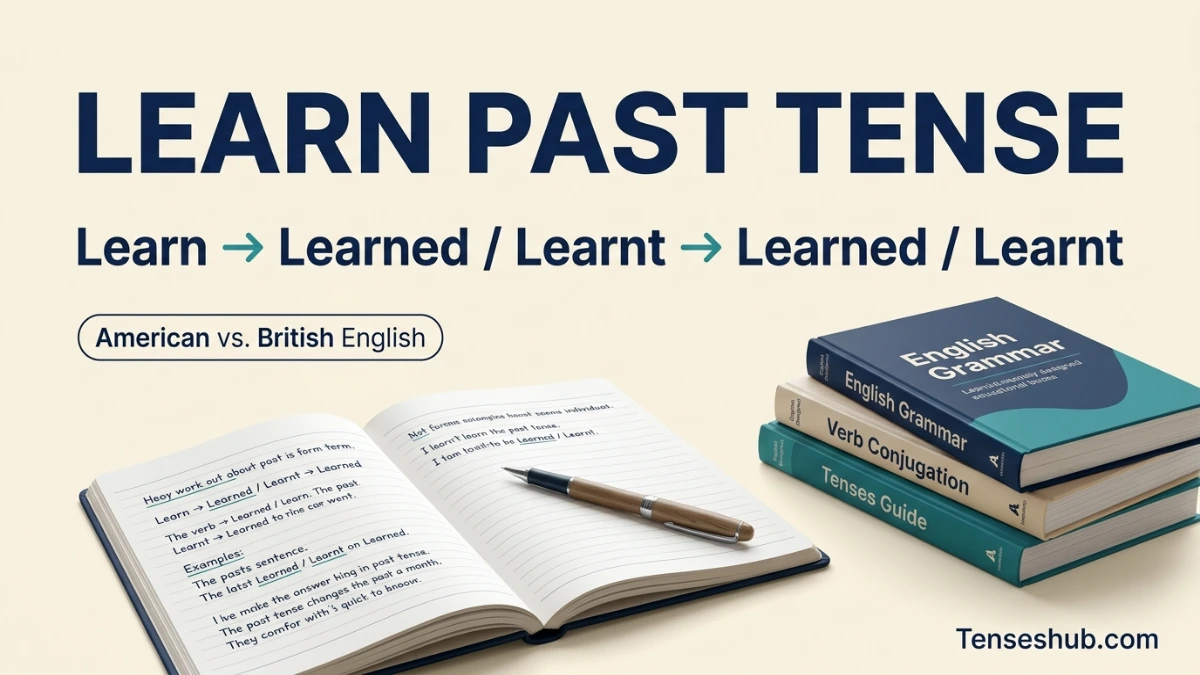
The learn past tense is usually learned in American English, while both learned and learnt are widely used in British English.
The verb learn means to gain knowledge, develop a skill, or understand something through study and experience. For example, “I learned a new word yesterday” describes something you discovered or understood in the past.
Learning this verb is useful because you talk about things you’ve studied, skills you’ve developed, and lessons you’ve gained from experience almost every day. You’ll also need the correct form when writing stories, school assignments, emails, and professional documents.
In this guide, you’ll learn the verb forms of learn, how to use them in different sentences, when to choose learned or learnt, and how to avoid common grammar mistakes.
Quick Answer: What Is the Past Tense of Learn?
The past tense of learn is learned or learnt. Both forms are correct; learned is more common in American English, while British English uses both forms.
| Verb Form | Word |
|---|---|
| Base form (V1) | learn |
| Simple past (V2) | learned / learnt |
| Past participle (V3) | learned / learnt |
| ing form | learning |
| Third person singular | learns |
Examples:
- Past: I learned a new skill yesterday.
- Past: She learnt to drive last year.
- Present perfect: We have learned a lot this week.
What Is the Learn Past Tense?
The past tense of learn describes gaining knowledge, understanding, or a skill at an earlier time. It helps you explain what you studied, discovered, or experienced in the past.
For example:
- I learned English at school.
- She learnt how to cook from her mother.
- They learned an important lesson from the mistake.
Each sentence describes learning that happened in the past.
Is Learn a Regular or Irregular Verb?
Learn can be treated as a regular or irregular verb because it has two accepted past tense forms:
- Regular form: learn → learned → learned
- Irregular form: learn → learnt → learnt
Both patterns are correct in modern English. The choice often depends on regional preference rather than a difference in meaning.
If you’re writing for an American audience, learned is usually the safest choice. For a British audience, either form is acceptable, although preferences vary.
What Does Learn Mean?
The verb learn has several common uses.
1. To gain knowledge
- I learned about planets in science class.
- He learnt three new English words.
2. To develop a skill
- She learned to swim last summer.
- My brother learnt how to repair a bicycle.
3. To discover information
- We learned that the meeting had been cancelled.
- I learnt the truth yesterday.
4. To understand something through experience
- He learned from his mistakes.
- I learned an important lesson from that experience.
Structure of Sentences of the Learn Past Tense
The simple past follows the same sentence order if you use learned or learnt.
1. Affirmative sentences
Use the subject followed by the past tense verb.
Formula: Subject + learned/learnt + object.
Examples:
- I learned a new skill.
- She learnt French at school.
- They learned the rules yesterday.
2. Negative sentences
Use did not or didn’t followed by the base form learn.
Formula: Subject + did not + learn + object.
Examples:
- I didn’t learn the answer.
- He did not learn the lesson.
- They didn’t learn much during the first class.
Remember, don’t write didn’t learned or didn’t learnt. The word did already shows the past tense.
3. Interrogative sentences
Place did before the subject, then use the base form learn.
Formula: Did + subject + learn + object?
Examples:
- Did you learn anything new?
- Did she learn English at school?
- Did they learn the rules?
You can also use question words:
- What did you learn?
- Where did he learn to drive?
- When did they learn about the change?
Formation of the Learn Past Tense
The verb learn has two accepted forms for the simple past and past participle. Understanding its other forms will help you use it correctly.
1. Simple past: Learned or learnt
The two forms are:
- Learn → learned
- Learn → learnt
Learned follows the regular pattern of adding ed. Learnt is an accepted alternative that doesn’t use the usual ed ending.
Examples:
- I learned to cook last year.
- I learnt to cook last year.
Both sentences are correct and have the same meaning.
2. Past participle: Learned or learnt
The past participle is also learned or learnt. Use it with helping verbs such as has, have, and had.
Examples:
- I have learned a lot.
- She has learnt several new words.
- They had learned the rules before the game began.
3. The ing form
To make the ing form, add ing to learn.
Learn → Learning
Examples:
- I am learning English.
- She was learning to drive.
- They enjoy learning new skills.
Don’t write learnning. The final consonant isn’t doubled.
4. The third person singular form
In the simple present tense, add s.
Learn → Learns
Examples:
- He learns quickly.
- She learns a new word every day.
- My brother learns from his mistakes.
5. Contractions with helping verbs
In everyday English, contractions make sentences sound natural.
Examples:
- I have learned a lot. → I’ve learned a lot.
- She has learnt the rules. → She’s learnt the rules.
- I did not learn the answer. → I didn’t learn the answer.
In the last example, didn’t must be followed by the base form learn.
How to Use Learned and Learnt
Both forms communicate the same meaning. The main difference is regional preference.
1. Use learned in American English
American English generally prefers learned as both the simple past and past participle.
Examples:
- I learned how to use the computer.
- She learned a valuable lesson.
- We have learned a lot this year.
If you’re writing for an American school, website, or audience, learned is a reliable choice.
2. Use learned or learnt in British English
British English accepts both forms. Learnt is especially familiar in British usage, although learned is also common.
Examples:
- I learnt to swim when I was six.
- She learned a new language at university.
- They have learnt many useful skills.
The meaning doesn’t change when you switch between the two forms.
3. Talk about education
Use learned or learnt when describing something you studied.
Examples:
- We learned about the solar system yesterday.
- I learnt three new grammar rules.
- The students learned how to solve the problem.
4. Describe a skill
Use the verb when explaining how you developed an ability.
Examples:
- He learned to ride a bicycle.
- She learnt how to bake bread.
- I learned to speak English through practice.
5. Explain what experience taught you
The verb learn can also describe a lesson gained from an event or mistake.
Examples:
- I learned not to trust every online offer.
- She learnt from her past mistakes.
- We learned the importance of teamwork.
Learn Past Tense: Verb Pattern Table
| Tense or Form | Pattern | Example |
|---|---|---|
| Simple past | Subject + learned/learnt | I learned English. |
| Negative past | Subject + didn’t + learn | I didn’t learn English. |
| Past question | Did + subject + learn? | Did you learn English? |
| Present perfect | Subject + have/has + learned/learnt | I have learned English. |
| Past perfect | Subject + had + learned/learnt | I had learned English. |
| Past continuous | Subject + was/were + learning | I was learning English. |
| Simple present | Subject + learn/learns | She learns English. |
Real Life Examples of Learn Past Tense
These examples show how to use learned and learnt in everyday conversations and writing.
Affirmative sentences
- I learned five new words yesterday.
- She learnt to swim during the summer.
- We learned how to use the new software.
- He learnt an important lesson from his mistake.
- They learned about healthy eating at school.
Negative sentences
- I didn’t learn the answer in class.
- She didn’t learn to drive last year.
- We did not learn about this topic before.
- He didn’t learn the instructions properly.
- They didn’t learn much from the first lesson.
Interrogative sentences
- Did you learn anything new today?
- When did she learn to cook?
- Where did he learn English?
- Did they learn the rules before the match?
- What did you learn from your experience?
Formal examples
- The employees learned how to use the updated system.
- The students learnt the importance of accurate research.
- We learned that the original information was incorrect.
Informal examples
- I learned something interesting today.
- She learnt that the movie was already sold out.
- I’ve learned to be more careful with my time.
Examples with other tenses
- Present: I learn something new every day.
- Present continuous: I am learning Spanish.
- Simple past: I learned Spanish last year.
- Present perfect: I have learned several Spanish phrases.
- Past perfect: I had learned the basics before moving abroad.
Common Mistakes When Using Learn
1. Using learned or learnt after did
Incorrect: Did you learned the lesson?
Correct: Did you learn the lesson?
Why? Use the base form after did.
2. Using learned after didn’t
Incorrect: She didn’t learnt anything.
Correct: She didn’t learn anything.
Why? The auxiliary didn’t already marks the past tense.
3. Thinking learnt is always wrong
Incorrect: “Learnt” is never correct English.
Correct: Both “learned” and “learnt” are correct.
Why? Learnt is a standard form, particularly in British English.
4. Using learn for a completed past event
Incorrect: I learn a new word yesterday.
Correct: I learned a new word yesterday.
Why? The word yesterday identifies a completed past event, so use the simple past.
5. Doubling the final consonant incorrectly
Incorrect: I am learnning English.
Correct: I am learning English.
Why? The correct ing form is learning, with one n.
6. Confusing learn with teach
Incorrect: My teacher learned me English.
Correct: My teacher taught me English.
Why? Learn means to gain knowledge. Teach means to help someone gain knowledge.
You learn something, while a teacher teaches it to you.
Key Grammar Rules for Learn
- Use learned or learnt for the simple past. Example: I learned a new skill yesterday.
- Use learned or learnt as the past participle. Example: She has learned a lot.
- Use learn after did and didn’t. Example: Did you learn the answer?
- Add ing without doubling the final consonant. Example: learn → learning.
- Use learns with he, she, or it in the simple present. Example: He learns quickly.
- Choose a consistent regional style. Prefer learned for American English; learned and learnt are both acceptable in British English.
- Don’t confuse learn with teach. Example: I learned English, and my teacher taught me English.
Learned vs. Learnt vs. Learning
These forms are related, but they serve different grammatical purposes.
| Word | Use | Example |
|---|---|---|
| Learn | Base form | I want to learn English. |
| Learned | Simple past or past participle | I learned English. |
| Learnt | Simple past or past participle | I learnt English. |
| Learning | ing form | I am learning English. |
| Learns | Present form with he/she/it | She learns English. |
Learned vs. learnt
Both forms mean the same thing.
- American English: I learned to drive.
- British English: I learnt to drive.
These are regional preferences, not different meanings.
Learn vs. teach
Learn describes gaining knowledge, while teach describes giving knowledge or instruction.
- I learned English from my teacher.
- My teacher taught me English.
The past tense of teach is taught, not teached.
Learned vs. had learned
Learned is the simple past form, while had learned is the past perfect.
- Simple past: I learned the rules yesterday.
- Past perfect: I had learned the rules before the test began.
Use the past perfect when you need to show that one past action happened before another past event.
Exercises: Practice the Past Tense of Learn
Test your knowledge with these beginner friendly exercises.
Exercise 1: Fill in the blanks
Complete each sentence with the correct form of learn.
- I ______ a new word yesterday.
- Did she ______ the lesson?
- He has ______ a lot this year.
- We are ______ English.
- My brother ______ quickly.
Exercise 2: Correct the sentences
Find and correct the mistake in each sentence.
- I learn a new skill yesterday.
- Did you learned the answer?
- She didn’t learnt anything.
- He is learnning Spanish.
- My teacher learned me grammar.
Exercise 3: Rewrite the sentences
Follow the instructions in parentheses.
- I learned English. (Make it negative.)
- She learnt to swim. (Make it a question.)
- He learns new words. (Change to the simple past.)
- I learned the rules. (Use the present perfect.)
- They learned the basics before the test. (Use the past perfect.)
Exercise 4: Multiple choice questions
1. What is the past tense of learn?
A. Learn
B. Learned or learnt
C. Learning
2. Which sentence is correct?
A. Did she learnt English?
B. Did she learn English?
C. Did she learns English?
3. Which is the correct ing form?
A. Learnning
B. Learnting
C. Learning
4. Which form is generally preferred in American English?
A. Learned
B. Learnt
C. Learnning
5. What is the past tense of teach?
A. Teached
B. Taught
C. Teaching
Answer Key
Exercise 1
- learned / learnt
- learn
- learned / learnt
- learning
- learns
Exercise 2
- I learned a new skill yesterday.
- Did you learn the answer?
- She didn’t learn anything.
- He is learning Spanish.
- My teacher taught me grammar.
Exercise 3
- I did not learn English.
- Did she learn to swim?
- He learned new words.
- I have learned the rules.
- They had learned the basics before the test.
Exercise 4
- B. Learned or learnt
- B. Did she learn English?
- C. Learning
- A. Learned
- B. Taught
FAQs
1. What is the past tense of learn?
The past tense is learned or learnt. Both forms are correct.
2. Is learned or learnt correct?
Both are correct. American English generally prefers learned, while British English commonly uses both.
3. Is learn a regular or irregular verb?
It has both a regular form, learned, and an irregular form, learnt.
4. What is the past participle of learn?
The past participle is learned or learnt. Example: I have learned a lot.
5. What is the ing form of learn?
The ing form is learning. Example: She is learning English.
6. Do you say “I learned” or “I have learned”?
Use I learned for a completed past event, especially when its time is specified. Use I have learned when the experience connects to the present.
- I learned it yesterday.
- I have learned a lot this year.
7. What is the negative past tense of learn?
Use did not learn or didn’t learn. Example: I didn’t learn the answer.
8. What is the past tense of learn in American English?
Learned is the usual American English form.
9. What is the past tense of learn in British English?
Both learned and learnt are correct in British English.
10. What is the difference between learn and teach?
Learn means to gain knowledge or a skill. Teach means to give someone knowledge or help them develop a skill.
Conclusion
The past tense of learn is learned or learnt, and both forms are grammatically correct. American English generally prefers learned, while British English accepts both forms.
The past participle is also learned or learnt, so you can say “I learned a new skill” or “I have learnt a new skill.”
Remember to use the base form learn after did and didn’t. The ing form is learning, and the third person singular form is learns. Also, don’t confuse learn with teach: you learn knowledge, while someone teaches it to you.
With a little practice, you’ll find these forms easier to remember. Try writing a few sentences about what you learned today, and you’ll build confidence in your English grammar.
Hi, I’m Robert Lowth, a passionate expert in English tenses and grammar. I specialize in simplifying complex tense rules to help learners understand and use English with confidence. My goal is to make grammar clear, practical, and easy for everyday communication. tenseshub.com