What will you do tomorrow? Will you travel, study, work, or stay at home? When we talk about actions that are expected to happen in the future, we often use the simple future tense. It is one of the most useful English tenses for everyday conversations, writing, planning, and predictions.
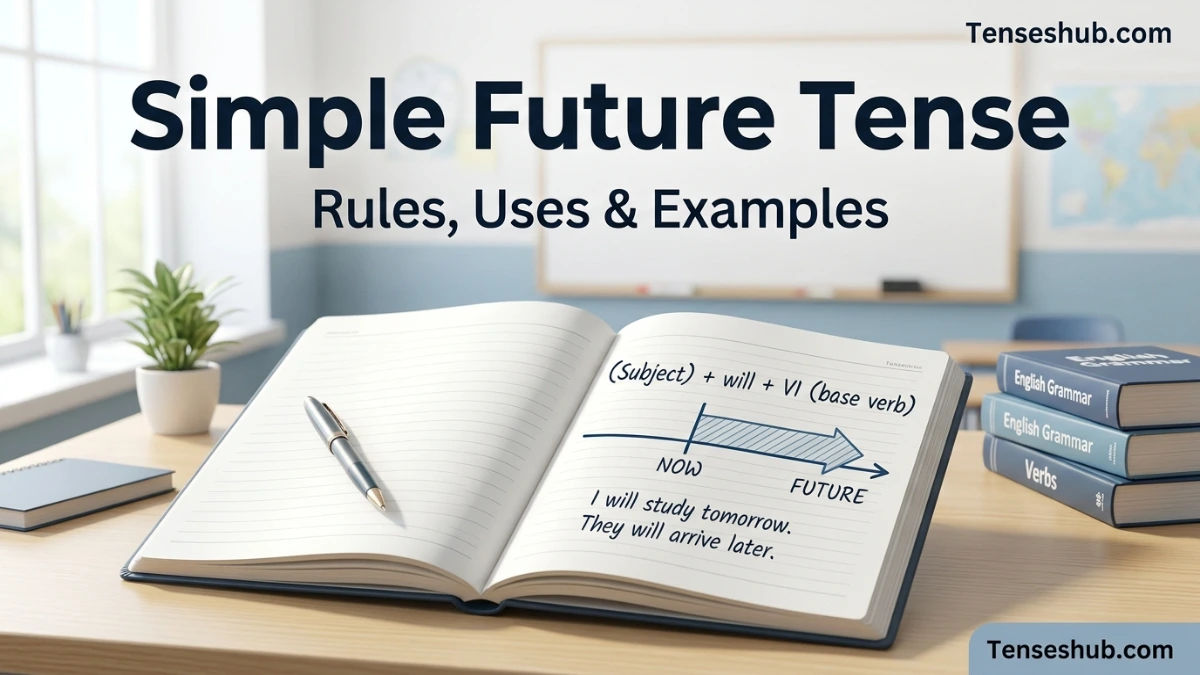
The simple future tense helps us talk about actions that have not happened yet. We can use it for future decisions, promises, offers, predictions, warnings, and events that we expect to happen. The most common structure uses will + the base form of the verb, such as will go, will study, or will work.
Many English learners become confused about where to use will, how to make negative sentences, and if the main verb should change. The good news is that the basic rule is simple: after will, use the base form (V1) of the verb.
In this guide, you will learn the simple future tense, including its definition, structure, formation, uses, rules, examples, common mistakes, comparisons, and practice exercises.
Quick Answer
The simple future tense describes an action or situation that will happen in the future. Its most common structure is subject + will + base verb.
| Sentence Type | Basic Structure | Example |
|---|---|---|
| Affirmative | Subject + will + V1 | She will travel. |
| Negative | Subject + will not + V1 | She will not travel. |
| Question | Will + subject + V1? | Will she travel? |
Example: I will call you tomorrow.
The short form of will not is won’t.
What Is Simple Future Tense?
The simple future tense is a verb tense used to talk about actions, events, or situations that will happen after the present time.
The most common way to form the simple future is:
Subject + will + base verb
For example:
- I will study tonight.
- She will visit her grandmother tomorrow.
- They will arrive soon.
- We will finish the project next week.
The main verb does not change after will. if the subject is I, you, he, she, it, we, or they, the verb stays in its base form.
Compare:
- I will go.
- He will go.
- They will go.
Not:
- He will goes.
- They will went.
What Does the Simple Future Tense Express?
The simple future can express several meanings, including:
- future actions
- predictions
- promises
- offers
- spontaneous decisions
- requests
- warnings
- expectations
For example:
I will help you.
This can be a promise or an offer.
It will rain tomorrow.
This is a prediction.
I will answer the phone.
This can express a decision made at the moment of speaking.
Structure of Sentences of Simple Future Tense
The sentence structure changes depending on if you are making an affirmative statement, a negative statement, or a question.
Affirmative Sentences
The basic structure is:
Subject + will + base verb + object/complement
Examples:
- I will call you.
- She will start school tomorrow.
- We will visit the museum.
- They will complete the work.
The main verb remains in its base form.
He will play football.
Not:
He will plays football.
Negative Sentences
The structure is:
Subject + will not + base verb + object/complement
Examples:
- I will not forget you.
- She will not attend the meeting.
- They will not come tomorrow.
- We will not buy the car.
The contraction won’t can replace will not:
I won’t forget you.
She won’t attend the meeting.
Interrogative Sentences
The structure is:
Will + subject + base verb + object/complement?
Examples:
- Will you come tomorrow?
- Will she join us?
- Will they finish the work?
- Will he call you?
For information questions, use a question word before will:
Wh word + will + subject + base verb?
Examples:
- When will you arrive?
- Where will they stay?
- What will she do?
- Why will he leave early?
Formation of Simple Future Tense
The simple future tense is easy to form because will is used with the base form of the main verb.
Using “Will”
The basic formula is:
Subject + will + V1
Examples:
- I will work.
- You will learn.
- He will come.
- She will write.
- We will travel.
- They will play.
The main verb does not take s, ed, ing, or any other ending after will.
Regular Verbs
Regular verbs remain in their base form after will.
| Base Verb | Simple Future |
|---|---|
| work | will work |
| play | will play |
| clean | will clean |
| study | will study |
| open | will open |
For example:
She will study tonight.
Do not change study to studies or studied after will.
Irregular Verbs
Irregular verbs also stay in their base form after will.
| Base Verb | Simple Future |
|---|---|
| go | will go |
| eat | will eat |
| take | will take |
| write | will write |
| see | will see |
For example:
I will go tomorrow.
Not:
I will went tomorrow.
Contractions
In everyday English, will is often shortened.
| Full Form | Contraction |
|---|---|
| I will | I’ll |
| you will | you’ll |
| he will | he’ll |
| she will | she’ll |
| it will | it’ll |
| we will | we’ll |
| they will | they’ll |
Examples:
- I’ll call you later.
- She’ll arrive soon.
- We’ll help you.
- They’ll visit us tomorrow.
will not → won’t
Example:
I won’t be late.
How to Use Simple Future Tense
The simple future tense has several important uses in everyday English.
1. To Talk About Future Actions
Use the simple future for an action that will happen after now.
- I will visit you tomorrow.
- She will start her new job next month.
- They will travel to London next year.
- We will meet after lunch.
Common time expressions include:
- tomorrow
- tonight
- next week
- next month
- next year
- soon
- later
- in the future
2. To Make Predictions
Use will when predicting what you think will happen.
- I think it will rain tonight.
- She will become a successful writer.
- The team will win the match.
- Technology will change many parts of our lives.
Words such as think, believe, expect, and probably often appear with predictions.
I think he will pass the exam.
3. For Spontaneous Decisions
Use will when you make a decision at the moment of speaking.
Imagine someone says:
The phone is ringing.
You can respond:
I will answer it.
The decision was made at that moment.
Another example:
I’m thirsty. I will get some water.
4. To Make Promises
The simple future is commonly used for promises.
- I will help you.
- I will never forget this.
- We will support you.
- I will call you tonight.
For example:
I will finish the work by tomorrow.
5. To Make Offers
Use will when offering to do something.
- I will carry your bag.
- I will help you with your homework.
- We will pay for dinner.
- I will open the door.
6. To Give Warnings
The simple future can also be used for warnings.
- You will regret that decision.
- If you touch that, you will hurt yourself.
- You will miss the bus if you do not hurry.
The meaning depends on context and tone.
7. In the First Conditional
The simple future is commonly used in the main clause of a first conditional sentence.
The basic pattern is:
If + present simple, will + base verb
Examples:
- If it rains, we will stay home.
- If you study, you will pass the exam.
- If she calls, I will answer.
- If they arrive early, we will start the meeting.
Notice that we normally do not use will directly after if in this basic first conditional pattern.
Correct:
If I see him, I will tell him.
Incorrect:
If I will see him, I will tell him.
Structure or Verb Pattern Table
| Use | Formula | Example |
|---|---|---|
| Future action | Subject + will + V1 | I will travel tomorrow. |
| Negative | Subject + will not + V1 | I will not travel. |
| Short negative | Subject + won’t + V1 | I won’t travel. |
| Yes/No question | Will + subject + V1? | Will you travel? |
| Wh-question | Wh-word + will + subject + V1? | When will you travel? |
| Prediction | Subject + will + V1 | It will rain. |
| Promise | Subject + will + V1 | I will help you. |
| First conditional | If + present, will + V1 | If I study, I will pass. |
Real Life Examples
Here are examples showing how the simple future tense works in everyday situations.
Affirmative Examples
- I will call you after work.
- She will visit her parents tomorrow.
- We will start the meeting at nine.
- They will arrive in the evening.
- He will send the email later.
Negative Examples
- I will not forget your advice.
- She won’t attend the party.
- We won’t be late.
- They will not buy a new car this year.
- He won’t change his decision.
Questions
- Will you help me with this project?
- Will she come tomorrow?
- Will they join us for dinner?
- When will you finish your homework?
- Where will he stay?
Promises and Offers
- I will help you with your assignment.
- I’ll call you when I get home.
- I’ll carry those books for you.
- We will keep your information private.
Predictions
- I think the weather will improve tomorrow.
- She will probably arrive late.
- This lesson will help you understand the tense.
- I believe they will succeed.
Formal and Informal Examples
In formal writing:
The company will announce the results next Monday.
In everyday conversation:
I’ll send you the details later.
Both forms are grammatically correct. The contraction is simply more common in casual speech.
Common Mistakes
Mistake 1: Adding “ s” After Will
Wrong: He will goes to school.
Correct: He will go to school.
After will, always use the base form of the verb.
Mistake 2: Using the Past Form After Will
Wrong: She will went home.
Correct: She will go home.
Do not use V2 after will.
Mistake 3: Using “Will” Twice
Wrong: I will will call you.
Correct: I will call you.
Only one will is needed before the main verb.
Mistake 4: Using “Will” After “If” in a Basic First Conditional
Wrong: If it will rain, we will stay home.
Correct: If it rains, we will stay home.
Use the present simple after if in the standard first conditional.
Mistake 5: Confusing “Won’t” and “Don’t”
Wrong: I don’t go tomorrow.
If you mean a future decision or prediction, use:
I won’t go tomorrow.
However, I don’t go can be correct when talking about a present habit, depending on the context.
Mistake 6: Using “Will” for Every Future Situation
English has several ways to talk about the future. For example:
I will study tonight.
But:
I am going to study tonight.
And:
I am studying tonight.
These forms can have different meanings depending on if you are expressing a spontaneous decision, prior plan, or fixed arrangement.
Key Grammar Rules
- Use will + base verb for the simple future.
Example: She will work tomorrow. - Never add s to the main verb after will.
Correct: He will play.
Incorrect: He will plays. - Use will not or won’t for negative sentences.
Example: I won’t forget. - Put will before the subject in yes/no questions.
Example: Will you come? - Use the base form after will, even with irregular verbs.
Example: They will go, not They will went. - Use will for many predictions, promises, offers, and spontaneous decisions.
Example: I’ll help you. - In the basic first conditional, use present simple after if.
Example: If she comes, I will talk to her.
Comparisons with Similar Grammar Forms
Simple Future vs. “Be Going To”
Both will and be going to can talk about future events, but they are often used in different situations.
Will is commonly used for spontaneous decisions, promises, offers, and predictions.
I’ll answer the phone.
Be going to is commonly used for plans or intentions that already exist.
I am going to study tonight.
Compare:
The phone is ringing. I’ll answer it.
The decision is made now.
I am going to study tonight.
The plan existed before the moment of speaking.
Simple Future vs. Present Continuous
The present continuous can describe a future arrangement, especially when a time or arrangement has already been fixed.
I will meet Sarah tomorrow.
This can simply state a future action.
I am meeting Sarah tomorrow.
This often suggests a planned arrangement.
Simple Future vs. Simple Present
The simple present can also refer to the future when talking about schedules, timetables, or fixed events.
The train will leave at 8 p.m.
This presents a future event.
The train leaves at 8 p.m.
This sounds like a timetable or scheduled departure.
Simple Future vs. Future Continuous
The simple future focuses on a future action or event:
I will study tonight.
The future continuous emphasizes an action that will be in progress at a particular future time:
I will be studying at 8 p.m.
Both refer to the future, but the focus is different.
Exercises
Exercise 1: Fill in the Blanks
Complete each sentence with will + the correct base verb.
- I ________ you tomorrow. (call)
- She ________ the project next week. (finish)
- They ________ to the beach on Saturday. (go)
- We ________ dinner at 8 p.m. (eat)
- He ________ the answer later. (know)
Exercise 2: Make the Sentences Negative
Rewrite each sentence using will not or won’t.
- I will attend the meeting.
- She will buy the dress.
- They will come tonight.
- We will forget your kindness.
Exercise 3: Make Questions
Turn each statement into a question.
- You will help me.
- She will join the class.
- They will arrive tomorrow.
- He will call his mother.
Exercise 4: Correct the Mistakes
- He will goes to work tomorrow.
- I will went to the store.
- She will studies tonight.
- If it will rain, we will stay home.
- They will will finish the work.
Exercise 5: Choose the Correct Answer
- I think she ________ pass the exam.
A. will
B. wills
C. will passes
D. will passed
- ________ you come to the party?
A. Do
B. Are
C. Will
D. Did
- We ________ be late.
A. won’t
B. don’t
C. aren’t
D. didn’t
- If I have enough time, I ________ you.
A. help
B. helped
C. will help
D. will helped
Answer Key
Exercise 1
- will call
- will finish
- will go
- will eat
- will know
Exercise 2
- I will not attend the meeting. / I won’t attend the meeting.
- She will not buy the dress. / She won’t buy the dress.
- They will not come tonight. / They won’t come tonight.
- We will not forget your kindness. / We won’t forget your kindness.
Exercise 3
- Will you help me?
- Will she join the class?
- Will they arrive tomorrow?
- Will he call his mother?
Exercise 4
- He will go to work tomorrow.
- I will go to the store.
- She will study tonight.
- If it rains, we will stay home.
- They will finish the work.
Exercise 5
- A. will
- C. Will
- A. won’t
- C. will help
FAQs
What is the simple future tense?
The simple future tense is used to talk about actions, events, predictions, decisions, promises, and situations that will happen after the present.
What is the formula of the simple future tense?
The basic formula is:
Subject + will + base verb
Example: She will travel tomorrow.
What is the simple future tense of “go”?
The simple future form is will go.
Example:
I will go to school tomorrow.
What helping verb is used in the simple future tense?
The most common helping verb is will.
Example:
They will arrive soon.
Is “will” used with every subject?
Yes. Will can be used with I, you, he, she, it, we, and they.
Examples:
- I will go.
- He will go.
- They will go.
What is the negative form of the simple future?
Use will not + base verb or the contraction won’t + base verb.
Example:
I will not go.
I won’t go.
What is the question form of the simple future?
Use:
Will + subject + base verb?
Example:
Will you come tomorrow?
Can I use “going to” instead of “will”?
Sometimes, yes. Both can refer to the future, but they are not always interchangeable in meaning. Will is often used for spontaneous decisions, promises, offers, and predictions, while be going to commonly refers to prior plans or intentions.
What is the difference between “will” and “won’t”?
Will expresses a positive future statement:
I will call you.
Won’t is the contraction of will not:
I won’t call you.
Do we use V1, V2, or V3 after “will”?
Use V1, the base form of the verb.
Correct:
She will write.
Incorrect:
She will wrote.
Can simple future be used for predictions?
Yes. For example:
I think it will rain tomorrow.
Conclusion
The simple future tense is one of the easiest and most useful English tenses once you understand its basic pattern. The main formula is subject + will + base verb, so you can create sentences such as I will study, She will travel, and They will arrive without changing the main verb.
Use the simple future to talk about future actions, predictions, promises, offers, spontaneous decisions, warnings, and many first conditional sentences. Remember that the verb after will always stays in its base form, even when the verb is irregular.
Pay close attention to common mistakes such as he will goes, she will went, and if it will rain. The correct forms are he will go, she will go, and if it rains. With regular practice using real life sentences, questions, and short exercises, the simple future tense will become much easier to use naturally in both speaking and writing.

Hi, I’m Noah Bester, a tenses expert passionate about simplifying English grammar. I create practical, easy-to-understand guides to help learners master tenses with confidence. My goal is to make grammar clear, useful, and applicable in everyday communication. tenseshub.com