Have you ever wanted to say “I was happy yesterday” or “We were students last year” in Spanish? If you know a little Spanish, you may already recognize the verb ser. The tricky part is choosing the correct form when you talk about the past.
The Spanish verb ser means “to be.” We use it to talk about identity, professions, origin, characteristics, and other essential details. When describing a completed situation in the past, Spanish often uses the preterite tense. This is where the ser preterite tense becomes important.
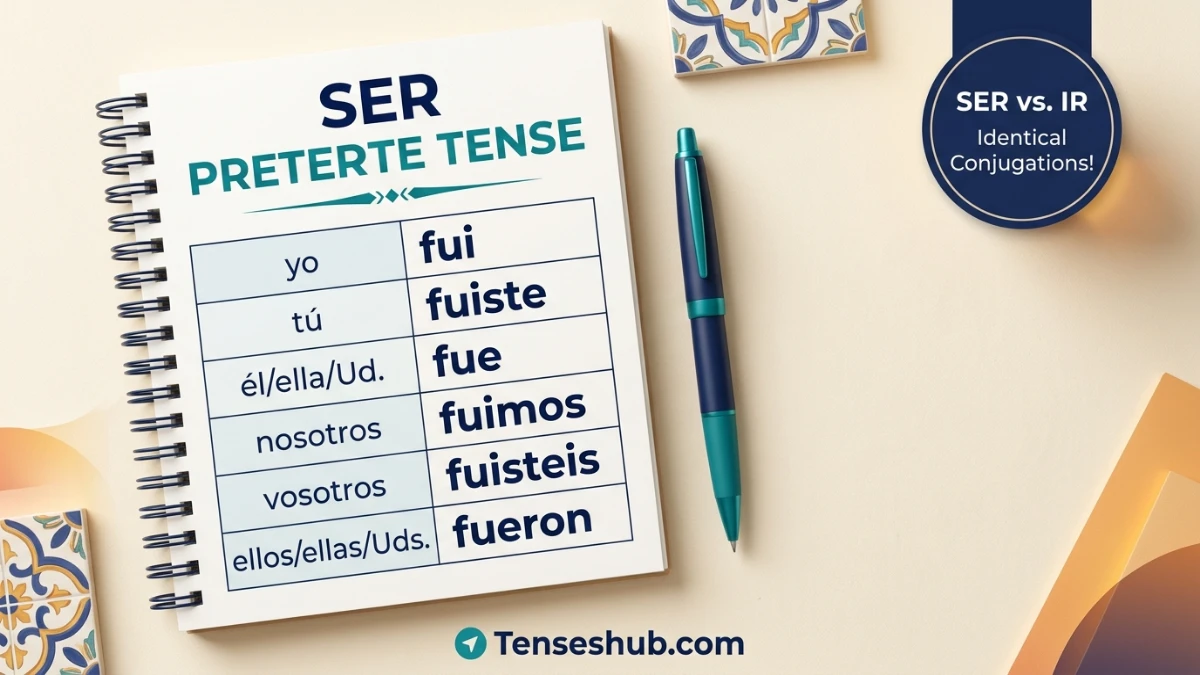
Unlike many Spanish verbs, ser doesn’t follow a regular conjugation pattern in the preterite. Its forms are fui, fuiste, fue, fuimos, fuisteis, and fueron. These forms may look unfamiliar at first, but they’re easy to learn with examples and regular practice.
In this guide, you’ll learn how to conjugate ser in the preterite, when to use each form, how to build sentences, and how to avoid confusing ser with ir, another Spanish verb that shares the same preterite forms.
Quick Answer: What Is the Ser Preterite Tense?
The preterite tense of ser is used to describe identities, characteristics, and situations viewed as completed in the past. Its six forms are fui, fuiste, fue, fuimos, fuisteis, and fueron.
| Subject | Ser in the preterite | English |
|---|---|---|
| Yo | fui | I was |
| Tú | fuiste | You were |
| Él / Ella / Usted | fue | He / She was; You were |
| Nosotros/as | fuimos | We were |
| Vosotros/as | fuisteis | You all were |
| Ellos / Ellas / Ustedes | fueron | They were; You all were |
Example: Ayer fui estudiante en una actividad escolar is not a natural way to say “I was a student yesterday” if you mean your general status. A more natural example is Fui estudiante durante cinco años “I was a student for five years.”
What Is the Ser Preterite Tense?
The ser preterite tense is the past tense form of the Spanish verb ser. It describes a past identity, condition, event characteristic, or situation that the speaker presents as completed.
For example:
- Fui profesor. I was a teacher.
- Ella fue amable. She was kind.
- La reunión fue corta. The meeting was short.
- Fuimos amigos durante años. We were friends for years.
The preterite doesn’t simply mean that something happened a long time ago. It presents the past situation as a completed whole. The imperfect tense, by contrast, often describes ongoing conditions, background details, or repeated situations in the past.
What Does Ser Mean in Spanish?
Ser is one of the two main Spanish verbs that mean “to be.” It’s commonly used for identity, origin, professions, relationships, and characteristics.
Examples:
- Soy Ana. I am Ana.
- Somos de México. We are from Mexico.
- Él es médico. He is a doctor.
- La casa es grande. The house is big.
When these ideas are placed in a completed past situation, the appropriate preterite form of ser may be used.
Examples:
- Fui estudiante. I was a student.
- Ella fue mi profesora. She was my teacher.
- La película fue interesante. The movie was interesting.
The correct tense depends on what you want to communicate, not simply on whether the English translation contains “was” or “were.”
Structure of Sentences of the Ser Preterite Tense
Spanish sentence order is flexible, but beginners can use simple patterns to build correct sentences.
1. Affirmative sentences
Formula: Subject + preterite form of ser + complement.
Examples:
- Yo fui estudiante. I was a student.
- Ella fue amable. She was kind.
- Nosotros fuimos compañeros. We were classmates.
Spanish often leaves out subject pronouns because the verb form already gives a clue about the subject.
For example, Fui estudiante means “I was a student.” You don’t need to include yo unless you want to emphasize the subject.
2. Negative sentences
Formula: Subject + no + preterite form of ser + complement.
Examples:
- Yo no fui profesor. I wasn’t a teacher.
- Ella no fue la ganadora. She wasn’t the winner.
- No fuimos responsables. We weren’t responsible.
In Spanish, no normally comes directly before the verb.
3. Interrogative sentences
Formula: ¿ + preterite form of ser + subject + complement + ?
Examples:
- ¿Fuiste estudiante? Were you a student?
- ¿Fue difícil el examen? Was the exam difficult?
- ¿Fueron ellos los ganadores? Were they the winners?
Spanish questions use an opening question mark (¿) and a closing question mark (?). Subject pronouns may be included or omitted depending on context.
Formation of the Ser Preterite Tense
The verb ser is irregular in the preterite. You can’t create its forms by adding the usual endings to ser. Instead, you need to memorize its six forms.
1. Learn the six conjugations
- Yo → fui
- Tú → fuiste
- Él / Ella / Usted → fue
- Nosotros/as → fuimos
- Vosotros/as → fuisteis
- Ellos / Ellas / Ustedes → fueron
These forms are used with the corresponding subjects. In most of Latin America, ustedes is used for plural “you.” In Spain, vosotros/as is commonly used for informal plural “you.”
2. Understand the irregular forms
Unlike regular verbs, ser doesn’t retain its infinitive stem in the preterite. For example, the regular verb hablar becomes hablé for “I spoke,” but ser becomes fui for “I was.”
There’s no simple spelling rule that generates all the forms. Repeated practice is the best way to remember them.
3. Use the forms with different subjects
Examples:
- Fui responsable. I was responsible.
- Fuiste puntual. You were punctual.
- Fue un buen día. It was a good day.
- Fuimos vecinos. We were neighbors.
- Fueron estudiantes. They were students.
4. Remember the shared forms of ser and ir
One important detail: ser and ir have exactly the same conjugations in the preterite.
| Subject | Ser | Ir |
|---|---|---|
| Yo | fui | fui |
| Tú | fuiste | fuiste |
| Él / Ella / Usted | fue | fue |
| Nosotros/as | fuimos | fuimos |
| Vosotros/as | fuisteis | fuisteis |
| Ellos / Ellas / Ustedes | fueron | fueron |
How do you know which verb is being used? Look at the rest of the sentence. Fui profesor means “I was a teacher,” while fui al mercado means “I went to the market.” The complement tells you the meaning.
How to Use Ser in the Preterite Tense
The preterite form of ser is useful when you describe a past situation as a completed event or period. Here are the main uses.
1. To describe a past identity or role
Use ser when identifying who someone was during a completed period.
Examples:
- Fue el director de la escuela durante dos años. He was the school principal for two years.
- Fui el capitán del equipo. I was the team captain.
- Mi abuela fue enfermera. My grandmother was a nurse.
2. To describe a completed event
The preterite of ser is common when describing how an event went or characterizing an event as a whole.
Examples:
- La fiesta fue divertida. The party was fun.
- El examen fue difícil. The exam was difficult.
- La reunión fue breve. The meeting was brief.
3. To talk about a completed period
When you view a role or relationship as a finished period, the preterite can be appropriate.
Examples:
- Fuimos amigos durante muchos años. We were friends for many years.
- Fue mi entrenador en 2020. He was my coach in 2020.
- Fui voluntaria durante el verano. I was a volunteer during the summer.
A time expression can help, but it doesn’t automatically determine the tense. The speaker’s intended meaning matters.
4. To describe a past characteristic or judgment
The preterite can describe a characteristic or evaluation of a completed event or situation.
Examples:
- El viaje fue largo. The trip was long.
- La película fue excelente. The movie was excellent.
- La decisión fue importante. The decision was important.
5. To distinguish ser from ir
Since both verbs share the same preterite forms, context is essential.
- Fui estudiante. I was a student.
- Fui a la escuela. I went to school.
- Fue una buena experiencia. It was a good experience.
- Fue al banco. they went to the bank.
When fui, fuiste, or another shared form is followed by a and a destination, the verb often means “went.” When it’s followed by a role, description, or identity, it often means “was” or “were.”
Ser Preterite Conjugation Table
Use this table to review each subject pronoun and its correct preterite form.
| Subject Pronoun | Conjugation | Example |
|---|---|---|
| Yo | fui | Fui estudiante. |
| Tú | fuiste | Fuiste amable. |
| Él / Ella / Usted | fue | Fue profesor. |
| Nosotros/as | fuimos | Fuimos amigos. |
| Vosotros/as | fuisteis | Fuisteis puntuales. |
| Ellos / Ellas / Ustedes | fueron | Fueron responsables. |
The endings don’t follow the regular preterite patterns, so learn each form as part of the full verb.
Real Life Examples of Ser Preterite Tense
These examples show how Spanish speakers use ser to talk about completed past situations.
Affirmative examples
- Fui estudiante de español. I was a Spanish student.
- Ella fue mi mejor amiga. She was my best friend.
- El partido fue emocionante. The match was exciting.
- Fuimos vecinos durante tres años. We were neighbors for three years.
- Mis padres fueron maestros. My parents were teachers.
Negative examples
- No fui el primero. I wasn’t the first.
- Ella no fue la ganadora. She wasn’t the winner.
- No fuimos compañeros de clase. We weren’t classmates.
- El examen no fue fácil. The exam wasn’t easy.
Question examples
- ¿Fuiste estudiante aquí? Were you a student here?
- ¿Fue interesante la película? Was the movie interesting?
- ¿Fueron ellos los responsables? Were they responsible?
- ¿Fuimos los primeros en llegar? Were we the first to arrive?
Everyday conversation
- ¿Cómo fue tu día? How was your day?
- Fue genial. It was great.
- ¿Fuiste el ganador? Were you the winner?
- No, fui el segundo. No, I was second.
Formal examples
- La reunión fue productiva. The meeting was productive.
- El informe fue importante para la empresa. The report was important to the company.
- Los resultados fueron satisfactorios. The results were satisfactory.
Common Mistakes with Ser Preterite Tense
1. Using the present form instead of the preterite
Incorrect: Yo soy estudiante el año pasado.
Correct: Fui estudiante el año pasado.
Why? Soy is present tense. Fui is the preterite form used for a completed past situation.
2. Using a regular ending
Incorrect: Yo seré profesor ayer.
Correct: Fui profesor ayer.
Why? Seré means “I will be.” The preterite form is fui.
3. Confusing ser with ir
Both verbs use fui, fuiste, fue, fuimos, fuisteis, and fueron in the preterite.
- Fue médico. He was a doctor.
- Fue al hospital. He went to the hospital.
Tip: Check the context and the words that follow the verb.
4. Using the wrong subject form
Incorrect: Nosotros fue estudiantes.
Correct: Nosotros fuimos estudiantes.
Why? Fuimos matches nosotros.
5. Forgetting no in negative sentences
Incorrect: Yo fui el ganador when you mean “I wasn’t the winner.”
Correct: Yo no fui el ganador.
Why? Put no before the verb to make the sentence negative.
6. Confusing the preterite with the imperfect
Incorrect for a completed event: La fiesta era divertida when you specifically mean “The party was fun” as a completed event.
More suitable: La fiesta fue divertida.
Why? Fue presents the event as a completed whole. Era can describe a past background, ongoing condition, or repeated situation. Both may be correct in different contexts.
Key Grammar Rules for Ser Preterite
- Memorize all six forms: fui, fuiste, fue, fuimos, fuisteis, fueron.
- Use the preterite for completed past situations: La reunión fue corta.
- Place no before the verb: No fui responsable.
- Use the form that matches the subject: Nosotros fuimos, not nosotros fue.
- Use context to distinguish ser from ir: Fue profesor means “He was a teacher,” while fue al trabajo means “He went to work.”
- Don’t confuse fue with era: Fue often presents a completed situation; era often describes a background or ongoing past state.
Ser Preterite vs. Imperfect vs. Present
Spanish learners often confuse fui, era, and soy. All can relate to being, but they refer to different time frames and perspectives.
| Form | Tense | Example | Meaning |
|---|---|---|---|
| Soy | Present | Soy estudiante. | I am a student. |
| Fui | Preterite | Fui estudiante. | I was a student. |
| Era | Imperfect | Era estudiante. | I was a student / I used to be a student. |
Fui vs. era
Use fui when presenting a past role or situation as a completed whole.
- Fui profesor durante cinco años. I was a teacher for five years.
- La película fue excelente. The movie was excellent.
Use era for background descriptions, ongoing states, or habitual past situations.
- Era profesor cuando vivía en Madrid. I was a teacher when I lived in Madrid.
- La película era interesante. The movie was interesting.
The difference isn’t simply whether an action has an exact date. The speaker’s viewpoint and the context determine which tense fits best.
Exercises: Practice Ser Preterite Tense
Test your knowledge with these beginner friendly exercises.
Exercise 1: Fill in the blanks
Complete each sentence with the correct preterite form of ser.
- Yo ______ estudiante el año pasado.
- Tú ______ muy amable ayer.
- Ella ______ mi profesora.
- Nosotros ______ buenos amigos.
- Ellos ______ los ganadores.
- Vosotros ______ puntuales.
Exercise 2: Correct the mistakes
Rewrite each sentence correctly.
- Yo soy estudiante el año pasado.
- Nosotros fue compañeros.
- Ella fueron la ganadora.
- Yo no fue el primero.
- Tú fuisteis muy amable.
Exercise 3: Translate into Spanish
- I was a student.
- She was my teacher.
- We were friends.
- They were the winners.
- The meeting was short.
Exercise 4: Multiple choice questions
1. What is the preterite form of ser for yo?
A. Soy
B. Fui
C. Era
2. Choose the correct sentence.
A. Nosotros fue amigos.
B. Nosotros fuimos amigos.
C. Nosotros fueron amigos.
3. What does “Fue al mercado” mean?
A. He was a market.
B. He went to the market.
C. He is at the market.
4. Which form matches ellos?
A. Fuiste
B. Fue
C. Fueron
5. Which sentence describes a completed event?
A. La fiesta fue divertida.
B. La fiesta es divertida.
C. La fiesta será divertida.
Answer Key
Exercise 1
- fui
- fuiste
- fue
- fuimos
- fueron
- fuisteis
Exercise 2
- Yo fui estudiante el año pasado.
- Nosotros fuimos compañeros.
- Ella fue la ganadora.
- Yo no fui el primero.
- Tú fuiste muy amable.
Exercise 3
- Fui estudiante.
- Ella fue mi profesora.
- Fuimos amigos.
- Fueron los ganadores.
- La reunión fue corta.
Exercise 4
- B. Fui
- B. Nosotros fuimos amigos.
- B. He went to the market.
- C. Fueron
- A. La fiesta fue divertida.
FAQs
1. What is the preterite tense of ser?
The preterite forms of ser are fui, fuiste, fue, fuimos, fuisteis, and fueron.
2. Is ser irregular in the preterite?
Yes. Ser is irregular because its preterite forms don’t follow the usual regular verb patterns.
3. What is the difference between fui and fue?
Fui means “I was” or “I went,” while fue means “he was,” “she was,” “you were” (formal), or “he/she/you went,” depending on context.
4. Are ser and ir the same in the preterite?
Yes. They share all six forms in the preterite. You determine the meaning from the rest of the sentence.
5. When should I use fui instead of era?
Use fui to present a past situation as a completed whole. Use era for background descriptions, ongoing past states, or habitual situations.
6. How do you make ser preterite negative?
Place no before the verb: No fui estudiante means “I wasn’t a student.”
7. What is the nosotros form of ser in the preterite?
The form is fuimos. Example: Fuimos amigos means “We were friends.”
8. What is the ustedes form of ser in the preterite?
The form is fueron. Example: Ustedes fueron muy amables means “You all were very kind.”
9. Does ser use accent marks in the preterite?
No. The six standard preterite formsfui, fuiste, fue, fuimos, fuisteis, and fuerondon’t use accent marks.
10. Is “Fui estudiante” correct Spanish?
Yes. It means “I was a student.” Depending on context, era estudiante may also be appropriate when describing an ongoing past situation.
Conclusion
Learning the ser preterite tense will help you describe past identities, roles, characteristics, and completed situations in Spanish.
The most important step is memorizing its six forms: fui, fuiste, fue, fuimos, fuisteis, and fueron. Unlike regular verbs, ser doesn’t follow the usual preterite endings.
Remember that ser and ir share the same preterite forms, so you’ll need to use context to understand whether a sentence means “was” or “went.”
It’s also useful to understand the difference between fui and era, since the preterite and imperfect describe past situations from different viewpoints.
Start by practicing the conjugation table, then write a few sentences about your school, family, or past experiences. With regular practice, you’ll become more confident using these forms in everyday Spanish.