Have you ever learned irregular verbs such as go → went → gone, eat → ate → eaten, or write → wrote → written and wondered what happens to them in the future tense?
This can be confusing because English irregular verbs change in the past, but they usually do not change when we talk about the future with will. For example, we say I went for the past, but I will go for the future. We do not say “I will went” or “I will gone.”
The good news is that future tense irregular verbs are much easier than they may seem. In the simple future, will is followed by the base form of the verb. This rule works with regular and irregular verbs alike.
In this guide, you will learn how irregular verbs work in the future tense, which verb form to use, common future structures, real life examples, mistakes, comparisons, and useful exercises.
Quick Answer
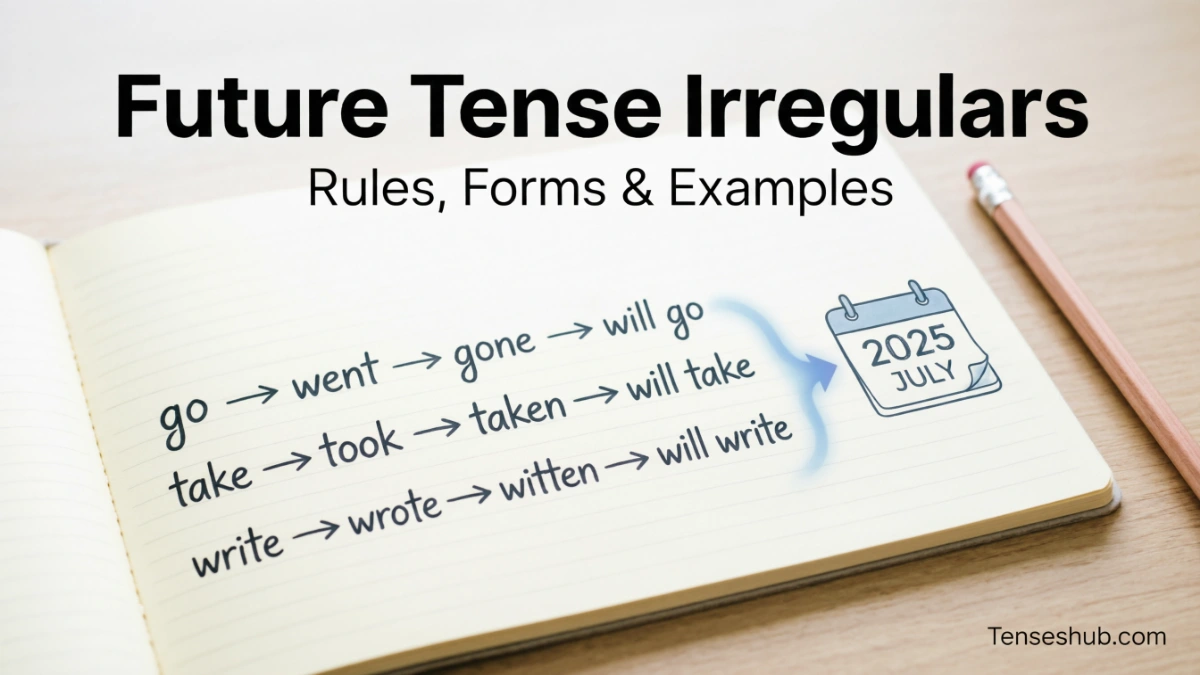
There is no special irregular form for most English verbs in the simple future. Use will + base verb, even when the verb is irregular in the past.
| Verb | Past Form | Future Form |
|---|---|---|
| go | went | will go |
| eat | ate | will eat |
| write | wrote | will write |
| see | saw | will see |
| take | took | will take |
For example: She went home yesterday, but she will go home tomorrow.
What Is Future Tense Irregulars?
The phrase future tense irregulars usually refers to irregular verbs used when talking about future actions.
However, there is an important grammar point to understand: irregular verbs do not normally have a special future tense form in English.
An irregular verb is a verb whose past forms do not follow the regular ed pattern.
For example:
- go → went → gone
- take → took → taken
- see → saw → seen
- write → wrote → written
- come → came → come
When these verbs are used with will, they return to their base form:
- will go
- will take
- will see
- will write
- will come
Why Does This Happen?
The helping verb will already shows that the action is in the future. Therefore, the main verb stays in its base form.
Compare:
- Past: She went home.
- Future: She will go home.
Not:
- She will went home.
- She will gone home.
The same rule applies to other irregular verbs.
More Examples
- I ate breakfast earlier.
- I will eat breakfast tomorrow.
- He wrote a letter yesterday.
- He will write a letter tomorrow.
- They saw the movie last night.
- They will see another movie next week.
The past form changes, but the future form after will uses the base verb.
Irregular Verbs in Other Future Forms
Irregular verbs can also appear in other future constructions, but the form depends on the grammar structure.
For example:
- I will go tomorrow.
- I am going to go tomorrow.
- I will have gone by noon.
- I will be going tomorrow.
The verb may appear as go, gone, or going depending on the tense or aspect. The key is to understand which verb form each structure requires.
Structure of Sentences of Future Tense Irregulars
The most common future structure uses will + base verb.
Affirmative Sentences
Pattern:
Subject + will + base verb + object/complement
Examples:
- I will go to school tomorrow.
- She will take the test next week.
- He will write the report tonight.
- They will see the doctor tomorrow.
The irregular verb remains in its base form.
Negative Sentences
Pattern:
Subject + will not + base verb + object/complement
Examples:
- I will not go there tomorrow.
- She will not take the train.
- He will not write the email tonight.
- They will not see the manager today.
The common contraction is:
will not = won’t
Examples:
- I won’t go tomorrow.
- She won’t take the bus.
- He won’t write the report today.
Interrogative Sentences
Pattern:
Will + subject + base verb + object/complement?
Examples:
- Will you go tomorrow?
- Will she take the exam?
- Will he write the report?
- Will they see us later?
Short answers:
- Yes, I will.
- No, I won’t.
- Yes, she will.
- No, she won’t.
Formation of Future Tense Irregulars
The simple future is formed with will + the base form of the main verb.
This is why irregular verbs become easy in the simple future.
The Basic Formula
will + V1
Examples:
- will go
- will come
- will eat
- will drink
- will write
- will take
- will give
- will see
The past forms are not used after will.
Common Irregular Verb Forms
| Base Verb (V1) | Past (V2) | Past Participle (V3) | Simple Future |
|---|---|---|---|
| go | went | gone | will go |
| come | came | come | will come |
| eat | ate | eaten | will eat |
| drink | drank | drunk | will drink |
| take | took | taken | will take |
| give | gave | given | will give |
| see | saw | seen | will see |
| write | wrote | written | will write |
| speak | spoke | spoken | will speak |
| buy | bought | bought | will buy |
| bring | brought | brought | will bring |
| find | found | found | will find |
Do Not Change the Verb After Will
A common learner mistake is to use the past form after will.
Incorrect:
I will went home tomorrow.
Correct:
I will go home tomorrow.
Incorrect:
She will took the bus.
Correct:
She will take the bus.
Incorrect:
They will saw the result.
Correct:
They will see the result.
Contractions
In everyday English, will is often shortened.
- I will → I’ll
- You will → you’ll
- He will → he’ll
- She will → she’ll
- It will → it’ll
- We will → we’ll
- They will → they’ll
Examples:
- I’ll go tomorrow.
- She’ll take the train.
- They’ll see you later.
For negative sentences:
will not → won’t
Examples:
- I won’t go.
- He won’t take it.
- They won’t come today.
Other Future Forms
Irregular verbs can also be used in other future structures.
Be going to + base verb
- I am going to go home.
- She is going to take the exam.
Future continuous
will be + verb ing
- I will be going home at six.
- She will be taking the test tomorrow.
Future perfect
will have + past participle
- I will have gone home by six.
- She will have taken the test by Friday.
- They will have written the report by then.
Notice that the V3 form appears in the future perfect, not because the verb is “irregular future,” but because will have + past participle is the required structure.
How to Use Future Tense Irregulars
Use irregular verbs in the future just like other verbs. The important point is choosing the correct verb form for the future structure you are using.
1. To Talk About Future Actions
Use will + base verb for an action that will happen in the future.
- I will go to Lahore tomorrow.
- She will take the exam next month.
- He will write the article tonight.
- They will come after lunch.
2. To Make Predictions
Use will when making a prediction.
- I think it will rain tomorrow.
- She will become a successful writer.
- They will win the next game.
- The price will rise soon.
3. To Make Promises
Will is also common for promises.
- I will help you.
- I will give you the book tomorrow.
- We will come to your house.
- I will keep your secret.
4. To Make Quick Decisions
We often use will when making a decision at the moment of speaking.
- The phone is ringing. I will answer it.
- You look tired. I will make some tea.
- I forgot the document. I will bring it tomorrow.
5. To Talk About Future Plans with Going To
Irregular verbs also work with be going to.
- I am going to buy a new laptop.
- She is going to write a book.
- They are going to come tomorrow.
- He is going to take a driving test.
6. To Describe an Action Completed Before a Future Time
Use the future perfect:
will have + V3
Examples:
- She will have written the report by Friday.
- They will have gone home by midnight.
- He will have taken the exam by then.
- We will have seen the results before the meeting.
Here, irregular past participles such as written, gone, taken, and seen are necessary.
Structure or Verb Pattern Table
| Future Form | Verb Pattern | Example |
|---|---|---|
| Simple future | will + V1 | She will go home. |
| Future negative | will not + V1 | She won’t go home. |
| Future question | Will + subject + V1? | Will she go home? |
| Going to | am/is/are going to + V1 | She is going to go home. |
| Future continuous | will be + V-ing | She will be going home. |
| Future perfect | will have + V3 | She will have gone home. |
Real Life Examples
Everyday Examples
- I will go to the store after work.
- She will take the bus tomorrow.
- We will eat dinner at eight.
- He will bring the documents later.
- They will come to the party tonight.
- I will buy a new phone next month.
Negative Examples
- I won’t go there tomorrow.
- She won’t take the train.
- He won’t eat before the meeting.
- They won’t bring the equipment today.
- We won’t see the manager until Monday.
Questions
- Will you go with us?
- Will she take the test tomorrow?
- Will he bring the documents?
- Will they come to the meeting?
- Will you buy the tickets?
Formal Examples
- The company will take further action next month.
- The committee will review the report tomorrow.
- The researcher will present the findings at the conference.
- The organization will provide additional information soon.
Informal Examples
- I’ll go with you.
- We’ll eat later.
- She’ll come after work.
- I’ll bring some snacks.
- They’ll see you tomorrow.
Future Perfect Examples
- By Friday, I will have written the complete report.
- By noon, she will have taken the exam.
- By next month, they will have gone through the entire course.
- By the end of the year, he will have seen many new places.
Common Mistakes
Mistake 1: Using the Past Form After Will
Incorrect:
She will went to school tomorrow.
Correct:
She will go to school tomorrow.
Why? After will, use the base form.
Mistake 2: Using the Past Participle After Will
Incorrect:
He will gone home later.
Correct:
He will go home later.
Why? The simple future requires will + V1, not V3.
Mistake 3: Adding ed to an Irregular Verb
Incorrect:
They will goed to the market.
Correct:
They will go to the market.
Why? Go is already the base form. Do not add ed.
Mistake 4: Changing the Verb for they
Incorrect:
She will goes home.
Correct:
She will go home.
Why? The main verb stays in the base form after will, even with he, she, or it.
Mistake 5: Using “Will” Twice
Incorrect:
I will will go tomorrow.
Correct:
I will go tomorrow.
Only one will is needed.
Mistake 6: Confusing Will Go with Will Have Gone
These forms have different meanings.
- I will go home at six.
This describes a future action. - I will have gone home by six.
This means the action will be completed before six.
Key Grammar Rules
- Use will + base verb for the simple future.
- She will go tomorrow.
- Do not use the past form after will.
- Correct: He will take the bus.
- Incorrect: He will took the bus.
- Do not use the past participle after will alone.
- Correct: They will see us.
- Incorrect: They will seen us.
- The main verb does not change for they after will.
- She will come.
- He will come.
- Use won’t as the contraction of will not.
- I won’t go.
- Use the past participle after will have.
- She will have written the report.
- Irregular verbs are irregular mainly because of their past forms, not because they require special simple future forms.
- go → went → gone → will go
Comparisons with Similar Grammar Forms
Simple Future vs. Simple Past
The simple past uses the past form, while the simple future with will uses the base form.
| Tense | Example |
|---|---|
| Past | She went home. |
| Future | She will go home. |
The important difference is went versus will go.
Will Go vs. Is Going To Go
Both can describe future actions.
Will go:
I will go tomorrow.
This is commonly used for predictions, promises, offers, or decisions made at the moment.
Going to go:
I am going to go tomorrow.
This often suggests a prior plan or intention.
Will Eat vs. Ate
- I ate dinner at seven. → Past
- I will eat dinner at seven. → Future
The past form ate changes, but the future uses the base form eat.
Will Write vs. Will Have Written
These structures describe different points in time.
- I will write the report tomorrow.
- I will have written the report by tomorrow evening.
The first focuses on a future action. The second shows that the action will be completed by a future deadline.
Will See vs. Will Be Seeing
- I will see the doctor tomorrow.
- I will be seeing the doctor tomorrow afternoon.
The first is simple future. The second is future continuous and emphasizes an action in progress or an arranged activity around a future time.
Regular vs. Irregular Verbs in the Future
There is little difference in the simple future structure.
| Verb Type | Base Verb | Past | Future |
|---|---|---|---|
| Regular | work | worked | will work |
| Regular | play | played | will play |
| Irregular | go | went | will go |
| Irregular | take | took | will take |
| Irregular | write | wrote | will write |
Both types use:
will + base verb
Exercises
Exercise 1: Fill in the Blanks
Complete each sentence with the correct future form.
- I will ______ to the store tomorrow. (go)
- She will ______ the bus at eight. (take)
- They will ______ dinner later. (eat)
- He will ______ the report tonight. (write)
- We will ______ you tomorrow. (see)
- I won’t ______ the meeting. (miss)
- Will you ______ with us? (come)
- She will ______ the documents tomorrow. (bring)
Exercise 2: Choose the Correct Answer
- Which sentence is correct?
a) She will went home.
b) She will go home.
c) She will gone home. - Which form comes after will?
a) V1
b) V2
c) V3 - Which sentence is correct?
a) He will took the exam.
b) He will take the exam.
c) He will taken the exam. - Which sentence uses the future perfect?
a) She will write the report.
b) She will be writing the report.
c) She will have written the report. - What is the future form of saw?
a) will saw
b) will seen
c) will see
Exercise 3: Correct the Mistakes
Rewrite each sentence correctly.
- I will went to school tomorrow.
- She will took the train.
- They will eaten dinner at eight.
- He will goes home later.
- We won’t went there.
- Will you came tomorrow?
Exercise 4: Rewrite the Sentences
Change each sentence as directed.
- She goes to the market.
Change it into the simple future. - He takes the bus.
Change it into a negative future sentence. - They come tomorrow.
Change it into a future question. - I write the report tomorrow.
Change it into the future perfect. - She sees the doctor tomorrow.
Change it into the future continuous.
Answer Key
Exercise 1
- go
- take
- eat
- write
- see
- miss
- come
- bring
Exercise 2
- b) She will go home.
- a) V1
- b) He will take the exam.
- c) She will have written the report.
- c) will see
Exercise 3
- I will go to school tomorrow.
- She will take the train.
- They will eat dinner at eight.
- He will go home later.
- We won’t go there.
- Will you come tomorrow?
Exercise 4
- She will go to the market.
- He will not take the bus.
- Will they come tomorrow?
- I will have written the report by tomorrow.
- She will be seeing the doctor tomorrow.
FAQs
Are there irregular future tense verbs in English?
English does not normally create special irregular forms for the simple future. With will, both regular and irregular verbs use the base form.
What is the future tense of an irregular verb?
Use will + base verb.
For example:
- go → will go
- take → will take
- write → will write
- see → will see
What is the future tense of “go”?
The simple future is will go.
Example:
I will go to school tomorrow.
What is the future tense of “eat”?
The simple future is will eat.
Example:
We will eat dinner later.
What is the future tense of “take”?
The simple future is will take.
Example:
She will take the exam tomorrow.
Do irregular verbs change after “will”?
No. Use the base form after will.
Correct:
He will come.
Incorrect:
He will came.
Is “will went” correct?
No. The correct form is will go.
Is “will gone” correct?
Not by itself. Use will go for the simple future. Use will have gone for the future perfect.
What is the difference between will go and will have gone?
Will go describes a future action:
I will go home at six.
Will have gone describes an action completed before a future time:
I will have gone home by six.
Do irregular verbs use ed in the future?
No. The simple future uses the base verb after will, so you do not add ed.
What are some common irregular verbs used in the future?
Common examples include:
- will go
- will come
- will eat
- will take
- will give
- will see
- will write
- will speak
- will buy
- will bring
- will find
Conclusion
Understanding future tense irregulars is easier once you remember one important rule: the simple future uses will + the base form of the verb. Irregular verbs such as go, take, eat, see, and write may change dramatically in the past, but their simple future forms remain will go, will take, will eat, will see, and will write.
Do not use forms such as “will went,” “will took,” or “will written” when forming the simple future. However, irregular past participles are needed in structures such as the future perfect: will have gone, will have taken, or will have written.
Once you understand which verb form each future structure requires, irregular verbs become much easier to use. Practice the examples and exercises above, and you will be able to use future forms naturally and accurately in both speaking and writing.

Hi, I’m Noah Bester, a tenses expert passionate about simplifying English grammar. I create practical, easy-to-understand guides to help learners master tenses with confidence. My goal is to make grammar clear, useful, and applicable in everyday communication. tenseshub.com