Have you ever wanted to say “I speak Spanish,” “She lives in Madrid,” or “We eat at home,” but felt unsure which verb ending to use? Learning the present tense in Spanish is one of the first important steps toward speaking and writing Spanish with confidence.
The Spanish present tense, called the presente de indicativo, helps you talk about daily routines, habits, facts, current situations, and actions that are happening around now. Unlike English, Spanish often changes the verb ending according to the subject. This means you can sometimes understand who is doing the action without using a subject pronoun.
For example, hablo means “I speak,” while hablamos means “we speak.” The verb ending gives you useful information.
In this guide, you will learn how to form the Spanish present tense, use regular and irregular verbs, make negative and question sentences, avoid common mistakes, and practice with real life examples.
Quick Answer
The present tense in Spanish is used to describe habits, routines, facts, and actions happening now. Regular Spanish verbs usually belong to three groups: ar, er, and ir.
| Verb | Meaning | “I” Form |
|---|---|---|
| hablar | to speak | hablo |
| comer | to eat | como |
| vivir | to live | vivo |
For example: Yo hablo español means “I speak Spanish.”
What Is the Present Tense in Spanish?
The present tense in Spanish is a verb tense used to express actions and situations connected to the present.
It can describe:
- What someone does regularly
- What is happening now
- Facts and general truths
- Permanent or long term situations
- Scheduled future events
- Opinions, feelings, and conditions
In Spanish, the present tense is called the presente de indicativo.
Examples
- Yo estudio español. I study Spanish.
- Ella trabaja en una escuela. She works at a school.
- Nosotros vivimos en Lahore. We live in Lahore.
- El agua hierve a 100 °C. Water boils at 100°C.
- Mañana viajamos a Madrid. Tomorrow we are traveling to Madrid.
The Spanish present tense is similar to the English simple present in many situations, but it can also describe an action happening right now.
For example:
- Como una manzana. I eat an apple. / I am eating an apple.
- Ella lee un libro. She reads a book. / She is reading a book.
The exact English translation depends on the context.
Why Is the Spanish Present Tense Important?
The present tense is useful because it helps you communicate in everyday situations. You use it when introducing yourself, describing your family, talking about your job, explaining your routine, and sharing basic information.
Learning the present tense also gives you a foundation for understanding other Spanish tenses, such as the preterite, imperfect, future, and present perfect.
Structure of Sentences of the Present Tense in Spanish
Spanish sentence structure is flexible, but beginners can start with a simple word order.
Affirmative Sentences
The basic pattern is:
Subject + Conjugated Verb + Complement
Examples:
- Yo estudio español. I study Spanish.
- María compra pan. María buys bread.
- Nosotros vivimos en una ciudad grande. We live in a big city.
Spanish often omits the subject pronoun because the verb ending already identifies the subject.
- Hablo español. I speak Spanish.
- Estudiamos por la noche. We study at night.
Both sentences are grammatically complete.
Negative Sentences
The basic pattern is:
Subject + No + Conjugated Verb + Complement
Examples:
- Yo no hablo francés. I do not speak French.
- Ella no trabaja los domingos. She does not work on Sundays.
- Nosotros no comemos carne. We do not eat meat.
The word no normally comes directly before the conjugated verb.
Interrogative Sentences
Spanish questions can follow the same word order as statements, or the subject can come after the verb.
¿Conjugated Verb + Complement?
Examples:
- ¿Hablas español? Do you speak Spanish?
- ¿Trabaja Ana aquí? Does Ana work here?
- ¿Viven ustedes en Madrid? Do you live in Madrid?
You can also use a question word:
Question Word + Conjugated Verb + Complement?
- ¿Dónde vives? Where do you live?
- ¿Qué comes? What do you eat?
- ¿Cuándo empieza la clase? When does the class start?
Spanish questions use an opening question mark ¿ and a closing question mark ?.
Formation of the Present Tense in Spanish
To form the Spanish present tense, remove the infinitive ending ar, er, or ir and add the correct ending for the subject.
The three regular verb groups are:
- ar verbs: hablar to speak
- er verbs: comer to eat
- ir verbs: vivir to live
Step 1: Remove the Infinitive Ending
| Infinitive | Remove | Verb Stem |
|---|---|---|
| hablar | -ar | habl |
| comer | -er | com |
| vivir | -ir | viv |
Step 2: Add the Correct Present Tense Ending
Regular verbs use different endings depending on if they end in ar, er, or ir.
Regular AR Verb: Hablar
Hablar means “to speak.”
| Subject | Ending | Conjugation | Meaning |
|---|---|---|---|
| yo | o | hablo | I speak |
| tú | as | hablas | you speak |
| él, ella, usted | a | habla | he, she, you speak |
| nosotros/as | amos | hablamos | we speak |
| vosotros/as | áis | habláis | you all speak |
| ellos, ellas, ustedes | an | hablan | they, you all speak |
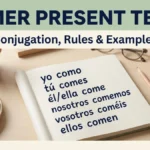
Regular ER Verb: Comer
Comer means “to eat.”
| Subject | Ending | Conjugation | Meaning |
|---|---|---|---|
| yo | o | como | I eat |
| tú | es | comes | you eat |
| él, ella, usted | e | come | he, she, you eat |
| nosotros/as | emos | comemos | we eat |
| vosotros/as | éis | coméis | you all eat |
| ellos, ellas, ustedes | en | comen | they, you all eat |
Regular IR Verb: Vivir
Vivir means “to live.”
| Subject | Ending | Conjugation | Meaning |
|---|---|---|---|
| yo | o | vivo | I live |
| tú | es | vives | you live |
| él, ella, usted | e | vive | he, she, you live |
| nosotros/as | imos | vivimos | we live |
| vosotros/as | ís | vivís | you all live |
| ellos, ellas, ustedes | en | viven | they, you all live |
Notice that regular er and ir verbs share most endings. The main difference is in the nosotros and vosotros forms.
Contractions and Subject Pronouns
Spanish does not use English style contractions such as I’m, you’re, or she’s with ordinary present tense verbs.
For example:
- Yo soy estudiante. I am a student.
- Tú eres amable. You are kind.
- Ella está cansada. She is tired.
Spanish subject pronouns are often optional:
- Yo hablo español. I speak Spanish.
- Hablo español. I speak Spanish.
Use the pronoun when you want to emphasize the subject or make the meaning clearer.
Important Irregular Verb Changes
Not all Spanish verbs follow regular patterns. Some common verbs change their stem or have an irregular yo form.
Examples include:
| Infinitive | Meaning | Present Tense Example |
|---|---|---|
| ser | to be | soy |
| estar | to be | estoy |
| ir | to go | voy |
| tener | to have | tengo |
| hacer | to do/make | hago |
| decir | to say/tell | digo |
| poder | can / to be able | puedo |
| querer | to want | quiero |
These verbs must be learned individually, although many follow recognizable patterns.
How to Use the Present Tense in Spanish
The Spanish present tense has several important uses. Understanding these uses helps you choose the correct tense in real conversations.
1. Daily Routines and Habits
Use the present tense to describe actions that happen regularly.
- Me levanto a las siete. I get up at seven.
- Desayuno todos los días. I have breakfast every day.
- Mi hermano estudia por la tarde. My brother studies in the afternoon.
- Trabajamos de lunes a viernes. We work from Monday to Friday.
Common time expressions include:
- todos los días every day
- siempre always
- normalmente normally
- a veces sometimes
- nunca never
2. Actions Happening Now
Spanish can use the simple present to describe an action happening at the moment of speaking.
- Ahora escribo un correo. I am writing an email now.
- ¿Qué haces? What are you doing?
- Mi madre cocina. My mother is cooking.
Spanish also uses estar + gerundio when you want to emphasize that an action is in progress.
- Estoy estudiando. I am studying.
- Ella está trabajando. She is working.
- Estamos aprendiendo español. We are learning Spanish.
The simple present is common in everyday speech, while estar + gerundio focuses more clearly on an action in progress.
3. Facts and General Truths
Use the present tense for facts, scientific information, and general truths.
- La Tierra gira alrededor del Sol. The Earth revolves around the Sun.
- El agua hierve a 100 °C. Water boils at 100°C.
- Los gatos duermen mucho. Cats sleep a lot.
4. Permanent or Long Term Situations
Use the present tense to describe where someone lives, works, or studies.
- Vivo en Pakistán. I live in Pakistan.
- Ella trabaja en un hospital. She works in a hospital.
- Estudiamos en la universidad. We study at the university.
These situations may change later, but the present tense describes them as current facts.
5. Opinions, Feelings, and Preferences
The present tense is used to express what you think, like, want, or feel.
- Me gusta la música. I like music.
- No quiero café. I do not want coffee.
- Creo que tienes razón. I think you are right.
- Necesitamos más tiempo. We need more time.
6. Near Future Plans and Schedules
Spanish can use the present tense for future events when the time is clear, especially with schedules or planned arrangements.
- Mañana tengo una reunión. Tomorrow I have a meeting.
- El tren sale a las ocho. The train leaves at eight.
- La clase empieza a las nueve. The class starts at nine.
The present tense works because the future time is understood from the context.
7. Instructions and Directions
The present tense can appear in simple instructions, explanations, and directions.
- Primero mezclas los ingredientes. First, you mix the ingredients.
- Después giras a la derecha. Then, you turn right.
- Abres el libro y lees la primera página. You open the book and read the first page.
Present Tense in Spanish: Verb Pattern Table
This compact table shows the regular endings for the three main verb groups.
| Subject | AR: hablar | ER: comer | IR: vivir |
|---|---|---|---|
| yo | hablo | como | vivo |
| tú | hablas | comes | vives |
| él/ella/usted | habla | come | vive |
| nosotros/as | hablamos | comemos | vivimos |
| vosotros/as | habláis | coméis | vivís |
| ellos/ellas/ustedes | hablan | comen | viven |
Important Note About Pronouns
Spanish uses these subject pronouns:
| Spanish | English |
|---|---|
| yo | I |
| tú | you, informal singular |
| él | he |
| ella | she |
| usted | you, formal singular |
| nosotros/nosotras | we |
| vosotros/vosotras | you all, informal plural, mainly Spain |
| ellos/ellas | they |
| ustedes | you all, plural |
In most of Latin America, ustedes is used for “you all.” In Spain, vosotros is common in informal situations, while ustedes is generally formal or used in certain regional contexts.
Real Life Examples
Here are practical examples of the Spanish present tense in everyday situations.
Talking About Yourself
- Me llamo Daniel. My name is Daniel.
- Vivo en una ciudad pequeña. I live in a small city.
- Estudio inglés y español. I study English and Spanish.
- Trabajo desde casa. I work from home.
- Me gusta leer por la noche. I like reading at night.
Talking About Family
- Mi madre cocina muy bien. My mother cooks very well.
- Mi padre trabaja en una oficina. My father works in an office.
- Mi hermana estudia medicina. My sister studies medicine.
- Mis hermanos viven cerca. My siblings live nearby.
Talking About Daily Activities
- Me despierto a las seis. I wake up at six.
- Tomo el desayuno a las siete. I have breakfast at seven.
- Voy al trabajo en autobús. I go to work by bus.
- Almuerzo a la una. I have lunch at one.
- Regreso a casa por la tarde. I return home in the afternoon.
Negative Sentences
- No hablo alemán. I do not speak German.
- Ella no come carne. She does not eat meat.
- No vivimos en Madrid. We do not live in Madrid.
- Mis amigos no trabajan los sábados. My friends do not work on Saturdays.
Questions
- ¿Hablas español? Do you speak Spanish?
- ¿Dónde vives? Where do you live?
- ¿Qué estudias? What do you study?
- ¿Trabaja usted aquí? Do you work here?
- ¿Cuándo empieza la película? When does the movie start?
Formal and Informal Examples
- ¿Cómo estás? How are you? (informal)
- ¿Cómo está usted? How are you? (formal)
- ¿Tienes tiempo? Do you have time? (informal)
- ¿Tiene tiempo? Do you have time? (formal)
Common Mistakes
Mistake 1: Using English Helping Verbs
Spanish does not normally use do or does to form present tense questions.
❌ ¿Do hablas español?
✅ ¿Hablas español?
The verb itself is conjugated to form the question.
Mistake 2: Forgetting the Verb Ending
❌ Yo hablar español.
✅ Yo hablo español.
The infinitive hablar must be changed to match the subject.
Mistake 3: Using the Wrong Ending Group
❌ Nosotros comimos when you mean “we eat” in the present.
✅ Nosotros comemos.
Comimos is the preterite form, meaning “we ate.” The present form is comemos.
Mistake 4: Adding “No” After the Verb
❌ Yo hablo no español.
✅ Yo no hablo español.
The negative word no normally comes before the conjugated verb.
Mistake 5: Confusing Tú and Usted
❌ ¿Cómo está tú?
✅ ¿Cómo estás tú?
Use tú with the informal form estás. Use usted with the formal form está.
Mistake 6: Forgetting Accent Marks
❌ Tu hablas español.
✅ Tú hablas español.
Tú means “you,” while tu means “your.” Accent marks can change meaning.
Mistake 7: Assuming Every Verb Is Regular
❌ Yo va al mercado.
✅ Yo voy al mercado.
The verb ir is irregular. Its “I” form is voy, not io or ira.
Key Grammar Rules
- Remove ar, er, or ir before adding a present tense ending.
hablar → habl → hablo - The verb ending must match the subject.
Yo como means “I eat,” while ellos comen means “they eat.” - Spanish often omits subject pronouns.
Estudio español already means “I study Spanish.” - Use no before the conjugated verb to make a negative sentence.
No trabajo hoy. I am not working today. - Spanish questions do not need do or does.
¿Vives aquí? Do you live here? - Regular er and ir verbs share many endings.
comes and vives both mean “you eat” and “you live.” - Some common verbs are irregular and must be learned separately.
ser → soy, ir → voy, tener → tengo.
Comparisons with Similar Grammar Forms
Spanish Present Tense vs. English Simple Present
The Spanish present tense often matches the English simple present.
| Spanish | English |
|---|---|
| Yo trabajo aquí. | I work here. |
| Ella vive en Madrid. | She lives in Madrid. |
| Nosotros estudiamos español. | We study Spanish. |
However, Spanish can also use the simple present for actions happening now:
- Leo un libro. I read a book. / I am reading a book.
English often needs the present continuous in this situation, but Spanish can use either the simple present or estar + gerundio, depending on the context.
Present Tense vs. Present Progressive
The Spanish present tense describes habits, facts, and current actions.
- Trabajo en una oficina. I work in an office.
- Trabajo ahora. I am working now.
The present progressive emphasizes an action in progress:
- Estoy trabajando. I am working.
Use the progressive when you want to highlight that the action is happening at this moment.
Present Tense vs. Preterite
The present tense describes current or repeated actions. The preterite describes completed actions in the past.
- Como pizza. I eat pizza. / I am eating pizza.
- Comí pizza ayer. I ate pizza yesterday.
Compare:
- Vivo en Lahore. I live in Lahore.
- Viví en Lahore durante dos años. I lived in Lahore for two years.
Present Tense vs. Imperfect
The present tense describes what happens now or regularly. The imperfect describes past habits, ongoing past situations, or background information.
- Estudio español. I study Spanish.
- Estudiaba español. I used to study Spanish. / I was studying Spanish.
If you want to learn more, related topics include Spanish preterite tense, Spanish imperfect tense, Spanish present progressive, and Spanish present perfect.
Exercises
Practice these questions to test your understanding of the Spanish present tense.
Exercise 1: Fill in the Blanks
Complete each sentence with the correct present tense form of the verb in parentheses.
- Yo ______ español. (hablar)
- Tú ______ una manzana. (comer)
- Ella ______ en Madrid. (vivir)
- Nosotros ______ en una escuela. (trabajar)
- Ellos ______ mucho. (estudiar)
- Usted ______ café. (beber)
- Yo ______ al mercado. (ir)
- Mi hermano ______ un coche. (tener)
Exercise 2: Make the Sentences Negative
Rewrite each sentence using no.
- Yo hablo francés.
- Ella trabaja los domingos.
- Nosotros comemos carne.
- Ellos viven aquí.
Exercise 3: Make Questions
Turn each statement into a question.
- Tú estudias español.
- Ella trabaja aquí.
- Ustedes viven en México.
- Él tiene tiempo.
Exercise 4: Correct the Mistakes
Find and correct the error in each sentence.
- Yo hablar español.
- Nosotros comemos ayer.
- ¿Do tú vives aquí?
- Ella no estudia no.
- Yo va al trabajo.
Exercise 5: Multiple Choice Questions
1. Which is the correct “I speak” form of hablar?
A. hablas
B. hablo
C. hablan
D. hablamos
2. Which sentence means “We live in Spain”?
A. Nosotros viven en España.
B. Nosotros vivir en España.
C. Nosotros vivimos en España.
D. Nosotros vivís en España.
3. What is the correct negative form of Ella come carne?
A. Ella no come carne.
B. Ella come no carne.
C. Ella no comer carne.
D. No ella come carne.
4. Which verb is irregular in the present tense?
A. hablar
B. comer
C. vivir
D. ir
5. What does ¿Dónde trabajas? mean?
A. What do you eat?
B. Where do you work?
C. When do you work?
D. Do you study?
Answer Key
Exercise 1
- hablo
- comes
- vive
- trabajamos
- estudian
- bebe
- voy
- tiene
Exercise 2
- Yo no hablo francés.
- Ella no trabaja los domingos.
- Nosotros no comemos carne.
- Ellos no viven aquí.
Exercise 3
- ¿Estudias español?
- ¿Trabaja ella aquí? / ¿Ella trabaja aquí?
- ¿Viven ustedes en México?
- ¿Tiene él tiempo?
Exercise 4
- Yo hablo español.
- Nosotros comemos. / Nosotros comimos ayer. (The correct choice depends on if the meaning is present or past.)
- ¿Tú vives aquí?
- Ella no estudia.
- Yo voy al trabajo.
Exercise 5
- B. hablo
- C. Nosotros vivimos en España.
- A. Ella no come carne.
- D. ir
- B. Where do you work?
FAQs
What is the present tense in Spanish called?
It is called the presente de indicativo. It describes present actions, habits, facts, and current situations.
What are the three Spanish present tense verb endings?
The three main infinitive endings are ar, er, and ir. Examples include hablar, comer, and vivir.
How do you form the present tense in Spanish?
Remove the infinitive ending and add the correct ending for the subject. For example, hablar becomes hablo for “I speak.”
Does Spanish use do or does in present tense questions?
No. Spanish normally forms questions by changing intonation or word order. For example, ¿Hablas español? means “Do you speak Spanish?”
How do you make a Spanish present tense sentence negative?
Place no before the conjugated verb. For example, No vivo aquí means “I do not live here.”
Can Spanish present tense describe an action happening now?
Yes. Como can mean “I eat” or “I am eating,” depending on context. You can also use estar + gerundio, as in Estoy comiendo.
What is the difference between tú and usted?
Both mean “you” for one person. Tú is informal, while usted is formal. Their verb forms are different: tú hablas and usted habla.
Are all Spanish present tense verbs regular?
No. Common verbs such as ser, ir, tener, and hacer are irregular. Their forms must be learned individually.
Why can Spanish omit the subject pronoun?
Spanish verb endings often show who performs the action. For example, hablo already means “I speak,” so yo is optional.
Is the Spanish present tense the same as the English present continuous?
Not always. Spanish often uses the simple present for actions happening now, while English frequently uses the present continuous. Spanish also has estar + gerundio for emphasis.
Conclusion
The present tense in Spanish is the foundation of everyday communication. It helps you talk about routines, facts, current actions, opinions, feelings, and future schedules. The most important first step is learning the three regular verb groups: ar, er, and ir.
Remember that Spanish verbs change their endings according to the subject. You should also practice placing no before the verb in negative sentences and forming questions without using English helping verbs such as “do” or “does.”
Start with common verbs like hablar, comer, vivir, ser, estar, and ir. Then build short sentences about your own life. With regular practice, Spanish present tense forms will become easier to recognize, remember, and use naturally.
Meta Description
Feature Image Prompt
:::

Hi, I’m Noah Bester, a tenses expert passionate about simplifying English grammar. I create practical, easy-to-understand guides to help learners master tenses with confidence. My goal is to make grammar clear, useful, and applicable in everyday communication. tenseshub.com