Have you ever wanted to say “I go to school” in Spanish but felt confused about which form of ir to use?
Many Spanish learners struggle with the present tense of ir because this verb changes differently from regular verbs. Since ir means “to go,” it is one of the most important verbs in daily conversation.
You use the present tense of ir when talking about going somewhere, future plans, routines, and even locations.
Native speakers use it all the time in real life situations like school, travel, shopping, and meeting friends.
The good news is that once you understand the patterns and practice a few examples, the verb becomes much easier to use.
In this guide, you will learn the meaning, structure, formation, rules, examples, common mistakes, exercises, and FAQs related to the present tense of ir in a simple and beginner friendly way.
Quick Answer (Featured Snippet)
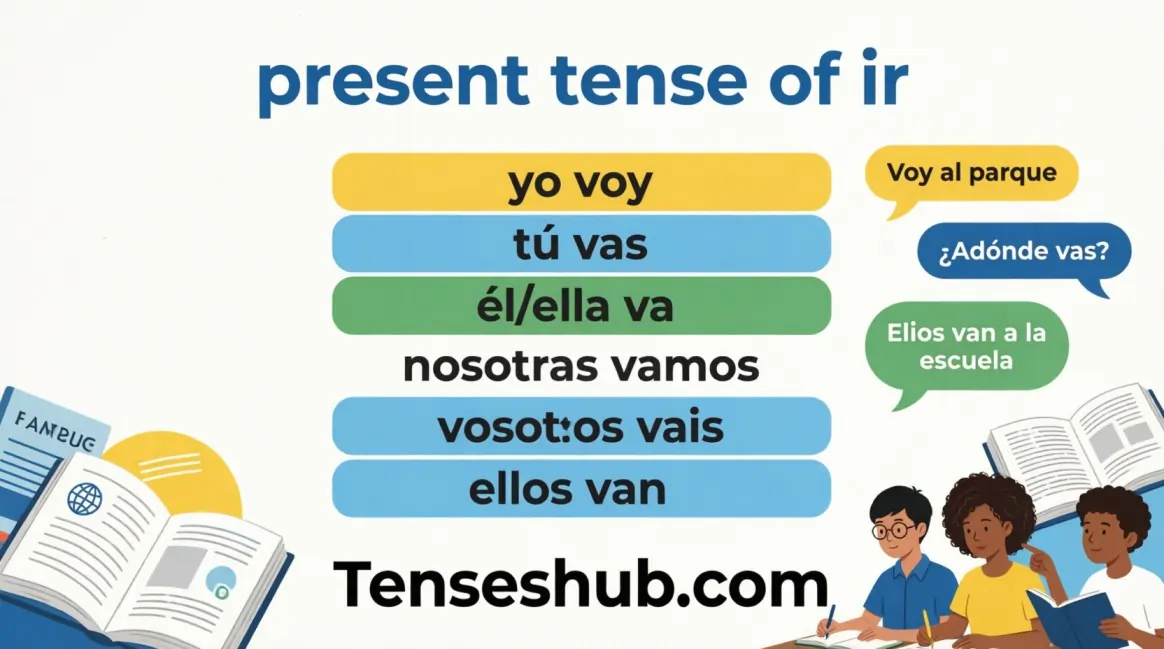
The present tense of ir is used to talk about going somewhere right now, routines, or near future plans in Spanish. The verb ir is irregular, so its forms do not follow normal verb endings.
| Subject | Verb Form |
|---|---|
| Yo | voy |
| Tú | vas |
| Él / Ella / Usted | va |
| Nosotros / Nosotras | vamos |
| Vosotros / Vosotras | vais |
| Ellos / Ellas / Ustedes | van |
What Is Present Tense of Ir?
The present tense of ir refers to the current forms of the Spanish verb ir, which means “to go.” It is used to describe actions happening now, regular movement, destinations, and future intentions.
Unlike regular Spanish verbs, ir is an irregular verb. This means its forms change in a unique way and must be memorized.
Main Functions of the Present Tense of Ir
- Talking about movement
- Describing routines
- Discussing plans
- Expressing future actions using ir + a + infinitive
Examples
- Yo voy al mercado.
(I go to the market.) - Nosotros vamos a la escuela.
(We go to school.) - Ella va a estudiar esta noche.
(She is going to study tonight.)
The present tense of ir is extremely common in spoken Spanish because people often talk about places, plans, and movement in daily life.
Structure of Sentences of Present Tense of Ir
In Spanish, sentence structure with ir changes depending on whether the sentence is positive, negative, or a question.
Positive Sentence Structure
Subject + present tense of ir + place/object
Examples:
- Yo voy al parque.
- Tú vas a casa.
- Ellos van al cine.
Negative Sentence Structure
Subject + no + present tense of ir + place/object
Examples:
- Yo no voy al banco.
- Ella no va a la oficina.
- Nosotros no vamos a la playa.
Question Sentence Structure
¿Present tense of ir + subject + place/object?
Examples:
- ¿Vas a la escuela?
- ¿Van ustedes al restaurante?
- ¿Va María al médico?
Short Answers
- Sí, voy.
- No, no voy.
- Sí, vamos.
- No, no van.
These structures help learners communicate naturally in everyday conversations.
Formation of Present Tense of Ir
The verb ir is highly irregular. Its forms do not follow the normal endings of regular ir verbs.
Base Verb
Ir = to go
Present Tense Forms
- Yo → voy
- Tú → vas
- Él/Ella/Usted → va
- Nosotros/Nosotras → vamos
- Vosotros/Vosotras → vais
- Ellos/Ellas/Ustedes → van
Why Is It Irregular?
Most Spanish verbs follow predictable endings. However, ir changes completely in some forms.
For example:
- Vivir → vivo
- Escribir → escribo
- Ir → voy
As you can see, voy looks very different from ir.
Using Ir + A + Infinitive
One very important structure uses the present tense of ir with another verb.
Formula
Present tense of ir + a + infinitive verb
Examples:
- Voy a comer.
(I am going to eat.) - Vamos a estudiar.
(We are going to study.) - Van a viajar mañana.
(They are going to travel tomorrow.)
This structure is commonly used to talk about future plans.
How to Use Present Tense of Ir
The present tense of ir has several practical uses in Spanish conversation.
1. Talking About Going Somewhere
This is the most basic use.
Examples:
- Voy al gimnasio.
- Vamos al parque.
- Ella va a la escuela.
2. Describing Daily Routines
People often use ir when discussing regular activities.
Examples:
- Voy al trabajo todos los días.
- Mis amigos van al mercado los sábados.
3. Talking About Future Plans
Spanish speakers often use ir + a + infinitive instead of the simple future tense.
Examples:
- Voy a dormir temprano.
- Vamos a visitar a nuestra abuela.
4. Asking About Destinations
Examples:
- ¿Adónde vas?
- ¿Van ustedes al cine?
5. Giving Directions or Plans
Examples:
- Voy primero al banco y luego a casa.
- Vamos a comer después de clase.
Pronunciation Tip
- “Voy” sounds like “boy” with a soft “v.”
- “Vais” sounds like “bye ees.”
Listening and repeating native pronunciation can help improve fluency.
Conjugation Table – Verb IR (to go)
| Subject Pronoun | Present Tense Form | English Meaning |
|---|---|---|
| Yo | voy | I go |
| Tú | vas | You go |
| Él / Ella / Usted | va | He / She / You (formal) goes |
| Nosotros / Nosotras | vamos | We go |
| Vosotros / Vosotras | vais | You all go |
| Ellos / Ellas / Ustedes | van | They go |
Real Life Examples
Here are practical examples of the present tense of ir in everyday situations.
- Yo voy a la biblioteca después de clase.
- Tú vas muy rápido.
- Ella va al hospital esta mañana.
- Nosotros vamos al centro comercial los domingos.
- Ellos van al restaurante esta noche.
- ¿Vas a la fiesta mañana?
- No voy al gimnasio hoy.
- Mi hermana va a estudiar medicina.
- Vamos a ver una película.
- ¿Van ustedes al aeropuerto?
- Tú no vas al trabajo los lunes.
- Voy a llamar a mi amigo después.
- Mis padres van de vacaciones en junio.
- ¿Adónde va Carlos?
- Nosotros vamos a aprender español juntos.
Common Mistakes
Many beginners make similar mistakes with the present tense of ir.
Mistake 1: Using Regular Verb Endings
❌ Yo iro al mercado.
✅ Yo voy al mercado.
Explanation: Ir is irregular.
Mistake 2: Forgetting “a” Before Places
❌ Voy el parque.
✅ Voy al parque.
Explanation: Spanish usually uses “a” before destinations.
Mistake 3: Wrong Subject Form
❌ Nosotros va a casa.
✅ Nosotros vamos a casa.
Explanation: Match the verb with the subject.
Mistake 4: Missing “a” in Future Structure
❌ Voy comer pizza.
✅ Voy a comer pizza.
Explanation: Use ir + a + infinitive.
Mistake 5: Confusing “va” and “van”
❌ Ellos va al cine.
✅ Ellos van al cine.
Explanation: Plural subjects need plural verbs.
Key Grammar Rules
1. Ir Is an Irregular Verb
Its forms must be memorized because they do not follow standard patterns.
Example:
- Yo voy
- Tú vas
2. Use “A” Before Destinations
Examples:
- Voy a casa.
- Vamos al parque.
3. Use Ir + A + Infinitive for Future Plans
Examples:
- Voy a estudiar.
- Van a viajar.
4. Match the Verb With the Subject
Examples:
- Ella va.
- Nosotros vamos.
5. Questions Often Start With the Verb
Examples:
- ¿Vas al cine?
- ¿Van ustedes al banco?
Comparisons with Similar Grammar Forms
Present Tense of Ir vs Future Tense
Present Tense of Ir
Used for current movement or near future plans.
Example:
- Voy a comer.
(I am going to eat.)
Future Tense
Used for future actions more formally.
Example:
- Comeré mañana.
(I will eat tomorrow.)
Present Tense of Ir vs Estar
Ir
Shows movement.
Example:
- Voy a la escuela.
Estar
Shows location or condition.
Example:
- Estoy en la escuela.
Present Tense of Ir vs Venir
Ir
Movement away from the speaker.
Example:
- Voy al mercado.
Venir
Movement toward the speaker.
Example:
- Vengo a tu casa.
Exercises
Fill in the Blanks
- Yo _____ al parque.
- Nosotros _____ a estudiar.
- Ella _____ al médico.
- Tú _____ muy rápido.
- Ellos _____ a viajar mañana.
Answers
- voy
- vamos
- va
- vas
- van
Sentence Correction Exercises
Correct the mistakes.
- Yo iro a casa.
- Nosotros va al cine.
- Ella voy al mercado.
- Tú van a estudiar.
- Ellos va a comer.
Answers
- Yo voy a casa.
- Nosotros vamos al cine.
- Ella va al mercado.
- Tú vas a estudiar.
- Ellos van a comer.
Rewrite Tasks
Rewrite the sentences using the correct form of ir.
- I go to school.
- We are going to travel.
- She goes to the office.
- They go to the park.
- You go to the bank.
Answers
- Yo voy a la escuela.
- Nosotros vamos a viajar.
- Ella va a la oficina.
- Ellos van al parque.
- Tú vas al banco.
Multiple Choice Questions (MCQs)
- What does ir mean?
a) To eat
b) To go
c) To see
d) To speak - Which form is correct for “yo”?
a) va
b) van
c) voy
d) vais - Which sentence is correct?
a) Yo va al cine.
b) Yo voy al cine.
c) Yo van al cine.
d) Yo vas al cine. - Which form matches “nosotros”?
a) vamos
b) van
c) voy
d) va - What structure shows future plans?
a) ir + infinitive
b) ir + a + infinitive
c) ir + noun
d) ir + adjective - Which sentence is negative?
a) Voy al parque.
b) No voy al parque.
c) ¿Voy al parque?
d) Vamos al parque. - Which form matches “ellos”?
a) vais
b) voy
c) van
d) vas - Which sentence is a question?
a) Voy a casa.
b) No voy a casa.
c) ¿Vas a casa?
d) Vamos a casa. - Which sentence is correct?
a) Ella van al banco.
b) Ella voy al banco.
c) Ella va al banco.
d) Ella vais al banco. - Which word usually comes before a destination?
a) de
b) en
c) con
d) a
Answer Key
- b
- c
- b
- a
- b
- b
- c
- c
- c
- d
FAQs
What does ir mean in Spanish?
Ir means “to go.”
Is ir a regular verb?
No, it is an irregular verb.
What is the yo form of ir?
The yo form is voy.
How do you say “we go” in Spanish?
You say nosotros vamos.
What is ir + a + infinitive used for?
It is used for future plans or intentions.
How do you ask “Where are you going?”
You can say: ¿Adónde vas?
Is ir used in daily conversation?
Yes, it is one of the most common Spanish verbs.
What is the difference between ir and venir?
Ir means movement away, while venir means movement toward.
Do I always use “a” after ir?
Usually yes, especially before destinations or infinitive verbs.
Why is the present tense of ir important?
It helps you talk about movement, routines, and future plans naturally.
Conclusion
Learning the present tense of ir is an important step in speaking Spanish confidently. Since ir means “to go,” you will use it often in everyday conversations about travel, routines, school, work, and future plans. Although the verb is irregular, its forms become easier with regular practice and repetition.
Remember the main forms: voy, vas, va, vamos, vais, and van. Also practice the useful structure ir + a + infinitive to talk about future actions naturally.
The best way to improve is by reading examples, speaking aloud, and creating your own sentences daily.
Keep practicing small conversations, and soon the present tense of ir will feel simple and natural in real life Spanish communication.

Hi, I’m Noah Bester, a tenses expert passionate about simplifying English grammar. I create practical, easy-to-understand guides to help learners master tenses with confidence. My goal is to make grammar clear, useful, and applicable in everyday communication. tenseshub.com