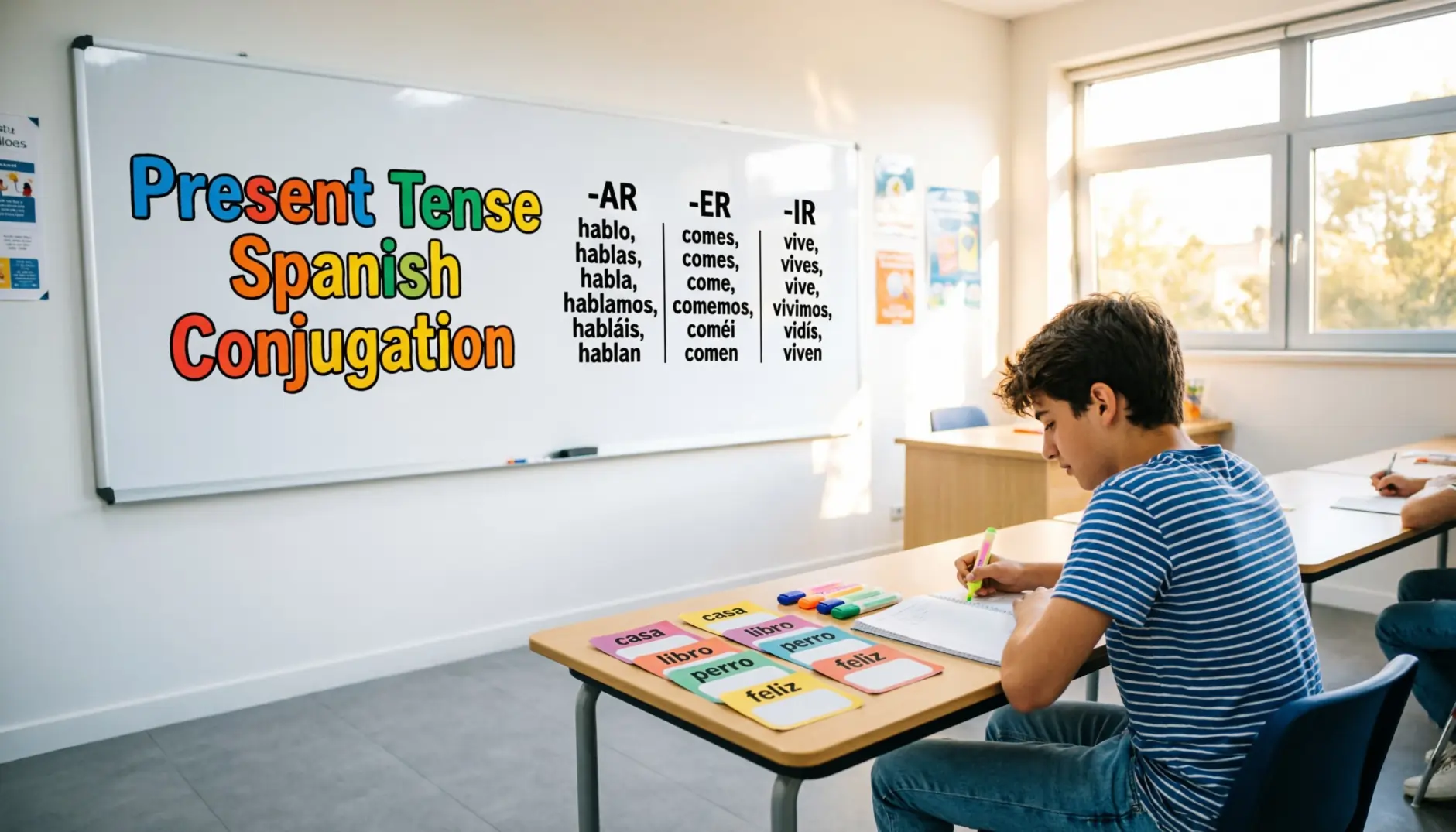
Learning a new language can feel confusing, especially when verbs start changing their forms. Many beginners struggle when they first see present tense Spanish conjugation because Spanish verbs do not stay the same like in English. For example, “I speak” becomes hablo, and “you eat” becomes comes.
If you are a student, blogger, or language learner, you might ask: “Why do Spanish verbs change so much?” or
“How can I remember all these forms?” Don’t worry you are not alone. Almost every beginner faces this challenge.
The good news is that present tense Spanish conjugation follows clear and simple patterns. Once you understand the rules, you can build sentences easily and speak real life.
Spanish with confidence. In this guide, you will learn step by step structures, tables, examples, and practice exercises that make everything simple and fun.
Quick Answer (Featured Snippet)
Present tense Spanish conjugation means changing a verb to show action happening now (I eat, you speak, they live).
| Subject | Example Verb: Hablar (to speak) |
| Yo (I) | hablo |
| Tú (You) | hablas |
| Él/Ella (He/She) | habla |
In simple words: verbs change based on who is doing the action in the present time.
What Is Present Tense Spanish Conjugation?
Present tense Spanish conjugation is the way Spanish verbs change to show actions happening right now or regularly.
In English, we usually say:
- I eat
- She eats
But in Spanish, verbs change more:
- Yo como (I eat)
- Ella come (She eats)
Function in Grammar
It helps show:
- Actions happening now
- Daily habits
- General truths
- Repeated actions
Basic Examples
- Yo hablo español. (I speak Spanish.)
- Nosotros vivimos aquí. (We live here.)
- Ella estudia mucho. (She studies a lot.)
So, present tense Spanish conjugation is all about matching verbs with the subject.
Structure of Sentences of Present Tense Spanish Conjugation
Spanish sentences follow a simple pattern:
1. Positive Sentences
Structure: Subject + Verb + Object
- Yo estudio español.
- Tú comes pizza.
- Ellos juegan fútbol.
2. Negative Sentences
Structure: Subject + No + Verb + Object
- Yo no estudio español.
- Tú no comes pizza.
- Ellos no juegan fútbol.
3. Questions
Structure: Verb + Subject + Object?
- ¿Estudias tú español?
- ¿Come ella pizza?
- ¿Juegan ellos fútbol?
Spanish questions also use question marks at the start and end.
Formation of Present Tense Spanish Conjugation
Spanish verbs are divided into three groups:
1. AR Verbs (e.g., hablar, trabajar)
Remove ar and add endings:
- yo → o
- tú → as
- él/ella → a
- nosotros → amos
- ellos → an
2. ER Verbs (e.g., comer, aprender)
Remove er and add:
- yo → o
- tú → es
- él/ella → e
- nosotros → emos
- ellos → en
3. IR Verbs (e.g., vivir, escribir)
Remove ir and add:
- yo → o
- tú → es
- él/ella → e
- nosotros → imos
- ellos → en
This pattern is the base of all present tense Spanish conjugation.
How to Use Present Tense Spanish Conjugation
You use present tense Spanish conjugation in daily communication.
1. Daily Habits
- Yo desayuno a las 8. (I have breakfast at 8.)
2. Actions Happening Now
- Ella estudia ahora. (She is studying now.)
3. General Truths
- El sol sale por el este. (The sun rises in the east.)
4. Talking About Life
- Nosotros vivimos en una ciudad grande.
Important Tip
Always match the verb ending with the subject. This is the key rule.
Conjugation or Structure Table
| Subject | AR (hablar) | ER (comer) | IR (vivir) |
| Yo | hablo | como | vivo |
| Tú | hablas | comes | vives |
| Él/Ella | habla | come | vive |
| Nosotros | hablamos | comemos | vivimos |
| Ellos | hablan | comen | viven |
This table is the heart of present tense Spanish conjugation.
Real Life Examples
Here are natural examples you can use daily:
- Yo hablo inglés y español.
- Tú comes arroz todos los días.
- Ella vive en Madrid.
- Nosotros estudiamos juntos.
- Ellos trabajan en una oficina.
- Yo no hablo francés.
- ¿Hablas tú español?
- Él come frutas por la mañana.
- Nosotros no vivimos aquí.
- ¿Estudian ustedes en la escuela?
- Ella trabaja muy duro.
- Yo vivo cerca de la ciudad.
- Tú no comes carne.
- Ellos juegan fútbol los domingos.
- Nosotros hablamos con amigos.
Common Mistakes
Mistake 1
❌ Yo habla español
✔ Yo hablo español
👉 Wrong verb ending for “yo”
Mistake 2
❌ Tú come pizza
✔ Tú comes pizza
👉 “Tú” needs es ending for er verbs
Mistake 3
❌ Ellos vive aquí
✔ Ellos viven aquí
👉 Plural subject needs plural verb
Mistake 4
❌ No yo estudio
✔ Yo no estudio
👉 “No” always comes before verb
Mistake 5
❌ Hablas tú?
✔ ¿Hablas tú?
👉 Question marks needed in Spanish
Key Grammar Rules
- Always match verb with subject
- Remove verb ending ( ar, er, ir) before adding new ending
- “No” comes before the verb in negatives
- Questions use upside down question mark (¿)
- Verb endings change depending on subject
- Regular verbs follow fixed patterns
- Word order is flexible but must stay clear
Comparisons with Similar Grammar Forms
Present Tense vs Past Tense
- Present: Yo hablo (I speak)
- Past: Yo hablé (I spoke)
Present Tense vs Future Tense
- Present: Yo como (I eat)
- Future: Yo comeré (I will eat)
English vs Spanish Present Tense
- English: I speak
- Spanish: Yo hablo (verb changes)
Spanish requires conjugation; English mostly does not.
Exercises
Fill in the blanks
- Yo ___ (hablar) español.
- Tú ___ (comer) pizza.
- Ella ___ (vivir) en México.
- Nosotros ___ (estudiar) juntos.
- Ellos ___ (trabajar) aquí.
Sentence correction
- Yo habla inglés.
- Tú come arroz.
- Ellos vive en casa.
- Nosotros estudia mucho.
- Ella trabajas duro.
Rewrite tasks
- I speak Spanish → (Spanish)
- You eat pizza → (Spanish)
- They live here → (Spanish)
- We study together → (Spanish)
- She works hard → (Spanish)
MCQs
- “Yo ___” form of hablar?
A) hablas B) hablo C) habla D) hablamos - “Tú comes” means:
A) I eat B) You eat C) He eats D) We eat - “Nosotros” means:
A) I B) You C) We D) They - Correct “ellos vivir”:
A) vive B) viven C) vivo D) vivas - Negative form structure:
A) Verb + no B) No + verb C) Subject + verb D) Verb only - “Ella come” means:
A) She eats B) He eats C) I eat D) We eat - Which is correct?
A) Yo hablas B) Yo hablo C) Yo habla D) Yo hablen - “We study” in Spanish:
A) Estudian B) Estudiamos C) Estudio D) Estudias - “You (tú) live” is:
A) vives B) vivo C) vive D) viven - Present tense is used for:
A) Future B) Past C) Now D) Never
Answers
Fill blanks: 1 hablo, 2 comes, 3 vive, 4 estudiamos, 5 trabajan
Corrections: 1 hablo, 2 comes, 3 viven, 4 estudiamos, 5 trabaja
Rewrite:
1 Yo hablo español
2 Tú comes pizza
3 Ellos viven aquí
4 Nosotros estudiamos juntos
5 Ella trabaja duro
MCQs: 1 B, 2 B, 3 C, 4 B, 5 B, 6 A, 7 B, 8 B, 9 A, 10 C
FAQs
1. What is present tense Spanish conjugation?
It is changing verbs to show actions happening now.
2. Why do Spanish verbs change?
Because they must match the subject.
3. How many verb types are there?
Three: ar, er, and ir verbs.
4. Is it hard to learn?
No, it becomes easy with practice.
5. What is the easiest way to learn it?
Practice tables and daily sentences.
6. Do all verbs follow rules?
Most do, but some are irregular.
7. What is the most common mistake?
Using wrong verb ending.
8. Can I speak Spanish without conjugation?
No, conjugation is necessary.
9. Is present tense used daily?
Yes, it is the most used tense.
10. How long to learn it?
A few weeks with regular practice.
Conclusion
Learning present tense Spanish conjugation is one of the most important steps in mastering Spanish. At first, it may feel confusing because verbs change depending on the subject.
But once you understand the simple patterns for ar, er, and ir verbs, everything becomes much easier.
This tense helps you talk about daily life, habits, and actions happening right now. The more you practice, the more natural it will feel.
Try reading examples, writing your own sentences, and using Spanish in real conversations. Even small daily practice can make a big difference.
Remember, every expert was once a beginner. Keep practicing present tense Spanish conjugation, and soon you will speak Spanish with confidence and ease.