Have you ever written a sentence like “I go to school yesterday” and wondered why it sounded Have you ever written a sentence like “I go to school yesterday” and wondered why it sounded incorrect?
Many English learners face this problem while talking about past actions. That is why learning simple past tense examples is very important.
The simple past tense helps us describe actions, events, or situations that started and finished in the past. We use it in daily conversations, stories, schoolwork, exams, and writing tasks.
Whether you are talking about your vacation, describing yesterday’s activities, or writing a story, the simple past tense is one of the most useful grammar topics in English.
Many learners feel confused about:
- When to use did
- Why some verbs end in ed
- Why verbs like go become went
Do not worry. This guide explains everything in simple language with easy rules, examples, tables, exercises, and common mistakes.
By the end of this article, you will feel confident using simple past tense sentences in real life conversations and writing.
Quick Answer About Simple Past Tense
The simple past tense is used to talk about actions that already happened and finished in the past.
Examples of Simple Past Tense
- I visited my grandmother yesterday.
- She watched a movie last night.
- They played football after school.
| Sentence Type | Example |
| Positive | They played football. |
| Negative | They did not play football. |
| Question | Did they play football? |
What Is the Simple Past Tense?
The simple past tense is a grammar form used to describe completed actions or events in the past. It tells us that something happened before now and is already finished.
We use the simple past tense to:
- Talk about past activities
- Describe completed events
- Share experiences
- Tell stories
- Discuss historical events
Basic Simple Past Tense Examples
- I cleaned my room.
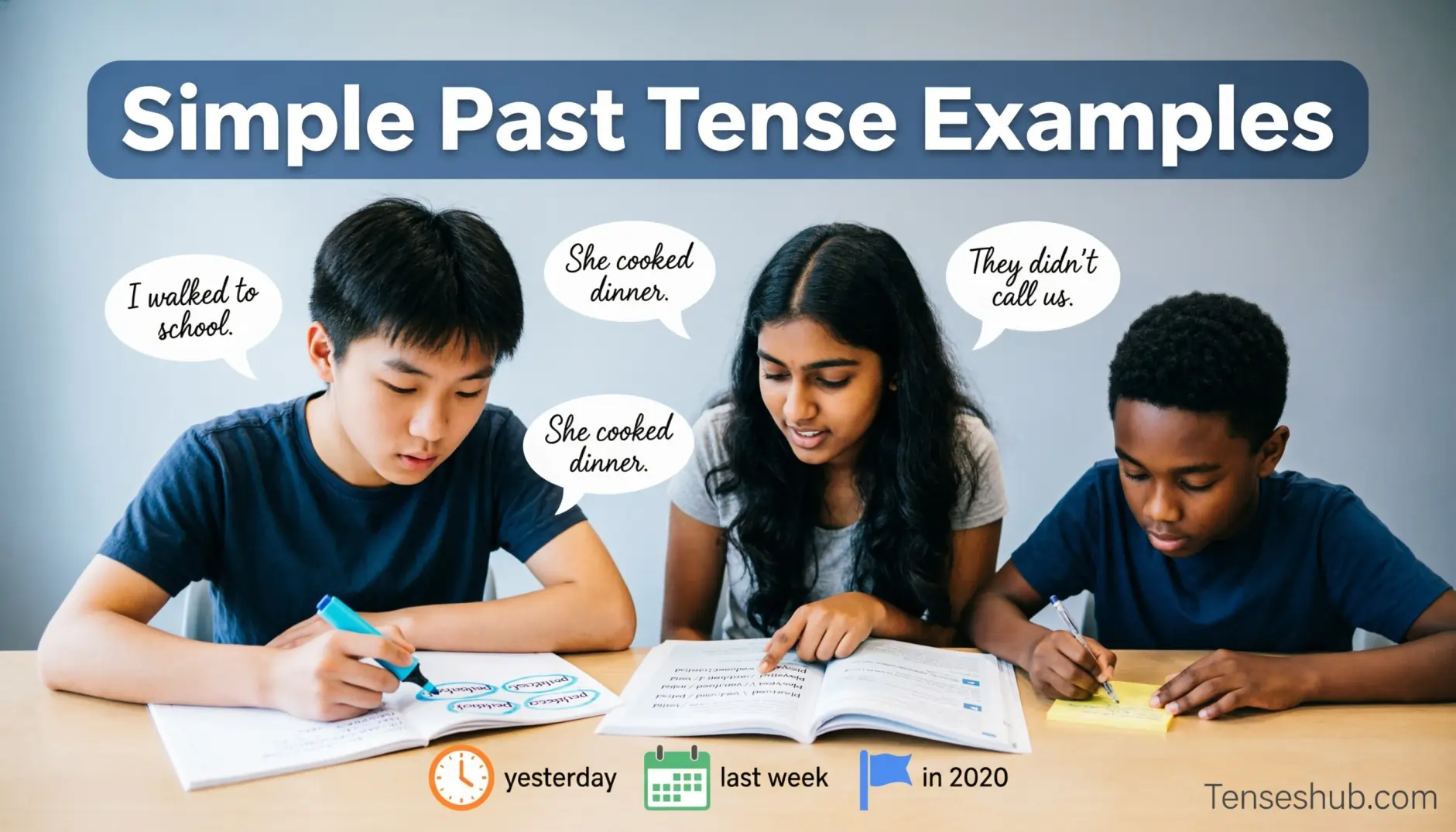
- She cooked dinner.
- We visited Lahore last week.
- They studied for the exam.
In English grammar, the simple past tense usually uses:
- The second form of the verb (V2)
- Time expressions like yesterday, last week, ago, or in 2020
More Daily Life Examples
- He called me yesterday.
- My parents traveled to Karachi last month.
- The teacher explained the lesson clearly.
The simple past tense is one of the most commonly used tenses in spoken and written English.
Structure of Simple Past Tense Sentences
Understanding sentence structure makes grammar much easier. Let’s learn positive, negative, and question forms.
Positive Sentences
Formula
Subject + Verb (Second Form) + Object
Examples
- I watched television.
- She visited her cousin.
- They played cricket.
Negative Sentences
Formula
Subject + did not + base verb + object
Examples
- I did not watch television.
- She did not visit her cousin.
- They did not play cricket.
Question Sentences
Formula
Did + subject + base verb + object?
Examples
- Did you finish your homework?
- Did she call you?
- Did they enjoy the trip?
Short Answers
- Yes, I did.
- No, she didn’t.
Important Rule
After did, always use the base form of the verb.
✅ Correct: Did he go?
❌ Wrong: Did he went?
Formation of the Simple Past Tense
The simple past tense is mainly formed by changing the verb into its past form.
Regular Verbs
Most regular verbs add ed to the base verb.
| Base Verb | Past Form |
| Play | Played |
| Walk | Walked |
| Watch | Watched |
| Clean | Cleaned |
Examples
- We walked to school.
- She cleaned the kitchen.
Irregular Verbs
Irregular verbs change differently and do not follow a fixed rule.
| Base Verb | Past Form |
| Go | Went |
| Eat | Ate |
| See | Saw |
| Buy | Bought |
Examples
- I went to the market.
- They bought a new car.
Important Formation Rules
Add “d” if the verb ends in “e”
- Live → Lived
- Dance → Danced
Double the final consonant in some short verbs
- Stop → Stopped
- Plan → Planned
Change “y” to “i” and add “ed”
- Study → Studied
- Carry → Carried
Uses of Simple Past Tense
The simple past tense is used in many everyday situations.
1. Completed Actions in the Past
- I finished my homework.
- She washed the dishes.
2. Actions at a Specific Time
- We visited Murree last summer.
- He arrived at 8 PM.
3. Past Habits
- My grandfather walked every morning.
- We played outside after school.
4. Storytelling
Stories often use the simple past tense.
Example:
A lion entered the forest and saw a rabbit.
5. Historical Events
- Pakistan became independent in 1947.
- The scientist discovered a new planet.
Common Time Words Used with Simple Past Tense
- Yesterday
- Last night
- Last year
- Two days ago
- In 2019
Pronunciation of “ ed” Endings
The ed ending has three different sounds.
| Sound | Example |
| /t/ | watched |
| /d/ | played |
| /ɪd/ | wanted |
Simple Past Tense Structure Table
| Subject | Positive | Negative | Question |
| I | I visited the park. | I did not visit the park. | Did I visit the park? |
| You | You watched TV. | You did not watch TV. | Did you watch TV? |
| He/She | She cooked dinner. | She did not cook dinner. | Did she cook dinner? |
| We | We played cricket. | We did not play cricket. | Did we play cricket? |
| They | They cleaned the room. | They did not clean the room. | Did they clean the room? |
Real Life Simple Past Tense Examples
Here are some practical examples used in daily life:
- I visited my uncle yesterday.
- She completed her project on time.
- They watched a comedy movie last night.
- Did you call your friend?
- We did not attend the meeting.
- My brother bought a new phone.
- The baby cried loudly.
- He forgot his school bag.
- Did your team win the match?
- I cooked pasta for dinner.
Common Mistakes in Simple Past Tense
Many English learners make mistakes while using the simple past tense.
| Wrong Sentence | Correct Sentence | Explanation |
| I goed home. | I went home. | “Go” is irregular. |
| She did not went. | She did not go. | Use base verb after “did.” |
| Did he ate lunch? | Did he eat lunch? | Base verb is needed. |
| We was happy. | We were happy. | Correct past form of “be.” |
| He study yesterday. | He studied yesterday. | Add “ ed.” |
Tips to Avoid Mistakes
- Learn common irregular verbs.
- Use base verbs after “did.”
- Practice writing daily sentences.
- Read English stories regularly.
Important Grammar Rules
1. Use the Second Form of the Verb
- She played tennis.
- He drove carefully.
2. Use the Base Verb After “Did”
- Did you eat breakfast?
- They did not come.
3. Use Time Expressions
Examples:
- Last week
- Yesterday
- Two hours ago
4. Avoid Present Verbs for Past Actions
❌ Wrong: I go yesterday.
✅ Correct: I went yesterday.
5. Regular and Irregular Verbs Are Different
- Walk → Walked
- Take → Took
6. “Was” and “Were” Are Past Forms of “Be”
- I was tired.
- They were happy.
Simple Past vs Other Tenses
Simple Past vs Present Simple
| Simple Past | Present Simple |
| I visited my aunt yesterday. | I visit my aunt every week. |
The simple past talks about finished actions, while the present simple describes routines or habits.
Simple Past vs Present Perfect
| Simple Past | Present Perfect |
| I watched the movie yesterday. | I have watched the movie. |
The simple past mentions a finished time, while the present perfect connects the action to the present.
Simple Past vs Past Continuous
| Simple Past | Past Continuous |
| She cooked dinner. | She was cooking dinner. |
The simple past focuses on completed actions, while the past continuous focuses on ongoing actions in the past.
Exercises on Simple Past Tense
Fill in the Blanks
- She ____ (visit) her grandmother yesterday.
- We ____ (play) football after school.
- He ____ not ____ (finish) the work.
- Did they ____ (watch) the movie?
- I ____ (buy) a new notebook.
Answers
- visited
- played
- did, finish
- watch
- bought
Sentence Correction Exercise
Correct These Sentences
- He goed to the market.
- Did she cooked dinner?
- I did not ate breakfast.
- They was late.
- She study hard yesterday.
Answers
- He went to the market.
- Did she cook dinner?
- I did not eat breakfast.
- They were late.
- She studied hard yesterday.
Rewrite the Sentences in Negative Form
- I cleaned the room.
- She called her friend.
- They watched TV.
- We visited the zoo.
- He completed the task.
Answers
- I did not clean the room.
- She did not call her friend.
- They did not watch TV.
- We did not visit the zoo.
- He did not complete the task.
MCQs About Simple Past Tense
1. Which sentence is correct?
A. She goed home.
B. She went home.
C. She go home.
D. She going home.
Answer: B
2. What is the past form of “eat”?
A. Eated
B. Ate
C. Eat
D. Eating
Answer: B
3. Which helping verb is used in negative simple past sentences?
A. Do
B. Does
C. Did
D. Is
Answer: C
4. Choose the correct sentence.
A. Did he played cricket?
B. Did he play cricket?
C. Did he plays cricket?
D. Did he playing cricket?
Answer: B
5. Which sentence is in the simple past tense?
A. I am reading.
B. I read every day.
C. I watched TV.
D. I will watch TV.
Answer: C
FAQs
1. What is the simple past tense?
The simple past tense describes actions completed in the past.
2. When do we use the simple past tense?
We use it for finished actions, events, or situations in the past.
3. What is the formula of the simple past tense?
Subject + verb (second form) + object
4. Why do we use “did”?
We use “did” to make negative and question sentences.
5. What are irregular verbs?
Irregular verbs change differently in the past tense, such as:
- Go → Went
- Eat → Ate
6. Is “did went” correct?
No. After “did,” always use the base verb:
✅ Did go
❌ Did went
7. How can I improve my simple past tense?
Practice speaking, reading, and writing daily using past tense sentences.
Conclusion
Learning simple past tense examples is an important step toward speaking and writing English confidently.
This tense helps you describe completed actions, share experiences, tell stories, and explain past events clearly.
Once you understand sentence structure, verb forms, and grammar rules, using the simple past tense becomes much easier.
Practice both regular and irregular verbs every day. Try writing sentences about yesterday, last week, or your past vacations. Read English stories, watch educational videos, and speak with friends using past tense sentences.
Mistakes are a normal part of learning. Keep practicing regularly, and soon you will use the simple past tense naturally in conversations, exams, and writing tasks.
Hi, I’m Robert Lowth, a passionate expert in English tenses and grammar. I specialize in simplifying complex tense rules to help learners understand and use English with confidence. My goal is to make grammar clear, practical, and easy for everyday communication. tenseshub.com