Have you ever wondered if the past tense of seek is seeked or sought? You’re not alone. Many English learners make this mistake because seek is an irregular verb, so it doesn’t follow the usual ” ed” rule.
Learning seek in past tense is important because this verb appears in everyday conversations, books, news articles, business writing, and exams.
If you’re talking about looking for help, searching for information, or asking for advice, using the correct verb form makes your English sound natural and accurate.
In this guide, you’ll learn the correct past tense of seek, how to use it in different sentence types, common grammar mistakes to avoid, practical examples, comparisons with similar verbs, and exercises to test your understanding.
By the end, you’ll feel confident using seek, sought, and sought correctly in speaking and writing.
Quick Answer
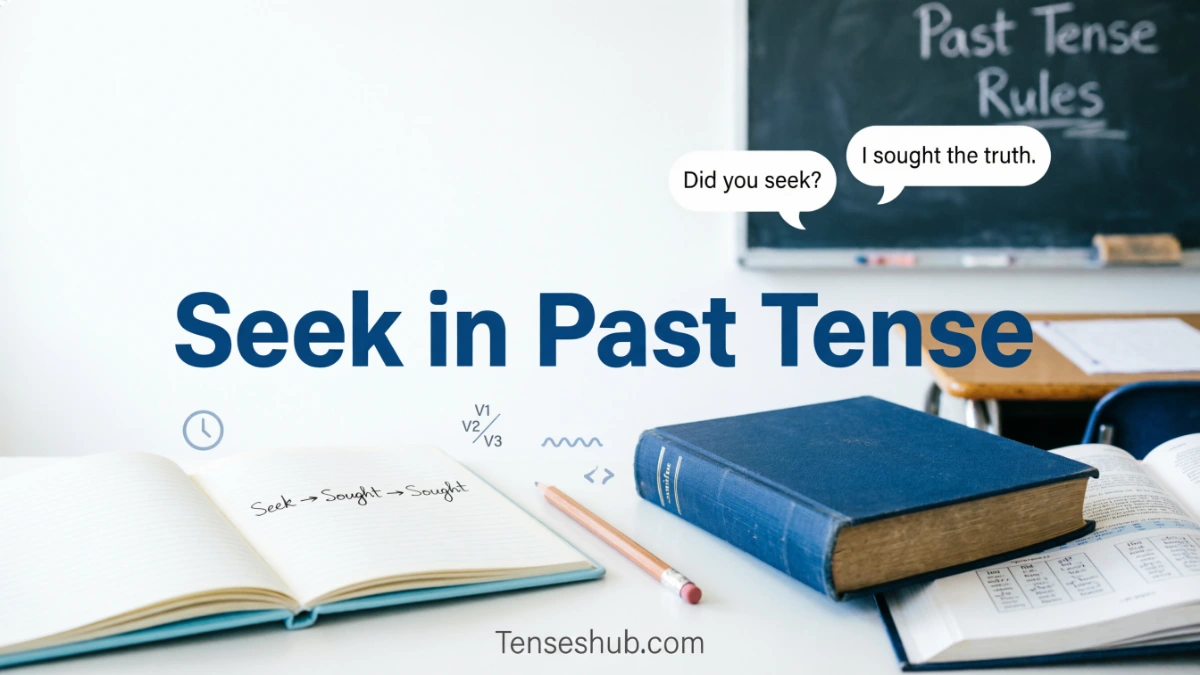
The past tense of seek is sought. The past participle is also sought. Seek is an irregular verb, so it does not follow the regular -ed pattern.
| Verb Form | Word |
|---|---|
| Base Form (V1) | seek |
| Past Tense (V2) | sought |
| Past Participle (V3) | sought |
| Present Participle | seeking |
Examples:
- I sought help from my teacher yesterday.
- She has sought professional advice.
Remember: seeked is incorrect in standard English. The correct past form is sought.
What Is Seek in Past Tense?
The past tense of seek is sought.
The verb seek means to try to find, obtain, or get something. It is often used with things such as help, advice, information, permission, opportunities, answers, and solutions.
Because seek is an irregular verb, its past tense does not end in -ed.
- Present: I seek help when I need it.
- Past: I sought help yesterday.
- Past participle: I have sought help before.
Meaning of Seek
We commonly use seek when someone:
- looks for information
- asks for help or advice
- tries to obtain something
- looks for an opportunity
- tries to achieve a goal
- searches for answers or solutions
Examples:
We seek better solutions.
Yesterday, we sought better solutions.
She has sought professional advice.
Notice that both the past tense and past participle of seek are sought.
Structure of Sentences of Seek in Past Tense
Here are the basic sentence patterns using sought.
Affirmative
Subject + sought + object
Examples:
- She sought medical advice.
- We sought a better solution.
- They sought new opportunities.
Negative
Subject + did not (didn’t) + seek + object
Examples:
- I did not seek help.
- She didn’t seek permission.
- They didn’t seek approval.
Interrogative
Did + subject + seek + object?
Examples:
- Did you seek advice?
- Did she seek a job?
- Did they seek assistance?
Remember that after did, always use the base verb seek, not sought.
Formation of Seek in Past Tense
Seek is an irregular verb, so its past form changes from seek to sought.
| Verb Form | Word & Example |
|---|---|
| Base Form | seek — I seek advice. |
| Simple Past | sought — I sought advice. |
| Past Participle | sought — I have sought advice. |
| Present Participle | seeking — I am seeking advice. |
Simple Past
Use sought when talking about an action that happened and finished in the past.
She sought medical advice yesterday.
Present Perfect
Use has/have + sought when talking about a past action connected to the present.
He has sought professional help.
Past Perfect
Use had + sought when one past action happened before another past action.
They had sought permission before entering the building.
Negative Sentences
Use did not + seek, not did not + sought.
✅ I didn’t seek help.
❌ I didn’t sought help.
Questions
Use did + subject + seek.
✅ Did you seek advice?
❌ Did you sought advice?
Remember: after did, always use the base form seek.
How to Use Seek in Past Tense
The past form sought is used when talking about something someone tried to find, obtain, or achieve in the past.
1. Looking for Something
Use sought when someone tried to find something.
She sought a new apartment.
We sought better prices.
2. Asking for Help or Advice
Use sought when someone tried to get help, advice, or support.
He sought medical advice.
They sought professional guidance.
3. Looking for Information
Use sought when someone tried to obtain information or answers.
I sought answers online.
They sought more information before making a decision.
4. Trying to Obtain Something
Seek can also mean trying to get or obtain something.
The company sought new investors.
She sought permission to enter the building.
5. Trying to Achieve Something
We can use sought for goals, results, or things someone wanted to achieve.
The organization sought peace.
The team sought a better solution.
6. Formal English
Seek and sought are common in formal, professional, academic, and written English. In casual conversation, people often use expressions such as look for or ask for instead.
Formal:
The company sought additional funding.
More conversational:
The company looked for additional funding.
Seek Verb Pattern Table
| Sentence Type | Pattern & Example |
|---|---|
| Affirmative | Pattern: Subject + sought + object Example: She sought help. |
| Negative | Pattern: Subject + did not + seek + object Example: She didn’t seek help. |
| Question | Pattern: Did + subject + seek + object? Example: Did she seek help? |
| Present Perfect | Pattern: Subject + has/have + sought Example: She has sought help. |
| Past Perfect | Pattern: Subject + had + sought Example: She had sought help |
The key rule is simple: use sought as the simple past form, but use seek after did.
Real Life Examples
Everyday Conversation
- I sought help from my friend.
- She sought a better school.
- They sought a new house.
At School
- The student sought extra practice.
- Our teacher sought feedback.
At Work
- The manager sought approval.
- We sought new customers.
Healthcare
- He sought medical treatment.
- They sought emergency assistance.
Formal Writing
- The company sought investors.
- The researchers sought reliable data.
Informal Conversation
- I sought advice before buying the car.
- Did you seek permission first?
Common Mistakes
Mistake 1
Using “Seeked” Instead of “Sought”
❌ I seeked help from my teacher.
✅ I sought help from my teacher.
Seek is an irregular verb, so its past tense is sought, not seeked.
Mistake 2
Using “Sought” After “Did”
❌ Did she sought advice?
✅ Did she seek advice?
After did, always use the base form seek.
Mistake 3
Using “Sought” After “Didn’t”
❌ They didn’t sought permission.
✅ They didn’t seek permission.
The correct structure is:
didn’t + seek
Mistake 4
Using “Seek” Instead of “Sought” in the Present Perfect
❌ She has seek professional advice.
✅ She has sought professional advice.
The present perfect uses:
has/have + past participle
The past participle of seek is sought.
Mistake 5
Using “Seek” Instead of “Sought” in the Past Perfect
❌ They had seek permission.
✅ They had sought permission.
The past perfect uses:
had + past participle
So the correct form is had sought.
Key Grammar Rules
- The past tense of seek is sought.
Example: I sought help yesterday. - Never use “seeked” as the standard past form.
❌ She seeked advice.
✅ She sought advice. - After did or didn’t, use seek.
Example: Did you seek help?
Example: I didn’t seek permission. - The past participle of seek is also sought.
Example: We have sought professional advice. - The past perfect uses had + sought.
Example: They had sought permission before entering. - Seek is often more formal than look for.
Example: The company sought new investors. - Seek can mean trying to find, obtain, or achieve something.
Example: She sought a better solution.
Comparisons with Similar Grammar Forms
Seek vs Look For
Both mean searching.
Seek
- More formal
- Often used in writing
Example:
- The company sought investors.
Look for
- More common in daily conversation
Example:
- I’m looking for my keys.
Seek vs Search
Seek
Focuses on trying to obtain something.
- She sought happiness.
Search
Focuses on the action of looking carefully.
- The police searched the building.
Seek vs Find
Seek
Means trying to get something.
- We sought answers.
Find
Means successfully getting it.
- We found the answers.
Seek vs Ask For
Sometimes these have similar meanings.
Formal:
- She sought advice.
Informal:
- She asked for advice.
Exercises
Exercise 1: Fill in the Blanks
Choose seek or sought.
- Yesterday I ______ help.
- She has ______ legal advice.
- Did you ______ permission?
- They ______ better opportunities.
- We didn’t ______ assistance.
Exercise 2: Correct the Mistakes
- He seeked a new job.
- Did she sought help?
- We have seek legal advice.
- They didn’t sought permission.
- I had seek information.
Exercise 3: Rewrite the Sentences
Change the sentences into the past tense.
- I seek help.
- They seek better jobs.
- She seeks advice.
- We seek answers.
- He seeks approval.
Exercise 4: Multiple Choice
1. What is the past tense of seek?
A. seeked
B. sought
C. seeking
D. seek
2. Which sentence is correct?
A. She seeked help.
B. She sought help.
C. She did sought help.
D. She seeking help.
3. Which sentence uses the present perfect correctly?
A. I have seek help.
B. I has sought help.
C. I have sought help.
D. I had seek help.
4. Which sentence is correct?
A. Did you sought advice?
B. Did you seek advice?
C. Did you seeking advice?
D. Did you seeks advice?
Answer Key
Exercise 1
- sought
- sought
- seek
- sought
- seek
Exercise 2
- He sought a new job.
- Did she seek help?
- We have sought legal advice.
- They didn’t seek permission.
- I had sought information.
Exercise 3
- I sought help.
- They sought better jobs.
- She sought advice.
- We sought answers.
- He sought approval.
Exercise 4
- B
- B
- C
- B
FAQs
What is the past tense of seek?
The past tense of seek is sought.
Is “seeked” correct?
No. Seeked is incorrect because seek is an irregular verb.
What is the past participle of seek?
The past participle is sought.
Can I say “did sought”?
No. Say did seek, because did is followed by the base verb.
Is seek a regular verb?
No. It is an irregular verb.
Is seek formal?
Yes. Seek is more formal than look for, although both are correct.
When should I use sought?
Use sought when talking about a completed action in the past or as the past participle in perfect tenses.
What are the four traditional future tenses?
The four traditional future tenses are simple future, future continuous, future perfect, and future perfect continuous. They use different structures to show future actions, ongoing actions, completed actions, and duration.
What is the difference between future perfect and future perfect continuous?
The future perfect focuses on an action that will be completed before a future time.
Example: “I will have finished the report by Friday.”
The future perfect continuous focuses on how long an action will have continued up to a future time.
Example: “By Friday, I will have been working on the report for a week.”
Can the present continuous talk about the future?
Yes. The present continuous can describe a planned or confirmed future arrangement.
Example: “We are meeting the client tomorrow.”
Can the simple present talk about the future?
Yes. The simple present can describe fixed schedules and timetables.
Example: “The train leaves at 8 a.m. tomorrow.”
What is the formula for future perfect continuous?
The formula is **subject + will have been + V ing**.
Example: “By December, I will have been learning English for two years.”
Conclusion
Future tense endings become much easier when you understand what each form means and when to use it. English can express the future in several ways, including will, be going to, the present continuous, and the four traditional future tenses.
Remember the main patterns: will + V1 for the simple future, will be + V ing for actions in progress, will have + V3 for completed future actions, and will have been + V ing for actions continuing over a period of time.
You can also use going to for plans and evidence based predictions and the present continuous for confirmed arrangements.
The best way to learn these forms is to practice them in real situations. Write about your plans, predictions, schedules, and future goals. With regular practice, choosing the correct future form will become much more natural.

Hi, I’m Noah Bester, a tenses expert passionate about simplifying English grammar. I create practical, easy-to-understand guides to help learners master tenses with confidence. My goal is to make grammar clear, useful, and applicable in everyday communication. tenseshub.com